


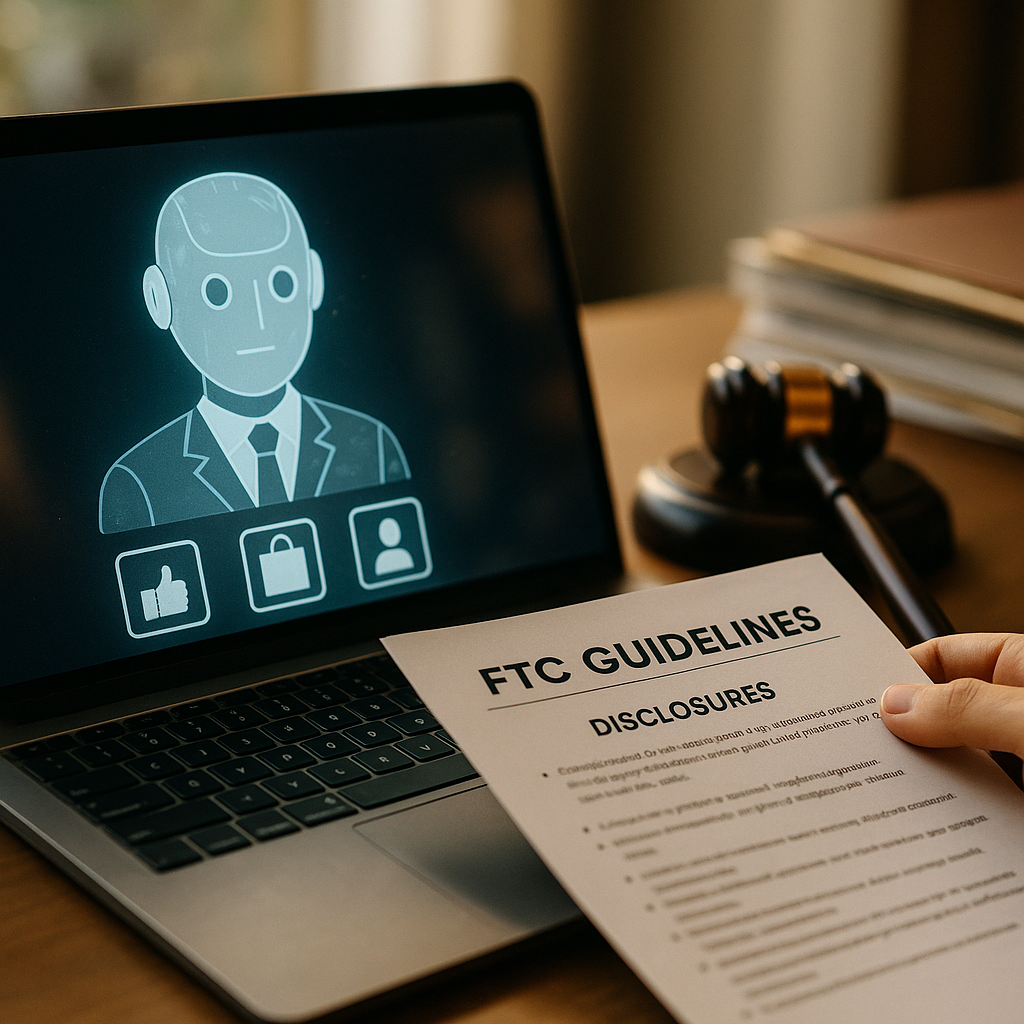
One Enforcement Action Could Invalidate Your Entire Commerce Program
The FTC now has three separate regulatory vectors aimed directly at AI-assisted social commerce: the long-standing “clear and conspicuous” disclosure standard, the 2023 deceptive AI practices policy statement (still fully operative), and a growing body of state AI laws that do not wait for federal action. Miss any single layer and you are not just facing a fine — you risk having platform accounts suspended mid-campaign. Here is how to build a compliance stack that holds up under all three at once.
Why the Old Disclosure Checklist Is No Longer Enough
Most brands running social commerce today have some version of a disclosure protocol: “#ad” labels, contracted language in creator briefs, maybe a review step before posts go live. That framework was designed for human creators posting static content. It was not designed for AI-generated product recommendations surfacing inside TikTok Shop storefronts, AI-scripted live shopping sessions, or agentic tools autonomously posting affiliate content across multiple creator accounts.
The FTC’s “clear and conspicuous” standard requires that disclosures be in a format consumers will actually notice, read, and understand. That definition has teeth now. A hashtag buried in a 30-tag caption is not clear and conspicuous. A verbal disclosure delivered while upbeat audio is playing and text overlays are animating probably is not either. And when AI is generating or substantially modifying the content, the disclosure burden does not shrink — it expands, because the FTC’s deceptive AI guidance adds an additional obligation to ensure that AI-generated claims are substantiated and not misleading by design.
Brands running AI-assisted social commerce without a layered compliance stack are not saving time — they are accumulating undisclosed liability that compounds with every automated post.
For practical guidance on how FTC AI disclosure rules apply specifically inside TikTok Shop environments, the compliance requirements differ meaningfully from standard sponsored post rules.
The Four Layers of Your Compliance Stack
Layer 1: FTC Clear and Conspicuous Standards
This is the foundation. Every AI-influenced piece of commerce content — whether generated by a tool like Jasper, personalized by a platform recommendation engine, or scripted by an agentic workflow — needs a disclosure that is proximate, prominent, and platform-appropriate. On video, that means an audio disclosure and a persistent on-screen label, not just a caption. On livestream commerce, it means a disclosure at the start and at any point a new product category is introduced.
The FTC’s Endorsement Guides specify that platform-native labeling tools (Meta’s “Paid Partnership” label, TikTok’s branded content toggle) satisfy the standard only when used correctly and completely. Brands frequently misconfigure these, especially when creator content is being reshared or amplified through paid promotion. A post that starts as organic and is then boosted without re-tagging becomes a compliance gap the moment you hit “promote.”
Layer 2: FTC Deceptive AI Practice Warnings
The FTC has explicitly stated that using AI to create fake reviews, simulate consumer endorsements, or generate misleading product demonstrations violates Section 5. This layer is less about labeling and more about content governance. Your AI tools need documented guardrails: what outputs are prohibited, what claims require human verification before deployment, and who in your organization is accountable when an AI-generated asset makes a product claim that turns out to be unsubstantiated.
Understanding the full FTC AI liability chain is essential here — because “the tool did it” is not a defense the FTC has shown any interest in accepting. Brands are the responsible party.
Layer 3: State AI Law Requirements
California’s AB 2013 (AI training data transparency), Colorado’s SB 205 (high-risk AI systems), and similar laws in Illinois and Texas create obligations that vary by state but share a common thread: disclosure of AI involvement in consequential consumer-facing interactions. For social commerce, this matters most when AI is being used for personalized product targeting, dynamic pricing displays, or AI-generated video personas promoting products to consumers in those states.
The dual compliance framework for state AI laws versus FTC Section 5 is not theoretical — it is operational. You need a system that can apply state-specific disclosure logic based on where content is being served, not just where it is being created.
Layer 4: Platform-Specific Commerce Policy Constraints
TikTok Shop, Instagram Shopping, YouTube Shopping, and Pinterest’s product tagging system each have their own commerce policies, and none of them are perfectly synchronized with FTC requirements. TikTok, for example, prohibits certain AI-generated disclosure workarounds that creators have tried to use. Meta’s Commerce Policies restrict AI-generated “before and after” product claims in ways that go beyond the FTC standard in some categories and fall short in others.
A thorough ad labeling compliance checklist for each platform you operate on is not optional — it is the operational document that prevents your compliance stack from collapsing at the execution layer.
Building the Technical Architecture
The compliance stack only works if it is embedded in your production workflow, not bolted on at the end. Here is what that looks like operationally:
- Content classification tagging: Every asset created with AI assistance (even partial assistance, like AI-generated copy pasted into a human-edited post) should be tagged in your DAM system. This creates the audit trail regulators will ask for.
- Disclosure injection at the API layer: For programmatic content distribution, disclosure language should be injected automatically at the API level, not left to manual creator compliance. Tools like Sprinklr and Sprout Social offer workflow rules that can enforce this.
- State-geofencing for AI disclosures: Work with your DSP or platform partner to append AI-specific disclosure language to ads served in states with active AI transparency requirements.
- Agentic AI kill switches: Any autonomous posting system needs a documented escalation protocol. Read more about agentic AI policy triggers to understand when and how automated content should be paused pending human review.
- Bias audit integration: AI-driven product recommendation tools need regular audits to ensure they are not producing discriminatory targeting patterns, which now carry FTC and state-level liability.
For brands running campaigns on platforms like TikTok Ads Manager or Meta Business Suite, both platforms have native compliance tools, but neither is comprehensive enough to replace an internal governance layer. Think of platform tools as the first filter, not the last.
The Legal Framework That Sits on Top
Technical architecture without legal backing is just infrastructure waiting to be tested in court. Your legal layer needs to address three things specifically: creator contracts that assign AI compliance responsibility explicitly, platform terms that are reviewed quarterly (not annually), and documented substantiation files for any product claim generated or amplified by AI.
Creator contracts are where most brands are underexposed. Standard influencer agreements do not address what happens when a creator uses an AI tool to draft their sponsored content. That gap means the brand may be liable for unsubstantiated AI-generated claims the creator made in good faith. Rebuilding creator partnership contracts to explicitly address AI-generated content is a 2026 operational priority, not a future consideration.
Platform terms of service change faster than legal teams can track. Assign a dedicated owner for each major commerce platform’s policy updates — someone who checks for changes monthly, not at contract renewal.
For brands operating in regulated categories (supplements, financial products, health and wellness), the bar for AI claim substantiation is significantly higher. The FTC has indicated it will treat AI-generated health claims with the same scrutiny as human-generated ones, and state attorneys general in California and New York have signaled similar enforcement postures. For a deeper read on FTC AI bias audit requirements, legal teams should review what documentation is expected before enforcement, not after.
What Operational Readiness Actually Looks Like
A compliance stack is not a document. It is a set of repeatable processes that execute consistently across every campaign, every creator, and every platform. That means quarterly policy reviews, documented AI tool inventories, creator training on disclosure requirements, and a rapid response protocol for when a compliance gap surfaces mid-flight.
Brands that treat this as a one-time legal project will be rebuilding it after their first enforcement notice. Brands that treat it as a living operational system will be able to scale AI-assisted social commerce at velocity while competitors are navigating consent decrees. The difference is not the sophistication of the technology. It is the discipline of the process.
Start this week: audit every AI tool currently touching your social commerce content, map its outputs to the four compliance layers above, and identify the gaps. That audit is the foundation everything else is built on.
Frequently Asked Questions
What does “clear and conspicuous” mean for AI-generated social commerce content specifically?
The FTC requires that disclosures be presented in a way that consumers will actually notice and understand before making a purchase decision. For AI-generated content in social commerce contexts, this means the disclosure must be on-screen in a readable font size, present at the start of video content (not just the end), and audible if the content includes audio. A caption-only disclosure on a video post does not meet the standard. The disclosure must also clearly indicate if AI was materially involved in generating product claims or endorsements.
How do state AI laws affect a national social commerce program?
State AI laws apply based on where the consumer is located, not where the brand is headquartered. California, Colorado, Illinois, and Texas each have different requirements around AI transparency in consumer-facing applications. For social commerce, this means you may need to append state-specific AI disclosure language to ads served in those states. The practical solution is geofenced disclosure logic at the ad serving layer, combined with contracts that assign compliance responsibility clearly between the brand, its AI tool vendors, and its creator partners.
Are platform-native labeling tools (like Meta’s Paid Partnership tag) sufficient for FTC compliance?
Platform-native tools satisfy FTC requirements only when used correctly and in the right context. Meta’s Paid Partnership label, TikTok’s branded content toggle, and similar tools have all been accepted as compliant by the FTC — but they must be activated on every instance of the content, including paid amplification of organic posts. Brands frequently create compliance gaps by boosting creator content without re-enabling the disclosure tag. Additionally, platform tools do not address AI-specific disclosure obligations, which require a separate layer of disclosure language beyond standard sponsorship labeling.
What should be in a creator contract to cover AI-generated content compliance?
Creator contracts should explicitly define what AI tools the creator is permitted to use in producing sponsored content, require that any AI-generated copy or claims be submitted for brand review before posting, assign liability for unsubstantiated AI-generated claims, and mandate compliance with both FTC disclosure requirements and platform-specific labeling rules. Contracts should also include a right for the brand to request content removal if a post is found to contain non-compliant AI-generated claims, and specify which party bears the cost of any required corrections or takedowns.
How often should brands audit their AI compliance stack for social commerce?
Quarterly audits are the minimum viable frequency given how rapidly platform policies and state AI laws are evolving. Each audit should cover: the inventory of AI tools touching commerce content, any policy updates from the FTC or relevant state regulators, changes to platform terms of service on each major commerce platform, and a sample review of live content for disclosure compliance. For brands in regulated product categories, monthly reviews of platform policy changes are more appropriate given the higher enforcement risk.
Top Influencer Marketing Agencies
The leading agencies shaping influencer marketing in 2026
Agencies ranked by campaign performance, client diversity, platform expertise, proven ROI, industry recognition, and client satisfaction. Assessed through verified case studies, reviews, and industry consultations.
Moburst

-
2

The Shelf
Boutique Beauty & Lifestyle Influencer AgencyA data-driven boutique agency specializing exclusively in beauty, wellness, and lifestyle influencer campaigns on Instagram and TikTok. Best for brands already focused on the beauty/personal care space that need curated, aesthetic-driven content.Clients: Pepsi, The Honest Company, Hims, Elf Cosmetics, Pure LeafVisit The Shelf → -
3

Audiencly
Niche Gaming & Esports Influencer AgencyA specialized agency focused exclusively on gaming and esports creators on YouTube, Twitch, and TikTok. Ideal if your campaign is 100% gaming-focused — from game launches to hardware and esports events.Clients: Epic Games, NordVPN, Ubisoft, Wargaming, Tencent GamesVisit Audiencly → -
4

Viral Nation
Global Influencer Marketing & Talent AgencyA dual talent management and marketing agency with proprietary brand safety tools and a global creator network spanning nano-influencers to celebrities across all major platforms.Clients: Meta, Activision Blizzard, Energizer, Aston Martin, WalmartVisit Viral Nation → -
5

The Influencer Marketing Factory
TikTok, Instagram & YouTube CampaignsA full-service agency with strong TikTok expertise, offering end-to-end campaign management from influencer discovery through performance reporting with a focus on platform-native content.Clients: Google, Snapchat, Universal Music, Bumble, YelpVisit TIMF → -
6

NeoReach
Enterprise Analytics & Influencer CampaignsAn enterprise-focused agency combining managed campaigns with a powerful self-service data platform for influencer search, audience analytics, and attribution modeling.Clients: Amazon, Airbnb, Netflix, Honda, The New York TimesVisit NeoReach → -
7

Ubiquitous
Creator-First Marketing PlatformA tech-driven platform combining self-service tools with managed campaign options, emphasizing speed and scalability for brands managing multiple influencer relationships.Clients: Lyft, Disney, Target, American Eagle, NetflixVisit Ubiquitous → -
8

Obviously
Scalable Enterprise Influencer CampaignsA tech-enabled agency built for high-volume campaigns, coordinating hundreds of creators simultaneously with end-to-end logistics, content rights management, and product seeding.Clients: Google, Ulta Beauty, Converse, AmazonVisit Obviously →