


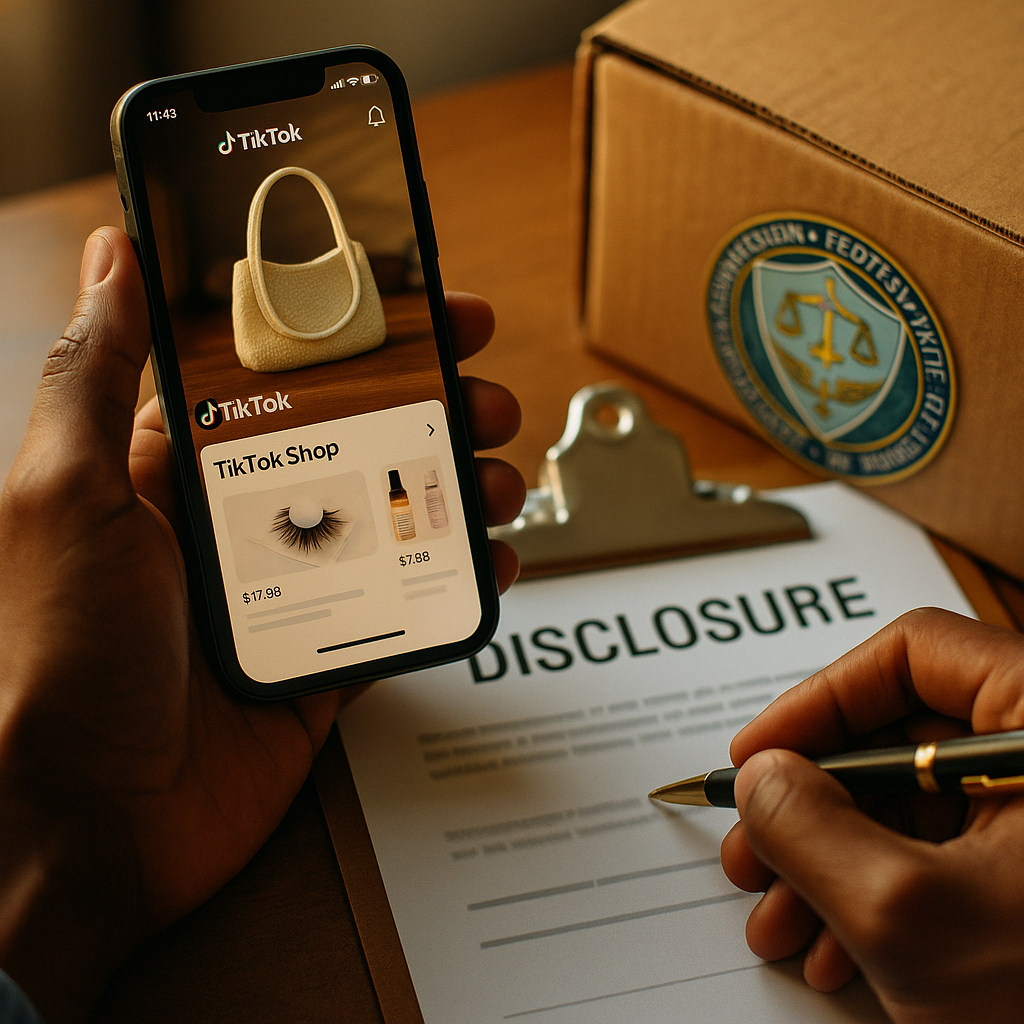
Your TikTok Shop Integration May Already Be a Federal Liability
Over 60% of brands deploying AI in social commerce have no documented disclosure protocol for AI-generated product recommendations, according to compliance surveys circulating among agency legal teams this year. The FTC’s July notice on state AI law compliance didn’t create new rules. It clarified that existing FTC Section 5 deceptive practice standards apply directly to AI-driven commerce deployments, and that state-level AI violations can trigger parallel federal exposure. If your brand legal team hasn’t restructured its AI disclosure framework since that notice dropped, you’re operating in a gap that enforcement actions will eventually find.
What the July Notice Actually Says (And What It Doesn’t)
The FTC’s position is more surgical than the headlines suggest. The agency isn’t issuing new AI-specific regulations. Instead, it’s signaling that when a brand’s AI system generates personalized product recommendations, synthesizes user reviews, or deploys AI personas in creator-style commerce content, and fails to disclose the AI’s role adequately, that constitutes a deceptive act or practice under Section 5 of the FTC Act. The notice specifically flags how state AI transparency laws, including those in Colorado, Texas, and California, create a compliance environment where state violations effectively become evidence of federal deceptive intent.
That’s the mechanism brands need to understand. A Colorado AI transparency violation doesn’t stay in Colorado. It becomes a paper trail the FTC can point to when building a Section 5 case. Your state compliance posture is now your federal compliance posture.
State AI law violations don’t stay regional. Under the FTC’s July notice framework, a documented state-level AI transparency failure is direct evidence of a deceptive practice under federal Section 5 standards — a liability chain most brand legal teams haven’t fully mapped.
For a deeper look at how the dual compliance architecture works between state AI statutes and federal authority, the state AI laws vs FTC Section 5 framework covered here is required reading for any legal team building its response.
Three Places AI Disclosure Breaks Down in Social Commerce
Brand legal teams often assume disclosure is a creative problem, something the content team handles with a label. In AI-driven social commerce, disclosure failure is almost always a structural problem. Here’s where it typically breaks:
- AI-generated product copy in TikTok Shop listings: If your brand uses a generative AI tool to write product descriptions or respond to buyer questions within TikTok Shop, and those responses are not disclosed as AI-generated, that’s a potential deceptive practice. The platform’s commerce environment makes disclosure harder because there’s no established native label for AI-generated seller responses the way there is for paid promotions.
- AI recommendation engines surfacing creator content: When an AI system decides which creator content appears in a shoppable feed, the recommendation itself may constitute a material commercial act. Disclosure obligations don’t just apply to the creator. They apply to the mechanism surfacing the content.
- AI persona deployment in live commerce: Several brands piloted AI-generated hosts for TikTok LIVE shopping events this year. Without explicit disclosure that the host is AI-generated, this is textbook deceptive practice territory under both the FTC’s guidance and multiple state AI statutes.
For brands running creator-affiliate commerce structures, the FTC disclosure rules for creator revenue share piece provides specific language frameworks that can be adapted to AI-assisted creator programs.
Data Privacy Documentation: The Overlooked Half of the Problem
The AI disclosure conversation tends to consume all the oxygen in legal team briefings. Data privacy documentation gets treated as a separate workstream. That’s a structural mistake.
TikTok Shop’s commerce infrastructure collects purchase intent signals, behavioral data, and first-party consumer information at a granular level. When your brand deploys AI tools that interact with that data pipeline, including recommendation engines, chatbots, or automated customer segmentation, you’re creating a data processing record that regulators can subpoena. If that record doesn’t show lawful basis documentation, data minimization practices, and clear disclosure to consumers about AI processing, you have a compounded exposure: one under AI transparency statutes, one under applicable data privacy law.
California’s CPRA, Colorado’s CPA, and Texas’s TDPSA all contain provisions specifically addressing automated decision-making. Any AI system making consequential decisions about what consumers see, or what offers they receive, may trigger opt-out rights. Has your legal team mapped which AI tools in your TikTok commerce stack qualify as automated decision-making systems under those definitions? Most haven’t.
The TikTok creator commerce data audit framework is a useful operational starting point, particularly for brands with European audience exposure running parallel compliance requirements.
Structuring the TikTok Commerce Integration Review
A TikTok Shop integration review, done properly in the current regulatory environment, is not a creative review. It’s a legal and technical audit with three distinct tracks.
Track one: AI touchpoint mapping. List every point in the consumer journey where AI influences what a consumer sees, hears, or reads. Product descriptions, recommendation ranking, customer service responses, live commerce hosts, and even AI-generated promotional thumbnails all belong on this map. Each touchpoint needs a disclosure decision documented.
Track two: Data flow documentation. Map what consumer data your AI tools receive from TikTok’s commerce infrastructure, how it’s processed, where it’s stored, and whether your data processing agreements with TikTok and any third-party AI vendors are current. The FTC’s guidance on data practices makes clear that vendor relationships don’t insulate brands from liability if they’re directing the data use.
Track three: State law exposure matrix. For each state where you have material consumer audience concentration, document which AI transparency and data privacy laws apply, what your current compliance posture is, and where gaps exist. Given that state violations feed federal Section 5 exposure, this matrix is effectively your federal risk register.
If your brand is also running creator-driven commerce on other platforms alongside TikTok, the compliance framework across TikTok, Snap, and LinkedIn addresses how to adapt these audit structures across platforms without duplicating work.
A TikTok Shop AI review isn’t a marketing compliance checkbox. It’s a tripartite legal audit: AI touchpoint disclosure, data flow documentation, and state-to-federal exposure mapping. Brands treating it as anything less are building liability, not managing it.
What AI Disclosure Language Should Actually Look Like
Legal teams often ask for template language. The honest answer is that no single template works across all AI deployments. But there are principles. Disclosure must be clear, conspicuous, and proximate to the AI-generated content. “Powered by AI” buried in a footer doesn’t meet the standard. For AI personas in live commerce, a verbal and visual disclosure at the start of the session is the minimum defensible position.
For recommendation-driven content, disclosure language needs to address both the commercial nature of the recommendation and the AI’s role in generating it. These are two separate material facts. Both require disclosure. The AI ad creative and FTC Section 5 analysis covers the specific language standards the FTC has referenced in recent enforcement communications, and it’s worth having your legal team cross-reference those standards against your current TikTok commerce content.
For brands managing agentic AI tools that are making real-time campaign decisions, the agentic AI FTC compliance protocol is the most operationally specific resource available for structuring error documentation and disclosure override procedures.
Additional regulatory context is available directly from the FTC’s official guidance library, and brands operating internationally should cross-reference the UK ICO’s AI and data guidance for parallel obligations. For platform-specific commerce policies, TikTok’s advertising policies and Meta’s business tools documentation are the authoritative sources on platform-level disclosure requirements.
The Immediate Next Step for Brand Legal Teams
Pull your TikTok Shop integration documentation today, identify every AI tool in the stack, and run it against the state AI transparency law requirements for your top five audience states. If you can’t produce that documentation in 48 hours, your disclosure gap is already a compliance gap.
Frequently Asked Questions
What does the FTC’s July AI notice mean for brands running TikTok Shop?
The FTC’s July notice clarifies that existing Section 5 deceptive practice standards apply to AI-driven social commerce deployments. If your brand uses AI to generate product descriptions, power recommendation engines, or deploy AI personas in live shopping events without adequate disclosure, that constitutes a deceptive act under federal law. The notice also establishes that state AI law violations can create parallel federal exposure, meaning state compliance failures become evidence in federal enforcement actions.
Which state AI laws create the most significant Section 5 exposure risk?
Colorado’s Artificial Intelligence Act, California’s CPRA automated decision-making provisions, and Texas’s TDPSA are the highest-priority statutes for most brands given their consumer audience size. These laws require disclosure of AI involvement in consequential decisions, opt-out rights for automated processing, and documented lawful basis for AI-driven data use. Violations in these states are most likely to be cited in FTC Section 5 proceedings given the enforcement infrastructure in each state.
Does AI disclosure apply to algorithmic recommendation engines, or only to AI-generated content?
Both. The FTC’s position covers AI systems that generate content and AI systems that make consequential decisions about what consumers see or receive. A recommendation engine that determines which products or creator content surfaces in a shoppable feed is making a material commercial decision. If that system isn’t disclosed, it’s potentially a deceptive practice regardless of whether the content itself was AI-generated.
What should a TikTok commerce AI integration review include?
A comprehensive review should cover three tracks: AI touchpoint mapping (every point where AI influences consumer experience), data flow documentation (how consumer data moves through your AI tools and TikTok’s commerce infrastructure), and a state law exposure matrix (which AI transparency and data privacy laws apply in your key audience states and where compliance gaps exist). This review should be documented and retained, as it also serves as evidence of good-faith compliance effort in any future enforcement inquiry.
How specific does AI disclosure language need to be?
Disclosure must be clear, conspicuous, and proximate to the AI-generated or AI-influenced content. Generic footer language like “powered by AI” doesn’t meet the standard. For AI personas in live commerce, verbal and visual disclosure at session start is the minimum defensible position. For AI-generated product content, disclosure should identify both the commercial nature of the content and the AI’s role. Two separate material facts, both requiring disclosure.
Top Influencer Marketing Agencies
The leading agencies shaping influencer marketing in 2026
Agencies ranked by campaign performance, client diversity, platform expertise, proven ROI, industry recognition, and client satisfaction. Assessed through verified case studies, reviews, and industry consultations.
Moburst

-
2

The Shelf
Boutique Beauty & Lifestyle Influencer AgencyA data-driven boutique agency specializing exclusively in beauty, wellness, and lifestyle influencer campaigns on Instagram and TikTok. Best for brands already focused on the beauty/personal care space that need curated, aesthetic-driven content.Clients: Pepsi, The Honest Company, Hims, Elf Cosmetics, Pure LeafVisit The Shelf → -
3

Audiencly
Niche Gaming & Esports Influencer AgencyA specialized agency focused exclusively on gaming and esports creators on YouTube, Twitch, and TikTok. Ideal if your campaign is 100% gaming-focused — from game launches to hardware and esports events.Clients: Epic Games, NordVPN, Ubisoft, Wargaming, Tencent GamesVisit Audiencly → -
4

Viral Nation
Global Influencer Marketing & Talent AgencyA dual talent management and marketing agency with proprietary brand safety tools and a global creator network spanning nano-influencers to celebrities across all major platforms.Clients: Meta, Activision Blizzard, Energizer, Aston Martin, WalmartVisit Viral Nation → -
5

The Influencer Marketing Factory
TikTok, Instagram & YouTube CampaignsA full-service agency with strong TikTok expertise, offering end-to-end campaign management from influencer discovery through performance reporting with a focus on platform-native content.Clients: Google, Snapchat, Universal Music, Bumble, YelpVisit TIMF → -
6

NeoReach
Enterprise Analytics & Influencer CampaignsAn enterprise-focused agency combining managed campaigns with a powerful self-service data platform for influencer search, audience analytics, and attribution modeling.Clients: Amazon, Airbnb, Netflix, Honda, The New York TimesVisit NeoReach → -
7

Ubiquitous
Creator-First Marketing PlatformA tech-driven platform combining self-service tools with managed campaign options, emphasizing speed and scalability for brands managing multiple influencer relationships.Clients: Lyft, Disney, Target, American Eagle, NetflixVisit Ubiquitous → -
8

Obviously
Scalable Enterprise Influencer CampaignsA tech-enabled agency built for high-volume campaigns, coordinating hundreds of creators simultaneously with end-to-end logistics, content rights management, and product seeding.Clients: Google, Ulta Beauty, Converse, AmazonVisit Obviously →