


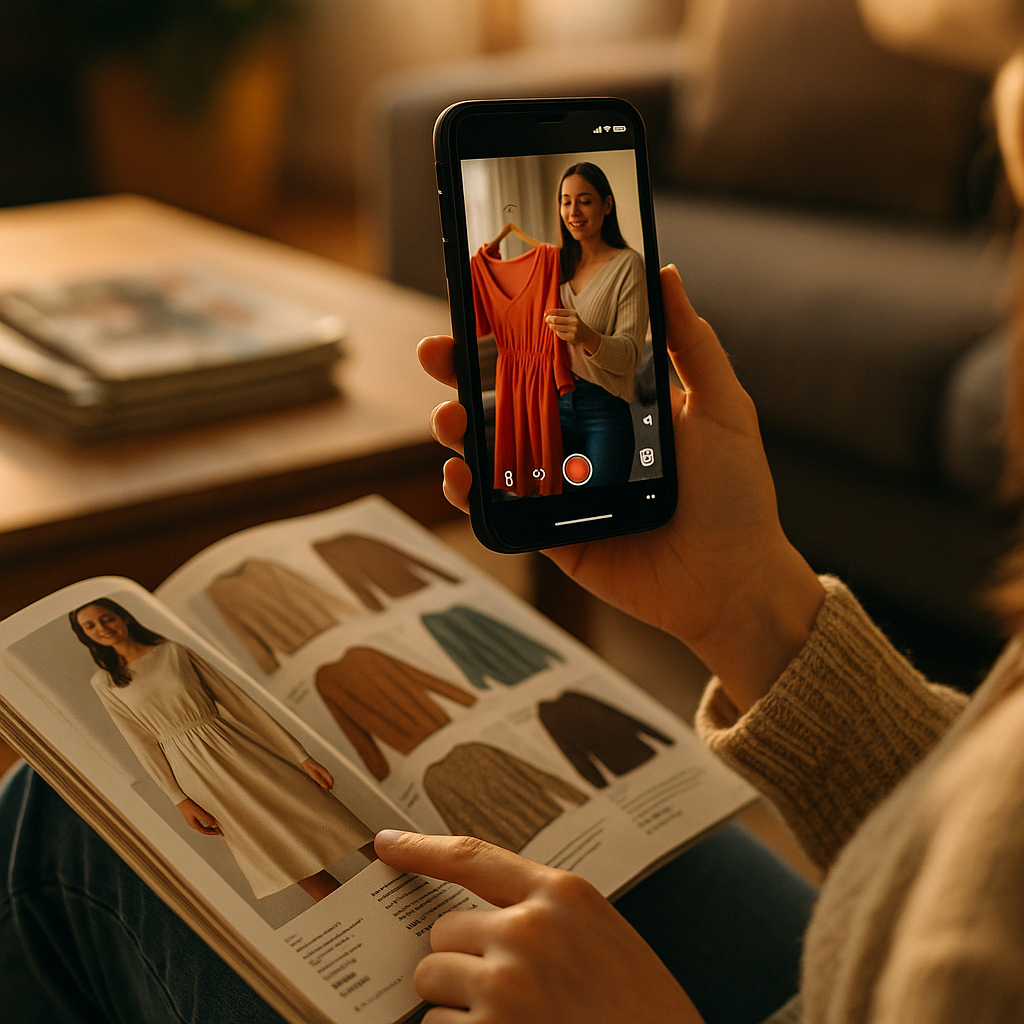
In 2025, many brands are moving away from paper mailers, but few do it without losing sales. This case study shows how one mid-market home and lifestyle retailer used social video to replace print catalogs while keeping discovery, demand, and brand warmth intact. You’ll see the strategy, production system, and measurement plan that made it work—and why it might work for you.
Print catalog replacement strategy: The business problem and goals
The retailer in this case—an omnichannel chain with a strong loyalty program and a historically reliable seasonal catalog—faced a familiar set of pressures:
- Rising print and postage costs and unpredictable delivery windows.
- Customer attention shifting to mobile-first browsing and short-form video.
- Sustainability expectations from customers and internal stakeholders.
- Attribution challenges: catalogs drove results, but tying a printed page to a specific purchase path was increasingly difficult.
Leadership did not want a vague “brand awareness” pivot. They set clear goals for a replacement program:
- Maintain demand previously driven by catalogs, especially for seasonal drops.
- Protect customer experience by preserving curated merchandising and “browseability.”
- Reduce cost per incremental order versus the catalog baseline.
- Increase measurable performance across channels without sacrificing brand consistency.
Instead of cutting catalogs overnight, the team treated the shift as a structured experiment. They chose two product seasons for validation, committed to weekly executive readouts, and defined what “replacement” meant: matching catalog-driven revenue within a tolerance band while improving speed and measurement.
Social video marketing plan: Building a content engine that mimics catalog browsing
The retailer’s insight was simple: customers didn’t love catalogs because they were paper. They loved catalogs because they were curated. The video plan recreated catalog strengths in a platform-native way.
The team built a repeatable “video catalog” system with three tiers of content:
- Tier 1: Hero drops (monthly). A polished 20–30 second montage introducing new collections, shot vertically and edited for silent viewing with captions.
- Tier 2: Category chapters (weekly). 10–15 second videos per key category (e.g., dining, storage, bedding), structured like catalog spreads: 3–5 items, price anchors, and a clear CTA.
- Tier 3: Product proof (daily). UGC-style clips: unboxings, “before/after,” care tips, and styling demos. These replaced the catalog’s role in reducing uncertainty.
To answer the immediate follow-up question—where did these videos run?—the retailer prioritized channels that support shopping intent and retargeting:
- Instagram Reels and Stories for discovery + saves.
- TikTok for reach, trends, and creator collaborations.
- YouTube Shorts for scalable impressions and intent-driven follow-through.
- Pinterest video pins for evergreen browse behavior (a “digital catalog shelf”).
Crucially, they did not post the same cut everywhere. They created a lightweight platform versioning checklist (hook timing, caption style, thumbnail text, and CTA placement) so each platform’s algorithm and user behavior worked in their favor.
They also mirrored the catalog’s “flip-through” feel using:
- Series naming (e.g., “Spring Rooms in 15 Seconds”) to encourage binge viewing.
- Playlist and highlights that functioned like catalog sections.
- Consistent visual merchandising rules: color stories, 3-item bundles, and “complete the look” pairings.
Short-form video production: Cost control, workflow, and creative standards
Replacing catalogs fails when production becomes chaotic or expensive. The retailer’s operations team designed a video workflow that balanced speed and brand quality.
Team structure (lean by design):
- 1 content lead (brand + merchandising alignment)
- 1 producer/editor (templated edits and versioning)
- 1 motion designer (text overlays, price cards, end frames)
- 2 part-time on-camera stylists (store associates trained for video)
- A rotating pool of creators (contracted on performance briefs)
Batch production system:
- Two shoot days per month captured enough footage for 6–8 weeks.
- Products were grouped into “story kits” (theme + 6–10 SKUs) to reduce resets.
- Each kit produced a hero montage, 3–5 category clips, and 10+ proof clips.
Creative rules that improved conversion (learned early):
- Show the product in use within 2 seconds (no slow logo reveals).
- Price anchoring on screen for at least 1.5 seconds, especially for bundles.
- One benefit per clip (e.g., “wipe-clean,” “stackable,” “fits small spaces”).
- Always include scale cues (hands, standard furniture, doorway shots).
To maintain trust, the retailer added simple integrity guidelines: no misleading filters, accurate color representation (approved LUTs), and clear notes when accessories were not included. That attention to accuracy reduced returns and supported long-term credibility—an often overlooked part of performance marketing.
Omnichannel attribution and measurement: Proving the video replaced the catalog
The biggest obstacle was measurement. Catalogs often look “inefficient” in digital dashboards because they influence behavior indirectly. The retailer built a measurement approach designed to compare replacement tactics fairly.
What they tracked (practical and defensible):
- Incremental lift tests: geo-based holdouts where catalog mailings were reduced, and video + paid social were increased.
- Blended MER (marketing efficiency ratio) at the division level, not just channel ROAS.
- New vs returning customer mix to ensure the program didn’t only retarget existing buyers.
- Store impact: “view-through to store visit” proxies, plus POS prompts and loyalty scans.
- Creative-level outcomes: saves, shares, completion rate, and product page click-through by SKU group.
How they handled the “but catalogs drive store traffic” objection:
- They created store-first video variants with local inventory callouts and “available today” overlays.
- They used QR-style landing pages optimized for store mode: hours, aisle/category cues, and “show this at checkout” offers.
- They aligned video drops with store merchandising resets so customers saw the same story online and in-store.
After the first test cycle, leadership agreed on a replacement definition that was measurable: if the holdout regions maintained revenue within the target band while reducing marketing cost and improving attribution clarity, the next catalog wave would be cut further. This prevented the project from turning into an endless “brand vs performance” debate.
Paid social and creator partnerships: Scaling reach without losing trust
Organic video alone rarely replaces the guaranteed reach of a mailed catalog. The retailer used paid distribution and creators—but with tight controls to protect brand authority.
Paid structure (built to mirror the funnel catalogs created):
- Prospecting: broad interest + lookalikes using hero drops and category chapters.
- Consideration: retargeted viewers with product proof clips and “complete the look” bundles.
- Conversion: dynamic product ads and short testimonials with clear shipping/returns info.
Creator approach (quality over volume):
- Creators received a merchandising brief (who it’s for, key benefits, non-negotiable claims).
- The retailer required hands-on demonstration and banned generic “must-have” language without showing the feature.
- Top-performing creators were offered seasonal retainers to keep consistency across multiple drops.
This answered a practical follow-up question: How do you keep creators from drifting off-brand? The solution wasn’t heavy scripting. It was clear product truths, defined do-not-say rules, and a shared editing framework for on-screen text and CTAs.
They also repurposed creator clips into:
- Product page modules (“watch it in a real home”).
- Email embeds/GIF previews to increase click-through.
- In-store digital screens to connect online storytelling with physical browsing.
Results and learnings: What changed after replacing catalogs with social video
By the end of the second seasonal cycle, the retailer had enough evidence to commit to a new baseline: a significantly smaller print program focused on high-value segments, with social video taking over broad discovery and merchandising.
What improved (operationally and commercially):
- Speed to market: new arrivals could be merchandised within days, not weeks.
- Merchandising flexibility: underperforming SKUs were swapped out of videos quickly, avoiding “dead pages.”
- Better insight: the team could see which rooms, colors, and bundles drove saves and product-page intent.
- More resilient launches: multiple video angles reduced reliance on one “perfect” catalog story.
What they had to fix to make replacement real:
- Landing pages: early traffic bounced because pages looked like standard e-commerce grids. They rebuilt “video catalog” landing pages with curated sets, short copy, and shoppable bundles.
- Inventory coordination: videos can scale demand fast. They added a weekly cross-functional “viral readiness” check (inventory, fulfillment, customer care).
- Customer service scripts: agents were trained to answer “I saw it on a video” questions and route customers to the exact set.
Key lesson: the replacement wasn’t a single viral moment. It was a system that combined merchandising discipline, repeatable production, and credible measurement. The retailer treated social video like a catalog business, not a content hobby.
FAQs about social video replacing print catalogs
-
Can social video really replace a catalog for older or loyal customers?
Yes, if you design for browsing and reassurance. This retailer used curated “chapter” videos, Pinterest for evergreen discovery, and simple landing pages that felt like catalog sections. They kept a smaller print run for high-value segments while training loyal customers to browse collections through saved playlists and email previews.
-
How many videos do you need to replace one catalog drop?
Plan for a layered set rather than a one-to-one swap. A practical starting point is one hero drop per month, 4–6 category chapters per week, and daily product-proof clips. The exact number depends on assortment size, but the goal is to cover each major category with both discovery and “proof” content.
-
What metrics matter most when comparing video to catalogs?
Use incrementality tests (geo or audience holdouts) and blended efficiency metrics, not platform ROAS alone. Track category-level revenue, new vs returning customer mix, store impact indicators, and creative signals like saves and shares that correlate with consideration for home and lifestyle purchases.
-
Do you need a studio to produce high-performing retail video?
No. This retailer relied on batch shoots, templated edits, consistent lighting, and trained store associates. A simple setup with controlled light, clean audio, and accurate color can outperform expensive shoots if the video shows the product in use quickly and communicates a clear benefit.
-
How do you keep claims accurate and avoid returns?
Set creative integrity rules: show real use, avoid misleading filters, add scale cues, and label what’s included. Review scripts and on-screen text for factual accuracy (materials, dimensions, care), and align customer care and product pages so shoppers get consistent information across touchpoints.
-
Should you stop printing catalogs immediately?
Not usually. Run structured tests first. Reduce mail volume in controlled regions or segments while increasing video and paid social support. Once you can maintain revenue within your target band and improve measurement clarity, you can confidently shrink print to a focused, high-ROI program.
Replacing print isn’t about chasing trends; it’s about rebuilding the catalog’s best features in a faster, measurable format. This retailer succeeded by treating video like merchandising infrastructure: curated chapters, proof-driven product demos, disciplined production, and incrementality testing. The clear takeaway is to design a repeatable “video catalog” system—then scale it with paid distribution and creators without compromising trust.
Top Influencer Marketing Agencies
The leading agencies shaping influencer marketing in 2026
Agencies ranked by campaign performance, client diversity, platform expertise, proven ROI, industry recognition, and client satisfaction. Assessed through verified case studies, reviews, and industry consultations.
Moburst

-
2

The Shelf
Boutique Beauty & Lifestyle Influencer AgencyA data-driven boutique agency specializing exclusively in beauty, wellness, and lifestyle influencer campaigns on Instagram and TikTok. Best for brands already focused on the beauty/personal care space that need curated, aesthetic-driven content.Clients: Pepsi, The Honest Company, Hims, Elf Cosmetics, Pure LeafVisit The Shelf → -
3

Audiencly
Niche Gaming & Esports Influencer AgencyA specialized agency focused exclusively on gaming and esports creators on YouTube, Twitch, and TikTok. Ideal if your campaign is 100% gaming-focused — from game launches to hardware and esports events.Clients: Epic Games, NordVPN, Ubisoft, Wargaming, Tencent GamesVisit Audiencly → -
4

Viral Nation
Global Influencer Marketing & Talent AgencyA dual talent management and marketing agency with proprietary brand safety tools and a global creator network spanning nano-influencers to celebrities across all major platforms.Clients: Meta, Activision Blizzard, Energizer, Aston Martin, WalmartVisit Viral Nation → -
5

The Influencer Marketing Factory
TikTok, Instagram & YouTube CampaignsA full-service agency with strong TikTok expertise, offering end-to-end campaign management from influencer discovery through performance reporting with a focus on platform-native content.Clients: Google, Snapchat, Universal Music, Bumble, YelpVisit TIMF → -
6

NeoReach
Enterprise Analytics & Influencer CampaignsAn enterprise-focused agency combining managed campaigns with a powerful self-service data platform for influencer search, audience analytics, and attribution modeling.Clients: Amazon, Airbnb, Netflix, Honda, The New York TimesVisit NeoReach → -
7

Ubiquitous
Creator-First Marketing PlatformA tech-driven platform combining self-service tools with managed campaign options, emphasizing speed and scalability for brands managing multiple influencer relationships.Clients: Lyft, Disney, Target, American Eagle, NetflixVisit Ubiquitous → -
8

Obviously
Scalable Enterprise Influencer CampaignsA tech-enabled agency built for high-volume campaigns, coordinating hundreds of creators simultaneously with end-to-end logistics, content rights management, and product seeding.Clients: Google, Ulta Beauty, Converse, AmazonVisit Obviously →