


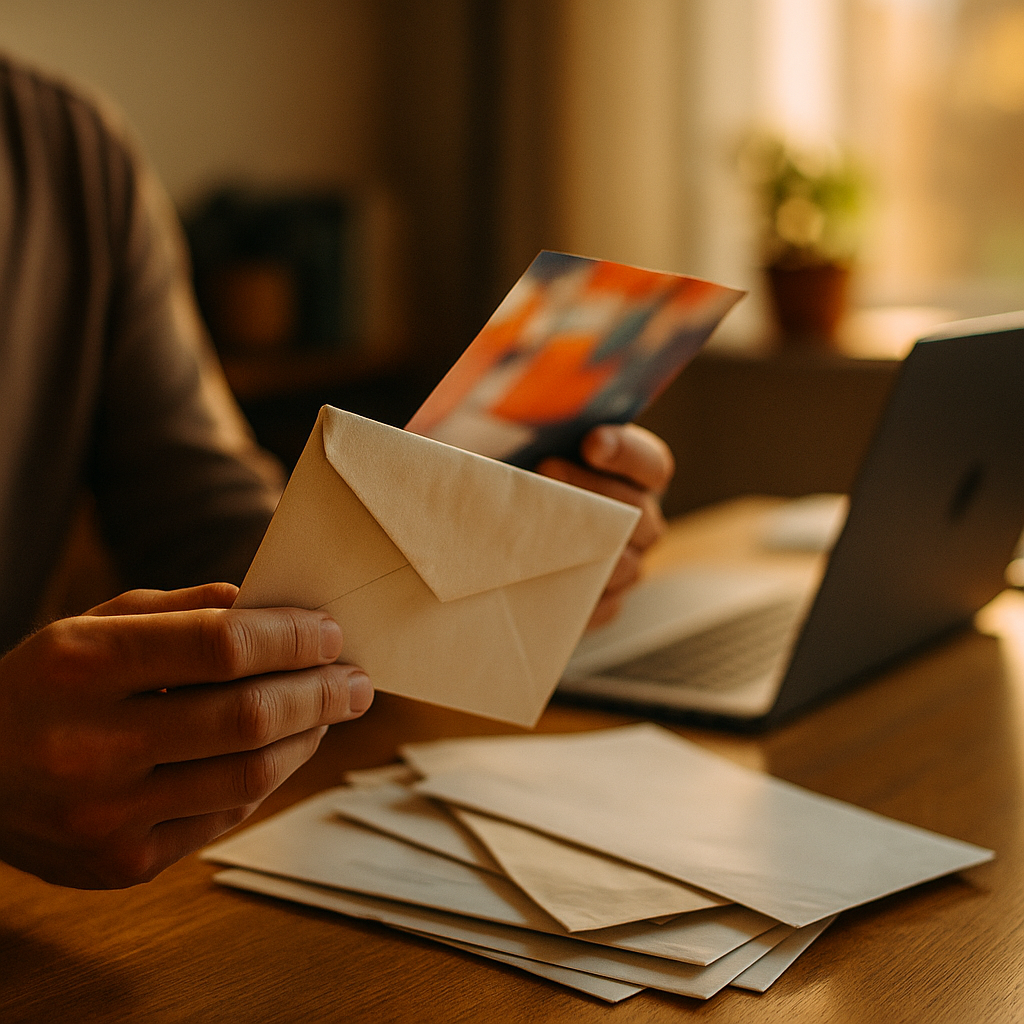
In 2025, marketers are witnessing a surprising shift: the Tactile Revival is pushing physical direct mail back into the spotlight. As inboxes overflow and ad costs rise, tangible mail is earning attention, trust, and action in ways many digital channels struggle to match. If you rely mostly on clicks and impressions, this performance gap raises a question worth exploring—what changed?
Why Direct Mail Marketing Works in 2025: Attention, Trust, and Less Noise
Digital marketing still matters, but it no longer enjoys the same “default attention” it once did. Consumers scroll past hundreds of posts, ads, and emails daily, and most of it blends into the same visual pattern. Direct mail interrupts that pattern. It arrives in a different context—your home or workplace—where competition is lower and attention is more intentional.
One driver is simple: channel saturation. Email inboxes are crowded and algorithmic feeds limit organic reach. At the same time, privacy changes and signal loss make it harder to target and measure digital campaigns with the precision teams depended on for years. Direct mail benefits from a more stable delivery environment: if the address is correct, the piece arrives.
Trust is the second driver. Many audiences treat digital ads with skepticism, especially when creative looks automated or overly personalized. A well-produced mailer can feel more credible because it carries a real-world cost to send and cannot be “spoofed” as easily as a banner ad. That physicality signals commitment.
For marketers, the practical implication is clear: direct mail is not replacing digital—it’s outperforming it in specific moments of the customer journey where attention and confidence matter most:
- First-touch acquisition for high-value products and services
- Reactivation of lapsed customers who ignore emails
- Local campaigns where proximity and relevance drive response
- Account-based outreach to decision-makers tired of generic sequences
If you are seeing declining email engagement, rising paid social CPMs, or fewer trackable conversions, direct mail is often the simplest way to regain control of reach and visibility.
Physical Mail Response Rates: What Current Data Signals (and What It Doesn’t)
Marketers ask the same follow-up question: “Is direct mail really performing better, or does it just feel that way?” In 2025, the most useful answer comes from looking at measurable outcomes—response, conversion, and customer value—while staying honest about attribution limitations.
Industry studies continue to show that physical mail response rates can outperform broad digital outreach, particularly when lists are well-targeted and offers are relevant. The key nuance: response rates vary dramatically by audience quality, format, and follow-up. A generic mass postcard sent to a cold list will not beat a well-run digital campaign. But a personalized mailer to a qualified segment often can.
Another reason direct mail “wins” is that many digital benchmarks are inflated by low-intent actions: opens, views, clicks, and accidental taps. Direct mail tends to produce fewer but more deliberate responses, which can increase downstream conversion rates.
To evaluate performance fairly, focus on these metrics instead of vanity numbers:
- Incremental lift versus a holdout group (the most reliable test)
- Cost per qualified lead rather than cost per click
- Revenue per household/account contacted
- Payback period and lifetime value for responders
If your team is concerned about measurement, build a testing structure that makes direct mail legible: unique offer codes, dedicated URLs, call tracking, QR codes, and controlled experiments. The goal is not perfect attribution—it’s confident decision-making based on lift and profitability.
Multisensory Branding and Consumer Psychology: The Science Behind the “Tactile” Advantage
Physical direct mail leverages a basic behavioral reality: humans process tangible objects differently than on-screen content. Touch adds another layer of perception that digital cannot replicate. When a piece of mail has weight, texture, or dimensional design, it creates a richer memory trace than a swipe-by impression.
This is where multisensory branding becomes more than a creative buzzword. Texture, embossing, soft-touch coatings, die-cuts, and even the sound of opening an envelope can contribute to a feeling of quality and care. That feeling often transfers to the brand—especially when the recipient is already evaluating credibility.
Direct mail also controls the environment more effectively than many digital placements. You decide the sequence of information (front/back, insert order, reveal mechanics). You can guide the reader’s attention through layout and physical interaction. Digital ads rarely receive that level of uninterrupted focus.
To turn this advantage into performance, match tactile decisions to the buying context:
- High-consideration offers: use premium stock, a clear value proposition, and proof elements (testimonials, guarantees, credentials)
- Time-sensitive promotions: make the deadline obvious and easy to act on (QR + short URL + SMS option)
- Local services: include neighborhood cues, maps, or “served near you” messaging to raise relevance
- B2B outreach: use dimensional mail selectively for top accounts, supported by a coordinated follow-up sequence
Recipients do not respond to “print” in the abstract. They respond to relevance, clarity, and confidence. Tactile enhancements work best when they reinforce those three fundamentals rather than trying to compensate for weak positioning.
Integrated Direct Mail and Digital: How Omnichannel Wins Actually Happen
The strongest results in 2025 come from integrated direct mail and digital, not from treating direct mail as a standalone replacement. Physical mail earns attention, and digital channels convert that attention efficiently—if you build the handoff on purpose.
A high-performing sequence often looks like this:
- Step 1: Digital signal capture (site visit, form fill, abandoned cart, webinar registration, intent data)
- Step 2: Triggered mail within a short window while intent is warm
- Step 3: Digital follow-up (retargeting, email, SMS, sales outreach) aligned to the exact offer in the mailer
- Step 4: Conversion path optimized for speed and confidence (clear landing page, social proof, frictionless checkout or booking)
This addresses a common follow-up question: “Does direct mail take too long?” It can—if you plan it like traditional campaign mail. But modern workflows allow for faster production and more responsive timing. Even when timing is not instant, direct mail still works well for higher-ticket decisions where the evaluation window is naturally longer.
Another follow-up question is whether QR codes are still effective. They are—when used correctly. The mistake is treating QR as the strategy. QR is just a bridge. If the landing experience is generic, slow, or inconsistent with the mailer, response drops. The most effective campaigns use:
- Campaign-specific landing pages that repeat the exact headline and offer
- One clear action per page (book, claim, call, buy)
- Proof near the CTA (reviews, credentials, case studies, guarantees)
- Fast mobile performance and minimal form fields
When direct mail and digital agree on message, timing, and next step, the result is an experience that feels personal without feeling invasive—an increasingly important balance in privacy-first marketing.
Direct Mail ROI and Measurement: Testing, Targeting, and Attribution Without Guesswork
Direct mail can be profitable, but it is not “cheap.” That’s why direct mail ROI depends on disciplined targeting and a measurement plan that your finance team will trust. The most common reason campaigns disappoint is not the channel—it’s sending to the wrong households or offering the wrong next step.
Start with targeting. Use your strongest first-party data whenever possible:
- Customer lists segmented by recency, frequency, and value
- Lead lists filtered by qualification signals (industry, role, budget range, intent)
- Geographic targeting tied to service radius, store catchment, or delivery capability
Then choose a testing framework that isolates what works. A practical approach is a structured test matrix:
- Audience test: segment A vs segment B (or modeled vs non-modeled)
- Offer test: incentive vs no incentive, or price framing A vs B
- Format test: postcard vs letter package, or flat vs dimensional for top accounts
- Follow-up test: mail-only vs mail + email + retargeting
For attribution, focus on what you can prove. Use a combination of:
- Holdout groups to calculate incremental lift
- Unique promo codes to link redemption
- Dedicated phone numbers with call tracking
- Short URLs tied to analytics and CRM
- Matchback analysis for purchases that happen without code usage
Finally, answer the CFO question upfront: “What will we do if it works?” Have a scaling plan. Many teams run a successful test and then stall because operations cannot handle increased demand or because budgets are locked into underperforming digital commitments. Direct mail works best when it is treated like a performance channel with clear expansion rules.
Best Practices for Modern Direct Mail Campaigns: Creative, Compliance, and Customer Experience
Execution matters more than nostalgia. The “tactile” advantage disappears if the mailer is confusing, irrelevant, or hard to act on. Modern direct mail is a user experience discipline as much as a design one.
Use these best practices to increase response and protect brand trust:
- Lead with the value proposition: the recipient should understand “what’s in it for me” in seconds
- Make the offer believable: include specific details, terms, and simple redemption steps
- Use proof strategically: short testimonials, ratings, partner logos, or quantified outcomes
- Personalize with restraint: tailor to needs and context without overreaching into “creepy” specificity
- Design for skimming: strong hierarchy, short blocks, clear CTA, and readable typography
- Plan the landing experience: message match, speed, and one primary action
In 2025, compliance and respect for privacy are part of performance. Be transparent about how recipients can opt out of future communications and ensure your data practices are documented. Trust is a conversion lever, and mishandling data erodes it quickly.
Also consider customer experience after the response. If your call handling, appointment scheduling, or fulfillment is slow, direct mail can expose operational gaps because it often generates high-intent inquiries. Prepare your team with scripts, training, and capacity planning before you scale.
FAQs About the Tactile Revival and Physical Direct Mail
Is direct mail only effective for older audiences?
No. While some older segments respond well, performance depends more on relevance and offer fit than age. Direct mail can be especially effective for households making high-consideration decisions (home services, healthcare, education, financial products) and for targeted B2B outreach to specific roles.
How do I track conversions from direct mail accurately?
Use a mix of unique promo codes, short URLs, QR codes, dedicated phone numbers, and CRM tagging. For the most reliable view, run holdout tests to measure incremental lift, then use matchback analysis to connect responders who convert without using a code.
What format performs best: postcards or letters?
Postcards can win on cost and speed for simple offers. Letters can outperform when you need more explanation, more trust-building, or a more personal tone. The best choice depends on your sales cycle and how much context the buyer needs to act.
How much should I spend to test direct mail?
Budget for a test that is large enough to produce a meaningful result and includes a holdout group. Many organizations start with a focused segment (best customers, warm leads, or a single geography), then expand once they have proven lift and a repeatable offer.
Does direct mail work without discounts?
Yes. Discounts are only one type of incentive. Many profitable campaigns use value-added offers (free assessment, extended warranty, bonus service, priority scheduling) or a strong promise backed by proof. The best incentive is the one that attracts the right buyers, not the most bargain-driven ones.
How quickly should I follow up after someone receives a mailer?
Coordinate follow-up within the expected delivery window. Retargeting and email can start as soon as recipients visit your landing page. For high-value leads, sales follow-up should happen quickly after the first inbound action, while intent is highest.
Physical direct mail is outperforming many digital tactics in 2025 because it wins the fight for attention and trust, then converts through clear, measurable next steps. The takeaway is practical: treat mail as a performance channel, test it with disciplined targeting and holdouts, and connect it to a fast digital path to purchase. When relevance meets tactility, response follows.
Top Influencer Marketing Agencies
The leading agencies shaping influencer marketing in 2026
Agencies ranked by campaign performance, client diversity, platform expertise, proven ROI, industry recognition, and client satisfaction. Assessed through verified case studies, reviews, and industry consultations.
Moburst

-
2

The Shelf
Boutique Beauty & Lifestyle Influencer AgencyA data-driven boutique agency specializing exclusively in beauty, wellness, and lifestyle influencer campaigns on Instagram and TikTok. Best for brands already focused on the beauty/personal care space that need curated, aesthetic-driven content.Clients: Pepsi, The Honest Company, Hims, Elf Cosmetics, Pure LeafVisit The Shelf → -
3

Audiencly
Niche Gaming & Esports Influencer AgencyA specialized agency focused exclusively on gaming and esports creators on YouTube, Twitch, and TikTok. Ideal if your campaign is 100% gaming-focused — from game launches to hardware and esports events.Clients: Epic Games, NordVPN, Ubisoft, Wargaming, Tencent GamesVisit Audiencly → -
4

Viral Nation
Global Influencer Marketing & Talent AgencyA dual talent management and marketing agency with proprietary brand safety tools and a global creator network spanning nano-influencers to celebrities across all major platforms.Clients: Meta, Activision Blizzard, Energizer, Aston Martin, WalmartVisit Viral Nation → -
5

The Influencer Marketing Factory
TikTok, Instagram & YouTube CampaignsA full-service agency with strong TikTok expertise, offering end-to-end campaign management from influencer discovery through performance reporting with a focus on platform-native content.Clients: Google, Snapchat, Universal Music, Bumble, YelpVisit TIMF → -
6

NeoReach
Enterprise Analytics & Influencer CampaignsAn enterprise-focused agency combining managed campaigns with a powerful self-service data platform for influencer search, audience analytics, and attribution modeling.Clients: Amazon, Airbnb, Netflix, Honda, The New York TimesVisit NeoReach → -
7

Ubiquitous
Creator-First Marketing PlatformA tech-driven platform combining self-service tools with managed campaign options, emphasizing speed and scalability for brands managing multiple influencer relationships.Clients: Lyft, Disney, Target, American Eagle, NetflixVisit Ubiquitous → -
8

Obviously
Scalable Enterprise Influencer CampaignsA tech-enabled agency built for high-volume campaigns, coordinating hundreds of creators simultaneously with end-to-end logistics, content rights management, and product seeding.Clients: Google, Ulta Beauty, Converse, AmazonVisit Obviously →