


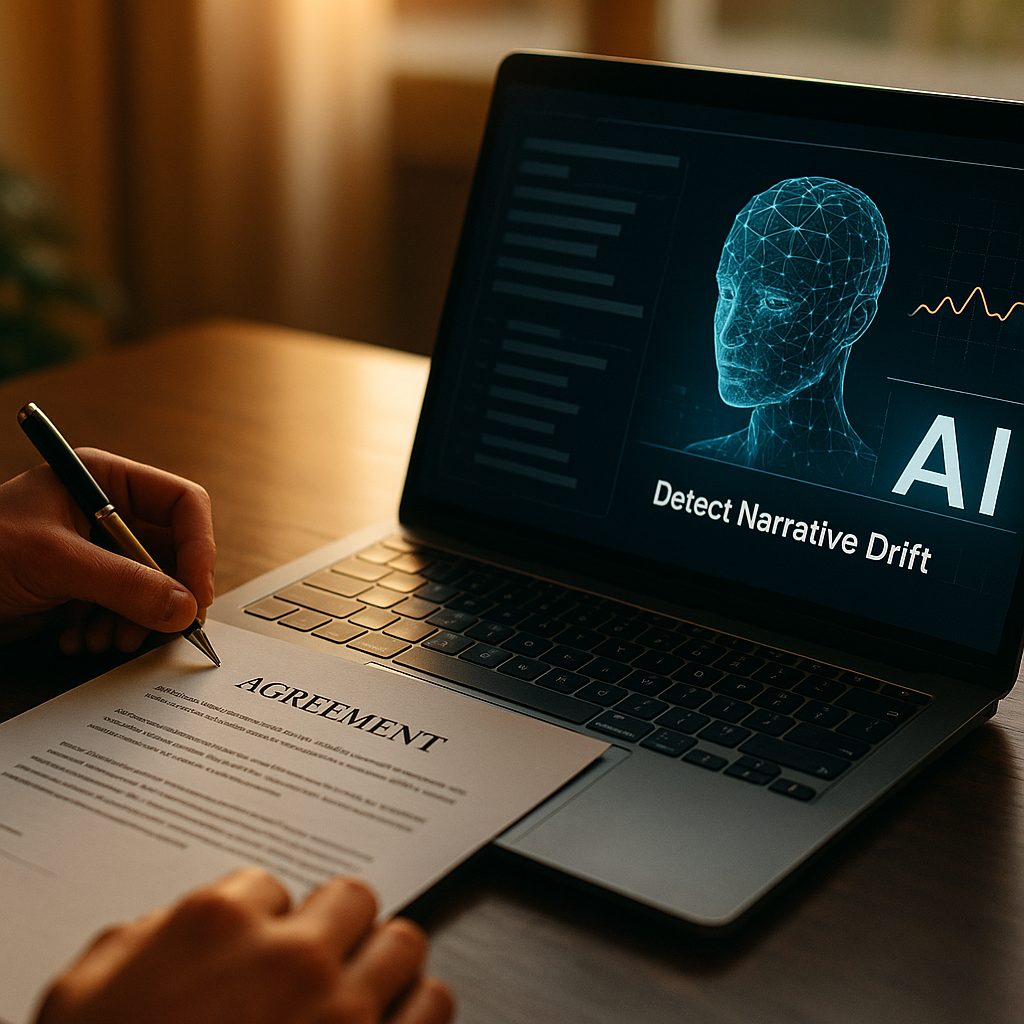
AI For Automated Narrative Drift Detection in Creator Agreements is becoming essential as brands, agencies, and creators publish faster across more channels in 2025. One ambiguous clause or off-brief post can trigger takedowns, disputes, and reputational damage. Modern workflows need more than manual review—they need continuous, explainable monitoring tied to contract language. This article breaks down how it works and why it matters—before the next campaign goes live.
Contract compliance automation: what “narrative drift” means in creator deals
Narrative drift is the gap between what a creator publishes and what the agreement requires or restricts. In creator agreements, drift can happen even when everyone has good intent—because creative evolves, trending audio changes meaning, or edits happen under time pressure.
In practical terms, drift typically shows up in four places:
- Message drift: the post emphasizes claims, benefits, or comparisons not approved in the brief (for example, implying guaranteed results).
- Brand-safety drift: tone, language, or references conflict with the brand’s safety standards (for example, sensitive topics that were prohibited).
- Disclosure drift: missing, unclear, or platform-inappropriate ad disclosures that violate contract terms or local rules.
- Usage and exclusivity drift: content includes restricted competitors, unlicensed music, or violates category exclusivity windows.
Creator agreements already describe many of these constraints, but they often live in scattered documents: a master services agreement, statement of work, creative brief, platform policies, and brand guidelines. The operational challenge is aligning real-world content with all those sources without slowing down production.
Automated drift detection focuses on two outcomes: identify where the content deviates and provide an audit trail that is clear enough for creators, managers, legal, and brand safety reviewers to act on quickly.
AI contract analysis: how automated narrative drift detection works end-to-end
Effective systems combine natural language processing, multimedia understanding, and contract-aware rules. The best implementations do not “guess”; they translate agreement terms into testable checks and produce evidence for each flag.
A typical workflow looks like this:
- Ingest and normalize agreements: upload PDFs, redlines, SOWs, and briefs; extract key clauses (claims, prohibited topics, disclosures, exclusivity, usage rights, approval steps).
- Build a campaign “narrative spec”: convert clauses into structured requirements—approved claims, required hashtags, banned words, competitor lists, approved product names, required disclaimers, and geographic restrictions.
- Ingest creator content: captions, scripts, transcripts, overlays, thumbnails, comments pinned by the creator, and linked landing pages. For video/audio, generate transcripts and detect on-screen text.
- Detect drift signals: compare content to the narrative spec. Systems flag missing disclosures, unapproved medical/financial claims, competitor mentions, risky topics, or tone mismatch.
- Explain and route: provide clause-level mapping (what requirement, what evidence, where in the content), assign severity, and route to the right owner (creator manager, legal, brand safety).
- Learn from outcomes: track overrides and approvals to improve precision, while keeping human decision-making in the loop.
Readers often ask: “Is this just keyword scanning?” The answer should be no. Keyword lists help, but drift often appears through paraphrase, sarcasm, or implied claims. Strong tools use semantic matching and claim detection, plus contract grounding—each alert links back to the specific clause or guideline it relates to.
Brand safety monitoring: drift risks you can catch before they become disputes
Narrative drift is not only a compliance issue; it is a relationship issue. When a brand says “this is off-brief,” creators often feel blindsided unless the feedback is precise, consistent, and tied to agreed terms. Automated drift detection helps by catching problems early and documenting them objectively.
Common high-impact risks to monitor include:
- Unapproved or regulated claims: “guaranteed,” “clinically proven,” “cures,” “no side effects,” or performance promises that require substantiation.
- Platform and disclosure compliance: missing “paid partnership” labels, unclear #ad disclosure placement, or disclosures not visible long enough in video.
- Competitor and exclusivity violations: visible competitor products in the background, verbal mentions, affiliate links, or discount codes for restricted categories.
- IP and licensing issues: unlicensed music, stock footage misuse, or use of trademarks outside agreed contexts.
- Safety and suitability: prohibited topics (for example, self-harm references), risky challenges, or content adjacent to sensitive news events that the agreement restricts.
Follow-up question: “Can AI judge tone?” It can flag tone indicators—insults, harassment, sexual content, hate-adjacent phrasing, or aggressive profanity—and compare them to brand guidelines. But tone decisions should remain reviewable by humans, with the AI providing the exact excerpt and the guideline reference that triggered the alert.
To reduce false alarms, calibrate severity tiers. For example: critical (legal/regulatory), high (brand safety), medium (brief mismatch), low (style suggestions). This keeps teams from ignoring the system when volume spikes.
Creator agreement governance: clause mapping, audit trails, and approvals
Automation only works when governance is clear. In creator programs, agreements may be templated, negotiated, or patched with email approvals. Drift detection must handle that reality without turning into a bureaucracy.
Best-practice governance in 2025 includes:
- Clause-to-check mapping: each automated check should reference the clause, guideline, or brief element it enforces.
- Version control: track which contract version and creative brief applied to each post, including any waivers or exceptions.
- Pre-publish and post-publish modes: preflight checks for drafts; continuous monitoring after publication for edits, stitched content, new captions, or reposts.
- Human-in-the-loop review: provide an approval workflow where managers can accept, remediate, or escalate with structured reasons.
- Evidence retention: store content snapshots, transcripts, and timestamps of detected issues to support dispute resolution.
Many teams ask: “Will this replace legal review?” It should not. Instead, it reduces repetitive checks and helps legal focus on edge cases, negotiation, and policy decisions. Think of it as a compliance layer that makes everyday enforcement consistent and measurable.
Another common question: “What if the agreement is vague?” That is where drift programs deliver unexpected value. If the system cannot convert a clause into a check, it highlights ambiguity. Teams can then refine templates by adding specifics like required disclosures, banned comparisons, or examples of prohibited claims.
Explainable AI compliance: accuracy, privacy, and EEAT in automated decisions
Because narrative drift detection can affect payments, takedowns, and creator relationships, the system must be trustworthy. That means explainability, privacy, and measurable accuracy.
To follow EEAT principles in a practical way:
- Experience: configure checks using real campaign outcomes—past disputes, platform enforcement patterns, and creator feedback about what was confusing.
- Expertise: involve legal/compliance and brand safety specialists in creating the narrative spec library (claims taxonomy, disclosure rules, prohibited-topic lists).
- Authoritativeness: align policies with platform disclosure features and internal brand guidelines; document decision standards so reviewers apply rules consistently.
- Trust: provide transparent rationales for flags, keep an audit trail, and allow appeals or overrides with recorded justification.
Accuracy should be measured using precision and recall on your own data. Start by sampling content across platforms and creators, then label drift cases with reviewers. Track:
- False positives (unnecessary friction) and false negatives (missed risks).
- Time-to-resolution: how quickly teams fix issues after an alert.
- Repeat drift rate: whether creators improve after receiving consistent, clause-based feedback.
Privacy and data handling are equally important. Drift systems often process drafts, contracts, and sometimes private links. Minimize risk by implementing:
- Least-privilege access and role-based permissions (creator manager vs. legal vs. finance).
- Data minimization: store only what is needed for compliance evidence and audits.
- Secure retention policies: define how long transcripts, snapshots, and agreement extracts are stored.
Finally, insist on explainable outputs. If a tool cannot show what text, timestamp, or visual element triggered the drift and which clause it maps to, it will be hard to operationalize and easy to contest.
Influencer marketing analytics: implementation checklist and ROI signals
Teams adopt narrative drift detection to reduce risk, protect brand equity, and speed approvals. To implement successfully, focus on outcomes instead of features.
Implementation checklist:
- Standardize templates: define a creator agreement addendum that clearly states disclosure rules, claim boundaries, prohibited topics, and exclusivity.
- Define the narrative spec: list approved claims, required phrases, disallowed comparisons, and escalation rules for regulated categories.
- Choose coverage: decide which platforms, languages, and content types (short-form video, livestream clips, podcasts, blog posts) you will monitor first.
- Integrate approvals: connect to your creator management and ticketing tools so alerts create tasks, not chaos.
- Calibrate thresholds: start with conservative alerting and tighten as reviewers confirm accuracy.
- Train teams: creators should receive clear guidance: what changed, why it matters, and how to fix it fast.
ROI signals to track:
- Reduced rework: fewer late-stage edits after legal or brand safety review.
- Faster cycle time: shorter time from draft to publish.
- Fewer takedowns and disputes: measurable reduction in content removals, payment holds, and escalations.
- Better creator retention: fewer conflicts caused by inconsistent enforcement, because feedback is clause-based and repeatable.
A question decision-makers ask: “Should we run this continuously or only before posting?” The best answer is both. Preflight checks prevent predictable issues; post-publish monitoring catches edits, reposts, stitched segments, and changes in captions or links that can introduce drift after approval.
FAQs
What is automated narrative drift detection in creator agreements?
It is the use of AI and rules-based checks to compare creator content (captions, scripts, transcripts, visuals, links) against contract terms, briefs, and brand guidelines to identify deviations, explain them, and route fixes.
Does narrative drift detection help with ad disclosure compliance?
Yes. It can detect missing or unclear disclosures, check placement in captions, and verify whether required labels or hashtags appear. For video, it can flag disclosures that are too brief or not visible in the right segment, depending on your policy rules.
Can AI detect competitor products in the background of a video?
It can assist by identifying logos, product packaging, or text overlays, then cross-referencing a competitor list tied to exclusivity clauses. Because visual detection can be imperfect, high-severity flags should be reviewed by a human before enforcement.
How do you reduce false positives so creators don’t lose trust?
Use severity tiers, require clause-based explanations, and tune the system with labeled examples from your own campaigns. Provide a clear override path and track which rules cause repeated friction, then refine them.
Is this only for large influencer programs?
No. Smaller teams benefit because manual review does not scale and mistakes are expensive. Start with a narrow scope—disclosures, prohibited claims, and exclusivity—then expand as templates and data mature.
Will automated monitoring create legal risk if it misses something?
Any system can miss issues, which is why organizations keep human review for high-risk categories and maintain documented processes. The goal is to reduce overall risk and response time, not to claim perfect detection.
AI-driven drift detection turns creator agreements from static PDFs into active guardrails that protect both brands and creators in 2025. By mapping clauses to measurable checks, monitoring content pre- and post-publish, and keeping explanations audit-ready, teams reduce rework and prevent avoidable disputes. The key takeaway: choose tools and processes that prioritize transparency, human review for high-risk calls, and consistent enforcement.
Top Influencer Marketing Agencies
The leading agencies shaping influencer marketing in 2026
Agencies ranked by campaign performance, client diversity, platform expertise, proven ROI, industry recognition, and client satisfaction. Assessed through verified case studies, reviews, and industry consultations.
Moburst

-
2

The Shelf
Boutique Beauty & Lifestyle Influencer AgencyA data-driven boutique agency specializing exclusively in beauty, wellness, and lifestyle influencer campaigns on Instagram and TikTok. Best for brands already focused on the beauty/personal care space that need curated, aesthetic-driven content.Clients: Pepsi, The Honest Company, Hims, Elf Cosmetics, Pure LeafVisit The Shelf → -
3

Audiencly
Niche Gaming & Esports Influencer AgencyA specialized agency focused exclusively on gaming and esports creators on YouTube, Twitch, and TikTok. Ideal if your campaign is 100% gaming-focused — from game launches to hardware and esports events.Clients: Epic Games, NordVPN, Ubisoft, Wargaming, Tencent GamesVisit Audiencly → -
4

Viral Nation
Global Influencer Marketing & Talent AgencyA dual talent management and marketing agency with proprietary brand safety tools and a global creator network spanning nano-influencers to celebrities across all major platforms.Clients: Meta, Activision Blizzard, Energizer, Aston Martin, WalmartVisit Viral Nation → -
5

The Influencer Marketing Factory
TikTok, Instagram & YouTube CampaignsA full-service agency with strong TikTok expertise, offering end-to-end campaign management from influencer discovery through performance reporting with a focus on platform-native content.Clients: Google, Snapchat, Universal Music, Bumble, YelpVisit TIMF → -
6

NeoReach
Enterprise Analytics & Influencer CampaignsAn enterprise-focused agency combining managed campaigns with a powerful self-service data platform for influencer search, audience analytics, and attribution modeling.Clients: Amazon, Airbnb, Netflix, Honda, The New York TimesVisit NeoReach → -
7

Ubiquitous
Creator-First Marketing PlatformA tech-driven platform combining self-service tools with managed campaign options, emphasizing speed and scalability for brands managing multiple influencer relationships.Clients: Lyft, Disney, Target, American Eagle, NetflixVisit Ubiquitous → -
8

Obviously
Scalable Enterprise Influencer CampaignsA tech-enabled agency built for high-volume campaigns, coordinating hundreds of creators simultaneously with end-to-end logistics, content rights management, and product seeding.Clients: Google, Ulta Beauty, Converse, AmazonVisit Obviously →