


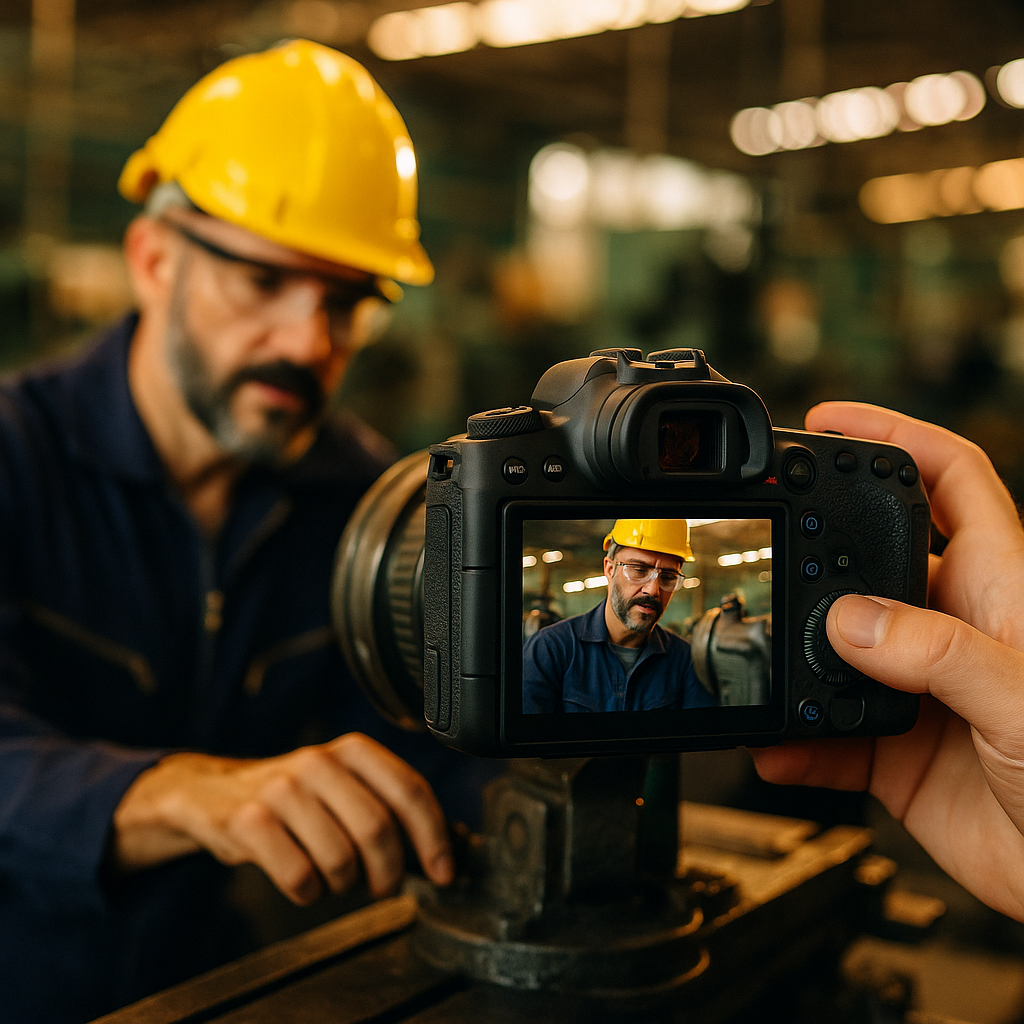
In 2025, many industrial brands struggle to attract skilled people because their work feels invisible to outsiders. This case study: a traditional manufacturer using video to humanize talent shows how one company replaced sterile job ads with authentic stories from the shop floor. The result wasn’t just better content; it was stronger trust, clearer expectations, and more qualified applicants. Here’s what changed—and why it worked.
Employer branding video strategy: The challenge and the opportunity
The manufacturer in this case study had a solid reputation with customers, stable operations, and competitive pay. Yet hiring for machinists, maintenance techs, quality inspectors, and shift supervisors kept getting harder. Exit interviews and recruiter notes showed a consistent theme: candidates didn’t understand the environment until they toured the plant, and many withdrew after realizing the work didn’t match their assumptions.
At the same time, the leadership team worried that showing the facility on camera would raise concerns about safety, confidentiality, or “looking old-fashioned.” The reality was simpler: the company lacked a modern way to explain its culture, training, and career progression without requiring a site visit.
Video offered a direct path to solve three problems at once:
- Visibility: Make skilled work tangible to people who have never stepped into a manufacturing facility.
- Credibility: Let employees speak in their own words, reducing skepticism toward marketing claims.
- Efficiency: Answer common candidate questions upfront to reduce mismatched applications and screening time.
The goal wasn’t to make manufacturing look like something it wasn’t. The goal was to show the human reality of the work, the standards, and the support systems—so the right candidates could opt in with confidence.
Manufacturing recruitment video: Turning a plant into a relatable story
The company built a manufacturing recruitment video program around real roles, real shifts, and real voices. Instead of one glossy “brand film,” the team produced a set of short, role-specific videos designed to meet candidates where they were in the hiring journey.
The content map aligned to typical candidate intent:
- “What is it like there?” A 90-second facility walkthrough led by a supervisor, including noise levels, PPE expectations, and break areas.
- “Can I grow?” Two-minute employee stories showing progression from entry-level to lead roles, with concrete milestones (training hours, certifications, mentorship).
- “Will I be safe and supported?” A safety-and-training piece featuring the safety manager and new hires describing onboarding and coaching.
- “Do people like each other?” A culture reel filmed during a shift handover and a team huddle, focusing on collaboration rather than forced “fun.”
Crucially, the company avoided scripting employees word-for-word. The communications lead prepared talking points and asked practical questions: “What surprised you in week one?” “What’s the hardest part of your job?” “What do you wish applicants understood before they apply?” This approach improved authenticity and helped candidates self-select based on realistic expectations.
To protect confidentiality and safety, the team built a simple filming protocol: blur sensitive screens, avoid proprietary processes, film around customer labels, and require PPE in all shop-floor shots. The safety manager signed off on scenes before release, keeping the program compliant and repeatable.
Employee testimonial videos: Building trust without corporate polish
Employee testimonial videos carried the program. The manufacturer selected a representative mix of tenure, roles, and backgrounds: apprentices, long-tenured machinists, a quality engineer, a maintenance tech, and two frontline supervisors. Selection wasn’t based on “most charismatic,” but on who could explain the work clearly and honestly.
Each testimonial followed a consistent structure that made the content easy to consume and compare:
- Role context: What they do and how their day is structured.
- What good looks like: How quality is measured, and what the team expects.
- Support: Who helps them succeed (trainer, mentor, team lead), and how feedback works.
- Growth: Skills learned in the last 6–12 months, and next steps.
- Reality check: The toughest part of the job, stated plainly.
This “reality check” segment became a trust accelerator. Candidates often distrust overly positive recruitment messages. When employees acknowledged challenges—heat, repetitive motion, tight tolerances, rotating shifts—then explained what the company does to mitigate them, viewers perceived the message as more credible.
The company also addressed a frequent candidate follow-up question inside the videos: “Do I need prior manufacturing experience?” Supervisors outlined which roles required experience and which could train from zero, describing what “trainable” means in practice: punctuality, attention to detail, willingness to learn, and comfort with safety rules.
To strengthen EEAT, each video description included the speaker’s name, role, and tenure, plus a short note on the training program and safety standards. The company avoided vague claims like “best culture” and instead used specific proof points: onboarding length, mentorship structure, and certification pathways.
Talent attraction in manufacturing: Distribution that meets candidates where they search
Great video content fails if candidates never see it. The manufacturer treated distribution like a hiring workflow, not a branding campaign. HR, recruiting, and marketing agreed on where video would appear and what each placement should accomplish.
Key placements included:
- Job postings: Each priority role had a short “day in the life” clip embedded near the top, before requirements, to reduce drop-off and improve self-selection.
- Careers landing pages: A role library of videos, grouped by department, with plain-language summaries and links to relevant openings.
- Recruiter outreach: Recruiters used a specific video in initial messages, matched to the candidate’s role interest, to answer questions before scheduling.
- Onsite and virtual interviews: Candidates watched a short safety-and-training clip to standardize expectations and reduce repetitive explanations.
- Social channels: Short cuts optimized for silent viewing, featuring captions and clear titles like “Maintenance Tech: First 90 Days.”
The team also used video to reduce common friction points. For example, shift schedules and overtime policies often triggered late-stage withdrawals. Rather than hiding those details, the manufacturer created a 60-second “scheduling explained” video featuring a production planner and a shift supervisor. Candidates who couldn’t make the schedule opted out early, while those who could arrived to interviews better prepared and less anxious.
To support accessibility and clarity, every video included captions, and each page included a short text summary for candidates who prefer reading or use assistive technology. This improved usability and helped search engines understand the content.
Recruitment marketing KPIs: What changed and how success was measured
The company defined success as a better match between candidates and roles, not vanity views. HR and recruiting agreed on a scorecard tied to business outcomes and candidate experience. Measurement focused on behavior and quality signals across the funnel.
Primary recruitment marketing KPIs included:
- Qualified applicant rate: The percentage of applicants meeting baseline criteria, tracked by role.
- Screen-to-interview conversion: Whether stronger understanding reduced time wasted on mismatched screens.
- Interview show rate: A proxy for candidate commitment and clarity.
- Offer acceptance rate: Whether expectations matched reality.
- Early turnover (first 90 days): A critical measure of “right fit” and onboarding alignment.
They also captured qualitative signals that often predict long-term success:
- Candidate questions evolved: Interviews shifted from basic “What do you do?” questions to role-specific questions about tooling, quality checks, and training—evidence of better preparation.
- Hiring manager confidence improved: Managers reported fewer surprises about candidate expectations regarding schedule, PPE, and pace.
- Recruiter efficiency increased: Recruiters reused videos to answer recurring questions, reducing repetitive explanations.
Because this is 2025, the company also monitored how video influenced search and platform behavior: time on page for job listings with embedded video, completion rate for short clips, and click-through to “apply” after viewing. The most practical insight: short, role-specific videos drove more meaningful actions than a single corporate overview.
The biggest performance gains came from addressing “hidden” deal-breakers head-on—shift patterns, physical demands, and quality standards. Transparency reduced total applicants in some roles, but increased qualified applicants and improved downstream outcomes. That trade-off saved time and stabilized hiring.
Authentic workplace video content: Governance, risk, and long-term sustainability
One-off videos can help briefly, but sustainable recruiting requires a repeatable system. The manufacturer created lightweight governance so content stayed accurate, compliant, and current without slowing production.
The governance model included:
- Content ownership: HR owned messaging priorities; marketing owned production standards; safety and operations approved shop-floor filming plans.
- Release checklist: PPE compliance, confidentiality checks, caption accuracy, and confirmation that role requirements and benefits statements were current.
- Update cadence: Quarterly review of top role videos and immediate updates when schedules, training programs, or equipment changed.
- Consent and dignity: Clear employee consent forms and the right to review their segment for factual accuracy (not to “sanitize” opinions).
The company also built a talent content pipeline. Instead of scrambling when a role opened, HR and recruiters kept a list of upcoming needs and filmed in batches. They used modular footage—B-roll of safe, non-proprietary tasks; team huddles; maintenance checks—so new videos could be assembled quickly without repeated disruption to production.
To keep authenticity high, they avoided forcing employees into “brand lines.” The communications lead trained interviewers to listen for concrete details: how training is delivered, how quality is verified, what supervisors do when mistakes happen, and what a good teammate looks like. These specifics helped candidates imagine themselves in the role, which is the core purpose of humanizing talent.
FAQs
What makes a manufacturing recruitment video feel authentic?
Authenticity comes from employee voice, specific details, and honest trade-offs. Use real people in real roles, show the actual environment, and include practical answers about training, safety, schedule, and expectations. Avoid exaggerated claims and let employees describe both challenges and support.
How long should employee testimonial videos be for hiring?
In 2025, most candidates prefer short, role-specific videos. Aim for 60–120 seconds for job-post embeds and 2–3 minutes for deeper testimonials on the careers site. Keep each video focused on one role and one set of questions.
Can video reduce turnover in the first 90 days?
Yes, when it improves expectation-setting. Videos that clearly explain shift patterns, physical demands, quality standards, and training reduce “surprise exits.” Pair video with consistent onboarding and supervisor coaching to maximize retention impact.
What should a traditional manufacturer avoid showing on camera?
Avoid proprietary processes, sensitive screens, customer-identifying labels, and unsafe behavior. Build a filming protocol with safety and operations, require PPE, and plan shots that communicate the work without exposing confidential details.
Where should these videos live for best results?
Start with job postings and role landing pages, then use them in recruiter outreach and interview preparation. Also publish short cuts on social channels to expand reach, but prioritize placements closest to the application decision.
Do we need a big budget to start?
No. A small set of well-planned videos can outperform a single expensive brand film. Focus first on high-need roles, clear audio, strong captions, and truthful storytelling. Upgrade production quality over time, but don’t delay publishing helpful content.
Video didn’t transform this manufacturer by making it look trendy; it worked by making the work understandable and the people visible. By filming real employees, answering candidate questions upfront, and distributing role-specific clips across the hiring funnel, the company improved match quality and reduced wasted effort. The takeaway is simple: build a repeatable video system that prioritizes truth, clarity, and respect—and your talent brand will earn trust.
Top Influencer Marketing Agencies
The leading agencies shaping influencer marketing in 2026
Agencies ranked by campaign performance, client diversity, platform expertise, proven ROI, industry recognition, and client satisfaction. Assessed through verified case studies, reviews, and industry consultations.
Moburst

-
2

The Shelf
Boutique Beauty & Lifestyle Influencer AgencyA data-driven boutique agency specializing exclusively in beauty, wellness, and lifestyle influencer campaigns on Instagram and TikTok. Best for brands already focused on the beauty/personal care space that need curated, aesthetic-driven content.Clients: Pepsi, The Honest Company, Hims, Elf Cosmetics, Pure LeafVisit The Shelf → -
3

Audiencly
Niche Gaming & Esports Influencer AgencyA specialized agency focused exclusively on gaming and esports creators on YouTube, Twitch, and TikTok. Ideal if your campaign is 100% gaming-focused — from game launches to hardware and esports events.Clients: Epic Games, NordVPN, Ubisoft, Wargaming, Tencent GamesVisit Audiencly → -
4

Viral Nation
Global Influencer Marketing & Talent AgencyA dual talent management and marketing agency with proprietary brand safety tools and a global creator network spanning nano-influencers to celebrities across all major platforms.Clients: Meta, Activision Blizzard, Energizer, Aston Martin, WalmartVisit Viral Nation → -
5

The Influencer Marketing Factory
TikTok, Instagram & YouTube CampaignsA full-service agency with strong TikTok expertise, offering end-to-end campaign management from influencer discovery through performance reporting with a focus on platform-native content.Clients: Google, Snapchat, Universal Music, Bumble, YelpVisit TIMF → -
6

NeoReach
Enterprise Analytics & Influencer CampaignsAn enterprise-focused agency combining managed campaigns with a powerful self-service data platform for influencer search, audience analytics, and attribution modeling.Clients: Amazon, Airbnb, Netflix, Honda, The New York TimesVisit NeoReach → -
7

Ubiquitous
Creator-First Marketing PlatformA tech-driven platform combining self-service tools with managed campaign options, emphasizing speed and scalability for brands managing multiple influencer relationships.Clients: Lyft, Disney, Target, American Eagle, NetflixVisit Ubiquitous → -
8

Obviously
Scalable Enterprise Influencer CampaignsA tech-enabled agency built for high-volume campaigns, coordinating hundreds of creators simultaneously with end-to-end logistics, content rights management, and product seeding.Clients: Google, Ulta Beauty, Converse, AmazonVisit Obviously →