


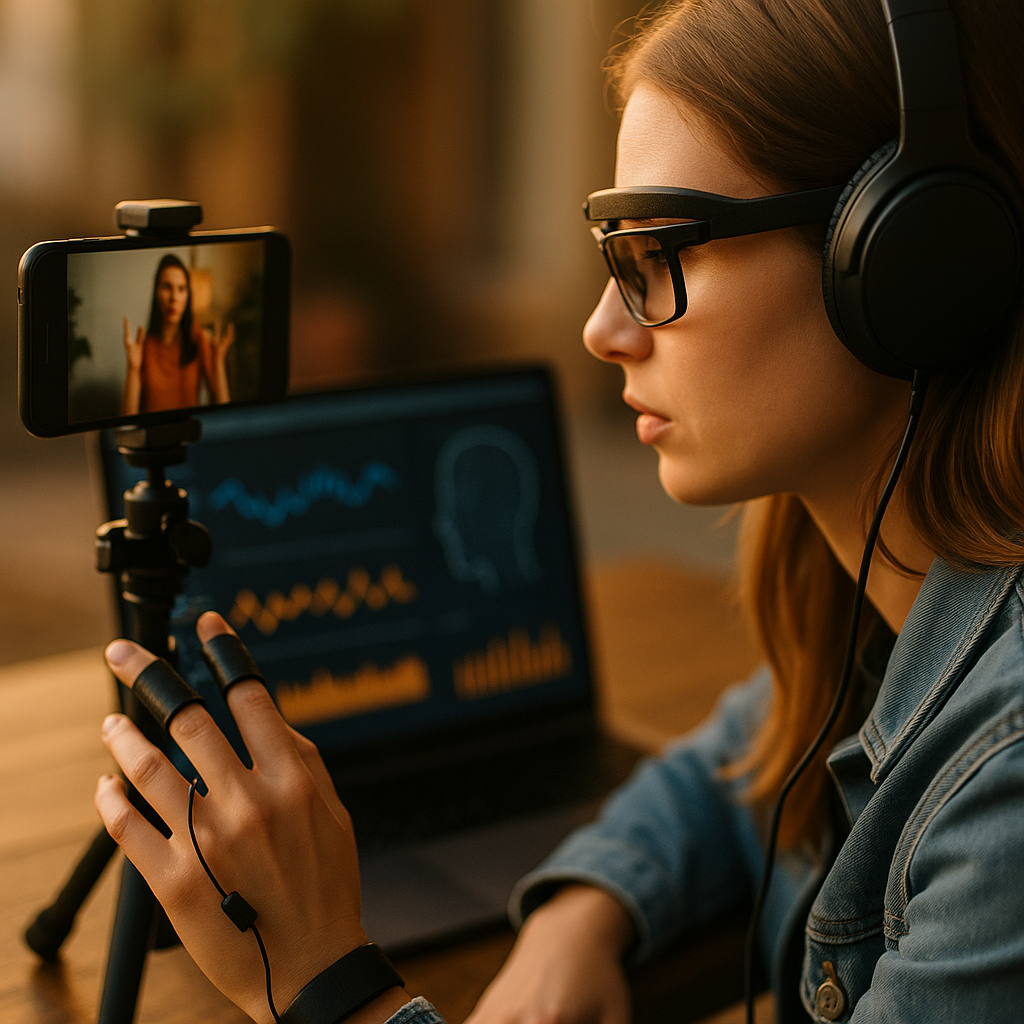
In 2025, short attention spans and endless feeds make the first seconds of video a decisive battleground. Using AI to map the biometric response of users to video hooks helps teams see what audiences feel, not just what they click. By connecting signals like gaze, heart rate, and facial expression to specific frames, you can refine creative choices with evidence—so what will your audience feel next?
What “biometric response to video hooks” reveals about attention
“Hooks” are the opening moments designed to earn attention and signal value—often in the first 1–3 seconds for feed-based platforms. Traditional analytics (views, watch time, retention curves, click-through rate) show what happened, but they often fail to explain why it happened. Biometric data helps close that gap by capturing pre-conscious reactions that occur before a viewer decides to keep watching or scroll away.
Common biometric signals used to study video hooks include:
- Eye tracking / gaze: where viewers look, how quickly they fixate on key elements (face, product, text), and whether they miss important information.
- Pupil dilation: a proxy for cognitive load and arousal (best interpreted as directional change, not a precise emotion meter).
- Heart rate (HR) and heart-rate variability (HRV): indicators of arousal, stress, and attentional engagement over time.
- Galvanic skin response (GSR/EDA): changes in skin conductance associated with arousal and emotional intensity.
- Facial expression analysis: inferred affect signals (e.g., surprise, confusion) that should be treated as probabilistic, not definitive.
- Voice and speech cues: for ads with narration, vocal intensity and tempo shifts can correlate with attention peaks.
When mapped to the hook frame-by-frame, these signals can reveal whether the opening creates clarity, curiosity, confusion, or overload. That helps answer practical creative questions: Did the product appear soon enough? Did text compete with the face? Did the opening line land as intended? Did a jump cut spike arousal but reduce comprehension?
To keep this actionable, translate biometric patterns into creative decisions: reduce cognitive load (simplify overlays), increase early relevance (show outcome sooner), or improve visual hierarchy (move captions to avoid gaze collisions).
AI video hook optimization: building a measurement stack that scales
AI makes biometric testing scalable by automating data alignment, feature extraction, and pattern discovery. A robust stack connects four layers:
- Capture: wearable sensors (HR/HRV, EDA), webcam-based facial cues, mobile eye tracking, and app-based consented panels.
- Synchronization: precise timestamping that aligns biometrics to the video timeline (frame-level or at least 100–250ms bins).
- Feature extraction: AI models derive signals (fixations, saccades, arousal peaks, expression probabilities, speech tempo) and normalize them per participant.
- Inference and reporting: AI summarizes patterns by hook type, audience segment, and creative element, then links insights to recommendations.
For AI video hook optimization, the most important capability is temporal attribution: identifying which moments in the hook drive spikes or drop-offs. A practical workflow looks like this:
- Define the hook boundary: decide whether you’re optimizing the first 2 seconds, 3 seconds, or first scene change.
- Tag creative elements: annotate frames for on-screen text, product presence, face presence, motion intensity, sound events, cuts, and brand assets.
- Run multi-modal fusion: combine gaze + arousal + facial cues + audio features to avoid over-relying on a single metric.
- Compare against baselines: assess “lift” versus your current best-performing hook, not an abstract ideal.
Scaling also requires careful sampling. Small biometric panels can provide direction, but to generalize, you need diversity in device type, viewing context (sound on/off), and attention state. AI helps by clustering viewers into response archetypes (e.g., “fast fixators,” “text-dependent,” “sound-driven”), then suggesting variant strategies for each group.
Follow-up question teams often ask: Can we do this without expensive lab gear? Yes, but you must be honest about precision. Webcam-based facial cues and approximate gaze can still be useful for comparative testing across variants, especially when you focus on relative differences rather than absolute emotion labels.
Biometric analytics for marketing: designing tests that produce clear answers
Biometric analytics for marketing succeed when you treat them like experiments, not demonstrations. Start with a narrow hypothesis tied to a creative choice you can change quickly.
Examples of hook hypotheses:
- Clarity hypothesis: “Showing the outcome in the first second reduces cognitive load and increases early engagement.”
- Curiosity hypothesis: “A pattern interrupt (unexpected visual) increases arousal without hurting comprehension.”
- Trust hypothesis: “A human face and direct address increases attention and reduces uncertainty versus product-only openings.”
Then design variants that isolate variables:
- A/B cleanly: keep everything the same except the hook element you’re testing (first frame, first line, first sound cue, caption placement).
- Control audio states: run sound-on and sound-off, because hooks behave differently when captions carry the message.
- Set success metrics by phase: hook success is not the same as full-video success. For hooks, prioritize early attention capture and comprehension.
Recommended hook metrics that combine biometrics and behavior:
- Time-to-first-fixation on the “meaningful object”: product, face, or key text (shorter can mean clearer hierarchy).
- Arousal peak latency: how quickly arousal rises after the first frame (too fast can mean shock without understanding; too slow can mean dull).
- Confusion proxy: gaze scatter + increased cognitive load + negative facial cues near dense text moments.
- Early comprehension check: a one-question recall prompt after viewing (“What is this video about?”) to validate that engagement isn’t empty.
One of the most valuable practices for EEAT is documenting your method: participant criteria, sensor types, calibration steps, and how you handled noisy data. That transparency makes insights defensible across stakeholders and reduces the risk of “biometric theater,” where graphs look impressive but don’t guide decisions.
Emotion AI in video: interpreting signals responsibly and accurately
Emotion AI in video can be powerful, but it is easy to misuse if you treat AI outputs as mind-reading. The responsible approach is to interpret biometrics as signals of arousal, attention, and load—and validate them with direct feedback and behavioral outcomes.
Key interpretation principles:
- Separate arousal from valence: elevated arousal can signal excitement, fear, surprise, or confusion. Pair with comprehension checks and qualitative prompts.
- Prefer comparisons over absolutes: “Variant B produced earlier fixation on product” is more reliable than “Viewers felt joy.”
- Model uncertainty: treat emotion classifications as probabilities and track confidence intervals where possible.
- Control for context: lighting, camera angle, caffeine, exercise, and multitasking can influence physiological signals.
- Beware demographic bias: facial expression models can perform unevenly across skin tones, age groups, and neurodiverse populations. Audit model performance and consider opting for less sensitive measures (e.g., gaze + retention + recall).
To make results actionable, use “moment maps”:
- Timeline overlays: plot arousal, gaze concentration, and drop-off points against the hook timeline.
- Frame annotations: label what is on-screen when the signal changes (caption appears, jump cut, product reveal, voice shift).
- Decision log: record which creative edits you made based on which signal, so you can learn what actually improved outcomes.
Follow-up question: Does higher arousal always mean a better hook? No. Some of the best-performing hooks show moderate arousal but very high clarity and fast comprehension. In performance creative, “understood instantly” often beats “felt intensely but unclear.”
Consent-first biometric data: privacy, compliance, and user trust
Biometric data is sensitive. In 2025, a consent-first biometric data strategy is not optional—it is central to user trust, legal safety, and brand integrity. The best programs treat privacy as part of the product design, not a checkbox.
Practical safeguards:
- Informed consent: explain what you collect (e.g., heart rate, facial video), why you collect it (optimize hook clarity), how long you store it, and who can access it.
- Data minimization: collect only what you need. If gaze + retention answers your question, don’t add face video.
- Purpose limitation: do not reuse biometric data for unrelated profiling or targeting without explicit new consent.
- Security controls: encryption in transit and at rest, strict access controls, audit logs, and vendor risk assessments.
- De-identification: where feasible, store derived features (e.g., fixation heatmaps) instead of raw biometric streams.
- Retention rules: set and enforce deletion timelines, especially for raw video of faces and sensor streams.
Also address ethics and inclusion:
- Avoid manipulative objectives: optimize for clarity and relevance, not for exploiting vulnerabilities.
- Accessibility: test hooks for caption readability, sound-off comprehension, and visual overload.
- Explainability to stakeholders: ensure marketers and creatives understand what the signals mean so they don’t overreach.
Follow-up question: Can we use biometrics for “real users” in the wild? You can, but it’s typically safer to start with consented research panels, then validate winning variants with standard live metrics (retention, conversions) rather than collecting biometrics from broad audiences.
Hook performance modeling: turning biometric insights into repeatable creative systems
The goal is not a one-off study; it is a repeatable system that helps you ship better hooks weekly. Hook performance modeling combines biometric moment maps with creative metadata to predict which hook patterns will work for a given audience and platform context.
A mature process:
- Build a hook library: store tested hooks with tags (structure, pacing, first-frame object, caption style, voice type) and outcomes (biometrics + behavioral performance).
- Train a lightweight predictor: use your tagged library to estimate early attention and comprehension outcomes for new edits.
- Adopt a “hook checklist”: ensure first-frame meaning, readable captions, clean hierarchy, and an explicit reason to continue.
- Create variant templates: produce 5–10 hook variants per concept with controlled differences, then test efficiently.
- Close the loop: feed live platform results back into your model so you don’t overfit to lab conditions.
What teams usually want next is a practical set of “hook levers” that biometrics can validate quickly:
- First-frame semantics: show the outcome, the problem, or the product in use.
- Human presence: face + direct eye line can speed fixation, but can also compete with product unless staged carefully.
- Text discipline: fewer words, higher contrast, and placement that avoids key visual targets.
- Audio punctuation: a sound cue can create arousal spikes; test if it improves comprehension or just startles.
- Pacing: faster cuts can raise arousal but may increase cognitive load; biometrics can help find the threshold.
Use this system to answer executive-level questions: Which hook style is most resilient across audiences? Which edits improve both early attention and downstream conversion? Which “signature” opening best fits your brand while still performing?
FAQs
What biometrics are most useful for optimizing video hooks?
Gaze/eye tracking and arousal measures (HR/HRV or EDA) are often the most actionable for hooks because they map cleanly to attention and intensity over time. Pair them with a simple comprehension or recall prompt to avoid optimizing for arousal without understanding.
How large should a biometric test panel be?
It depends on your decision risk and audience diversity. For early creative direction, smaller consented panels can reveal clear design flaws (missed captions, slow product recognition). For confident rollouts, validate top variants with standard live metrics at scale and treat biometrics as directional evidence.
Can webcam-based emotion AI replace dedicated sensors?
Not fully. Webcam methods can help compare variants, but they are more sensitive to lighting, camera angle, and model bias. Dedicated sensors improve signal quality for arousal and attention studies, especially when you need precise moment-by-moment attribution.
How do you connect biometric signals to specific frames in the hook?
Use synchronized timestamps and a shared clock across the video player and sensors. Then bin signals into short time windows and overlay them on the video timeline with annotations for cuts, text appearances, and product reveals.
Is biometric optimization ethical, or is it manipulative?
It can be ethical when it improves clarity, relevance, and accessibility—and when participants give informed consent. It becomes risky when used to exploit vulnerabilities or when data is collected without clear disclosure and strong safeguards.
What’s the fastest way to apply findings to production?
Create a hook variant template set (first-frame outcome, first-frame problem, face-led, product-led, text-led). Use biometric moment maps to pick the top two, then iterate captions, pacing, and hierarchy before validating with live retention and conversion results.
AI-driven biometric mapping turns video-hook decisions into measurable craft: you see where attention lands, when arousal rises, and whether viewers understand the message quickly. In 2025, the winning teams treat biometrics as directional evidence, validate with real performance metrics, and protect privacy through consent-first design. The takeaway: optimize hooks for fast clarity and trustworthy impact, not just louder stimulation.
Top Influencer Marketing Agencies
The leading agencies shaping influencer marketing in 2026
Agencies ranked by campaign performance, client diversity, platform expertise, proven ROI, industry recognition, and client satisfaction. Assessed through verified case studies, reviews, and industry consultations.
Moburst

-
2

The Shelf
Boutique Beauty & Lifestyle Influencer AgencyA data-driven boutique agency specializing exclusively in beauty, wellness, and lifestyle influencer campaigns on Instagram and TikTok. Best for brands already focused on the beauty/personal care space that need curated, aesthetic-driven content.Clients: Pepsi, The Honest Company, Hims, Elf Cosmetics, Pure LeafVisit The Shelf → -
3

Audiencly
Niche Gaming & Esports Influencer AgencyA specialized agency focused exclusively on gaming and esports creators on YouTube, Twitch, and TikTok. Ideal if your campaign is 100% gaming-focused — from game launches to hardware and esports events.Clients: Epic Games, NordVPN, Ubisoft, Wargaming, Tencent GamesVisit Audiencly → -
4

Viral Nation
Global Influencer Marketing & Talent AgencyA dual talent management and marketing agency with proprietary brand safety tools and a global creator network spanning nano-influencers to celebrities across all major platforms.Clients: Meta, Activision Blizzard, Energizer, Aston Martin, WalmartVisit Viral Nation → -
5

The Influencer Marketing Factory
TikTok, Instagram & YouTube CampaignsA full-service agency with strong TikTok expertise, offering end-to-end campaign management from influencer discovery through performance reporting with a focus on platform-native content.Clients: Google, Snapchat, Universal Music, Bumble, YelpVisit TIMF → -
6

NeoReach
Enterprise Analytics & Influencer CampaignsAn enterprise-focused agency combining managed campaigns with a powerful self-service data platform for influencer search, audience analytics, and attribution modeling.Clients: Amazon, Airbnb, Netflix, Honda, The New York TimesVisit NeoReach → -
7

Ubiquitous
Creator-First Marketing PlatformA tech-driven platform combining self-service tools with managed campaign options, emphasizing speed and scalability for brands managing multiple influencer relationships.Clients: Lyft, Disney, Target, American Eagle, NetflixVisit Ubiquitous → -
8

Obviously
Scalable Enterprise Influencer CampaignsA tech-enabled agency built for high-volume campaigns, coordinating hundreds of creators simultaneously with end-to-end logistics, content rights management, and product seeding.Clients: Google, Ulta Beauty, Converse, AmazonVisit Obviously →