


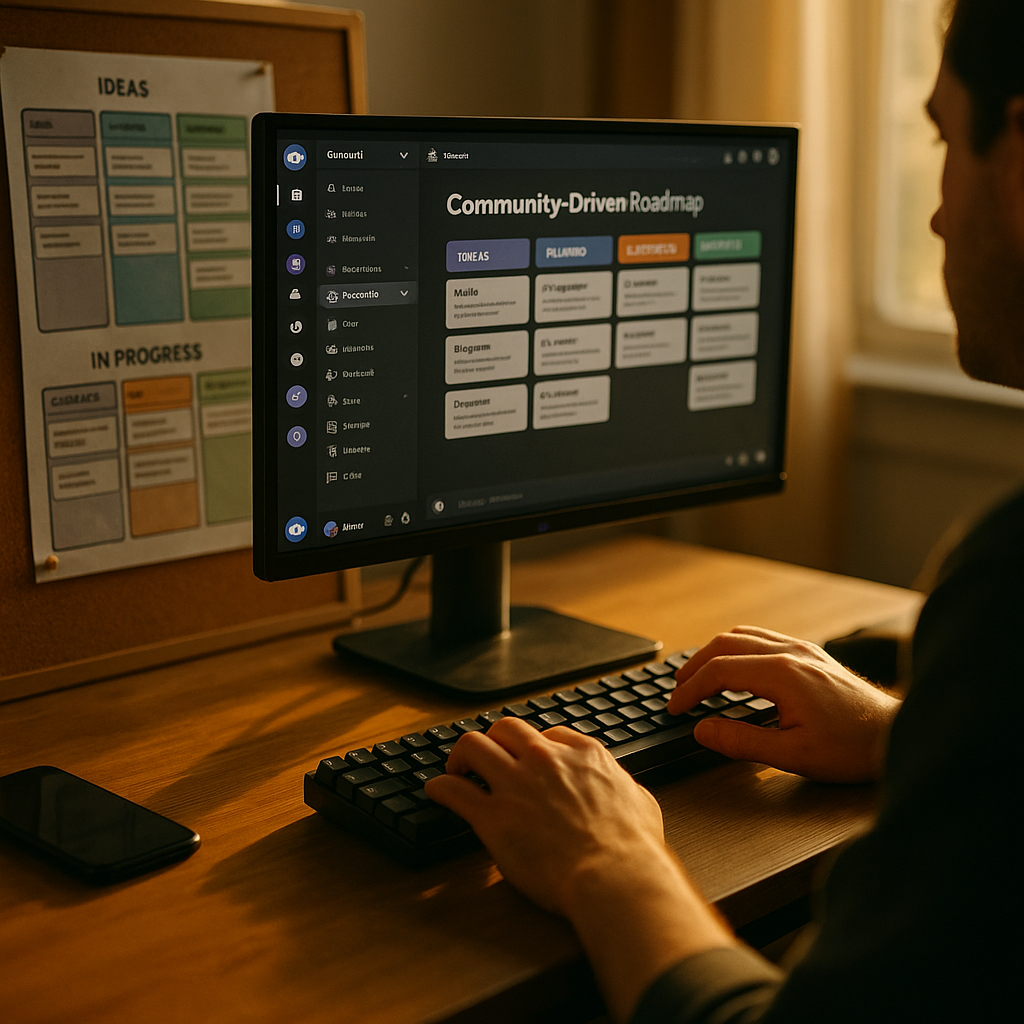
Building products in 2025 means your users expect a voice, not a survey link. A Playbook for Community Driven Product Roadmaps on Discord turns that expectation into a repeatable system: collect feedback where your community already talks, convert it into evidence, and ship in public with clear trade-offs. Do it well and you earn trust—do it poorly and you create noise. Which path will you choose?
Discord product feedback channels: structure that scales
A community-driven roadmap works only if input is organized. Discord is fast, conversational, and messy by default—so start by designing a channel architecture that separates ideas from decisions and support from strategy. This reduces repetition, keeps discussions searchable, and makes it easier to prove that roadmap choices reflect real demand.
Recommended channel blueprint (adapt to your size):
- #announcements: product updates, roadmap snapshots, and release notes. Lock posting to the team to avoid dilution.
- #start-here: community rules, how to give feedback, what happens to suggestions, and where to find decisions.
- #product-ideas: the primary intake channel. Use a single template (problem, user type, context, desired outcome).
- #bugs: separate from ideas; bugs have urgency and reproducibility requirements.
- #roadmap: read-only or tightly moderated. Post what’s now/next/later and link back to evidence threads.
- #research-recruiting: a place to invite users into interviews, beta tests, and usability studies.
Moderation mechanics that prevent chaos:
- Pin a submission format in #product-ideas and enforce it. If a post lacks context, ask a clarifying question and tag it for follow-up.
- Use tags and prefixes in titles (for example: [Mobile], [Integrations], [Billing], [New User], [Power User]). Consistency beats complexity.
- Create a “duplicates” habit: when two threads match, merge by linking, closing one thread with a short note, and consolidating votes and evidence.
Readers usually ask: “Won’t structure kill engagement?” It doesn’t if you keep discussion channels open and reserve structure for intake. Your goal is not to slow conversation; it’s to make conversation usable for decisions.
Community voting and prioritization: turn opinions into evidence
Discord makes it easy for the loudest voices to dominate. A roadmap requires more than enthusiasm; it needs evidence and repeatability. Treat community signals as inputs to a prioritization model, not as the model itself.
Set expectations up front in #start-here:
- Votes and reactions influence priority but do not guarantee delivery.
- Decisions balance user impact, feasibility, risk, and strategic fit.
- Some work (security, compliance, reliability) may ship without a vote.
Collect higher-quality signals inside Discord:
- Require problem statements: “What are you trying to accomplish?” is more useful than “Add X.”
- Ask for frequency and severity: “How often does this happen?” and “What do you do instead?”
- Segment reactions with lightweight prompts: “React with ✅ if you experience this weekly; 🟨 monthly; 🟥 rarely.”
- Encourage counterexamples: ask who wouldn’t use a feature and why. This reduces overbuilding.
Prioritize with a transparent rubric that you can explain in one paragraph. For example, score ideas on:
- User impact (who benefits and how much)
- Reach (how many users encounter the problem)
- Confidence (quality of evidence: recordings, repro steps, benchmarks)
- Effort (engineering and design complexity)
- Risk (security, performance, support burden)
Then answer the follow-up question your community will ask: “If we voted, why didn’t it win?” Respond with specifics: the limiting constraint (effort, risk, strategic fit), what evidence would change the decision, and whether there’s a smaller alternative you can ship sooner.
Discord roadmap transparency: decisions, trade-offs, and trust
Transparency is not publishing every internal debate. It’s consistently showing what you decided, why you decided it, and what happens next. On Discord, you earn trust by closing the loop quickly and publicly—especially when you say “not now.”
Adopt a simple roadmap cadence:
- Weekly: a short “What shipped / What we learned” post in #announcements, linking to relevant threads.
- Monthly: update a Now/Next/Later view in #roadmap with 5–10 bullets max.
- Per release: publish release notes with user-facing outcomes, not only technical changes.
Use decision posts that read like mini case studies:
- The problem (in community language)
- Who it affects (new users, admins, teams, creators, etc.)
- Evidence (links to threads, screenshots, bug IDs, short quotes)
- Decision (build, defer, decline, or test)
- Trade-offs (what you’re not doing and why)
- Next step (beta signups, research call, timeline window)
Handle “decline” decisions professionally. A clear decline with reasoning preserves credibility more than vague promises. Offer alternatives: a workaround, an integration, a smaller change, or a request for more data.
This is where EEAT shows up in practice: you demonstrate experience by referencing real user contexts, expertise by explaining constraints and risks, authoritativeness by being consistent and accountable, and trust by following through on your stated process.
Community moderation and governance: keep signal high without shutting people down
Community-driven roadmaps fail when channels become complaint sinks. Moderation is not censorship; it’s maintaining a productive environment where feedback can be acted on. Governance also protects your team from burnout and your community from confusion.
Set governance rules that match product goals:
- Define what “product feedback” means: problems, workflows, edge cases, and outcomes. Ban vague rants and require specifics.
- Separate support from roadmap: if a post is actually a support request, redirect it to the right channel and capture the underlying product insight if it exists.
- Use role-based access: create roles like “Beta Tester,” “Power User,” and “Customer Admin” to segment feedback when needed.
Operational moderation practices:
- Appoint feedback curators (PMs, community managers, or trusted community members) to summarize weekly themes.
- Enforce civility consistently: delete personal attacks, not criticism. Explain removals briefly to avoid rumors.
- Prevent pile-ons: when a thread gets heated, restate the problem, ask for reproducible details, and move off-topic debate into a separate channel.
- Use “slow mode” strategically during launches or outages to preserve readability.
Answer the unspoken question: “Do you actually read this?” Prove it by quoting summaries in roadmap updates, tagging users when their reports lead to changes, and publishing a monthly “Top insights from Discord” digest with outcomes.
Product discovery and research on Discord: from threads to validated bets
Discord is not only a feedback inbox; it can be a lightweight research lab. The difference between a reactive roadmap and a community-driven one is discovery: you explore problems systematically, test assumptions, and recruit the right users before committing engineering time.
Turn discussions into discovery assets:
- Thread summarization: after 48–72 hours, post a summary comment: key pain points, proposed solutions, open questions, and who is affected.
- Follow-up prompts: ask for screenshots, short screen recordings, or step-by-step workflows (with privacy guidance).
- Mini-surveys: keep them short and post results back into the same thread to maintain context and trust.
Recruit for research ethically in #research-recruiting:
- Explain what participation involves (time, format, compensation if offered, and what data you collect).
- State confidentiality clearly: whether sessions are recorded and how you store notes.
- Choose diverse participants: balance power users with new users, different platforms, and different use cases.
Validate before you roadmap:
- Prototype tests: share short videos or clickable mocks, gather reactions, and ask “What would you expect to happen next?”
- Beta programs: gate early access with a role, collect structured feedback, and publish known issues.
- Success criteria: define what “works” means (reduced time-to-task, fewer support tickets, higher activation) and report back after shipping.
When readers ask, “How do we avoid building for a niche?” the answer is segmentation and validation: label feedback by persona and frequency, then test solutions with a broader slice before committing to a full build.
Roadmap execution and release communication: ship with the community, not at them
Execution is where many community roadmaps break: ideas pile up, priorities shift, and users feel ignored. Avoid that by connecting Discord feedback to delivery rituals and communicating progress in ways that reduce uncertainty.
Create a feedback-to-shipping pipeline:
- Intake (Discord thread) → Triage (tag, dedupe, ask clarifying questions) → Review (score with rubric) → Decision (Now/Next/Later) → Build → Beta → Release → Retrospective.
Define ownership so nothing disappears:
- Community manager: ensures posts follow format, collects themes, keeps threads healthy.
- Product manager: owns triage decisions, research plan, and roadmap communications.
- Engineering lead: estimates effort, flags risk, and communicates technical constraints in plain language.
- Design lead: ensures solutions match user workflows and accessibility requirements.
Release communication that drives adoption:
- Describe outcomes: “You can now export in one click” beats “Added export endpoint.”
- Include a short “who this is for” section so users self-select relevance.
- Link to the origin thread and thank contributors. This is a trust flywheel.
- Document breaking changes and migration steps in a single, easy-to-find message.
Measure success and report back without overclaiming:
- Adoption (feature usage), retention impact, support volume changes, and qualitative satisfaction in follow-up threads.
- What you learned and what you will adjust next iteration.
Finally, answer the practical follow-up: “How do we handle scope creep?” Publish a rule: if a feature expands beyond the original problem, you split it into phases and re-validate phase two with the community.
FAQs: community driven roadmaps on Discord
How do we keep Discord feedback from becoming a popularity contest?
Use votes as a signal, not a decision. Require problem statements, collect frequency/severity, segment by persona, and apply a transparent scoring rubric that includes effort and risk. Publish decision notes so users see how signals translate into priorities.
What’s the minimum setup to start?
Create five channels: #start-here, #announcements, #product-ideas, #bugs, and #roadmap. Pin a submission template, assign one owner to triage weekly, and commit to a monthly Now/Next/Later update that links back to key threads.
Should we use threads or separate channels for each idea?
Use a single #product-ideas channel with threads for each idea. This keeps discovery centralized, reduces channel sprawl, and makes it easier to search, dedupe, and summarize. Create separate channels only for major initiatives or large beta programs.
How do we handle confidential roadmap items?
Don’t discuss sensitive items publicly. Share outcomes and user-facing problems instead of internal details, and use private channels with vetted roles (for example, Customer Admin or Beta Tester) when appropriate. Be clear that some work can’t be shared until release.
What if the community asks for something that conflicts with our strategy?
Decline or defer with a specific explanation tied to goals and constraints. Offer an alternative path—such as an integration, a smaller iteration, or a research session to explore the underlying need. Consistency matters more than saying yes.
How do we prove the roadmap is actually community-driven?
Close the loop publicly: link shipped features to source threads, publish monthly “what we heard” summaries, credit contributors, and report on outcomes after release. A visible chain from feedback to decision to delivery builds trust over time.
Community-led roadmapping on Discord works when you treat conversation as raw material for decisions, not as the decision itself. Structure channels, demand clear problem statements, apply a transparent prioritization rubric, and communicate trade-offs with discipline. Keep moderation fair, run lightweight research, and close the loop from thread to release. The takeaway: build a system the community can understand, and they will help you ship better.
Top Influencer Marketing Agencies
The leading agencies shaping influencer marketing in 2026
Agencies ranked by campaign performance, client diversity, platform expertise, proven ROI, industry recognition, and client satisfaction. Assessed through verified case studies, reviews, and industry consultations.
Moburst

-
2

The Shelf
Boutique Beauty & Lifestyle Influencer AgencyA data-driven boutique agency specializing exclusively in beauty, wellness, and lifestyle influencer campaigns on Instagram and TikTok. Best for brands already focused on the beauty/personal care space that need curated, aesthetic-driven content.Clients: Pepsi, The Honest Company, Hims, Elf Cosmetics, Pure LeafVisit The Shelf → -
3

Audiencly
Niche Gaming & Esports Influencer AgencyA specialized agency focused exclusively on gaming and esports creators on YouTube, Twitch, and TikTok. Ideal if your campaign is 100% gaming-focused — from game launches to hardware and esports events.Clients: Epic Games, NordVPN, Ubisoft, Wargaming, Tencent GamesVisit Audiencly → -
4

Viral Nation
Global Influencer Marketing & Talent AgencyA dual talent management and marketing agency with proprietary brand safety tools and a global creator network spanning nano-influencers to celebrities across all major platforms.Clients: Meta, Activision Blizzard, Energizer, Aston Martin, WalmartVisit Viral Nation → -
5

The Influencer Marketing Factory
TikTok, Instagram & YouTube CampaignsA full-service agency with strong TikTok expertise, offering end-to-end campaign management from influencer discovery through performance reporting with a focus on platform-native content.Clients: Google, Snapchat, Universal Music, Bumble, YelpVisit TIMF → -
6

NeoReach
Enterprise Analytics & Influencer CampaignsAn enterprise-focused agency combining managed campaigns with a powerful self-service data platform for influencer search, audience analytics, and attribution modeling.Clients: Amazon, Airbnb, Netflix, Honda, The New York TimesVisit NeoReach → -
7

Ubiquitous
Creator-First Marketing PlatformA tech-driven platform combining self-service tools with managed campaign options, emphasizing speed and scalability for brands managing multiple influencer relationships.Clients: Lyft, Disney, Target, American Eagle, NetflixVisit Ubiquitous → -
8

Obviously
Scalable Enterprise Influencer CampaignsA tech-enabled agency built for high-volume campaigns, coordinating hundreds of creators simultaneously with end-to-end logistics, content rights management, and product seeding.Clients: Google, Ulta Beauty, Converse, AmazonVisit Obviously →