


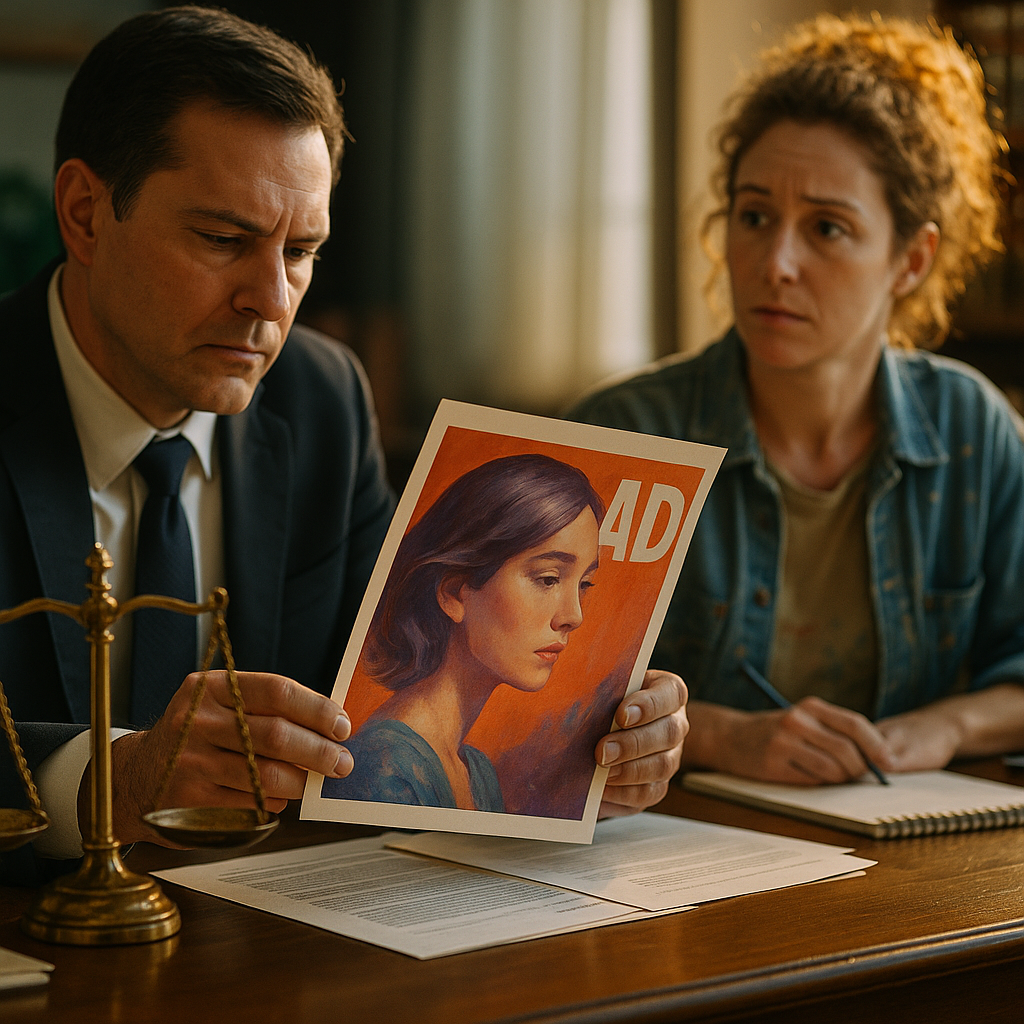
Legal risks of using AI to mimic a specific artist’s style in ads have moved from theoretical to urgent in 2025, as brands adopt generative tools for faster creative production. What looks like “just a vibe” can trigger lawsuits, takedowns, contract disputes, and reputational fallout—especially when the output feels unmistakably like one living creator. Before you brief an agency or prompt a model, know where the legal traps hide—because one campaign can set them off.
Copyright infringement risks
Copyright law generally protects original expression, not broad ideas, techniques, or genres. That distinction matters because “style” alone can be difficult to claim as copyrighted. The problem in advertising is practical: AI-generated work that “mimics an artist” often does more than borrow a mood. It can reproduce copyright-protected elements that courts recognize as expression, such as distinctive characters, recurring motifs, composition choices, signature visual arrangements, or near-identical sequences.
Where brands get exposed is when the AI output is substantially similar to a protected work, or when it contains recognizable fragments from training data. Even if your prompt never names the artist, the result can still cross the line if it copies protectable elements. In litigation, similarity is assessed by looking at what an ordinary observer would think and whether protectable aspects were taken—not by whether you “intended” to copy.
Common ad scenarios that elevate risk:
- Prompting for a specific living artist (“in the style of [Artist]”) and publishing the output as campaign creative.
- Using AI to “finish” or “extend” an artist’s known work (e.g., expanding a famous illustration into new scenes).
- Generating a lookalike character or signature element strongly associated with one creator.
- Replicating a series aesthetic that repeats consistent protectable elements across multiple works.
Practical takeaway: Treat “style mimicry” as a copyright clearance issue, not a design choice. Ask whether a reviewer could point to specific works that the ad appears to draw from—and whether the resemblance is a selling point. If the campaign depends on recognizability, you likely need permission or a different direction.
Right of publicity and name/likeness claims
Even when copyright is uncertain, right of publicity and related misappropriation laws can create direct liability. These rights protect a person’s identity used commercially—often including name, image, voice, and sometimes broader identifiers. For artists, the “identifier” might be a distinctive signature, a recurring persona, or an easily recognized brand identity that the ad exploits to sell a product.
Risk spikes when the campaign suggests endorsement, affiliation, or sponsorship by a real person. If the ad copy, visuals, targeting, or influencer tie-ins make consumers think the artist participated—or would approve—you can face claims even if you never used a literal photograph of them.
High-risk examples in ads:
- “In the style of [Artist]” used in public-facing marketing, captions, or behind-the-scenes content.
- Soundalike/voicealike ads that evoke a known creator’s voice or narration style for commercial gain.
- Using an artist’s name for targeting (keywords, landing pages, or “fans of [Artist]”) alongside lookalike creative.
Follow-up question brands ask: “What if we never mention the artist?” Silence helps, but it’s not a shield if the work is unmistakable and the campaign is structured to benefit from that recognizability. Courts and regulators often look at the net impression: what the public is led to believe.
Practical takeaway: If your concept depends on “borrowed identity” to persuade consumers, treat it like endorsement advertising: secure a license, a collaboration agreement, or pivot to an original approach.
Trademark, unfair competition, and false endorsement
Some artists operate as brands. Their names can function as trademarks, and their studios may own marks tied to merchandise, prints, or digital assets. When an ad creates confusion about source or sponsorship, you may trigger trademark and unfair competition claims, including false endorsement and false association.
How confusion happens in AI mimicry:
- Lookalike packaging or layout that resembles an artist’s branded releases.
- Using similar marks or taglines that consumers associate with the artist.
- Implying “official” collaboration through ambiguous language (“inspired by a legendary illustrator”) paired with visuals that strongly point to a specific person.
Trademark risk also shows up in metadata: ad keywords, product titles, filenames, alt text, and campaign documentation that references the artist. Those choices can support a claim that you were trying to capture traffic meant for the artist’s brand.
Practical takeaway: Audit not only the creative, but the full ad stack—landing pages, SEO fields, paid search keywords, and social captions. If you are trading on an artist’s brand equity, expect scrutiny.
Training data, licensing, and vendor contract liability
A major legal and operational risk in 2025 is not just the output—it’s the inputs and toolchain. If your team used a model trained on copyrighted works without proper authorization, you may face claims or disruptions even if your specific output seems “original enough.” Brands often assume the vendor carries all risk; in practice, liability can travel through contracts and indemnity clauses.
Key questions to resolve before production:
- What data was the model trained on? Ask for a clear description, not marketing language.
- What rights does the vendor grant? Look for commercial use rights, territorial scope, and whether outputs are exclusive or shared.
- Who bears infringement risk? Review indemnities, caps, exclusions (especially “prompt-based” exclusions), and defense obligations.
- Can you document provenance? Maintain records of prompts, model version, settings, reference images, and review steps.
Advertising-specific risk: campaigns are time-sensitive. If a rights holder sends a demand letter or platform takedown notice, you may have to pull ads immediately, wasting media spend and damaging launch plans. That operational cost is often larger than the legal fees.
Practical takeaway: Treat AI vendors like critical creative suppliers. Use procurement-grade review: written rights grants, meaningful indemnities, clear audit rights, and a process for handling claims quickly.
Compliance, disclosure, and consumer protection in advertising
Beyond IP claims, you also face consumer protection and advertising compliance risk. If an ad implies human authorship, a partnership, or an authentic artistic commission when none exists, regulators and platforms may view it as misleading. That concern grows when the campaign leverages a specific artist’s perceived values or reputation to build trust.
Where compliance problems appear:
- Implied collaboration (visual cues and copy that suggest the artist worked on it).
- Deceptive “behind the scenes” content that frames AI output as hand-created by a known creator.
- Influencer amplification that fails to clarify the creative process or relationship.
Platform policies also matter. Some ad networks and social platforms restrict deceptive synthetic media or require certain disclosures for manipulated content. Your legal team may approve a concept, but a platform may still reject the ad or limit reach.
How to reduce risk without killing creativity:
- Use a “no living artist” rule for prompt instructions and reference packs.
- Build a distinct style guide from licensed or in-house elements and document how it differs from any one creator.
- Disclose when appropriate, especially if the campaign could plausibly be interpreted as a collaboration or commissioned work.
- Run consumer confusion checks: ask unbiased reviewers what they think the source is and whether they infer endorsement.
Practical takeaway: In ads, the standard is not “Is it technically legal?” but “What will consumers believe?” Align creative, copy, and disclosures so you do not invite a false-endorsement narrative.
Risk mitigation checklist for brands and agencies
Brands want speed and novelty; artists want control and credit; regulators want clarity. You can respect all three with a structured workflow. The most effective mitigation approach is to treat AI mimicry as a clearance and governance problem from day one.
Pre-production guardrails:
- Ban naming living artists in prompts and in internal creative briefs unless you have written permission.
- Prohibit reference scraping (no “download a gallery and feed it in”) without verified rights.
- Choose models with commercial terms that match your use case and provide defensible documentation.
- Create an originality target: define what must be unique (palette, composition rules, motifs, typography, character design).
Production and review steps:
- Maintain an audit trail: prompts, seeds, iterations, tools, and team approvals.
- Do similarity screening for high-visibility campaigns: reverse image search, internal comparison against known works, and human review by someone trained in IP spotting.
- Separate “inspiration” from “imitation”: if a reviewer can name the artist immediately, treat it as a red flag.
Contract protections:
- Agency warranties that they did not intentionally mimic a specific living artist without authorization.
- Vendor indemnities with minimal prompt-based carve-outs for normal use.
- Clear rights in outputs, including the right to modify, distribute globally, and use in paid media.
When to license instead of imitate: If the artist’s recognizability is part of the strategy, licensing is usually cheaper than litigation and more effective than vague “inspired by” positioning. A collaboration can also boost authenticity and earn media coverage without the legal baggage.
Practical takeaway: Make originality a measurable requirement, not a hope. A short clearance checklist can prevent expensive rework and public disputes.
FAQs
Is it illegal to use AI “in the style of” a specific artist in an ad?
It can be. “Style” alone may not be protected in the abstract, but ads often cross into copyright infringement, false endorsement, trademark confusion, or right of publicity when the output is strongly identifiable or implies collaboration. The more the campaign depends on viewers recognizing a particular living artist, the higher the legal risk.
What if we never name the artist—are we safe?
Not necessarily. Claims can focus on the net impression of the ad and the recognizability of the copied expression or implied endorsement. Avoiding the artist’s name reduces risk, but it does not cure close similarity or consumer confusion.
Can we use an artist’s work as a “reference image” for an AI generator?
Only if you have rights to do so or a clearly applicable legal basis, and even then the output may still be too similar. In advertising, the safer route is to use licensed references, public-domain materials where applicable, or an internal style bible built from owned assets.
Who is liable: the brand, the agency, or the AI tool provider?
Potentially all of them. Plaintiffs often sue multiple parties involved in creation and distribution. Contracts can shift costs through indemnities, but they cannot prevent a lawsuit or a takedown. Brands should ensure agencies and vendors provide clear rights and meaningful defense obligations.
Does a disclaimer like “AI-generated” or “inspired by” prevent legal claims?
Disclaimers can help reduce consumer confusion, but they do not eliminate copyright, trademark, or publicity claims if the output is substantially similar or still implies endorsement. Use disclaimers as part of a broader compliance strategy, not as a substitute for clearance.
What is the safest alternative if we want a similar vibe?
Commission original work or develop a distinct brand style using owned and licensed elements. If a specific artist’s aesthetic is essential, negotiate a license or collaboration. You gain creative legitimacy, clearer rights, and a stronger story for the campaign.
Conclusion
Using AI to mimic a specific artist in ads can trigger copyright, publicity, trademark, and consumer protection problems, plus contract and takedown risk. In 2025, the safest path is simple: don’t build campaigns on recognizability you didn’t pay for. Use licensed tools and assets, document provenance, and run clearance reviews. If you want the artist’s magic, partner with them—don’t imitate them.
Top Influencer Marketing Agencies
The leading agencies shaping influencer marketing in 2026
Agencies ranked by campaign performance, client diversity, platform expertise, proven ROI, industry recognition, and client satisfaction. Assessed through verified case studies, reviews, and industry consultations.
Moburst

-
2

The Shelf
Boutique Beauty & Lifestyle Influencer AgencyA data-driven boutique agency specializing exclusively in beauty, wellness, and lifestyle influencer campaigns on Instagram and TikTok. Best for brands already focused on the beauty/personal care space that need curated, aesthetic-driven content.Clients: Pepsi, The Honest Company, Hims, Elf Cosmetics, Pure LeafVisit The Shelf → -
3

Audiencly
Niche Gaming & Esports Influencer AgencyA specialized agency focused exclusively on gaming and esports creators on YouTube, Twitch, and TikTok. Ideal if your campaign is 100% gaming-focused — from game launches to hardware and esports events.Clients: Epic Games, NordVPN, Ubisoft, Wargaming, Tencent GamesVisit Audiencly → -
4

Viral Nation
Global Influencer Marketing & Talent AgencyA dual talent management and marketing agency with proprietary brand safety tools and a global creator network spanning nano-influencers to celebrities across all major platforms.Clients: Meta, Activision Blizzard, Energizer, Aston Martin, WalmartVisit Viral Nation → -
5

The Influencer Marketing Factory
TikTok, Instagram & YouTube CampaignsA full-service agency with strong TikTok expertise, offering end-to-end campaign management from influencer discovery through performance reporting with a focus on platform-native content.Clients: Google, Snapchat, Universal Music, Bumble, YelpVisit TIMF → -
6

NeoReach
Enterprise Analytics & Influencer CampaignsAn enterprise-focused agency combining managed campaigns with a powerful self-service data platform for influencer search, audience analytics, and attribution modeling.Clients: Amazon, Airbnb, Netflix, Honda, The New York TimesVisit NeoReach → -
7

Ubiquitous
Creator-First Marketing PlatformA tech-driven platform combining self-service tools with managed campaign options, emphasizing speed and scalability for brands managing multiple influencer relationships.Clients: Lyft, Disney, Target, American Eagle, NetflixVisit Ubiquitous → -
8

Obviously
Scalable Enterprise Influencer CampaignsA tech-enabled agency built for high-volume campaigns, coordinating hundreds of creators simultaneously with end-to-end logistics, content rights management, and product seeding.Clients: Google, Ulta Beauty, Converse, AmazonVisit Obviously →