


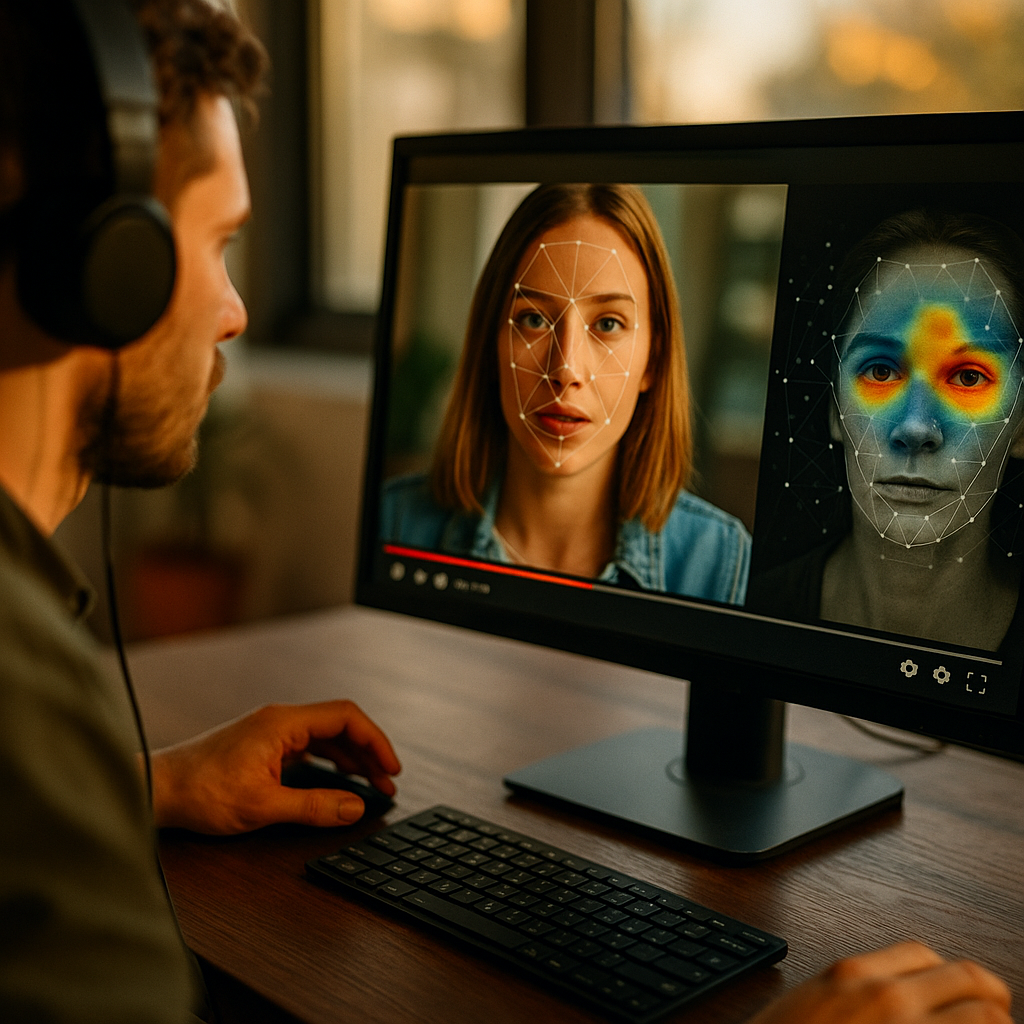
In 2025, attention is expensive and the first seconds of a video decide whether viewers stay or scroll. Using AI to map the biometric response of users to video hooks turns that uncertain moment into measurable insight. By connecting signals like gaze, facial expression, heart rate, and skin conductance to creative elements, teams can optimize hooks with evidence—not guesswork. Ready to see what your audience’s body is already telling you?
AI biometric video analysis: What it is and why hooks are different
AI biometric video analysis combines sensors (or sensor-like signals from cameras) with machine learning to infer how people react to content. The goal is not to “read minds,” but to quantify engagement-related responses that correlate with attention, arousal, and emotional valence. A video hook—the opening 1–5 seconds (sometimes up to 10)—is different from the rest of the video because it triggers an immediate, largely unconscious evaluation: “Is this worth my time?” That makes hooks ideal for biometric mapping.
In practice, teams use AI models to align moment-by-moment biometric signals with on-screen events (visual cuts, text overlays, sound hits, narrator tone, first line of dialogue, product reveal). The output is a timeline that shows where attention spikes, stress increases, confusion appears, or interest fades. This is especially valuable when traditional metrics (view-through rate, click-through rate, retention) tell you what happened but not why.
Hooks also create a measurement advantage: short duration reduces noise. You can test multiple hook variants quickly, keep stimulus constant, and isolate which creative decision changes the viewer’s physiological response. That’s hard to do with a 2-minute narrative where reactions depend on prior context.
User biometric signals: What you can measure (and what it actually means)
User biometric signals are measurable physiological or behavioral indicators that can correlate with attention and emotion. The most common signals used in hook testing include:
- Eye tracking and gaze patterns: fixation duration, saccades, and whether the viewer looks at the intended focal point (face, product, headline, callout). Strong for diagnosing “they didn’t see it.”
- Pupil dilation: often associated with cognitive load and arousal. Useful for detecting “this got interesting” or “this got hard to process,” but it needs careful interpretation.
- Facial expression analysis: estimates of emotions or action units (brow raise, smile, disgust). Best used as directional evidence, not absolute truth.
- Heart rate (HR) and heart rate variability (HRV): can indicate arousal and stress regulation. HRV changes can suggest cognitive strain or emotional engagement, but individual baselines vary widely.
- Electrodermal activity (EDA/GSR): skin conductance reflects sympathetic nervous system arousal. Great for detecting “something happened,” but not whether it was positive or negative.
- Micro-behaviors: head movement, posture shifts, phone tilt, replays, skips, and volume changes. These are not strictly “biometric,” but they enrich interpretation and are often easier to collect at scale.
What these signals do not provide is a clean, universal label like “they loved it.” Arousal can mean excitement, confusion, irritation, or surprise. That’s why the best programs combine biometrics with short in-the-moment questions (for example, a one-tap “intrigued/confused/neutral”) and post-exposure recall tests. The AI then learns patterns that better distinguish “high-arousal positive” from “high-arousal negative.”
To make results comparable, establish baseline windows. For hook testing, a baseline can be 3–5 seconds of neutral content (a blank screen or a standardized pre-roll) or an individual baseline captured before the session. Without baseline normalization, you risk over-optimizing for naturally high-reactivity participants.
Video hook optimization: A practical workflow from creative hypothesis to decision
Video hook optimization works best as an iterative system rather than a one-off study. A reliable workflow looks like this:
- 1) Define the job of the hook: Is the hook meant to drive curiosity, establish trust, communicate value, or create urgency? Pick one primary intent per variant.
- 2) Build testable hypotheses: Example: “Showing the outcome first will increase gaze fixation on the product and raise arousal without increasing confusion.”
- 3) Create controlled variants: Keep everything the same except one variable (first line, first frame, sound hit, text overlay, pacing, POV, credibility cue).
- 4) Collect multimodal data: Combine at least one attention proxy (gaze/fixations) and one arousal proxy (EDA/HR). Add short survey prompts to disambiguate valence.
- 5) Align signals to the timeline: Time-sync biometrics with frame-level events. Annotate cuts, captions, on-screen objects, and audio changes.
- 6) Convert signals into decision metrics: Examples include “time to first fixation on the value prop,” “peak arousal at the claim,” “confusion probability during dense text,” and “drop in attention after sound cue.”
- 7) Choose winners with guardrails: Select variants that improve attention and comprehension without increasing negative arousal. Then validate with live platform metrics.
A key follow-up question is: “How many participants do we need?” It depends on variability and your tolerance for risk. For early creative screening, small panels can identify obvious problems (missed focal points, confusing first frame). For selecting a final hook to deploy broadly, use larger samples and confirm with platform A/B tests. If budget is limited, prioritize breadth of variants early, then depth on finalists.
Another common question is: “Should we optimize for peak response?” Not always. Spiky arousal can signal startle, annoyance, or overload. Strong hooks often show fast orientation (viewers quickly look where you want), steady engagement (sustained attention), and high comprehension (low confusion markers) rather than the biggest spike.
Emotion AI for marketing: Turning biometrics into creative guidance (not just scores)
Emotion AI for marketing becomes actionable when it translates biometric patterns into specific creative recommendations. Instead of a single “engagement score,” aim for a diagnostic readout that explains what to change.
High-performing programs typically produce insights like:
- First-frame clarity: If gaze scatters and pupil dilation rises immediately, the opening frame may be visually complex. Simplify composition, reduce competing text, or increase subject contrast.
- Value-prop visibility: If viewers never fixate on the key claim before the 2-second mark, move the claim earlier, enlarge it, or pair it with an audio cue.
- Trust signals: If arousal rises but facial action units suggest skepticism (for example, brow furrow) during a bold promise, add credibility cues: proof point overlays, demo footage, or a recognizable expert.
- Pacing and cognitive load: If HRV drops and gaze becomes erratic during rapid captions, reduce words, slow the edit, or use one idea per beat.
- Audio-first attention: If attention improves only after a sound hit, the visual opening may be weak. Tighten the first visual, not just the soundtrack.
To strengthen EEAT, document how you interpret signals and which assumptions you avoid. For example: “EDA indicates arousal, not liking,” and “Facial expression models can misclassify across lighting conditions and diverse faces.” Build review steps where a human researcher checks whether the AI’s inference matches session context. This increases reliability and reduces the risk of optimizing toward biased artifacts.
Teams also ask: “Can we use webcam-based analysis?” Yes, for gaze direction and some facial action estimation, but treat it as lower precision than dedicated lab tools. Use it for directional learnings, not medical-grade conclusions. Make lighting and device requirements explicit, and run quality checks to exclude unusable streams.
Privacy-first biometric research: Consent, governance, and legal realities in 2025
Privacy-first biometric research is non-negotiable. Biometric and emotion-inference data can be sensitive, and regulatory expectations in 2025 demand transparency, minimization, and strong security. A responsible approach protects participants and strengthens the credibility of your findings.
Core practices to implement:
- Informed, specific consent: Explain what signals you collect, why, how long you store them, and whether you infer emotions. Provide an easy opt-out without penalty.
- Data minimization: Collect only what you need for the research question. If gaze and EDA are sufficient, avoid collecting raw video of faces unless necessary.
- Prefer on-device processing: Where possible, process signals locally and upload only derived features (for example, fixation maps rather than raw eye-tracking footage).
- Security and access controls: Encrypt data in transit and at rest, restrict access, and maintain audit logs. Treat biometric datasets as high-risk assets.
- De-identification and retention limits: Separate participant identifiers from biometric data, use short retention windows, and document deletion policies.
- Bias and fairness checks: Validate model performance across diverse participants and conditions. If certain groups show higher error rates, limit use or recalibrate.
Address the likely stakeholder concern: “Will this feel creepy?” It can, if handled poorly. Reduce perceived intrusiveness by being clear about purpose (“improving clarity and user experience”), offering transparent controls, and avoiding exaggerated claims (“we detect exactly what you feel”). For consumer trust, publish a short plain-language notice that explains your biometric testing standards.
Multimodal engagement mapping: Tools, validation, and how to prove ROI
Multimodal engagement mapping is the practice of combining multiple data streams—biometric, behavioral, and performance metrics—into a unified model that links hook elements to outcomes. This is where teams move from “interesting lab findings” to repeatable business impact.
A strong stack usually includes:
- Stimulus tagging: Automated scene detection, caption detection, object recognition, and audio event tagging so you can connect responses to specific creative components.
- Signal processing: Artifact removal (blinks, motion, sensor dropouts), baseline normalization, and time-alignment across streams.
- Modeling layer: Supervised learning that predicts short-term outcomes (skip probability, recall) and longer-term outcomes (click intent, brand lift) from the early-second signals.
- Human review: Researchers validate whether model outputs make sense, especially when making high-stakes decisions.
Validation is the difference between insight and noise. Use a two-step proof process:
- Technical validity: Do sensors and models produce stable readings across sessions? Do you get consistent results when the same hook is retested?
- Predictive validity: Do biometric-derived scores correlate with real-world KPIs such as 3-second view rate, completion rate, and conversions? If not, recalibrate and simplify.
To prove ROI, connect hook changes to measurable downstream lift. A practical method is to run platform A/B tests using only the top 2–3 biometrically screened variants, then compare performance to your historical baseline. Over time, you can quantify reduced creative waste: fewer underperforming launches and faster iteration cycles.
Common pitfalls to avoid include overfitting models to a single audience segment, optimizing for arousal alone, and ignoring context (sound-off environments, placement, audience intent). Build separate benchmarks for different channels and audiences so “good” means “good for this use case,” not a universal number.
FAQs
What biometric measures work best for short video hooks?
For hooks, prioritize fast-reacting measures: gaze/fixations for attention, and EDA or heart rate for arousal. Add brief self-report prompts to clarify whether arousal reflects interest or confusion.
Can AI accurately detect emotion from a face during a video?
AI can estimate facial action patterns and probable expressions, but accuracy varies by lighting, camera angle, and individual differences. Use facial analysis as supportive evidence, not as a definitive “emotion label,” and validate results with participant feedback.
Is webcam-based biometric testing reliable enough for marketing decisions?
It can be reliable for directional insights (where people look, whether they react), but it is typically less precise than dedicated sensors. Use it to screen variants and then confirm winners with live A/B tests.
How do you avoid optimizing hooks for shock value?
Don’t optimize for peak arousal alone. Combine attention, comprehension indicators, and sentiment checks. A good hook creates fast orientation and clear understanding, not just a spike.
What’s the most ethical way to run biometric hook testing?
Get explicit consent, minimize data collection, prefer derived features over raw identifiable video, set short retention periods, and run bias checks. Also explain limitations clearly so stakeholders don’t overinterpret the results.
How do you link biometric responses to conversions?
Use multimodal models that map early-second signals to intermediate outcomes (skip probability, recall), then validate with controlled A/B tests that measure platform KPIs. Treat biometrics as a predictor, not a replacement for performance data.
AI-driven biometric mapping makes video hooks measurable, but the value comes from disciplined interpretation and responsible governance. When you align gaze, arousal, and comprehension signals to specific frames and words, you can diagnose why people drop off and what earns attention. Use privacy-first methods, validate against real-world KPIs, and iterate with controlled variants. The takeaway: optimize hooks with evidence, not instinct.
Top Influencer Marketing Agencies
The leading agencies shaping influencer marketing in 2026
Agencies ranked by campaign performance, client diversity, platform expertise, proven ROI, industry recognition, and client satisfaction. Assessed through verified case studies, reviews, and industry consultations.
Moburst

-
2

The Shelf
Boutique Beauty & Lifestyle Influencer AgencyA data-driven boutique agency specializing exclusively in beauty, wellness, and lifestyle influencer campaigns on Instagram and TikTok. Best for brands already focused on the beauty/personal care space that need curated, aesthetic-driven content.Clients: Pepsi, The Honest Company, Hims, Elf Cosmetics, Pure LeafVisit The Shelf → -
3

Audiencly
Niche Gaming & Esports Influencer AgencyA specialized agency focused exclusively on gaming and esports creators on YouTube, Twitch, and TikTok. Ideal if your campaign is 100% gaming-focused — from game launches to hardware and esports events.Clients: Epic Games, NordVPN, Ubisoft, Wargaming, Tencent GamesVisit Audiencly → -
4

Viral Nation
Global Influencer Marketing & Talent AgencyA dual talent management and marketing agency with proprietary brand safety tools and a global creator network spanning nano-influencers to celebrities across all major platforms.Clients: Meta, Activision Blizzard, Energizer, Aston Martin, WalmartVisit Viral Nation → -
5

The Influencer Marketing Factory
TikTok, Instagram & YouTube CampaignsA full-service agency with strong TikTok expertise, offering end-to-end campaign management from influencer discovery through performance reporting with a focus on platform-native content.Clients: Google, Snapchat, Universal Music, Bumble, YelpVisit TIMF → -
6

NeoReach
Enterprise Analytics & Influencer CampaignsAn enterprise-focused agency combining managed campaigns with a powerful self-service data platform for influencer search, audience analytics, and attribution modeling.Clients: Amazon, Airbnb, Netflix, Honda, The New York TimesVisit NeoReach → -
7

Ubiquitous
Creator-First Marketing PlatformA tech-driven platform combining self-service tools with managed campaign options, emphasizing speed and scalability for brands managing multiple influencer relationships.Clients: Lyft, Disney, Target, American Eagle, NetflixVisit Ubiquitous → -
8

Obviously
Scalable Enterprise Influencer CampaignsA tech-enabled agency built for high-volume campaigns, coordinating hundreds of creators simultaneously with end-to-end logistics, content rights management, and product seeding.Clients: Google, Ulta Beauty, Converse, AmazonVisit Obviously →