


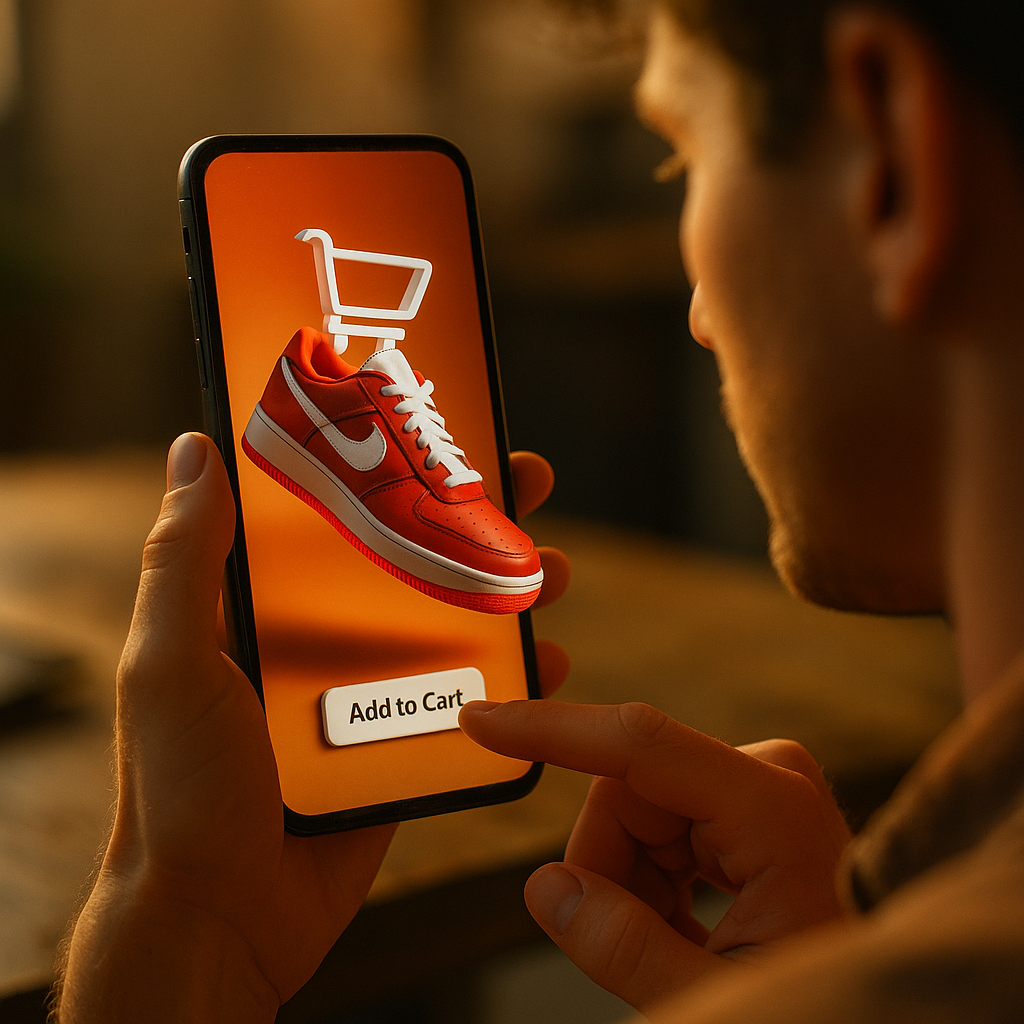
In 2025, immersive media is no longer experimental—it is a performance channel. The challenge is not rendering realism, but guiding attention and memory inside depth. The science of visual anchoring in 3D immersive advertisements explains how brands can place “attention magnets” in space so viewers notice, understand, and recall the message without feeling pushed. Done well, anchoring turns curiosity into action—so what makes it work?
Visual anchoring psychology: how attention locks in 3D space
Visual anchoring is the deliberate placement of stable reference cues that help people orient, interpret, and remember information. In 3D immersive ads—AR lenses, VR scenes, mixed reality experiences, and volumetric placements—anchors act like perceptual “handles.” They reduce search effort, guide gaze, and create a repeatable path from discovery to comprehension.
Anchoring works because human perception is selective. We do not process everything in a scene; we prioritize what appears salient, stable, and meaningful. A good anchor uses that bias without overwhelming the viewer. Common anchor types include:
- Object anchors: A product model, hero object, or branded icon that remains stable as the viewer moves.
- Environmental anchors: Real-world surfaces (tables, walls, floors) or virtual landmarks that define where “here” is.
- Task anchors: A clear interactive target such as “tap to rotate,” “place in room,” or “compare sizes.”
- Narrative anchors: A character, voice cue, or repeated motif that ties multiple moments together.
The psychological payoff is simple: when viewers can quickly answer “Where should I look?” and “What does this mean?” they stay longer and absorb more. If they cannot, they exit—often before the brand message lands.
To apply this in practice, start by defining one primary anchor per scene. If everything tries to be the anchor, nothing becomes one. Then decide the viewing distance (near-field vs room-scale) and the likely motion (standing, walking, seated). These choices determine anchor size, contrast, and placement.
Spatial cognition in immersive ads: depth cues that build trust
Immersive advertising succeeds when the brain believes the scene is coherent. That belief comes from spatial cognition: how people understand layout, distance, and object relationships. Anchors support spatial cognition by providing consistent depth cues, helping viewers feel grounded rather than disoriented.
Key depth cues you can shape for advertising outcomes include:
- Occlusion: When one object partially covers another, it signals depth immediately. A product that cleanly occludes and is occluded by scene elements feels “placed,” not pasted.
- Scale and familiar size: A reference object (a chair, a hand, a doorway) helps the viewer judge product size accurately. This matters for purchase confidence.
- Perspective and parallax: As the viewer moves, anchored objects should shift in a physically consistent way. Unstable parallax breaks trust.
- Lighting and shadows: Consistent light direction and contact shadows act as truth signals. Even stylized experiences benefit from coherent shading.
- Floor-plane consistency: If “down” is ambiguous, users feel uneasy. A clear ground plane is often the simplest stabilizer in room-scale placements.
Brands often ask a practical follow-up: should the anchor be in the center? Not always. Center placement can feel forceful and may conflict with natural scanning patterns. Instead, treat the anchor as a destination and design a gentle approach: peripheral cue, then a guided move toward the main object, then a moment of stillness for comprehension.
Another common question: is realism mandatory for trust? No. Coherence matters more than photorealism. A stylized ad can feel credible if its rules are consistent—stable anchors, consistent shadows, predictable interactions, and readable scale cues.
Gaze guidance and salience mapping: designing anchors people actually notice
In 2D, you can assume the frame. In 3D, the viewer chooses where to look, and that freedom changes everything. Visual anchoring must therefore be paired with gaze guidance: shaping what attracts attention first, second, and third.
Designers do this using salience mapping principles—features that the visual system prioritizes. The most reliable drivers are contrast, motion, novelty, and meaning. In immersive ads, the best anchors combine bottom-up salience (what pops) with top-down relevance (what aligns with the viewer’s goal).
Effective, user-respecting methods include:
- Controlled motion: Small, purposeful animation on the anchor (a slow rotation, subtle shimmer) draws attention without causing fatigue.
- Contrast in the right dimension: Use color contrast, luminance contrast, or material contrast, but not all at once. Excess contrast becomes visual noise.
- Directional cues: Arrows, light beams, or character gaze can “point” without feeling like UI clutter.
- Audio as a soft anchor: Spatial audio can orient viewers toward a product before they see it, reducing search time.
- Semantic cues: A label such as “New,” “Try it,” or a benefit claim placed near the anchor can convert attention into understanding.
One of the most important follow-up questions is how fast the viewer should find the anchor. In performance-focused creative, aim for immediate recognition: within the first moments of entry, there should be a clear “first thing.” If a user needs to hunt, you risk losing them before the value proposition appears.
Also consider comfort. Rapid, high-frequency motion and aggressive flicker can increase cognitive strain and reduce session length. Anchoring should feel like guidance, not coercion.
Memory and brand recall: why anchors improve conversion
Attention is not the end goal; memory is. Visual anchors help encode brand and product information by creating stable associations between a cue (logo, shape, color system, character) and a spatial context (where it was, how you interacted with it, what happened next).
Immersive ads can leverage several memory mechanisms:
- Distinctiveness: A unique 3D form or signature interaction makes the experience easier to recall than a standard banner.
- Repetition with variation: Reintroduce the anchor at key moments (entry, interaction, decision) while changing the surrounding scene slightly to keep interest.
- Context-dependent cues: If the product is anchored to a familiar environment (kitchen counter, living room), recall can improve because the context matches real purchase-use situations.
- Embodied interaction: Rotating, placing, or resizing an item creates motor involvement, which can strengthen memory traces.
To translate recall into conversion, tie the anchor to a single, clear promise. For example: a “before/after” anchored on the product, a size comparison anchored to a room surface, or a material demo anchored to a close-up interaction. Avoid scattering benefits across multiple unconnected objects.
Another likely question: where should branding appear? Use a layered approach. Keep the product or hero asset as the primary anchor, then add branding as a supportive anchor: subtle logo placement on the object, a short brand line near the interaction point, and a final confirmation moment (such as a persistent badge) only after the user engages. This avoids front-loading logos in a way that can feel intrusive.
AR/VR ad UX best practices: anchor placement, comfort, and accessibility
Anchoring decisions are also UX decisions. If the anchor is uncomfortable to view, hard to reach, or confusing to manipulate, the ad fails regardless of visuals. Strong creative teams apply a few repeatable rules of thumb.
Placement and distance
- Keep primary anchors within a comfortable viewing zone: close enough to see detail, far enough to avoid eye strain. Use adaptive scaling if device conditions vary.
- Avoid forcing extreme head tilt: anchors placed too high or low reduce comfort and shorten dwell time.
- Provide a “home” position: a simple way to reset the object to a stable pose helps new users recover.
Interaction clarity
- Make the first action obvious: a single highlighted affordance beats a menu of options. “Tap to place” or “Pinch to resize” should be discoverable.
- Confirm interactions: micro-feedback such as a snap, glow, or sound reassures users the anchor is stable.
- Prevent accidental moves: lock an anchored object once placed, or require a deliberate “move” mode.
Comfort and accessibility
- Limit visual overload: too many floating elements can trigger fatigue. Prioritize one main anchor and one secondary support.
- Support readability: ensure text labels are large enough and remain facing the viewer when needed, especially for benefit claims and pricing.
- Offer alternatives: if gestures fail, provide tap-based controls; if audio cues exist, provide visual equivalents.
Brands also ask how to keep anchors consistent across devices. The answer is to design with relative, not absolute, rules: anchor to detected planes when available, fall back to a stable screen-space anchor when tracking degrades, and ensure brand-critical elements remain legible at multiple resolutions.
Measurement and experimentation: validating visual anchors with analytics
EEAT-aligned immersive advertising relies on proof, not intuition. You can test anchoring choices with the same rigor used in other performance channels, provided you collect the right signals and respect privacy expectations.
Useful measurement approaches include:
- Attention proxies: dwell time near the anchor, interaction starts, rotation/zoom frequency, and completion rate of the key task.
- Path analysis: the sequence of interactions (place → inspect → compare → CTA) reveals whether the anchor guided behavior as intended.
- A/B tests on anchor variables: compare a stable environmental anchor vs a floating product anchor; test motion intensity; test label presence; test audio cue timing.
- Readability and comprehension checks: short in-experience prompts or post-experience surveys can confirm whether viewers understood the benefit claim.
- Conversion linkage: connect immersive engagement events to downstream actions (add-to-cart, store locator, lead form) to avoid optimizing for novelty.
To keep experiments credible, define success metrics before launching. For example: “Increase completed product inspection interactions by X” or “Reduce time-to-first-interaction.” Then keep the rest of the experience constant while you change only anchor-related variables. This is the fastest path to finding which anchors are genuinely helpful versus merely decorative.
Finally, document your decisions. In 2025, stakeholders expect transparency: what you tested, what improved, what you removed, and why. That record strengthens trust and makes future creative iteration faster and less subjective.
FAQs
What is visual anchoring in 3D immersive advertising?
It is the use of stable visual or spatial cues—such as a product model, a surface placement point, or a guiding label—to direct attention, support orientation, and improve understanding inside AR/VR or other 3D ad experiences.
How many anchors should a 3D immersive ad include?
Most experiences perform best with one primary anchor and one secondary support cue. More than that can dilute attention and increase cognitive load, especially on mobile AR.
Is an anchor the same as a call-to-action?
No. A CTA asks for action; an anchor stabilizes attention and meaning. A CTA can be designed as an anchor, but the strongest immersive flows use anchoring first (orientation and comprehension), then a CTA when the user is ready.
What makes an anchor feel “real” in AR?
Consistent scale, believable occlusion, coherent lighting/shadows, and stable tracking. Even stylized objects feel real when they obey the scene’s rules and remain steady during movement.
How do I test whether my anchor improves performance?
Run controlled A/B tests on a single variable (placement, motion, label, or audio cue) and measure time-to-first-interaction, task completion rate, and downstream conversion events. Avoid optimizing only for dwell time, which can reflect confusion.
Can visual anchoring reduce motion discomfort in VR?
Yes. Stable reference points and predictable object behavior can reduce disorientation. Anchors should remain consistent during camera movement and avoid aggressive motion or flicker.
Visual anchoring turns immersive advertising into guided perception: viewers know where to look, what matters, and how to act. The best anchors combine psychology, spatial coherence, and restrained salience so the experience stays comfortable and credible. Measure anchor performance with clear metrics, then iterate based on evidence. In 2025, brands that master anchoring earn attention that lasts beyond the session.
Top Influencer Marketing Agencies
The leading agencies shaping influencer marketing in 2026
Agencies ranked by campaign performance, client diversity, platform expertise, proven ROI, industry recognition, and client satisfaction. Assessed through verified case studies, reviews, and industry consultations.
Moburst

-
2

The Shelf
Boutique Beauty & Lifestyle Influencer AgencyA data-driven boutique agency specializing exclusively in beauty, wellness, and lifestyle influencer campaigns on Instagram and TikTok. Best for brands already focused on the beauty/personal care space that need curated, aesthetic-driven content.Clients: Pepsi, The Honest Company, Hims, Elf Cosmetics, Pure LeafVisit The Shelf → -
3

Audiencly
Niche Gaming & Esports Influencer AgencyA specialized agency focused exclusively on gaming and esports creators on YouTube, Twitch, and TikTok. Ideal if your campaign is 100% gaming-focused — from game launches to hardware and esports events.Clients: Epic Games, NordVPN, Ubisoft, Wargaming, Tencent GamesVisit Audiencly → -
4

Viral Nation
Global Influencer Marketing & Talent AgencyA dual talent management and marketing agency with proprietary brand safety tools and a global creator network spanning nano-influencers to celebrities across all major platforms.Clients: Meta, Activision Blizzard, Energizer, Aston Martin, WalmartVisit Viral Nation → -
5

The Influencer Marketing Factory
TikTok, Instagram & YouTube CampaignsA full-service agency with strong TikTok expertise, offering end-to-end campaign management from influencer discovery through performance reporting with a focus on platform-native content.Clients: Google, Snapchat, Universal Music, Bumble, YelpVisit TIMF → -
6

NeoReach
Enterprise Analytics & Influencer CampaignsAn enterprise-focused agency combining managed campaigns with a powerful self-service data platform for influencer search, audience analytics, and attribution modeling.Clients: Amazon, Airbnb, Netflix, Honda, The New York TimesVisit NeoReach → -
7

Ubiquitous
Creator-First Marketing PlatformA tech-driven platform combining self-service tools with managed campaign options, emphasizing speed and scalability for brands managing multiple influencer relationships.Clients: Lyft, Disney, Target, American Eagle, NetflixVisit Ubiquitous → -
8

Obviously
Scalable Enterprise Influencer CampaignsA tech-enabled agency built for high-volume campaigns, coordinating hundreds of creators simultaneously with end-to-end logistics, content rights management, and product seeding.Clients: Google, Ulta Beauty, Converse, AmazonVisit Obviously →