


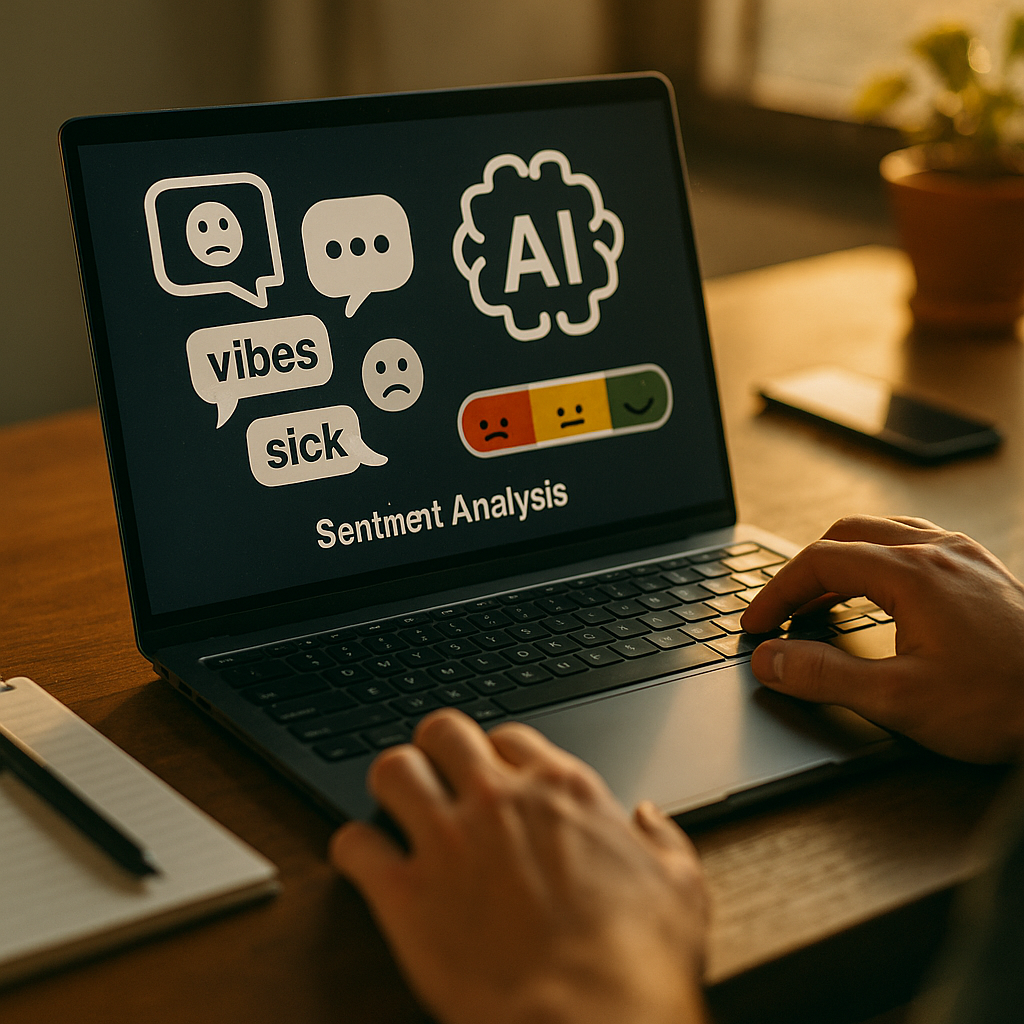
In 2025, brands and researchers rely on AI for contextual sentiment to move beyond simple “positive vs. negative” scoring and interpret what people actually mean. That includes tricky cases like sarcasm, playful teasing, reclaimed slurs, and fast-changing slang across platforms. This article explains how modern language models learn context, where they still fail, and how to build reliable workflows that earn trust—ready to spot what others miss?
Contextual sentiment analysis: why “tone” is harder than polarity
Contextual sentiment analysis aims to infer sentiment in context, not in isolation. Traditional sentiment tools often treat words as fixed signals: “great” is positive, “terrible” is negative. Real communication breaks those rules constantly. “Great, just what I needed” can mean frustration. “Sick” can mean impressive. A customer might say “I’m dead” to express laughter, not harm.
To make sentiment useful for decision-making, AI must consider:
- Local context: surrounding words, punctuation, capitalization, emojis, and intensifiers.
- Conversation context: previous messages, replies, quotes, and thread structure.
- Situational context: known product issues, current events, or service outages that shift interpretation.
- Speaker context: community norms, user history (where appropriate), and demographic or regional language patterns.
In practice, contextual sentiment delivers more than a score. The most helpful systems pair sentiment with reason codes (what drove the sentiment), targets (what the sentiment is about), and uncertainty (how confident the model is). This matters because sarcasm and slang are not edge cases; they are everyday language, especially on social platforms and in informal support channels.
Sarcasm detection with AI: signals, models, and common failure modes
Sarcasm detection is one of the most demanding tasks in natural language understanding because sarcasm often expresses a meaning that contradicts the literal text. People use it to complain indirectly, signal in-group humor, or soften criticism. AI can detect sarcasm more accurately when it sees broader context and multiple cues.
Modern approaches typically combine:
- Transformer language models fine-tuned on sarcasm-labeled data from social posts, forums, and customer conversations.
- Conversation-aware modeling that includes the parent message or earlier turns (sarcasm often responds to something specific).
- Multimodal cues where available: images, GIF descriptions, and emojis can flip sentiment.
- Pragmatic features like incongruity (praising a bad outcome), hyperbole, and rhetorical questions.
Even strong models fail in predictable ways. Understanding these failure modes is part of deploying AI responsibly:
- Missing context: “Love that for me” might be sincere in one thread and sarcastic in another.
- Domain mismatch: sarcasm in gaming communities differs from sarcasm in finance or healthcare discussions.
- Overfitting to markers: models can learn that “/s” or certain emojis mean sarcasm, then misclassify unmarked sarcasm or sincere uses of those tokens.
- Cultural variation: irony conventions differ across regions and languages; a model tuned on one community can misread another.
For teams evaluating tools, a practical question is: Does the system expose confidence and allow fallback? The best deployments don’t force a definitive sarcasm label when the model is unsure. They flag “possible sarcasm” for review or route it through additional checks, reducing the risk of misinterpreting customers.
Slang interpretation in NLP: keeping up with fast-changing language
Slang interpretation in NLP is challenging because slang evolves quickly, varies by community, and often carries meanings that differ from dictionary definitions. Terms can be positive, negative, or neutral depending on who says them and about whom. Some phrases are supportive in one context and harmful in another.
Effective AI systems handle slang through a mix of strategies:
- Continuous vocabulary adaptation: updating tokenization and embeddings to better represent emerging terms and creative spellings.
- Domain- and platform-specific fine-tuning: training on the channels you monitor (reviews, social posts, chats) rather than generic corpora alone.
- Entity and target extraction: identifying what the slang refers to (a product feature, a competitor, a person) so sentiment attaches to the right target.
- Context windows and thread linking: slang meanings often become clear only when you read the surrounding messages.
Teams also ask a crucial follow-up: How do we keep up without retraining constantly? A practical answer is to combine a strong base model with lightweight updates:
- Human-in-the-loop curation of new terms and usage examples from your own data.
- Prompted classification for rare slang: use structured prompts that ask the model to infer meaning from context and justify the label.
- Active learning: prioritize uncertain or high-impact messages for labeling so each annotation improves coverage.
This approach is more stable than chasing every trend. It also supports governance: you can document what changed, why it changed, and what evidence supports new interpretations.
LLMs for nuanced sentiment: hybrid pipelines that improve accuracy and trust
LLMs for nuanced sentiment can outperform older sentiment engines because they represent language in context and generalize better across phrasing. But raw LLM outputs can be inconsistent, especially when prompts drift, conversations are long, or language is ambiguous. The most reliable solutions use hybrid pipelines that combine LLM flexibility with structured NLP components and clear rules.
A robust architecture often includes:
- Pre-processing: language detection, de-duplication, spam filtering, and basic normalization (without removing meaning-carrying punctuation).
- Targeted sentiment: identify the sentiment target (shipping, pricing, a feature) before scoring sentiment, so one message can be “happy with product, angry about delivery.”
- LLM reasoning with constraints: a controlled prompt that forces a fixed output schema (label, target, evidence span, confidence).
- Rule-based safeguards: handle high-risk phrases (self-harm, threats, harassment) with deterministic routing to human teams.
- Calibration and thresholds: convert model confidence into action thresholds (auto-tag, queue for review, or ignore).
Readers often want to know: Should we use a single model for everything? In most organizations, the best answer is no. Use specialized components where precision matters. For example, keep a dedicated toxicity or policy-violation classifier alongside sentiment, because a message can be “positive” in tone while still containing prohibited content.
To support strong decision-making, insist on explanations tied to evidence. A helpful system highlights the text spans that drove the label and distinguishes between sarcasm cues (incongruity, exaggeration) and genuine praise or complaints. This makes model outputs auditable and easier to improve.
Social media sentiment analysis: handling sarcasm, emojis, and community norms
Social media sentiment analysis is a stress test for contextual understanding. Posts are short, messy, and full of references. Irony is common, and slang shifts weekly. Emojis, reaction GIFs, and quoting add layers of meaning that are easy for models to misread if they are treated as noise.
To capture sentiment realistically, systems should:
- Interpret emojis contextually: a skull emoji can mean “that’s hilarious,” not something morbid; a sparkle can soften criticism; a thumbs-up can be sincere or passive-aggressive.
- Use thread context: replies often invert sentiment. A standalone “sure” is ambiguous; in response to a delayed shipment, it might signal frustration.
- Recognize stance and intent: people may mock a brand, defend it, or quote criticism to refute it. Sentiment without stance leads to wrong conclusions.
- Detect quoted text: models should avoid attributing sentiment in a quote to the author who is criticizing that quote.
Brand teams also ask: Can we compare sentiment across platforms? Yes, but only if you normalize for platform differences. A “ratioed” reply thread and a product review section are not the same environment. The best practice is to report sentiment by channel, include confidence bands, and track changes over time rather than chasing a single universal score.
Finally, build in a way to handle community norms. Some communities use harsh language affectionately; others consider mild sarcasm hostile. Calibrate models on representative samples from each channel, and keep an escalation process for edge cases that involve sensitive topics.
AI sentiment model evaluation: benchmarks, bias, and EEAT-ready governance
AI sentiment model evaluation determines whether your contextual understanding is reliable enough for business decisions. Accuracy alone is not sufficient; you need evidence that the model performs well on sarcasm, slang, dialect variation, and real customer scenarios. In 2025, evaluation also needs to be defensible to stakeholders who ask how the system works and how you prevent harm.
Use an evaluation plan that reflects real usage:
- Build a representative test set drawn from your channels and regions, with explicit labels for sarcasm, slang, and ambiguity.
- Measure targeted metrics: overall F1 is useful, but also track sarcasm recall, false positives for negativity, and target-level sentiment accuracy.
- Include abstention metrics: if the system can say “uncertain,” measure how often it abstains and whether abstentions are appropriate.
- Run slice analysis: compare performance across dialects, age-coded slang, and community types to detect bias.
- Stress-test prompts and drift: verify that small prompt changes or new slang don’t collapse performance.
To align with Google’s EEAT expectations for helpful, trustworthy content and systems, document and operationalize governance:
- Experience: incorporate feedback from support agents, community managers, and analysts who see real conversations daily.
- Expertise: involve linguists or trained annotators for sarcasm and pragmatic meaning; use clear labeling guidelines and inter-annotator agreement checks.
- Authoritativeness: maintain an internal model card describing data sources, intended use, limitations, and evaluation results.
- Trust: log model versions, track errors, provide explanations, and route high-stakes decisions to humans.
If you need a clear operational takeaway: treat sarcasm and slang as first-class evaluation categories, not rare exceptions. Your dashboards should show how these categories affect sentiment trends, so leaders don’t act on misleading spikes caused by a meme or a viral sarcastic phrase.
FAQs
What is contextual sentiment analysis in simple terms?
It is sentiment detection that considers surrounding text, conversation history, and the situation so the system can interpret meaning, not just individual words. It helps distinguish sincere praise from sarcasm and clarifies what the sentiment is directed at.
Can AI accurately detect sarcasm?
AI can detect sarcasm reasonably well in domains where it has strong training data and access to conversation context, but it still makes mistakes when cues are subtle or cultural context is missing. The safest systems report confidence and allow human review for uncertain cases.
How do models learn new slang in 2025 without constant retraining?
Teams commonly use a strong base model plus continuous monitoring, active learning, and small curated updates. They prioritize labeling uncertain, high-impact messages and maintain a slang glossary with examples to keep interpretations consistent.
Why does sentiment analysis get emojis wrong?
Emojis are highly contextual and can invert tone. A single emoji can signal irony, soften criticism, or intensify emotion. Models improve when emojis are treated as meaningful tokens and evaluated on real platform data.
What is the best way to evaluate sentiment tools for sarcasm and slang?
Create a test set from your own channels with explicit labels for sarcasm, slang, and ambiguity. Measure target-level sentiment, error types, and performance by segment (platform, region, community). Include confidence calibration and abstention performance.
Is it safe to automate actions based on sentiment scores?
Automating low-risk tasks like tagging or routing can be safe with good thresholds and monitoring. For high-stakes actions (account enforcement, escalation, reputational responses), keep a human-in-the-loop and use deterministic safeguards for policy-violation categories.
AI that understands tone needs more than a polarity score; it must recognize context, targets, and uncertainty to handle sarcasm and slang reliably. In 2025, the strongest results come from hybrid pipelines, representative evaluation, and clear governance that makes outputs explainable and auditable. Build with real conversations, track drift, and route ambiguous cases for review so decisions reflect meaning, not noise.
Top Influencer Marketing Agencies
The leading agencies shaping influencer marketing in 2026
Agencies ranked by campaign performance, client diversity, platform expertise, proven ROI, industry recognition, and client satisfaction. Assessed through verified case studies, reviews, and industry consultations.
Moburst

-
2

The Shelf
Boutique Beauty & Lifestyle Influencer AgencyA data-driven boutique agency specializing exclusively in beauty, wellness, and lifestyle influencer campaigns on Instagram and TikTok. Best for brands already focused on the beauty/personal care space that need curated, aesthetic-driven content.Clients: Pepsi, The Honest Company, Hims, Elf Cosmetics, Pure LeafVisit The Shelf → -
3

Audiencly
Niche Gaming & Esports Influencer AgencyA specialized agency focused exclusively on gaming and esports creators on YouTube, Twitch, and TikTok. Ideal if your campaign is 100% gaming-focused — from game launches to hardware and esports events.Clients: Epic Games, NordVPN, Ubisoft, Wargaming, Tencent GamesVisit Audiencly → -
4

Viral Nation
Global Influencer Marketing & Talent AgencyA dual talent management and marketing agency with proprietary brand safety tools and a global creator network spanning nano-influencers to celebrities across all major platforms.Clients: Meta, Activision Blizzard, Energizer, Aston Martin, WalmartVisit Viral Nation → -
5

The Influencer Marketing Factory
TikTok, Instagram & YouTube CampaignsA full-service agency with strong TikTok expertise, offering end-to-end campaign management from influencer discovery through performance reporting with a focus on platform-native content.Clients: Google, Snapchat, Universal Music, Bumble, YelpVisit TIMF → -
6

NeoReach
Enterprise Analytics & Influencer CampaignsAn enterprise-focused agency combining managed campaigns with a powerful self-service data platform for influencer search, audience analytics, and attribution modeling.Clients: Amazon, Airbnb, Netflix, Honda, The New York TimesVisit NeoReach → -
7

Ubiquitous
Creator-First Marketing PlatformA tech-driven platform combining self-service tools with managed campaign options, emphasizing speed and scalability for brands managing multiple influencer relationships.Clients: Lyft, Disney, Target, American Eagle, NetflixVisit Ubiquitous → -
8

Obviously
Scalable Enterprise Influencer CampaignsA tech-enabled agency built for high-volume campaigns, coordinating hundreds of creators simultaneously with end-to-end logistics, content rights management, and product seeding.Clients: Google, Ulta Beauty, Converse, AmazonVisit Obviously →