


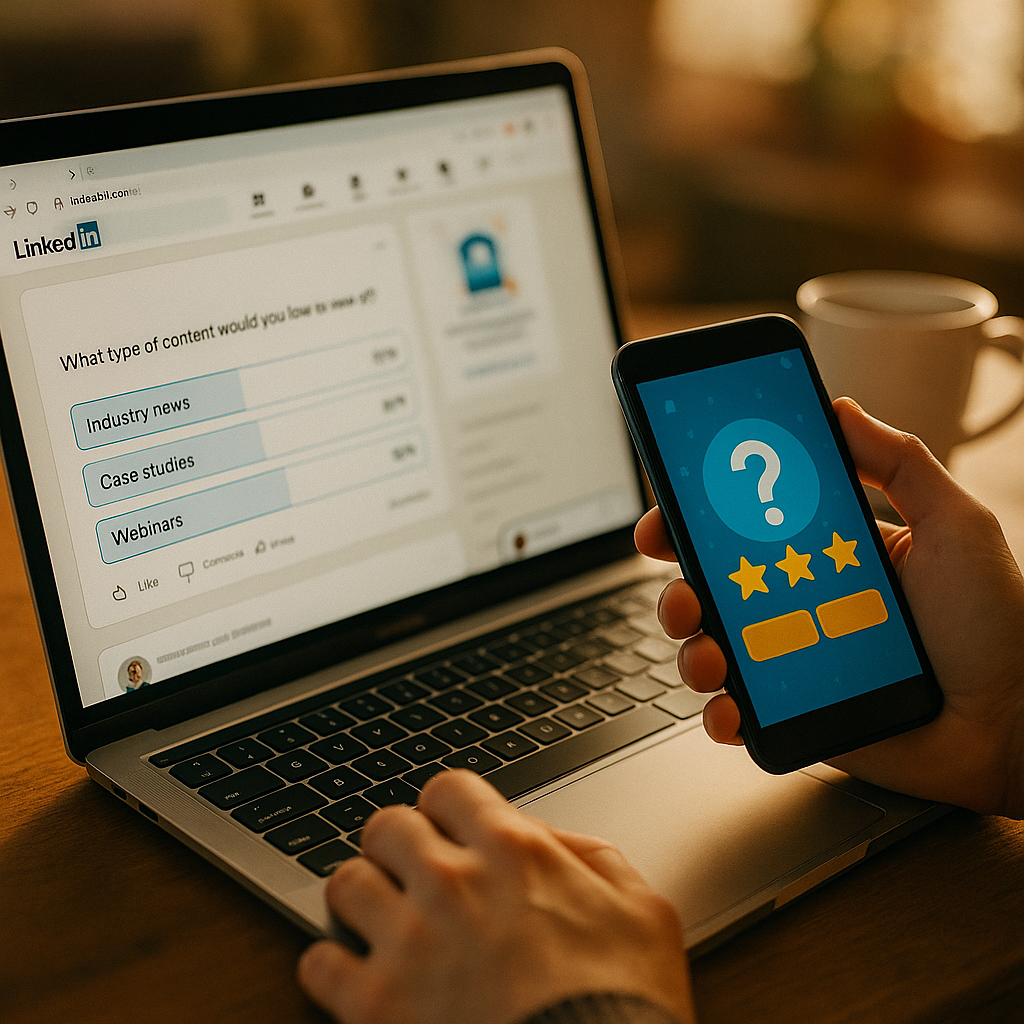
Interactive LinkedIn polls can do more than collect opinions: they can trigger conversation, teach your audience something useful, and push prospects closer to action. In 2025, the platform rewards signals like meaningful comments and saves, not empty vanity metrics. This playbook for interactive polls and gamification on LinkedIn shows what to ask, how to structure responses, and how to turn results into content that keeps people coming back—ready to test it?
Audience engagement strategy: Set goals, guardrails, and success metrics
Start with a clear outcome. Polls and gamified posts work when they support a business goal, not when they chase novelty. Decide which of these you need most:
- Demand generation: qualify pain points, segment interest, and invite opt-ins without sounding like a sales pitch.
- Community building: spark discussion among peers and encourage “me too” stories that build trust.
- Product feedback: pressure-test messaging, prioritize features, or validate objections.
- Education: reveal misconceptions, teach a framework, and make learning feel like a game.
Then set guardrails so you don’t dilute credibility. Keep claims verifiable, avoid manipulative “engagement bait,” and design polls that produce useful insight even with a small sample. If you’re in a regulated industry, pre-approve phrasing and avoid asking for sensitive personal data.
Define what “success” means before you publish:
- Comment quality: number of thoughtful replies that add examples, constraints, or counterpoints.
- Saves and shares: signals your audience wants to reference the poll later.
- Qualified profile visits: do the right people check you out afterward?
- Follow-on actions: newsletter sign-ups, demo requests, event registrations, or DMs that mention the poll.
Answer the obvious follow-up question: “How many votes do I need?” You need enough votes to spot a pattern and to earn conversation. If comments are strong and aligned with your target audience, a poll with fewer votes can outperform a high-vote poll that attracts the wrong crowd.
LinkedIn poll questions: Build prompts that invite perspective, not guesses
The best poll questions reduce friction and increase relevance. People vote when the question is specific, timely, and framed around a decision they actually face. Use these principles:
- Choose one clear variable: avoid multi-part questions that confuse voters.
- Make options mutually exclusive: remove overlap so results mean something.
- Use audience language: mirror the words your buyers use in calls and comments.
- Design for discussion: the poll is the opener; the comments are the value.
High-performing poll formats you can adapt:
- Decision fork: “Which trade-off would you choose?” Great for surfacing priorities.
- Myth check: “Which statement is most accurate?” Follow with a mini-lesson.
- Process diagnostic: “Where does your workflow break most often?” Great for pain-point mapping.
- Benchmark: “What’s your target KPI range?” Use ranges, not exact numbers, to reduce sensitivity.
- Scenario pick: “If X happens, what do you do first?” Excellent for training and role-based engagement.
Write options that feel “clickable.” Four options is common, but the real rule is: include the main answers people will look for, plus a safety valve like “It depends” only if you plan to unpack the dependencies in comments. If “It depends” wins, that’s not failure; it’s a cue to follow up with a breakdown post.
Add a comment prompt immediately after posting. Pin your first comment with: (1) why you’re asking, (2) what you’ll do with results, and (3) a question that invites a story. Example: “If you voted B, what’s the trigger that makes you choose it?”
Gamification on LinkedIn: Use simple mechanics that reward participation
Gamification works on LinkedIn when it feels professional: light challenge, real learning, and a clear payoff. Avoid gimmicks that reduce trust. Instead, use low-friction mechanics that respect the reader’s time.
Reliable gamification patterns for LinkedIn:
- Prediction + reveal: ask people to vote, then reveal the “best answer” with context in 24–48 hours.
- Two-step challenge: poll first, then a follow-up post where commenters justify their vote using a framework you provide.
- Scorecard: “Give yourself 1 point for each practice you do.” End with tiers (e.g., baseline, strong, elite) and specific next steps.
- Choose-your-path: “If you voted A, do this next. If you voted B, do that next.” This turns one poll into segmented value.
- Micro-quiz: poll options are answers; the comments contain the explanation and a practical example.
Design the reward. On LinkedIn, the best “prize” is clarity: a template, checklist, decision tree, or example. If you offer a downloadable asset, be transparent and keep it optional: “If you want the worksheet, comment ‘worksheet’ and I’ll DM it.” Make sure you can actually deliver promptly, or you’ll erode trust.
Keep your gameplay fair. If you’re running a contest, state rules clearly in a comment: eligibility, selection method, and timing. If you work in HR, finance, health, or legal, keep it informational and avoid implying guarantees.
Content marketing funnel: Turn poll results into a 7-day content sequence
A poll is not a one-off post; it’s a data collection step and a narrative starter. Plan a short sequence so the effort compounds. Here’s a practical 7-day flow you can repeat:
- Day 1 (Poll): ask the question; pin a comment that invites a specific story.
- Day 2 (Comment roundup): share 5–8 anonymized themes from replies and tag contributors (with permission).
- Day 3 (Deep dive): write a post addressing the top option and the hidden nuance in comments.
- Day 4 (Counterpoint): highlight why the second-most popular option is rational in certain contexts.
- Day 5 (Framework): publish a simple decision tree: “If X, choose A; if Y, choose B.”
- Day 6 (Proof): share a mini case study, example, or teardown showing the framework in action.
- Day 7 (Call to action): invite the next step: webinar, newsletter, consultation, or a follow-up poll.
This sequence answers a common follow-up: “How do I promote without being pushy?” You earn attention with the poll and education, then you offer a relevant next step as a continuation, not a pitch.
To strengthen credibility (EEAT), include what you observed, what you can’t infer, and what you’ll test next. Example: “This poll reflects responses from people who follow my content, so it’s not a representative market sample. I’m using it to shape next week’s guide and validate language for upcoming interviews.”
LinkedIn algorithm signals: Timing, comments, and distribution without spam
In 2025, distribution on LinkedIn tends to follow early engagement quality. Your job is to make it easy for the right people to respond meaningfully.
- Post when your audience is alert: choose a consistent slot and test over four polls before changing it.
- Seed the first comments: ask 3–5 trusted peers to add thoughtful perspectives (not generic praise). Make the ask specific: “Share your reasoning and one example.”
- Respond fast and substantively: reply to early comments with follow-up questions, not one-word reactions.
- Use light structure: short paragraphs, a clear question, and one pinned comment to guide the thread.
- Avoid engagement manipulation: skip “vote and I’ll vote back.” It attracts low-intent activity.
Extend reach without spamming. Instead of blasting the same poll to everyone, selectively DM people who have a proven interest in the topic and ask for their perspective. Keep it optional and respectful: “No need to vote if you’re busy—would love your take in one sentence.”
Watch for a distribution trap: if your poll is too broad, it may reach a wide audience that doesn’t convert. It can feel good in the moment and underperform later. A sharper niche question often produces fewer votes but more qualified conversations and follow-ons.
LinkedIn analytics: Measure what matters and iterate with a test plan
Polls give you both quantitative and qualitative data. Use both. Track votes and vote share, but treat comments as your research goldmine: objections, vocabulary, triggers, and constraints.
Build a lightweight dashboard (even a spreadsheet works) with these fields:
- Poll topic and audience segment
- Option labels (so you can see which wording wins)
- Vote distribution
- Top 10 comment themes
- Follow-on actions (DMs, sign-ups, booked calls)
- Content spin-offs created (posts, carousels, newsletters)
Run controlled tests. Change one thing at a time:
- Test A: “Which is harder?” vs. “Which blocks you today?” (emotion vs. immediacy)
- Test B: options as outcomes vs. options as processes
- Test C: industry-specific phrasing vs. general phrasing
Answer the practical follow-up: “How often should I post polls?” For most brands and creators, 1 poll per week is sustainable and leaves room for interpretation posts that build authority. If you post polls daily, you’ll often train your audience to react quickly and think less deeply.
Protect trust with clear disclosure. If a poll is tied to research for a product, say so. If you plan to quote comments, ask permission before using names outside the thread.
FAQs: Interactive polls and gamification on LinkedIn
-
Do LinkedIn polls work for B2B lead generation?
Yes, when the poll is tied to a real decision and you follow it with useful interpretation content. Use the poll to segment needs, then offer a relevant next step (worksheet, webinar, consult) that matches the winning pain point.
-
What’s the best number of poll options?
Four options usually balances clarity and insight. Use fewer when the decision is binary, and use ranges when asking about metrics. Add “Other” only if you plan to ask commenters to specify what “other” means.
-
How do I make a poll feel “gamified” without being gimmicky?
Attach a professional payoff: a reveal post, a scorecard, a decision tree, or a mini-lesson. Keep the challenge simple, make the learning obvious, and avoid tricks that pressure people to engage.
-
Should I reveal the “right answer” in the poll post or later?
Reveal it later if your goal is conversation and learning. Post the poll first, then publish a follow-up within 24–48 hours explaining the best answer with context and examples from the comments.
-
How can I handle biased poll results?
State the limitation: your voters are not the whole market. Use results as directional insight, then validate with customer interviews, sales call notes, or a second poll aimed at a narrower segment.
-
Can company pages use the same playbook as personal profiles?
Yes, but pages often need stronger hooks and clearer incentives to comment. Pair page polls with employee amplification: have subject-matter experts add thoughtful comments from their profiles to enrich the thread.
Polls and gamification work best when you treat them as a research-and-teaching loop, not a single engagement spike. Set a clear goal, ask a decision-based question, and design a lightweight challenge that rewards participation with clarity. Then turn the results into a short content sequence that deepens trust and drives action. In 2025, consistency and usefulness win—publish, learn, iterate.
Top Influencer Marketing Agencies
The leading agencies shaping influencer marketing in 2026
Agencies ranked by campaign performance, client diversity, platform expertise, proven ROI, industry recognition, and client satisfaction. Assessed through verified case studies, reviews, and industry consultations.
Moburst

-
2

The Shelf
Boutique Beauty & Lifestyle Influencer AgencyA data-driven boutique agency specializing exclusively in beauty, wellness, and lifestyle influencer campaigns on Instagram and TikTok. Best for brands already focused on the beauty/personal care space that need curated, aesthetic-driven content.Clients: Pepsi, The Honest Company, Hims, Elf Cosmetics, Pure LeafVisit The Shelf → -
3

Audiencly
Niche Gaming & Esports Influencer AgencyA specialized agency focused exclusively on gaming and esports creators on YouTube, Twitch, and TikTok. Ideal if your campaign is 100% gaming-focused — from game launches to hardware and esports events.Clients: Epic Games, NordVPN, Ubisoft, Wargaming, Tencent GamesVisit Audiencly → -
4

Viral Nation
Global Influencer Marketing & Talent AgencyA dual talent management and marketing agency with proprietary brand safety tools and a global creator network spanning nano-influencers to celebrities across all major platforms.Clients: Meta, Activision Blizzard, Energizer, Aston Martin, WalmartVisit Viral Nation → -
5

The Influencer Marketing Factory
TikTok, Instagram & YouTube CampaignsA full-service agency with strong TikTok expertise, offering end-to-end campaign management from influencer discovery through performance reporting with a focus on platform-native content.Clients: Google, Snapchat, Universal Music, Bumble, YelpVisit TIMF → -
6

NeoReach
Enterprise Analytics & Influencer CampaignsAn enterprise-focused agency combining managed campaigns with a powerful self-service data platform for influencer search, audience analytics, and attribution modeling.Clients: Amazon, Airbnb, Netflix, Honda, The New York TimesVisit NeoReach → -
7

Ubiquitous
Creator-First Marketing PlatformA tech-driven platform combining self-service tools with managed campaign options, emphasizing speed and scalability for brands managing multiple influencer relationships.Clients: Lyft, Disney, Target, American Eagle, NetflixVisit Ubiquitous → -
8

Obviously
Scalable Enterprise Influencer CampaignsA tech-enabled agency built for high-volume campaigns, coordinating hundreds of creators simultaneously with end-to-end logistics, content rights management, and product seeding.Clients: Google, Ulta Beauty, Converse, AmazonVisit Obviously →