


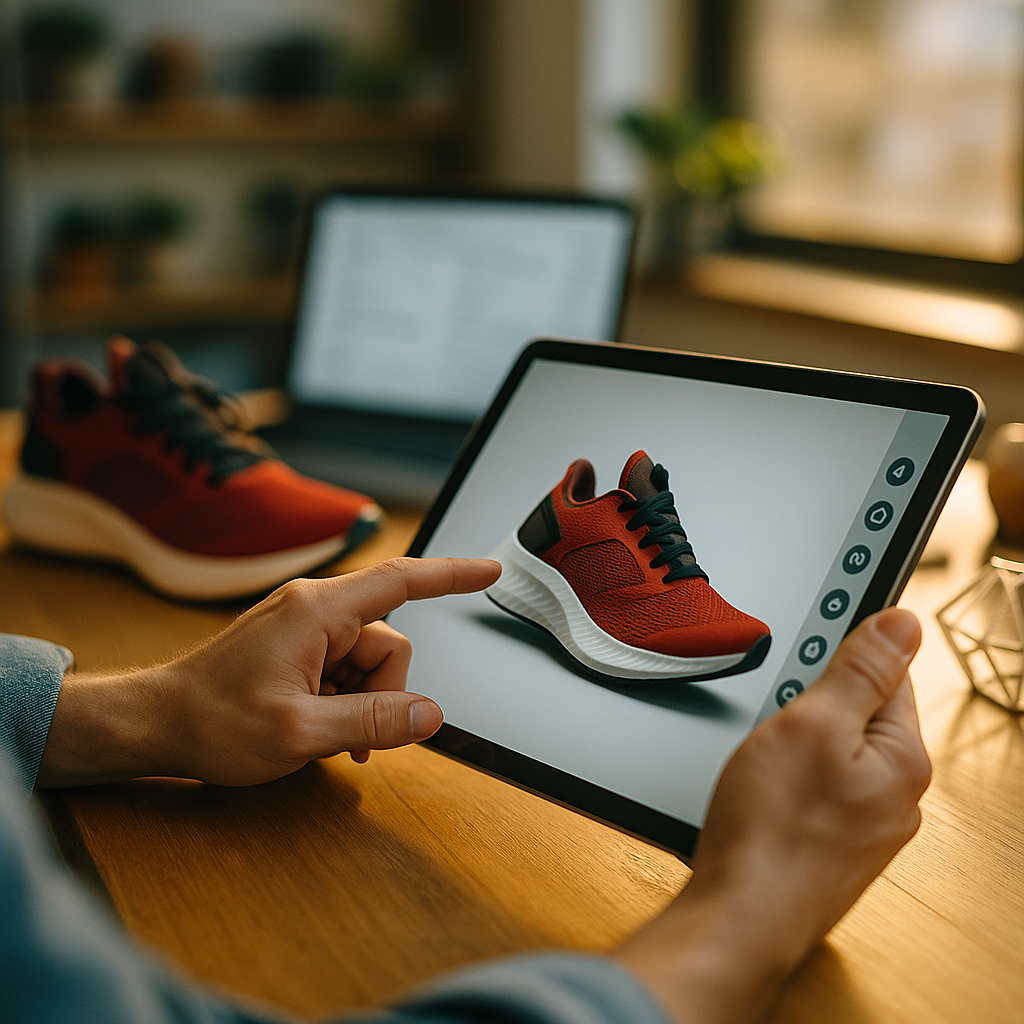
Using AI to Design Interactive 3D Product Demos at Scale has moved from a niche experiment to a practical growth lever in 2025. Teams want richer digital experiences without ballooning costs, while buyers expect to explore products as if they were in hand. This guide shows how to plan, produce, and govern AI-assisted 3D demos responsibly—so you ship faster, stay accurate, and convert more visitors. Ready to scale without sacrificing quality?
Interactive 3D product demos: what they are and why buyers expect them
Interactive 3D product demos let customers rotate, zoom, explode, configure, and compare products in a browser—often with hotspots, guided steps, and contextual annotations. They reduce uncertainty because the user controls the inspection, not a static marketing image. In 2025, this matters because remote evaluation is normal across B2B and B2C, and purchase committees want clarity before they book a call or approve a budget.
Done well, 3D demos answer common follow-up questions directly inside the experience:
- “Will it fit?” Provide dimensions, scale views, and environment placement.
- “How does it work?” Use step-by-step animations and labeled parts.
- “Which configuration is right?” Offer guided configuration with constraints.
- “Is this real?” Link claims to specs, certifications, and source-of-truth data.
The challenge has always been production: creating accurate 3D assets, interactions, and variants for entire catalogs. That’s where AI changes the cost curve—if you apply it with clear quality gates and strong governance.
AI 3D content generation: where it helps (and where it doesn’t)
AI can accelerate several steps in the 3D demo pipeline, but it is not a single “make 3D” button. The biggest wins come from combining generative tools with deterministic rules, product data, and human review.
High-value use cases in 2025:
- Asset cleanup and optimization: AI-assisted retopology suggestions, UV unwrapping helpers, texture upscaling, and material inference can shorten DCC (digital content creation) work.
- Variant generation: When products differ by color, finish, label, or small components, AI can help generate textures and apply material sets consistently—while rules prevent invalid combinations.
- Auto-annotation and hotspot drafting: Models can propose hotspot locations and draft microcopy from product specs, then a reviewer approves and edits.
- Scripted interaction templates: AI can help generate code snippets for common interactions (explode, part highlighting, guided tours) that engineers then test and harden.
- Localization support: Translation models speed up labels and tour scripts, with terminology locked to a glossary and reviewed by SMEs.
Where AI can mislead if you’re not careful:
- Geometry fidelity for regulated or tight-tolerance products: If exact dimensions matter (medical, aerospace, industrial fits), treat AI as assistive, not authoritative. Prefer CAD-derived meshes and measurable constraints.
- Material realism vs. truth: Generating “nicer” surfaces can drift from the real product finish. Maintain a material library tied to manufacturing specs.
- Feature hallucination: AI can invent ports, buttons, or accessories if prompts are vague. Lock prompts to structured data and require visual QA.
To follow Google’s helpful-content expectations and EEAT, prioritize accuracy over novelty: document sources (CAD, PIM fields, brand guidelines), record review steps, and give users reliable, verifiable information inside the demo.
3D product visualization pipeline: an end-to-end scalable workflow
Scaling is less about any single tool and more about a pipeline that converts product truth into interactive experiences repeatedly. A strong workflow has clear inputs, standardized outputs, and measurable quality criteria.
1) Define the “source of truth”
Use CAD (preferred for geometry), PLM/PDM, and PIM for attributes (dimensions, materials, SKUs, compatibility). Decide which system wins if data conflicts. This prevents mismatched claims between the demo and spec sheet.
2) Create a reusable demo blueprint
Standardize interaction patterns by product type: e.g., electronics (ports + UI overlays), furniture (scale + room placement), industrial equipment (safety zones + maintenance steps). A blueprint includes camera paths, hotspot schema, naming conventions, and performance budgets.
3) Convert and optimize 3D assets
Convert CAD to real-time meshes, then apply optimization targets: polygon budgets, texture sizes, LODs, and compression. AI can propose optimizations, but use automated checks (file size, draw calls, texture limits) as hard gates.
4) Generate variants with constraints
Connect the configurator to SKU logic: valid colors, regions, accessories, and compliance rules. AI can accelerate texture set creation, but the variant rules must remain deterministic to avoid invalid product representations.
5) Author interactions and guidance
Use templates for hotspots, guided tours, and step sequences. Let AI draft tour text and suggested hotspot placement from specs; then require SME approval, especially when describing safety, performance, or compatibility.
6) QA for truth, usability, and performance
Run three QA tracks:
- Truth QA: geometry checks against CAD references, labeling accuracy, variant validity.
- Experience QA: task completion (“find port,” “compare sizes”), clarity of copy, accessibility and keyboard navigation.
- Performance QA: load time, FPS on target devices, memory usage, and fallbacks.
7) Publish with analytics and governance
Ship demos through a managed content system, version assets, and log approvals. Add analytics events for hotspot clicks, configuration changes, and drop-off points to inform iteration.
AI-driven configurators and personalization: turning demos into conversion tools
Interactive 3D demos become revenue tools when they guide users to the right option and remove friction. AI helps by tailoring what the visitor sees, but personalization must stay transparent and respectful of privacy.
Practical personalization patterns:
- Guided selling paths: Ask 2–4 questions (“space constraints,” “power source,” “usage frequency”), then highlight matching configurations in 3D.
- Role-based tours for B2B: A procurement viewer sees compliance and warranty; an engineer sees dimensions, interfaces, and maintenance steps.
- Contextual help: If a user lingers on a hotspot or repeatedly toggles variants, surface a short explanation or a comparison view.
How to keep this credible (EEAT-aligned):
- Explain recommendations: Show why an option is suggested (“fits within 600 mm depth,” “compatible with your selected mount”).
- Separate facts from estimates: If you simulate performance or fit, label assumptions and link to spec sources.
- Respect consent: If personalization uses saved preferences or account data, disclose it and offer control.
Answer common follow-up questions directly in the UI: “Can I export this configuration?” “Can I share it with my team?” “Is pricing final?” Provide share links, configuration IDs, and a clear pathway to a quote or cart.
WebGL and real-time 3D performance: shipping fast experiences on every device
Great demos fail if they load slowly or stutter. In 2025, users expect smooth real-time 3D in browsers, yet device capabilities vary widely. Treat performance as a feature, not an afterthought.
Key performance practices:
- Set a performance budget early: Target download size, texture limits, and draw call counts per product category.
- Use LODs and progressive loading: Load a lightweight model first, then stream higher detail as needed.
- Texture discipline: Reuse materials, atlas textures when appropriate, and compress assets for the web.
- Fallbacks for low-end devices: Offer a 360-spin or high-quality renders when real-time 3D isn’t viable.
- Measure real users: Instrument load time, interaction latency, and error rates by device class and network conditions.
Where AI can help performance: AI-assisted optimization suggestions can flag oversized textures, detect redundant materials, and propose mesh simplifications. Still, automated “fixes” should be validated because aggressive simplification can remove functional details that users need for evaluation.
Also plan for accessibility: keyboard navigation for hotspots, readable labels, and clear focus states. Accessibility improves usability for everyone and supports trustworthy, high-quality content standards.
Digital twin product marketing: governance, compliance, and trust at scale
When you scale 3D demos across a catalog, risk scales too. A single inaccurate depiction can trigger returns, support costs, or compliance exposure. Strong governance is what turns AI speed into durable value.
Build a trust framework:
- Review roles and sign-off: Assign SME owners per product line (engineering, QA, regulatory, brand). Record approvals and version history.
- Traceability: Link each demo to source assets (CAD version, PIM record ID, material spec). This is essential for audits and updates.
- Claims control: Lock performance statements and safety language to approved copy blocks. Let AI draft, but never let it publish without review.
- Change management: When a SKU changes, automate alerts so demos update or retire. Stale demos undermine trust quickly.
- Security and IP protection: Decide what level of detail is safe to expose. For sensitive products, use simplified geometry while preserving user-relevant features.
What “expertise” looks like in practice: show measurement references, include downloadable spec sheets, cite certification IDs where relevant, and provide clear contact paths for technical questions. This supports EEAT by making it easy for users to verify what they’re seeing.
FAQs
How accurate can AI-generated 3D product demos be?
Accuracy depends on inputs and controls. The most reliable approach uses CAD-derived geometry for dimensions and fit, then applies AI for assistive tasks like texture creation, annotation drafts, and optimization suggestions. Add automated checks and SME review to keep the demo faithful to the real product.
What do I need to start scaling interactive 3D demos across a catalog?
You need a defined source of truth (CAD/PLM/PIM), a standardized demo template, a conversion and optimization pipeline, and a governance model for approvals and updates. Start with one product family, prove performance and conversion impact, then expand with reusable components.
How do I keep variants (colors, accessories, regions) from becoming unmanageable?
Model variants as data, not manual scenes. Use a rules-based configurator tied to SKU logic, and generate textures/material sets from a controlled library. AI can speed creation, but deterministic constraints should enforce valid combinations.
Will interactive 3D demos hurt page speed and SEO?
Not if you budget performance and implement progressive loading and fallbacks. Keep initial payload small, stream detail on demand, and provide indexable supporting content (specs, alt-equivalent text in surrounding UI copy, and clear navigation). Measure real-user performance and iterate.
Which teams should own quality and approvals?
Marketing can own experience goals and messaging, but engineering or product should validate technical accuracy, and compliance/regulatory should approve claims where required. A shared sign-off workflow with version tracking prevents drift as the catalog evolves.
How do I measure ROI from AI-assisted 3D demos?
Track engagement (interaction rate, time in demo, hotspot usage), conversion signals (add-to-cart, quote requests, demo-to-lead rate), and support outcomes (fewer pre-sales questions, lower return reasons tied to misunderstanding). Compare against pages without 3D or against baseline cohorts.
AI makes scalable 3D demos achievable in 2025, but results depend on process, not hype. Use CAD and product data as truth, apply AI to accelerate repeatable production tasks, and enforce strict QA for accuracy, usability, and performance. When you pair configurators with transparent guidance and solid governance, interactive 3D becomes a dependable sales asset—not a risky experiment. Build one blueprint, prove it, then scale.
Top Influencer Marketing Agencies
The leading agencies shaping influencer marketing in 2026
Agencies ranked by campaign performance, client diversity, platform expertise, proven ROI, industry recognition, and client satisfaction. Assessed through verified case studies, reviews, and industry consultations.
Moburst

-
2

The Shelf
Boutique Beauty & Lifestyle Influencer AgencyA data-driven boutique agency specializing exclusively in beauty, wellness, and lifestyle influencer campaigns on Instagram and TikTok. Best for brands already focused on the beauty/personal care space that need curated, aesthetic-driven content.Clients: Pepsi, The Honest Company, Hims, Elf Cosmetics, Pure LeafVisit The Shelf → -
3

Audiencly
Niche Gaming & Esports Influencer AgencyA specialized agency focused exclusively on gaming and esports creators on YouTube, Twitch, and TikTok. Ideal if your campaign is 100% gaming-focused — from game launches to hardware and esports events.Clients: Epic Games, NordVPN, Ubisoft, Wargaming, Tencent GamesVisit Audiencly → -
4

Viral Nation
Global Influencer Marketing & Talent AgencyA dual talent management and marketing agency with proprietary brand safety tools and a global creator network spanning nano-influencers to celebrities across all major platforms.Clients: Meta, Activision Blizzard, Energizer, Aston Martin, WalmartVisit Viral Nation → -
5

The Influencer Marketing Factory
TikTok, Instagram & YouTube CampaignsA full-service agency with strong TikTok expertise, offering end-to-end campaign management from influencer discovery through performance reporting with a focus on platform-native content.Clients: Google, Snapchat, Universal Music, Bumble, YelpVisit TIMF → -
6

NeoReach
Enterprise Analytics & Influencer CampaignsAn enterprise-focused agency combining managed campaigns with a powerful self-service data platform for influencer search, audience analytics, and attribution modeling.Clients: Amazon, Airbnb, Netflix, Honda, The New York TimesVisit NeoReach → -
7

Ubiquitous
Creator-First Marketing PlatformA tech-driven platform combining self-service tools with managed campaign options, emphasizing speed and scalability for brands managing multiple influencer relationships.Clients: Lyft, Disney, Target, American Eagle, NetflixVisit Ubiquitous → -
8

Obviously
Scalable Enterprise Influencer CampaignsA tech-enabled agency built for high-volume campaigns, coordinating hundreds of creators simultaneously with end-to-end logistics, content rights management, and product seeding.Clients: Google, Ulta Beauty, Converse, AmazonVisit Obviously →