


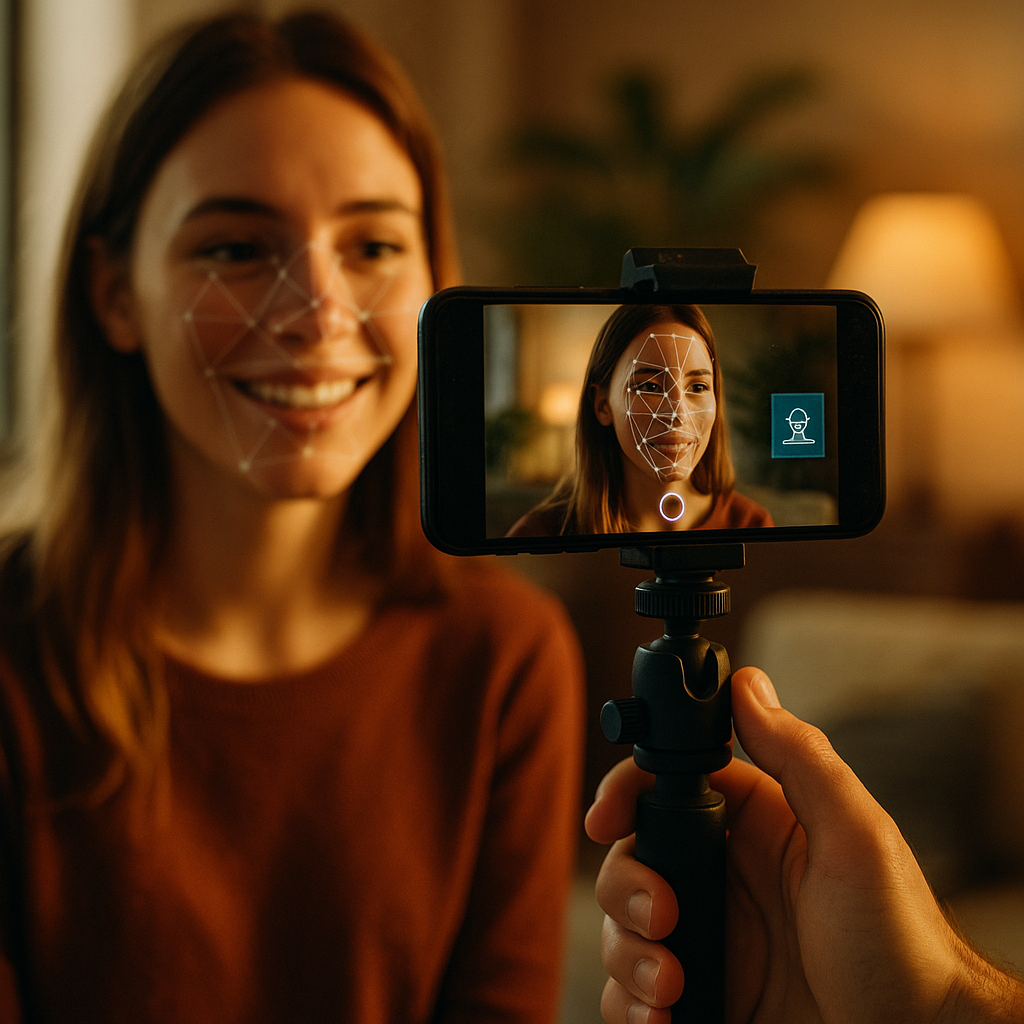
Video audiences decide fast: stay, skip, or scroll. In 2025, Using AI to Map the Biometric Response of Users to Video Hooks gives teams a practical way to see which opening moments trigger attention, emotion, and intent. When you connect biometric signals to frame-level creative choices, you stop guessing and start designing openings that earn attention. Want proof your first three seconds work?
AI video hooks optimization: what “biometric response” really measures
“Biometric response” refers to measurable physiological and behavioral signals that change when a person experiences attention, emotion, stress, or cognitive load. For video hooks, the goal is not to label a viewer as “happy” or “sad,” but to detect moments of change that indicate engagement or disengagement and link those changes to specific creative elements.
Common signals used in hook testing include:
- Eye tracking (gaze location, fixation duration, saccades) to see what viewers actually look at during the first seconds.
- Facial expressions (action units rather than simplistic “emotion” tags) to detect micro-reactions to surprise, confusion, or delight.
- Electrodermal activity (EDA/GSR) to estimate arousal changes that often correlate with attention or stress.
- Heart rate (PPG/ECG) and heart rate variability to capture arousal and cognitive load patterns.
- Voice and speech features (for interactive or user-generated contexts) such as pitch and pace changes.
- Interaction telemetry (pauses, rewinds, skips, drop-off points) as behavioral ground truth that complements biometrics.
How AI fits in: machine learning aligns these signals to the video timeline, reduces noise, and identifies patterns that reliably predict outcomes like completion, click-through, recall, or brand lift. The most useful systems produce an interpretable “hook map” that shows which frames, words, sounds, or on-screen elements correspond to measurable spikes or drops in attention.
Follow-up question readers ask: Is this only for big brands? No. The tooling ranges from lightweight webcam-based attention proxies to lab-grade sensors. The best approach depends on your risk tolerance, budget, and how high-stakes the creative decision is.
Biometric analytics for video: the AI workflow from sensors to hook maps
A reliable program needs more than gadgets. You need a workflow that protects data quality, avoids overclaiming, and connects signals to creative decisions. A practical end-to-end workflow looks like this:
- Define the hook objective: stop-the-scroll, clarity, suspense, product comprehension, or emotional resonance. Choose one primary goal per test to avoid muddled interpretation.
- Select a measurement stack: combine at least one biometric channel (eye, face, EDA/HR) with behavioral outcomes (retention curve, clicks, conversions, recall). Biometrics alone cannot prove business impact.
- Instrument the video timeline: create timecoded markers for spoken words, scene cuts, on-screen text, sound effects, product reveals, and key claims. This enables attribution.
- Collect data with controls: standardize device type, lighting, viewing distance, and audio level when possible. For remote tests, capture metadata (device, bandwidth, environment) to explain variance.
- Preprocess and validate: remove unusable segments (face not detected, extreme motion, sensor dropouts), normalize per viewer, and check that signal-to-noise is acceptable.
- Model and align: use AI to align multimodal signals to frames and detect statistically meaningful changes around events (cuts, claims, reveals). Prefer models that output confidence intervals or uncertainty.
- Generate the hook map: visualize attention peaks, confusion indicators, and drop-off risk moments, each tied to specific creative features.
- Translate into edits: produce a ranked list of actionable changes (e.g., “remove legal text in first 2 seconds,” “move product payoff earlier,” “replace ambiguous headline”).
- Retest and iterate: confirm improvements against outcomes, not just biometrics.
Key principle: treat biometrics as diagnostic signals, not a scoreboard. Your success metric still lives in audience behavior and campaign outcomes.
User attention mapping: designing experiments that marketers can trust
Biometrics can mislead when the test design is weak. To produce decisions you can defend, design your experiments with the same discipline you would use for conversion testing.
What to test (high leverage in the first 3–7 seconds):
- Opening visual: face vs product vs outcome shot.
- First line: question, contrarian statement, benefit claim, or story setup.
- Pacing: cut frequency, motion intensity, on-screen text density.
- Audio strategy: music onset, silence, sound effects, voice clarity.
- Brand timing: immediate branding vs delayed reveal.
- Proof cues: demos, testimonials, numbers, before/after.
Recommended study structure to reduce false conclusions:
- Use matched variants: change one element at a time for diagnostic tests, and use bundled changes only when speed matters and you can retest.
- Counterbalance order: randomize viewing order to reduce fatigue and novelty effects.
- Segment by intent: a hook that works for warm audiences may fail for cold audiences. Separate results by audience source, familiarity, and category knowledge.
- Include comprehension checks: if a hook spikes arousal but viewers misunderstand the offer, you will pay for it later in low-quality clicks or returns.
Interpreting attention vs arousal: a spike in arousal can mean excitement, confusion, or even annoyance. Pair arousal signals with gaze patterns and facial action units, then confirm with outcomes (hold time, recall, click intent). This prevents the common mistake of optimizing for “intensity” instead of clarity and persuasion.
Follow-up question: How many participants do you need? It depends on variability and the size of the effect. For early creative screening, teams often start with smaller panels to find obvious problems, then validate winners with larger samples tied to outcome metrics.
Emotion AI in marketing: turning biometric insights into better hooks
The value of mapping biometric response is not the chart; it is the edit list. The most effective teams create a repeatable translation layer from signals to craft decisions.
High-confidence patterns and what to do about them:
- Early gaze dispersion + quick drop-off: viewers do not know what to look at. Edit: simplify the frame, reduce on-screen text, use a single focal subject, and add a clear verbal anchor.
- Fixations on captions, not product: the message is carrying the hook but the product is not. Edit: align captions with product action; show the benefit while stating it.
- Arousal spike at a cut + negative facial action units: a jump cut may feel jarring or inauthentic. Edit: soften the transition, reduce motion, or use a continuous shot for the claim.
- Steady attention but low click intent: entertaining hook, weak value proposition. Edit: move the payoff earlier, specify the benefit, and tighten the offer.
- Confusion markers during disclaimers or complex claims: cognitive overload. Edit: move nonessential details later, replace jargon, and use a single proof point.
Practical hook formulas that biometrics often validates (when executed clearly):
- Outcome first: show the “after” before explaining the “how.”
- Problem agitation with restraint: name the pain point quickly, then shift to solution before frustration rises.
- Pattern interrupt with relevance: surprise that connects to the product, not random spectacle.
- Fast proof cue: a demo moment, a tangible result, or a credible constraint (“in 30 seconds,” “under $X,” “no tools”).
Answering the next question: Will optimizing hooks harm brand trust? It can if you chase spikes and neglect honesty. Use biometric signals to improve clarity and pace, not to manufacture misleading curiosity. Trust increases when the hook accurately previews what follows.
Multimodal AI insights: data quality, privacy, and ethical guardrails
Using biometrics raises legitimate concerns. Strong programs treat privacy and ethics as product requirements, not legal cleanup. This also improves data quality because participants engage more honestly when they understand what is collected and why.
Privacy-by-design essentials:
- Informed consent: explain what signals you collect (e.g., video for facial analysis, eye tracking, EDA), how long you store them, and whether raw recordings are retained.
- Data minimization: collect only what you need for the specific research question; avoid “because we can.”
- Prefer derived features: store anonymized time-series features (e.g., arousal index) instead of raw face video when possible.
- Secure storage and access control: restrict raw biometric access; log usage; encrypt at rest and in transit.
- Clear deletion policy: define retention windows and honor deletion requests.
- Bias and fairness checks: validate that models perform consistently across skin tones, lighting conditions, ages, and other relevant viewer characteristics.
Ethical use boundary: do not use biometrics to infer sensitive traits or to target individuals based on physiological vulnerabilities. Keep the purpose on creative effectiveness at the cohort level, and ensure participants can opt out without penalty.
EEAT in practice: document your methodology, sensor limitations, model uncertainty, and decision rules. When stakeholders ask, “Can we trust this?”, you should be able to show how the data was collected, cleaned, and interpreted, and where it might be wrong.
AI creative testing platforms: building a scalable measurement program
To scale beyond one-off studies, treat biometric hook testing as a system: standardized assets, repeatable protocols, and a decision framework that ties signals to outcomes.
What to look for in tools and partners:
- Timecoded outputs that map signals to frames, words, and scene elements.
- Method transparency: clear descriptions of models, calibration steps, and confidence scoring.
- Outcome integration: ability to connect to retention curves, ad platform metrics, landing page analytics, and brand lift or recall surveys.
- Remote + lab flexibility: remote for speed, lab for high fidelity, with comparable reporting.
- Governance features: consent management, role-based access, retention controls, and audit logs.
A practical operating model:
- Weekly creative intake: collect new hook variants with consistent naming, aspect ratio, and target audience notes.
- Two-stage testing: fast screen for obvious issues, then deeper biometric + outcome validation for finalists.
- Hook library: store annotated winners with the “why” (the signal pattern and the edit that fixed it) so teams learn across campaigns.
- Decision rules: define thresholds like “reduce confusion markers in first 4 seconds” or “increase early focal fixation on product by X” and require outcome confirmation before rollout.
What success looks like: fewer subjective debates, faster iteration cycles, and hooks that earn attention without sacrificing comprehension or trust. The measurable win is improved early retention and downstream efficiency, not just a prettier chart.
FAQs: AI and biometric response for video hooks
Is webcam-based biometric analysis accurate enough for hook testing?
It can be useful for directional insights when conditions are controlled and the goal is comparative testing between variants. Treat it as a proxy with uncertainty, and validate key decisions with behavioral outcomes and, when stakes are high, higher-fidelity sensors.
What’s the difference between attention and emotion in biometric data?
Attention signals show focus and processing (e.g., gaze fixation, reduced wandering). Emotion-related signals reflect arousal and valence indicators (e.g., EDA changes, facial action units). Arousal is not automatically positive; interpret it alongside gaze and outcomes.
How do you connect biometric spikes to specific creative elements?
You timecode the video (cuts, captions, claims, sound cues) and align signals to those events. AI helps detect consistent changes across viewers and attributes them to frames or moments with confidence scoring.
Can biometric optimization make hooks feel manipulative?
Yes, if you optimize for shock or ambiguity that the video cannot pay off. Use biometrics to improve clarity, pacing, and relevance, and ensure the hook accurately previews the content and offer.
What metrics should I pair with biometrics to make decisions?
At minimum: early retention (first 3–10 seconds), completion rate, click-through or next-step intent, and a comprehension or recall check. Biometrics should explain why those metrics move, not replace them.
How do you handle privacy and consent for biometric studies?
Use explicit consent, minimize raw data retention, secure storage, limit access, and provide deletion options. Store derived features when possible and avoid individual-level targeting based on physiological traits.
AI-driven biometric mapping turns the first seconds of video into something you can measure, diagnose, and improve. In 2025, the teams that win treat biometrics as a decision aid: align signals to the timeline, validate with outcomes, and translate patterns into specific edits. Build privacy and methodology into the process, and your hooks become clearer, faster, and more trustworthy. The takeaway: optimize for understanding, then scale what works.
Top Influencer Marketing Agencies
The leading agencies shaping influencer marketing in 2026
Agencies ranked by campaign performance, client diversity, platform expertise, proven ROI, industry recognition, and client satisfaction. Assessed through verified case studies, reviews, and industry consultations.
Moburst

-
2

The Shelf
Boutique Beauty & Lifestyle Influencer AgencyA data-driven boutique agency specializing exclusively in beauty, wellness, and lifestyle influencer campaigns on Instagram and TikTok. Best for brands already focused on the beauty/personal care space that need curated, aesthetic-driven content.Clients: Pepsi, The Honest Company, Hims, Elf Cosmetics, Pure LeafVisit The Shelf → -
3

Audiencly
Niche Gaming & Esports Influencer AgencyA specialized agency focused exclusively on gaming and esports creators on YouTube, Twitch, and TikTok. Ideal if your campaign is 100% gaming-focused — from game launches to hardware and esports events.Clients: Epic Games, NordVPN, Ubisoft, Wargaming, Tencent GamesVisit Audiencly → -
4

Viral Nation
Global Influencer Marketing & Talent AgencyA dual talent management and marketing agency with proprietary brand safety tools and a global creator network spanning nano-influencers to celebrities across all major platforms.Clients: Meta, Activision Blizzard, Energizer, Aston Martin, WalmartVisit Viral Nation → -
5

The Influencer Marketing Factory
TikTok, Instagram & YouTube CampaignsA full-service agency with strong TikTok expertise, offering end-to-end campaign management from influencer discovery through performance reporting with a focus on platform-native content.Clients: Google, Snapchat, Universal Music, Bumble, YelpVisit TIMF → -
6

NeoReach
Enterprise Analytics & Influencer CampaignsAn enterprise-focused agency combining managed campaigns with a powerful self-service data platform for influencer search, audience analytics, and attribution modeling.Clients: Amazon, Airbnb, Netflix, Honda, The New York TimesVisit NeoReach → -
7

Ubiquitous
Creator-First Marketing PlatformA tech-driven platform combining self-service tools with managed campaign options, emphasizing speed and scalability for brands managing multiple influencer relationships.Clients: Lyft, Disney, Target, American Eagle, NetflixVisit Ubiquitous → -
8

Obviously
Scalable Enterprise Influencer CampaignsA tech-enabled agency built for high-volume campaigns, coordinating hundreds of creators simultaneously with end-to-end logistics, content rights management, and product seeding.Clients: Google, Ulta Beauty, Converse, AmazonVisit Obviously →