


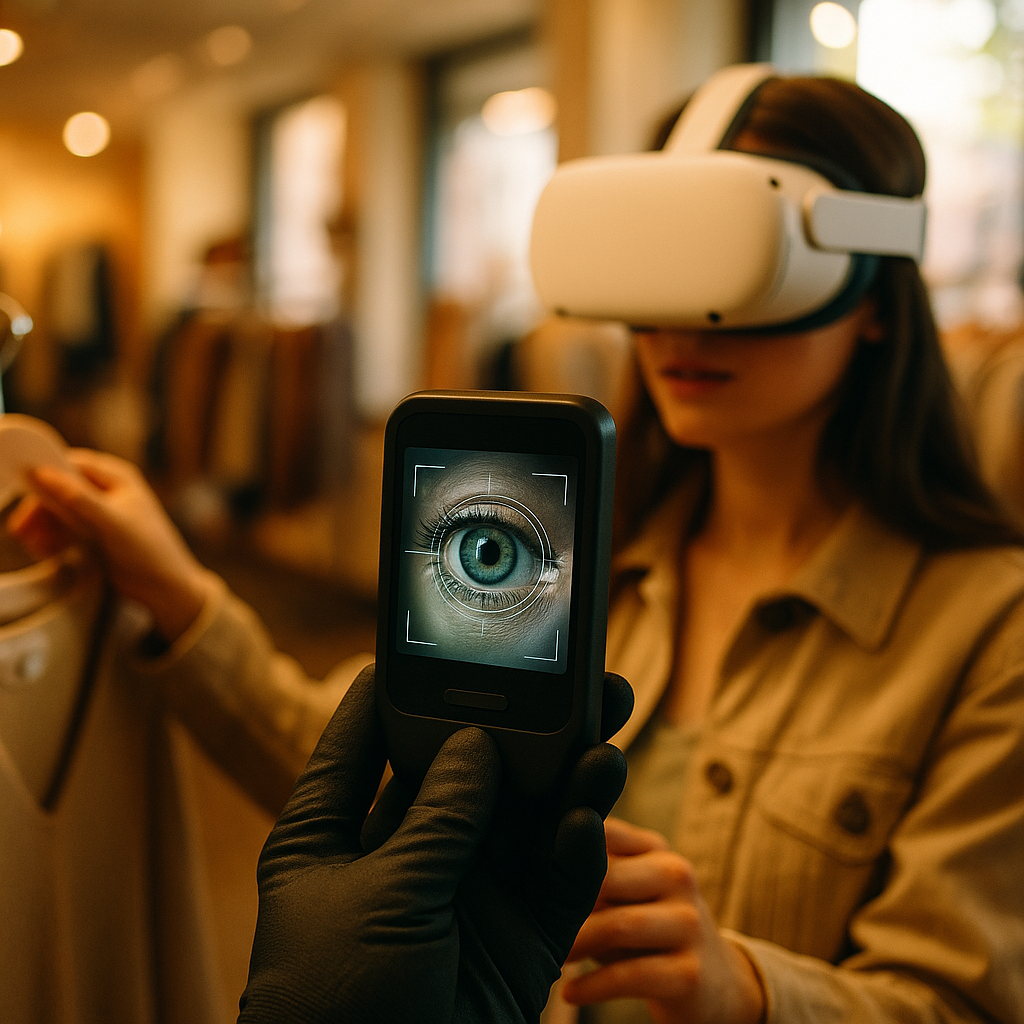
Virtual reality commerce is moving from novelty to mainstream, and retailers now collect more intimate signals than clicks. Navigating biometric data privacy in virtual reality shopping requires understanding what sensors capture, how that data can identify you, and what choices you actually have. This guide explains the risks, the rules, and practical steps for safer VR purchases—before your next “try-on” becomes a profile.
Biometric data in VR: what headsets and apps can collect
VR shopping feels frictionless because the system continuously measures how you move, look, and react. In 2025, many consumer headsets and retail apps can capture biometric data directly (through sensors) or infer it from behavior. Understanding the categories is the first step to managing privacy.
Common VR biometrics and “biometric-like” signals include:
- Eye tracking (gaze direction, fixation time, pupil dilation). Retailers use it for attention analytics, product placement tests, and ad measurement.
- Facial tracking (expressions, micro-movements). This can be used to infer emotion or engagement, especially during virtual try-ons.
- Voice data (voiceprints, tone, cadence). Voice assistants and in-world customer service tools may store recordings and transcripts.
- Hand and body tracking (pose, reach, stride, tremor). Even without names attached, movement patterns can be uniquely identifying.
- Physiological signals from accessories (heart rate, skin temperature, electrodermal activity). These may appear in fitness-oriented headsets or optional peripherals.
Not all of these are legally classified as “biometric identifiers” everywhere, but they can still become identifying when combined with account data, device IDs, payment tokens, location signals, or detailed behavioral logs. If a platform can reliably link a pattern to a person or household, privacy risk increases—even if the raw data looks anonymous.
Follow-up question readers often ask: “If I’m not using face recognition, why worry?” Because retail VR often relies on inference: gaze and movement can predict preferences, conditions, or vulnerabilities. The privacy issue is not only identification; it is also sensitive profiling.
VR shopping privacy risks: re-identification, profiling, and manipulation
Biometric signals in VR are high-resolution and continuous. That combination makes them valuable for personalization—and potentially invasive when used beyond what a shopper expects. The key risks fall into three buckets: re-identification, profiling, and behavioral influence.
Re-identification risk happens when “anonymous” sensor streams are tied back to a real person. VR movement and gaze patterns can be distinctive, and they become more linkable when platforms share data across apps, devices, ad networks, or loyalty programs. Even if a retailer claims “we don’t store your name,” a persistent device or account identifier can be enough to rebuild identity over time.
Sensitive profiling arises when platforms infer attributes from biometrics and behavior. Examples include:
- Inferring emotional state from facial cues or gaze jitter to optimize sales prompts.
- Deriving health-related signals from tremor, balance, or physiological sensors, even if the app is “just shopping.”
- Using gaze dwell time and body language to assign price sensitivity or “impulse likelihood.”
Manipulation and dark patterns can become more potent in immersive environments. If a system knows what you looked at, how long, and how your body reacted, it can tune the environment to nudge decisions—lighting, scarcity cues, salesperson avatars, or timing of discounts. In VR, these nudges can feel like “the world” rather than “an ad.”
Security risk matters too. Biometric data is hard to change; you can reset a password, but you cannot reset your gait or voice. A breach exposing biometric templates, raw recordings, or derived features can create long-term harm, including cross-service tracking or fraud.
Practical reader question: “Isn’t personalization worth it?” It can be—when it is transparent, optional, and limited to what’s necessary. The problem is hidden secondary use: when data collected to “improve fit” becomes input for advertising, pricing, or third-party analytics without clear consent.
Consumer data protection laws: GDPR, CPRA, and biometric regulations
In 2025, VR shopping privacy is governed by a patchwork of laws and platform policies. The safest approach is to assume that biometric and immersive data will be treated as sensitive, even where definitions differ, and to demand strong controls from any retailer or platform you use.
GDPR and EU privacy rules treat biometric data used for unique identification as a special category requiring a strong legal basis, often explicit consent. The GDPR also restricts profiling and automated decision-making that significantly affects individuals, and it requires purpose limitation, data minimization, transparency, and data subject rights (access, deletion, objection).
California’s CPRA (and similar state-level rules) elevates certain data to “sensitive personal information” and strengthens consumer rights around access, deletion, and opting out of sharing for cross-context behavioral advertising. For VR shoppers, the practical impact is that retailers must disclose categories of data collected and purposes, and must honor opt-outs where applicable.
Biometric privacy laws in some jurisdictions impose additional duties, such as obtaining informed consent before collecting biometric identifiers, publishing retention schedules, and limiting sale or disclosure. These rules often focus on face geometry, fingerprints, iris scans, and voiceprints, but regulators increasingly look at functional equivalents when they enable identification.
What this means for shoppers:
- You should be able to find clear disclosures about what sensors are used (eye tracking, face tracking, voice) and why.
- You should have opt-out choices for advertising and certain data sharing, and deletion options for stored recordings and logs.
- You should see retention limits, not “we keep it as long as needed” with no details.
What this means for retailers: if you operate VR shopping experiences, build privacy into product design—data mapping, risk assessments, vendor contracts, and least-privilege access. Provide just-in-time notices in VR, not only long web policies that users never read.
Consent and transparency in immersive commerce: what “meaningful” looks like
Consent in VR cannot be a single checkbox buried in a setup screen. Because immersive environments can collect continuously, meaningful consent must be granular, contextual, and reversible. Shoppers should understand what is being collected right now, not only what might be collected in theory.
Markers of meaningful transparency:
- Just-in-time prompts when enabling eye tracking, face tracking, or microphone recording, with a plain-language purpose.
- Separate toggles for “needed to function” vs “used to personalize/advertise” vs “shared with partners.”
- Visible status indicators showing when the mic or eye tracking is active.
- Easy revocation inside the VR experience and in account settings, with no loss of core shopping access unless strictly necessary.
- Plain explanations of consequences (for example, “disabling eye tracking may reduce try-on accuracy; it will not affect checkout”).
Watch for consent designs that pressure acceptance: “accept all to continue,” confusing toggle language, or default-on “improvement” settings that actually feed advertising. If a retailer claims data use is “anonymous,” look for details: What identifiers remain? Is the data aggregated? How long is it stored? Who can access it?
Follow-up question: “If I consent once, can the retailer change uses later?” Policy changes happen, but meaningful consent requires notice and, for materially new uses of sensitive data, a renewed opt-in. If you see broad language like “for any business purpose,” treat it as a risk signal.
Data security and retention for biometric identifiers: best practices to demand
Even when collection is legitimate, security failures can turn sensitive VR data into lasting harm. Shoppers should look for signals that a platform treats biometric and immersive telemetry as high-risk. Retailers should implement controls that match the sensitivity of the data.
Security measures that indicate maturity:
- Data minimization by design: collect only what is necessary for the feature; avoid raw sensor storage when derived, non-identifying features will do.
- On-device processing where feasible, especially for eye and face tracking, with only necessary outputs sent to servers.
- Encryption in transit and at rest, with strong key management and limited access paths.
- Segmentation: keep biometric data separate from identity and payment data; reduce linkability across systems.
- Short retention windows with automatic deletion, plus user-triggered deletion that actually removes backups where feasible.
- Vendor controls: written limits on analytics partners, prohibition on onward sale, and audit rights.
Red flags: indefinite retention, vague “improve services” language paired with broad sharing, no way to delete recordings, and no explanation of whether eye/face tracking is processed locally or uploaded.
Retailers can strengthen trust by publishing a clear data map (categories collected, purpose, retention) and by offering independent security assurances. Shoppers can also reduce risk by limiting what they provide: avoid linking unnecessary social accounts, and use a payment method that minimizes data exposure when possible.
How to shop safely in VR: settings, choices, and practical checklists
Privacy protection improves when you combine platform controls with smart habits. The goal is not to avoid VR shopping, but to limit collection to what you find acceptable and to prevent secondary use.
Before you enter a VR store:
- Review headset privacy settings: disable eye tracking and face tracking by default, then enable only when a feature truly needs it.
- Check microphone permissions and use push-to-talk if available.
- Limit ad tracking: opt out of cross-app tracking and interest-based ads in platform settings.
- Use a separate shopping profile if your platform allows multiple profiles, reducing linkage to social or work activity.
Inside the VR shopping experience:
- Look for clear indicators that sensors are active; if the app offers “performance analytics,” keep it off unless you want it.
- Skip optional “emotion” or “personalization” features that rely on face/eye signals unless the value is clear.
- Be cautious with virtual try-ons that request face scans or room scans; confirm whether scans are processed on-device and how long they are stored.
After checkout:
- Delete stored recordings and scans where possible (voice history, body/face calibration data, room mapping).
- Request access or deletion through the retailer’s privacy portal if you want confirmation of what was stored.
- Revoke permissions for apps you no longer use, especially microphone and tracking permissions.
What if a retailer won’t let you opt out? Treat that as a signal to shop elsewhere. In 2025, many brands can offer core browsing and checkout without collecting high-risk biometrics. If an experience claims eye tracking is required, ask whether it is truly necessary or simply beneficial for analytics.
FAQs about biometric data privacy in VR shopping
Is eye tracking considered biometric data?
It can be. Eye tracking data may be treated as biometric or sensitive depending on how it is used and whether it can identify you. Even when not legally classified as a biometric identifier, gaze patterns can still enable profiling and should be protected like sensitive data.
Can VR shopping apps sell my biometric data?
Some laws restrict the sale or disclosure of biometric identifiers, and many platforms prohibit certain sharing in policy. In practice, risk often comes from “sharing” for analytics or advertising rather than a direct sale. Look for disclosures about partners, cross-context advertising, and whether data is de-identified.
What’s the difference between raw biometric data and derived data?
Raw data includes recordings or sensor streams (voice audio, face mesh, gaze vectors). Derived data includes features or inferences (engagement scores, emotion predictions, attention heatmaps). Derived data can still be sensitive because it may reveal attributes or influence decisions about you.
Do I have to allow face scans for virtual try-ons?
No, not always. Some try-ons work with less invasive inputs or on-device processing. If an app requires a face scan, check whether it is stored, for how long, and whether you can delete it. If the app cannot explain this clearly, consider avoiding the feature.
How can I tell if data is processed on-device or uploaded?
Look for the retailer’s and platform’s technical privacy notes, permission screens, and settings descriptions. If documentation is unclear, assume upload may occur. Strong privacy programs state where processing happens, what is transmitted, and what is retained.
What should I do if I suspect misuse of my VR biometric data?
Revoke permissions, delete stored histories, and submit a data access/deletion request to the retailer and platform. Document what you observed (screenshots of settings and notices). If responses are inadequate, file a complaint with the relevant regulator in your jurisdiction.
Virtual reality shopping can be convenient, but it relies on signals that expose more than product preferences. Treat eye, face, voice, and movement data as sensitive, limit collection to necessary features, and use platform controls to opt out of tracking and sharing. In 2025, the safest path is informed choice: demand clear disclosures, short retention, and easy deletion—then shop with confidence.
Top Influencer Marketing Agencies
The leading agencies shaping influencer marketing in 2026
Agencies ranked by campaign performance, client diversity, platform expertise, proven ROI, industry recognition, and client satisfaction. Assessed through verified case studies, reviews, and industry consultations.
Moburst

-
2

The Shelf
Boutique Beauty & Lifestyle Influencer AgencyA data-driven boutique agency specializing exclusively in beauty, wellness, and lifestyle influencer campaigns on Instagram and TikTok. Best for brands already focused on the beauty/personal care space that need curated, aesthetic-driven content.Clients: Pepsi, The Honest Company, Hims, Elf Cosmetics, Pure LeafVisit The Shelf → -
3

Audiencly
Niche Gaming & Esports Influencer AgencyA specialized agency focused exclusively on gaming and esports creators on YouTube, Twitch, and TikTok. Ideal if your campaign is 100% gaming-focused — from game launches to hardware and esports events.Clients: Epic Games, NordVPN, Ubisoft, Wargaming, Tencent GamesVisit Audiencly → -
4

Viral Nation
Global Influencer Marketing & Talent AgencyA dual talent management and marketing agency with proprietary brand safety tools and a global creator network spanning nano-influencers to celebrities across all major platforms.Clients: Meta, Activision Blizzard, Energizer, Aston Martin, WalmartVisit Viral Nation → -
5

The Influencer Marketing Factory
TikTok, Instagram & YouTube CampaignsA full-service agency with strong TikTok expertise, offering end-to-end campaign management from influencer discovery through performance reporting with a focus on platform-native content.Clients: Google, Snapchat, Universal Music, Bumble, YelpVisit TIMF → -
6

NeoReach
Enterprise Analytics & Influencer CampaignsAn enterprise-focused agency combining managed campaigns with a powerful self-service data platform for influencer search, audience analytics, and attribution modeling.Clients: Amazon, Airbnb, Netflix, Honda, The New York TimesVisit NeoReach → -
7

Ubiquitous
Creator-First Marketing PlatformA tech-driven platform combining self-service tools with managed campaign options, emphasizing speed and scalability for brands managing multiple influencer relationships.Clients: Lyft, Disney, Target, American Eagle, NetflixVisit Ubiquitous → -
8

Obviously
Scalable Enterprise Influencer CampaignsA tech-enabled agency built for high-volume campaigns, coordinating hundreds of creators simultaneously with end-to-end logistics, content rights management, and product seeding.Clients: Google, Ulta Beauty, Converse, AmazonVisit Obviously →