


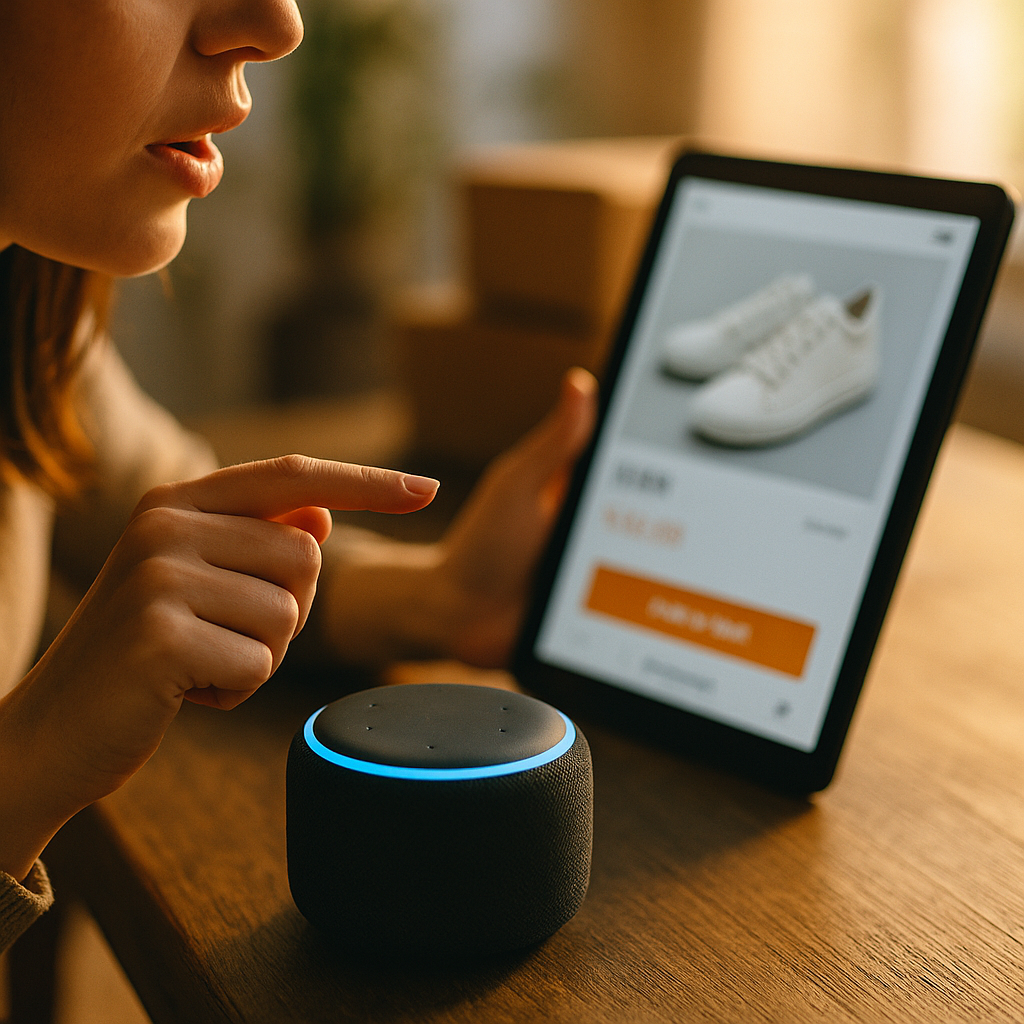
In 2025, shoppers increasingly expect to browse and buy without tapping a screen, and brands must meet them where they speak. Headless ecommerce for voice first shopping combines flexible commerce architecture with conversational interfaces that can sell through smart speakers, in-car assistants, and mobile voice. This article reviews what works, what breaks, and how to build voice journeys that convert—before your competitors do.
Why voice commerce UX needs headless architecture
Voice shopping is not “web checkout with a microphone.” It is a different interaction model: users ask, confirm, refine, and decide in short turns. Traditional monolithic storefronts are optimized for pages, navigation menus, and visual browsing. Voice is optimized for intents, entities, and spoken confirmation. This mismatch is exactly where headless architecture shines.
Headless separates the commerce engine (catalog, pricing, promotions, cart, checkout, customer accounts) from the presentation layer (web, app, kiosk, voice assistant). For voice, this brings three direct benefits:
- Omnichannel parity: the same product data, prices, inventory, and promotions can power web, app, and voice experiences, reducing “voice-only” discrepancies that erode trust.
- Faster iteration: voice flows change often as you tune intents and reduce friction. Headless APIs let you ship conversational improvements without waiting on front-end release cycles tied to a theme or template.
- Context-aware experiences: voice assistants can pass signals (device type, locale, customer ID, order history) into API calls so the commerce engine returns tailored results without brittle UI workarounds.
Voice also raises a UX constraint: users can’t scan a grid of options. If your catalog is large, voice needs structure (facets, top picks, constraints, and disambiguation). Headless helps by enabling purpose-built endpoints (or orchestration layers) that return “speakable” results: fewer choices, clearer attributes, and stronger defaults.
Composable commerce stack for voice assistants
A voice-first setup rarely connects a voice platform directly to a commerce platform. In practice, teams use a composable stack where each component has clear responsibility and can evolve independently.
Core components you typically need:
- Commerce engine (headless commerce platform): product information, price books, promotions, inventory, cart, checkout, order management, returns, customer accounts.
- API gateway and orchestration: rate limiting, auth, caching, and a “voice orchestration” layer that merges catalog + inventory + personalization into one response.
- Search and discovery: synonym handling, facets, relevance tuning, and “top intent” results that minimize back-and-forth.
- Customer identity: sign-in, token management, and account linking between the assistant and your customer profile.
- Payments and fraud: tokenized payments, step-up authentication, risk scoring, and support for “confirm with passcode” or device-based confirmation.
- Analytics and experimentation: conversation logs (privacy-safe), funnel analytics, A/B testing of prompts, and error reporting.
Integration approach: treat the voice assistant as a client application that calls your APIs. Avoid embedding business logic in the voice platform’s scripts. Put pricing rules, eligibility checks, and inventory validation in the commerce domain so every channel behaves consistently.
What “good” looks like in 2025: a voice request triggers an intent (for example, “reorder coffee pods”), your orchestration layer resolves identity, fetches the customer’s prior purchases, checks current inventory, suggests the best matching SKU, confirms price and delivery date, and submits the order with a secure confirmation step. The assistant remains a conversational shell; your stack remains the system of record.
Voice first shopping journeys and conversational checkout
Voice experiences win when they reduce cognitive load and time-to-order. They lose when they force users through long confirmations, read out irrelevant attributes, or trap them in loops. The best voice journeys are short, specific, and reversible.
High-converting voice flows to prioritize:
- Reorder and replenishment: “Buy my usual,” “Reorder last month’s,” “Add detergent to my cart.” This is the most natural fit because it relies on history rather than discovery.
- Track, change, and return: “Where is my order,” “Change delivery window,” “Start a return.” These build trust and train customers to use voice with your brand.
- Quick add-to-cart for known items: “Add two AA batteries,” “Buy iPhone charger,” followed by one clarifying question if needed.
- Guided gifting: voice can work if you constrain choices: “Gift under $50 for a 10-year-old who likes science,” then present 2–3 options and offer to send links to the phone for final review.
Design principles that prevent drop-off:
- Ask fewer questions: if size, color, or subscription frequency can be inferred from history or preferences, propose a default and ask for confirmation.
- Limit options: present a maximum of three items at a time. If more exist, ask a narrowing question (“Do you prefer pods or ground?”).
- Use progressive disclosure: speak only the attributes needed to decide. Offer details on request (“Want ingredients or reviews?”).
- Create an “escape hatch”: let users switch to screen (“I’ve sent the options to your phone”) and resume later without losing the cart.
- Make confirmation meaningful: confirm the total price, delivery date, and return policy highlights; avoid repeating long SKU names.
Checkout reality: pure voice checkout is feasible for low-risk reorders and stored payment methods, but it must be secure. Many brands use a hybrid pattern: voice initiates the cart and shipping method, then a push notification finalizes payment and consent. That approach respects privacy and reduces accidental purchases.
SEO and structured data for voice search commerce
Voice-first shopping experiences depend on discoverability. Even if the transaction happens in an assistant, the user often begins with voice search on mobile (“Where can I buy…”) or asks an assistant for brand and product recommendations. Your content and product data must be machine-readable and “speakable.”
Practical SEO steps for voice commerce in 2025:
- Target conversational queries: build pages that answer “best,” “near me,” “how much,” “does it fit,” “is it compatible,” and “how long shipping takes” with short, direct answers.
- Strengthen product detail clarity: ensure each product has a clean name, brand, model, compatibility notes, and a concise value proposition that can be spoken.
- Improve local and availability signals: for retailers, keep store inventory and pickup options accurate, and align on consistent NAP data across listings.
- Optimize for featured answers: add brief, factual paragraphs and lists that can be read aloud without losing meaning.
Structured data guidance: use Product, Offer, AggregateRating, and FAQ-style structured content in ways that map cleanly to your catalog. In a headless setup, generate structured content from your product information management system so it stays consistent across web and voice. Avoid “marketing-only” attributes that confuse assistants; prioritize data that helps disambiguate: size, unit count, material, compatibility, and warranty.
Follow-up question you might have: “Does headless help SEO?” Yes—if you implement server-rendering or hybrid rendering properly, keep crawlable URLs, and ensure canonicalization. Headless does not guarantee SEO; it enables you to design the delivery layer so search engines and assistants can reliably parse your content.
Security, privacy, and accessibility in voice commerce
Voice adds new trust challenges. People worry about accidental purchases, household members ordering items, or assistants mishearing critical details. A voice-first strategy must show restraint, build verification into the flow, and protect customer data end-to-end.
Security controls to implement:
- Step-up authentication: require a PIN, biometric confirmation on a paired device, or account re-auth for high-value items, address changes, and new payment methods.
- Role-based household controls: allow account owners to set limits, approve purchases, or restrict categories for shared devices.
- Tokenized payments: never expose raw payment details to the voice layer. Use tokens and PCI-compliant payment processors.
- Order verification: confirm price, quantity, delivery address, and delivery date in a single concise recap, then require an explicit “Place order.”
Privacy practices aligned with EEAT:
- Data minimization: store only what you need for the experience, and define retention windows for transcripts and intent logs.
- Transparent consent: clearly state when the assistant links to an account, what data is shared, and how to disconnect.
- Auditability: keep traceable logs of commerce actions (what was ordered, when, by which linked account) without keeping unnecessary voice recordings.
Accessibility: voice can improve access for people with visual or motor impairments, but only if prompts are clear and error handling is respectful. Provide alternatives: SMS/email summaries, screen handoff, and easy cancellation. Avoid rapid speech, jargon, and long product names. Accessibility improvements also reduce cart abandonment for everyone.
Implementation checklist and KPIs for headless voice commerce
A review is only useful if it leads to a build plan. Below is a practical checklist that keeps teams aligned across product, engineering, security, and merchandising.
Implementation checklist:
- Define voice use cases: start with reorder, order tracking, and quick add-to-cart; delay open-ended discovery until data and prompts mature.
- Clean product data: normalize names, units, variants, and attribute taxonomy. Voice fails when catalog data is inconsistent.
- Create “speakable” responses: design a response schema that includes short titles, one-line descriptions, and top differentiators.
- Build an orchestration layer: consolidate calls to search, inventory, pricing, promotions, and personalization into a single endpoint per intent.
- Design for disambiguation: implement rules for “same name, different variant” situations, and decide when to send choices to a screen.
- Secure account linking: implement OAuth-based linking and step-up authentication for sensitive actions.
- Test in realistic environments: background noise, accents, kids at home, in-car use, and intermittent connectivity.
- Instrument analytics: track intent recognition, fallback rate, time-to-complete, and conversion by flow.
KPIs that matter for voice-first shopping experiences:
- Task completion rate: percent of sessions that reach a successful outcome (order placed, tracking delivered, return started).
- Fallback and reprompt rate: how often the system says “I didn’t catch that” or asks the user to repeat.
- Disambiguation depth: number of clarifying turns before a product is selected; keep it low with better data and smarter defaults.
- Voice-to-cart and voice-to-order conversion: measure both, since some flows intentionally hand off to a screen for final purchase.
- Repeat usage: how many customers use voice again within 30 days after a first successful task.
- Customer support contact rate: voice should reduce “where is my order” contacts; if it increases them, your confirmations and post-order messaging need work.
Answer to the question executives ask: “Should we go headless just for voice?” If voice is one of several emerging channels you expect to serve—mobile, kiosks, partner apps, in-car, messaging—headless is a strategic foundation. If voice is experimental and your current stack is stable, you can still prototype using an API layer in front of your existing platform, then migrate to a fuller headless model once value is proven.
FAQs
What is the main benefit of headless commerce for voice shopping?
It lets you reuse the same commerce capabilities—catalog, pricing, inventory, cart, checkout, and customer accounts—across voice and other channels while tailoring the conversational interface without changing the core platform.
Can customers complete checkout entirely by voice?
Yes for low-risk scenarios like reorders with stored payment methods, but many brands use step-up verification or a phone handoff for final payment confirmation to reduce fraud and accidental purchases.
How do you handle product discovery when users can’t see a list?
Constrain choices to 2–3 options, ask one narrowing question at a time, and use customer history to propose defaults. For complex comparisons, send a summary and links to a screen while preserving the cart.
Does headless commerce improve voice search SEO?
Indirectly. Headless helps you publish consistent, structured product content and fast experiences, but SEO still depends on crawlable rendering, clean URLs, canonical tags, and content that answers conversational queries.
What data quality issues break voice commerce most often?
Inconsistent variant naming, missing units (count, size, weight), unclear compatibility attributes, and duplicated product titles. Voice relies on disambiguation, so clarity and normalization are essential.
What are the most important metrics to monitor after launch?
Task completion rate, fallback/reprompt rate, disambiguation turns, voice-to-cart and voice-to-order conversion, repeat usage, and support contact rate tied to voice-originated sessions.
Headless ecommerce and voice interfaces fit together because they solve different problems: headless standardizes commerce logic, while voice specializes in fast, conversational decisions. In 2025, the winning approach is pragmatic—start with reorders and service tasks, build an orchestration layer, and secure confirmation steps. Treat product data as UX, measure completion relentlessly, and expand only after reliability is proven.
Top Influencer Marketing Agencies
The leading agencies shaping influencer marketing in 2026
Agencies ranked by campaign performance, client diversity, platform expertise, proven ROI, industry recognition, and client satisfaction. Assessed through verified case studies, reviews, and industry consultations.
Moburst

-
2

The Shelf
Boutique Beauty & Lifestyle Influencer AgencyA data-driven boutique agency specializing exclusively in beauty, wellness, and lifestyle influencer campaigns on Instagram and TikTok. Best for brands already focused on the beauty/personal care space that need curated, aesthetic-driven content.Clients: Pepsi, The Honest Company, Hims, Elf Cosmetics, Pure LeafVisit The Shelf → -
3

Audiencly
Niche Gaming & Esports Influencer AgencyA specialized agency focused exclusively on gaming and esports creators on YouTube, Twitch, and TikTok. Ideal if your campaign is 100% gaming-focused — from game launches to hardware and esports events.Clients: Epic Games, NordVPN, Ubisoft, Wargaming, Tencent GamesVisit Audiencly → -
4

Viral Nation
Global Influencer Marketing & Talent AgencyA dual talent management and marketing agency with proprietary brand safety tools and a global creator network spanning nano-influencers to celebrities across all major platforms.Clients: Meta, Activision Blizzard, Energizer, Aston Martin, WalmartVisit Viral Nation → -
5

The Influencer Marketing Factory
TikTok, Instagram & YouTube CampaignsA full-service agency with strong TikTok expertise, offering end-to-end campaign management from influencer discovery through performance reporting with a focus on platform-native content.Clients: Google, Snapchat, Universal Music, Bumble, YelpVisit TIMF → -
6

NeoReach
Enterprise Analytics & Influencer CampaignsAn enterprise-focused agency combining managed campaigns with a powerful self-service data platform for influencer search, audience analytics, and attribution modeling.Clients: Amazon, Airbnb, Netflix, Honda, The New York TimesVisit NeoReach → -
7

Ubiquitous
Creator-First Marketing PlatformA tech-driven platform combining self-service tools with managed campaign options, emphasizing speed and scalability for brands managing multiple influencer relationships.Clients: Lyft, Disney, Target, American Eagle, NetflixVisit Ubiquitous → -
8

Obviously
Scalable Enterprise Influencer CampaignsA tech-enabled agency built for high-volume campaigns, coordinating hundreds of creators simultaneously with end-to-end logistics, content rights management, and product seeding.Clients: Google, Ulta Beauty, Converse, AmazonVisit Obviously →