


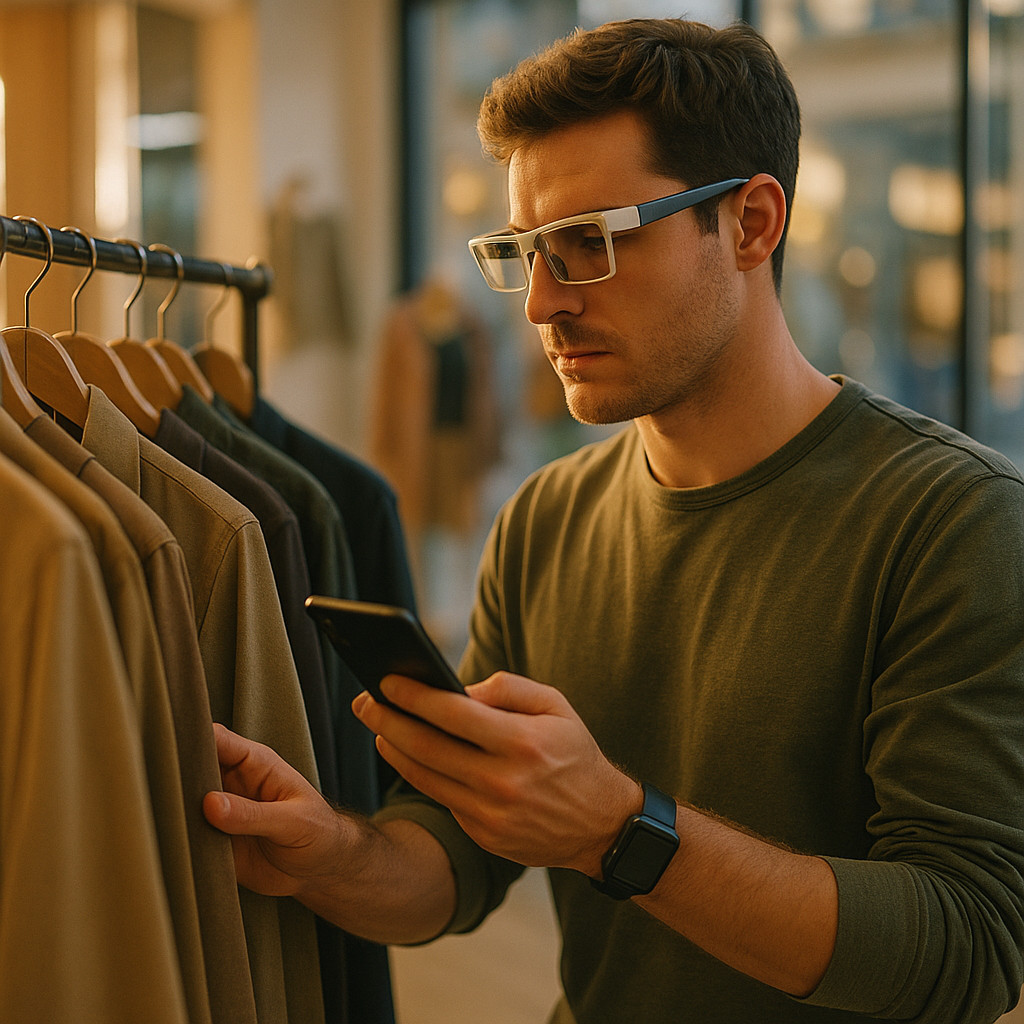
The Impact of Wearable AI Devices on Future Brand Discovery Habits is becoming a practical concern for marketers and consumers in 2025. As AI shifts from phones to glasses, rings, earbuds, and health trackers, discovery turns into a continuous, context-aware experience. The devices you wear see, hear, and infer intent in real time, changing how brands are found, compared, and trusted—so what wins attention next?
Wearable AI devices and ambient search
Wearable AI devices are moving search from a deliberate activity (“open app, type query”) to an ambient layer that runs alongside daily life. Smart glasses can identify products in your field of view, earbuds can answer questions hands-free, and rings or watches can infer when you’re exercising, commuting, or shopping. This creates a new discovery mode: zero-interface discovery—brands appear as suggestions, not results.
In practice, “ambient search” means the wearable’s assistant anticipates the next question: What is this? Is it compatible with what I own? Is there a cheaper or healthier option nearby? Instead of clicking ten links, users often accept one recommendation. That compression changes brand competition: the fight shifts from ranking in a long list to being the single option the assistant confidently suggests.
Marketers should expect discovery prompts to come from real-world context: a user looks at a sneaker on the train; glasses overlay price comparisons and authenticity checks. A user walks past a café; earbuds mention a brand’s seasonal drink because the wearable knows the user prefers low sugar and is meeting a friend within 10 minutes. This is not science fiction; it is the logical extension of on-device models, multimodal perception, and improved battery efficiency.
The follow-up question most teams ask is: does this replace phone search? It doesn’t fully replace it, but it changes the entry point. Wearables often initiate discovery, while phones and laptops handle deeper evaluation and checkout. Brands that design for both moments—instant “why this” and deeper “prove it”—will earn the conversion.
Brand discovery habits and personalized recommendations
Brand discovery habits are increasingly shaped by personalized recommendations that rely on signals wearables capture: movement patterns, location cadence, biometric trends, and even conversational cues. The upside for users is relevance; the risk is an echo chamber where a few brands repeatedly surface because they already fit the user profile.
In 2025, the assistant’s recommendation logic often blends:
- Immediate intent (what the user is doing right now)
- Longer-term preferences (diet, style, budget boundaries, sustainability interest)
- Constraints (time, proximity, availability, compatibility)
- Confidence signals (reviews, return rates, verified authenticity, expert sources)
This changes how brands get “discovered.” Traditional awareness campaigns still matter, but wearable-driven discovery heavily rewards structured clarity: clear product naming, unambiguous variants, transparent specs, and reliable inventory data. If the assistant can’t confidently distinguish your “Pro,” “Plus,” and “Max” models—or can’t verify which one fits the user’s existing ecosystem—it may avoid recommending you.
To counter filter bubbles and keep discovery fresh, platforms are likely to introduce “exploration modes” that intentionally diversify suggestions. Brands can benefit by creating distinct occasions for discovery: limited-time experiences, local partnerships, or content that helps users learn (not just buy). When the assistant sees your brand repeatedly providing helpful answers—care instructions, sizing guidance, ingredient explanations, warranty clarity—it treats you as a safer recommendation.
A practical implication: your best-performing content may no longer be a blog post; it may be a compact, assistant-friendly knowledge unit—FAQs, comparison tables, troubleshooting steps, and concise claims with evidence. The wearable assistant can summarize it on demand, which effectively becomes the first impression.
Voice commerce and hands-free shopping journeys
Voice commerce becomes more natural when the microphone is already in the earbud and the AI is always available. The discovery journey turns conversational: “Find a rain jacket under $150 that’s breathable and not shiny.” The assistant then asks clarifying questions, narrows options, and may place an order without a screen.
This hands-free flow reshapes brand discovery in three important ways:
- Fewer visible touchpoints: users may never see your homepage. They hear your brand name and a short rationale.
- Higher stakes for pronunciation and naming: brands with confusing names suffer in voice-first environments. Distinct, pronounceable names and consistent product titles win.
- Trust becomes the interface: when users can’t see ten options, they rely on the assistant’s confidence and the brand’s reputation.
Brands should plan for “audio-first proof.” That means concise, verifiable claims that an assistant can speak without legal ambiguity. Instead of “best-in-class,” provide measurable value: battery life ranges, material certifications, fit guarantees, return windows, and independent test results where available.
Users will also ask follow-up questions mid-journey: “Will it fit a 14-inch laptop?” “Is it machine washable?” “Can I return it in-store?” If your product data and policy language are not clean and structured, the assistant will hesitate, and hesitation often ends the sale. The brands that win will treat conversational discovery as a product design problem, not just a marketing channel.
Privacy-first marketing and consumer trust signals
Wearables intensify privacy concerns because they are intimate: they sit on bodies, travel everywhere, and may capture sensitive context. As a result, privacy-first marketing becomes a major driver of discovery. Consumers will increasingly choose brands that feel safe to engage with through AI intermediaries.
In 2025, privacy expectations are rising for three reasons: on-device processing is more feasible, regulatory scrutiny remains high across major markets, and consumers better understand data trade-offs. Wearable platforms will likely reward brands that minimize data collection, limit retention, and communicate clearly.
Trust signals that influence discovery through wearable AI include:
- Consent clarity: plain-language permissions and granular opt-ins
- Data minimization: collecting only what is needed for the stated purpose
- Security posture: strong encryption, breach transparency, secure authentication
- Policy honesty: no hidden sharing, no vague “partners” wording
- Responsible AI claims: explanations of how recommendations are generated and how bias is mitigated
These signals will show up indirectly in discovery. If a wearable assistant has a “safe brands” preference layer—based on audits, user feedback, or platform policies—then privacy posture becomes a ranking factor. Even without explicit scoring, users will ask: “Does this brand track me?” “Can I use it without creating an account?” “Will it sell my data?” If you can’t answer quickly and credibly, you lose the moment.
For EEAT-strengthening content, brands should publish clear privacy FAQs, explain what data is used for personalization, and offer alternatives (guest checkout, reduced tracking mode). Expert-reviewed policy summaries and easy-to-read security pages help both users and assistants interpret your brand as low risk.
Retail media and AI assistant optimization
Retail media remains influential, but wearable-driven discovery changes where and how ads matter. Instead of banners on a phone screen, ads may appear as assistant suggestions, audio mentions, or subtle overlays in smart glasses. This makes AI assistant optimization as important as classic SEO and marketplace optimization.
AI assistant optimization is not about “gaming” an algorithm; it is about making your brand easier to recommend responsibly. Focus on:
- High-integrity product data: accurate specs, rich attributes, compatibility info, and standardized identifiers
- Availability and fulfillment truth: real-time inventory, delivery estimates, and return options
- Evidence-backed claims: certifications, lab tests, third-party reviews, and warranty terms
- Consistent brand entity signals: uniform naming across retailers, apps, listings, and customer support
- Customer support readiness: fast resolutions and policies that reduce risk for first-time buyers
Retail media placements will likely become more outcome-based: “assistant-recommended” slots that require meeting quality thresholds. Brands should anticipate stricter requirements around reviews authenticity, counterfeit controls, and policy clarity. If a platform can’t trust your data, it can’t safely recommend you in a one-answer environment.
Answering the common follow-up: will paid media dominate assistant recommendations? Paid placement will exist, but it will be constrained by trust and user satisfaction. Assistants that repeatedly push irrelevant suggestions get ignored. The sustainable play is a mix of paid visibility and genuine helpfulness—so the assistant can justify recommending you with confidence.
Future shopping behavior and experiential brand moments
Future shopping behavior with wearables will place more emphasis on “micro-moments” and fewer on long browsing sessions. Discovery will happen in short bursts: outside a store, during a workout, while cooking, or as someone compares options in front of a shelf. Brands that create useful, context-aware experiences will earn attention without feeling intrusive.
Examples of experiential brand moments that fit wearable discovery:
- In-aisle guidance: glasses overlay allergens, sourcing details, or usage tips for your product
- Fit and try-on confidence: size recommendations based on prior purchases and return behavior
- Maintenance coaching: earbuds guide setup, cleaning, or troubleshooting after purchase
- Local utility: “in stock nearby,” appointment availability, or pickup readiness
- Community validation: verified owner insights and expert endorsements surfaced at decision time
This is where EEAT becomes tangible: experience shows up as practical guidance, expertise shows up as accurate and specific advice, authoritativeness shows up as independent validation, and trust shows up as honest limits and reliable fulfillment.
Brands should prepare for discovery that starts with the question “what should I do?” rather than “what should I buy?” If your content and services help users complete tasks—cook a meal, finish a workout, set up a device—your brand becomes the default recommendation because it consistently reduces friction.
FAQs about wearable AI and brand discovery
-
How will wearable AI devices change SEO and search visibility?
Wearables shift attention from long result pages to one or two assistant recommendations. Classic SEO still matters, but brands also need assistant-friendly structured information, clear entity signals, and evidence-backed answers that can be summarized accurately in voice or overlays.
-
Will brand apps matter less in a wearable-first world?
Apps still matter for loyalty, support, and deeper experiences, but they may stop being the first touchpoint. Wearables often introduce the brand; apps then handle onboarding, personalization controls, and post-purchase value such as coaching, updates, and warranty management.
-
What content should brands create to be recommended by AI assistants?
Create concise, verifiable content: product specs, compatibility notes, sizing and fit guidance, ingredient and allergen details, setup steps, returns and warranty terms, and comparison guidance. Make claims measurable and easy to cite, and keep them consistent across channels.
-
How can smaller brands compete when assistants recommend fewer options?
Win on clarity and trust. Use distinctive naming, clean product data, strong reviews quality, transparent policies, and a focused niche where you can be the “best match” for specific contexts. Partner with credible retailers or experts to build authority signals.
-
What privacy expectations will consumers have with wearable AI?
Consumers will expect minimal collection, clear consent, and control over personalization. Brands that offer guest modes, explain how recommendations use data, and avoid unnecessary tracking are more likely to be considered “safe” and therefore surfaced more often.
-
How should brands measure success in wearable-driven discovery?
Track assistant-attributed referrals where available, lift in branded queries, store visits and local availability interactions, repeat purchase rates, and support outcomes like reduced returns. Also monitor “recommendation readiness” metrics: data accuracy, review health, and policy comprehension.
Wearable AI devices are shifting discovery from searching to being guided, with assistants compressing choice into a few trusted suggestions. In 2025, brands earn visibility by supplying accurate product data, evidence-backed claims, privacy-forward policies, and genuinely helpful experiences that fit real-world moments. The takeaway is simple: design for contextual, conversational discovery—or risk becoming invisible when the assistant speaks.
Top Influencer Marketing Agencies
The leading agencies shaping influencer marketing in 2026
Agencies ranked by campaign performance, client diversity, platform expertise, proven ROI, industry recognition, and client satisfaction. Assessed through verified case studies, reviews, and industry consultations.
Moburst

-
2

The Shelf
Boutique Beauty & Lifestyle Influencer AgencyA data-driven boutique agency specializing exclusively in beauty, wellness, and lifestyle influencer campaigns on Instagram and TikTok. Best for brands already focused on the beauty/personal care space that need curated, aesthetic-driven content.Clients: Pepsi, The Honest Company, Hims, Elf Cosmetics, Pure LeafVisit The Shelf → -
3

Audiencly
Niche Gaming & Esports Influencer AgencyA specialized agency focused exclusively on gaming and esports creators on YouTube, Twitch, and TikTok. Ideal if your campaign is 100% gaming-focused — from game launches to hardware and esports events.Clients: Epic Games, NordVPN, Ubisoft, Wargaming, Tencent GamesVisit Audiencly → -
4

Viral Nation
Global Influencer Marketing & Talent AgencyA dual talent management and marketing agency with proprietary brand safety tools and a global creator network spanning nano-influencers to celebrities across all major platforms.Clients: Meta, Activision Blizzard, Energizer, Aston Martin, WalmartVisit Viral Nation → -
5

The Influencer Marketing Factory
TikTok, Instagram & YouTube CampaignsA full-service agency with strong TikTok expertise, offering end-to-end campaign management from influencer discovery through performance reporting with a focus on platform-native content.Clients: Google, Snapchat, Universal Music, Bumble, YelpVisit TIMF → -
6

NeoReach
Enterprise Analytics & Influencer CampaignsAn enterprise-focused agency combining managed campaigns with a powerful self-service data platform for influencer search, audience analytics, and attribution modeling.Clients: Amazon, Airbnb, Netflix, Honda, The New York TimesVisit NeoReach → -
7

Ubiquitous
Creator-First Marketing PlatformA tech-driven platform combining self-service tools with managed campaign options, emphasizing speed and scalability for brands managing multiple influencer relationships.Clients: Lyft, Disney, Target, American Eagle, NetflixVisit Ubiquitous → -
8

Obviously
Scalable Enterprise Influencer CampaignsA tech-enabled agency built for high-volume campaigns, coordinating hundreds of creators simultaneously with end-to-end logistics, content rights management, and product seeding.Clients: Google, Ulta Beauty, Converse, AmazonVisit Obviously →