


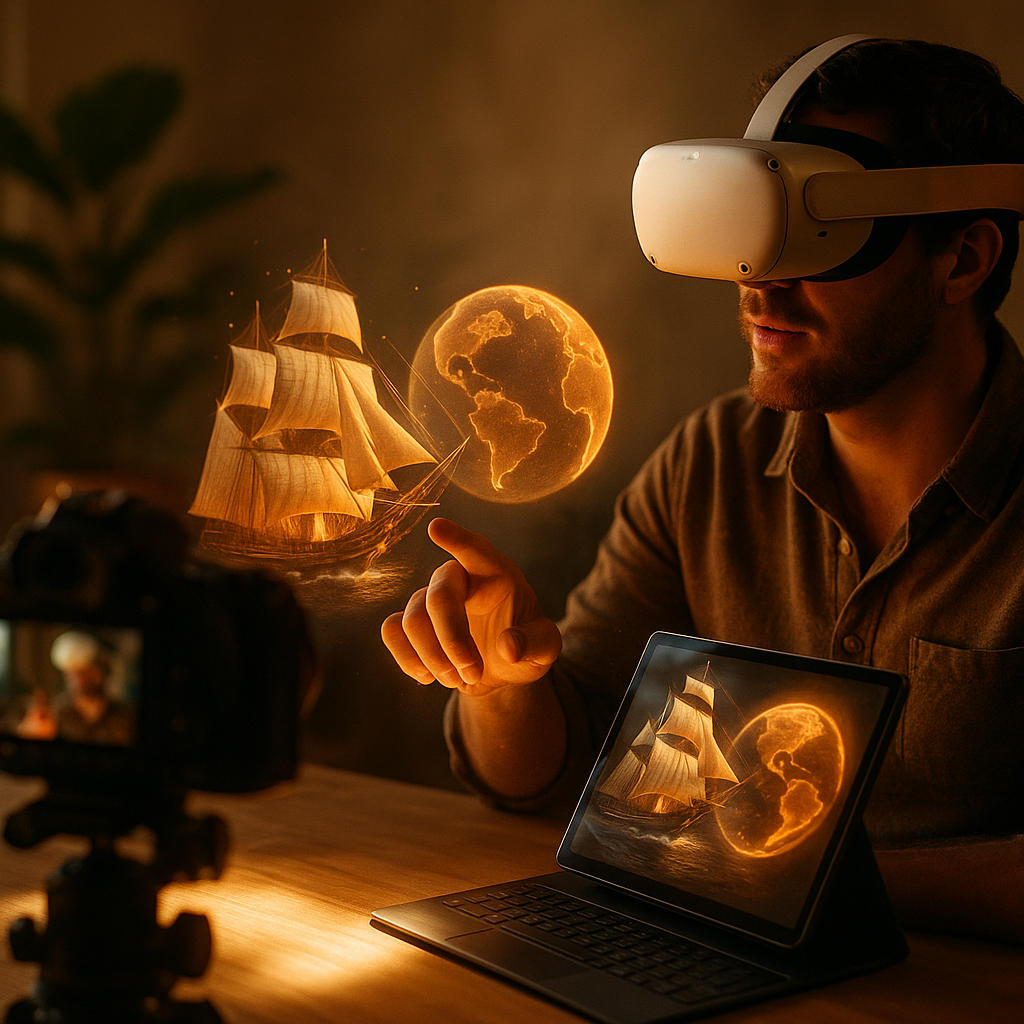
In 2025, spatial computing narrative brand content is shifting from screens to lived environments, merging storytelling with place, gesture, and context. For brands, this means stories can respond to where people are, what they see, and how they move—without feeling like ads. The winners will design narratives that earn attention, respect privacy, and deliver utility, not novelty. So what changes first?
What spatial computing means for immersive storytelling
Spatial computing blends digital content with the physical world using devices like mixed-reality headsets, AR glasses, smartphones, and sensor-rich environments. Unlike traditional media, it understands space: surfaces, depth, lighting, proximity, and sometimes body movement. That “understanding” turns narrative into an experience you inhabit rather than watch.
For brand teams, the core shift is structural. Spatial narratives are not linear scripts; they are systems of scenes, interactions, and rules. A user’s path through a store, museum, airport, or home becomes the timeline. The environment becomes the interface. The audience becomes a participant whose choices shape pacing, perspective, and meaning.
To keep it helpful (and not gimmicky), treat spatial as a new distribution channel plus a new creative grammar:
- Spatial placement: Put story elements where they naturally belong (instructions near the object, character moments at thresholds, rewards at destinations).
- Embodied interaction: Use gaze, hand tracking, voice, and movement only when they simplify actions or deepen emotion.
- Contextual continuity: Preserve story coherence even when users arrive out of order or skip steps.
- Ambient information: Replace pop-ups with subtle cues—light, sound, micro-animations—that guide without interrupting.
Readers often ask whether spatial content replaces video or social. It won’t. It complements them by making the “last mile” of brand narrative tangible: in the aisle, at the event, inside the product, or during setup and use.
How AR brand experiences reshape the customer journey
Spatial computing compresses the distance between awareness and action. When a story is anchored to a real place or object, it can answer questions at the exact moment of intent—what this is, how it works, what it looks like in my space, and what I should do next.
In practical terms, AR brand experiences change the customer journey in three ways:
- Pre-purchase confidence: Visualization and guided exploration reduce uncertainty (size, fit, compatibility, aesthetics). A narrative layer can explain “why this design exists” while the user inspects it.
- In-the-moment decisioning: Contextual storytelling can compare options, highlight tradeoffs, and reveal provenance—without forcing a user to leave the environment to research.
- Post-purchase loyalty: Setup, training, and care become interactive stories. Instead of reading manuals, users follow spatial cues and micro-lessons that build mastery and attachment.
To make this measurable, define outcomes beyond “engagement.” Tie experiences to business-relevant signals: reduced returns, increased attach rate, higher customer satisfaction, faster onboarding, fewer support tickets, or higher repeat purchase. If the experience cannot plausibly improve a real customer task, it will struggle to justify its footprint.
A common follow-up: will users tolerate branded overlays in public spaces? They will if the value is clear and control is explicit. Opt-in, clear labeling, and quick dismissal matter more than cinematic effects.
Designing interactive brand narratives for presence and trust
Spatial experiences intensify emotional impact because they create presence—the feeling that something is “here with me.” Presence can strengthen brand memory, but it also raises the bar for credibility. If a brand story feels manipulative or confusing in a headset, the discomfort is immediate.
Strong interactive brand narratives follow a few principles that map directly to trust:
- Role clarity: Make the user’s role obvious within 5–10 seconds. Are they exploring, learning, customizing, or solving a problem?
- Progressive disclosure: Reveal deeper layers only when a user asks or signals readiness. Avoid forcing exposition.
- Diegetic UI: Keep controls inside the world (labels on objects, menu cards that appear on a countertop, markers that “live” on a product) to reduce cognitive switching.
- Comfort-first pacing: Use stable horizons, minimal forced locomotion, and predictable transitions to reduce fatigue and motion discomfort.
- Accessibility by default: Support seated/standing use, voice alternatives, readable typography, captions, and color-contrast safe modes.
From an EEAT perspective, trust is built when you show your work. If you make sustainability claims, allow users to inspect evidence (supply chain steps, certifications, materials). If you promise performance, show a test environment and the conditions. Spatial computing excels at “show, not tell” because it can make explanations inspectable.
Another likely question: how long should spatial stories be? Shorter than you think. Aim for 30–120 seconds of meaningful value per segment, with optional deep dives. In spatial contexts, “binge-length” narratives are less common than modular moments that stack over time.
Spatial marketing strategy: platforms, production, and measurement
A credible spatial marketing strategy starts with constraints: device availability, context of use, and operational upkeep. In 2025, many users still encounter spatial content through phones, while headsets and glasses serve higher-intent moments (events, training, premium product experiences). A platform-agnostic plan protects your investment.
Build your program around three layers:
- Core narrative assets: 3D models, textures, audio, scripts, and interaction patterns that can travel across devices.
- Context modules: Location-specific scenes (retail aisle, showroom, trade booth) and object-specific scenes (packaging, product, accessory).
- Measurement framework: Events that reflect intent and value, not just time spent.
Measurement in spatial environments should answer: Did users complete a task? Did they understand a concept? Did they choose an option aligned with their needs? Track:
- Task completion rate: e.g., “Place product in room,” “Finish fitting guide,” “Complete setup.”
- Decision confidence signals: comparison views opened, spec layers inspected, questions asked via voice.
- Drop-off points: which interaction step causes exits—often a sign of confusing UI or low perceived value.
- Quality of attention: revisits, saved configurations, shared scenes, or handoff to purchase/support.
Production workflows also need guardrails. 3D content can become costly if unmanaged. Standardize polygon budgets, reuse materials, and create a “component library” for interactions (pick up, rotate, explode view, annotate, simulate). This keeps creative teams fast while ensuring consistent brand behavior across experiences.
If you’re wondering how to staff this: pair brand strategists with real-time 3D designers, UX writers, and analytics partners. Spatial storytelling lives at the intersection of narrative, interaction design, and product truth.
Privacy and ethics in contextual advertising in AR
Spatial computing can perceive sensitive context: home layouts, gaze direction, gestures, nearby people, and location. That’s why contextual advertising in AR must be designed for consent and restraint. Ethical missteps will not only create backlash—they can trigger platform restrictions and regulatory risk.
Follow these practices to align with EEAT and user expectations:
- Data minimization: Collect only what you need to deliver the experience. Prefer on-device processing where possible.
- Transparent permissioning: Explain why a sensor permission is needed in plain language at the moment of request.
- No dark patterns: Avoid “nagging” overlays, disguised ads, or forced attention mechanics (blocking a view until interaction).
- Clear labeling: Distinguish editorial or educational layers from promotional layers. Users should never guess what is sponsored.
- Respect shared spaces: In public or multi-person environments, avoid experiences that inadvertently capture bystanders or reveal personal info.
Brands should also plan for reputational resilience. Create an internal review checklist covering claims substantiation, inclusivity, accessibility, and privacy. Document decisions. If a user asks, “Why am I seeing this?” your answer should be simple, true, and non-creepy.
A frequent follow-up is whether personalization is still possible with strict privacy. Yes—use user-controlled personalization (choices, preferences, saved configurations) rather than inferred surveillance. The best spatial narratives feel responsive because the user steers them, not because the brand watches them.
The future of branded mixed reality content: storyworlds, utility, and longevity
The next phase of branded mixed reality content will reward brands that build storyworlds with practical value. The most durable spatial narratives won’t be one-off stunts; they’ll behave like living product layers—updated, localized, and connected to customer support, community, and commerce.
Expect three patterns to dominate:
- Utility-first storyworlds: Brands will fuse narrative with guidance—interactive “how it works,” “how to choose,” and “how to care” that feels like a story of mastery rather than a tutorial.
- Persistent identity objects: Digital companions, collections, badges, or customization states that persist across sessions and devices, turning customer history into continuity.
- Co-created narratives: Customers will remix scenes, share spatial snapshots, and contribute tips or setups. Brand governance will matter: templates, safety, and quality controls.
Longevity depends on portability and maintenance. Anchor experiences to openable asset formats and modular scene design so you can refresh content without rebuilding the world. Plan for lifecycle: seasonal updates, product revisions, localization, and retirement paths. A broken or outdated spatial layer harms trust faster than an old web page because it sits inside a user’s reality.
If you’re deciding where to start, choose one high-frequency moment that already generates friction: choosing the right model, assembling a product, learning a feature, or understanding the difference between tiers. Then wrap narrative around that job-to-be-done.
FAQs
What is spatial computing in branding?
It’s the use of AR/mixed-reality experiences that understand physical space to deliver brand storytelling, product information, and interaction in context—often through phones, headsets, or smart glasses.
How is spatial storytelling different from traditional video content?
Video is linear and screen-bound. Spatial storytelling is interactive and context-aware: users move through scenes, inspect objects, and influence pacing and order, with narrative anchored to real environments.
Do spatial experiences work without headsets?
Yes. Many effective experiences run on smartphones using AR, especially for product visualization, guided setup, and in-store discovery. Headsets typically deepen immersion for training, events, and premium demos.
How do you measure ROI for spatial computing narrative brand content?
Track outcomes tied to real tasks: conversion lift, reduced returns, fewer support contacts, faster onboarding, higher attach rates, and satisfaction scores—plus behavioral signals like task completion and revisits.
What are the biggest creative mistakes brands make in AR?
Leading with spectacle instead of utility, forcing long explanations, using uncomfortable movement, hiding sponsorship, and neglecting accessibility. If the experience doesn’t solve a user problem quickly, it won’t earn repeat use.
How can brands protect user privacy in mixed reality?
Use data minimization, on-device processing where possible, clear consent flows, plain-language explanations for permissions, and user-controlled personalization. Label promotional content clearly and avoid collecting sensitive environmental data unless essential.
Spatial computing is redefining narrative brand content by making stories interactive, contextual, and anchored to real spaces. In 2025, the best work prioritizes user value: clearer decisions, smoother onboarding, and trustworthy transparency—supported by measurable outcomes and privacy-first design. Start with one customer moment that needs help, build a modular spatial story around it, and scale only after it proves utility.
Top Influencer Marketing Agencies
The leading agencies shaping influencer marketing in 2026
Agencies ranked by campaign performance, client diversity, platform expertise, proven ROI, industry recognition, and client satisfaction. Assessed through verified case studies, reviews, and industry consultations.
Moburst

-
2

The Shelf
Boutique Beauty & Lifestyle Influencer AgencyA data-driven boutique agency specializing exclusively in beauty, wellness, and lifestyle influencer campaigns on Instagram and TikTok. Best for brands already focused on the beauty/personal care space that need curated, aesthetic-driven content.Clients: Pepsi, The Honest Company, Hims, Elf Cosmetics, Pure LeafVisit The Shelf → -
3

Audiencly
Niche Gaming & Esports Influencer AgencyA specialized agency focused exclusively on gaming and esports creators on YouTube, Twitch, and TikTok. Ideal if your campaign is 100% gaming-focused — from game launches to hardware and esports events.Clients: Epic Games, NordVPN, Ubisoft, Wargaming, Tencent GamesVisit Audiencly → -
4

Viral Nation
Global Influencer Marketing & Talent AgencyA dual talent management and marketing agency with proprietary brand safety tools and a global creator network spanning nano-influencers to celebrities across all major platforms.Clients: Meta, Activision Blizzard, Energizer, Aston Martin, WalmartVisit Viral Nation → -
5

The Influencer Marketing Factory
TikTok, Instagram & YouTube CampaignsA full-service agency with strong TikTok expertise, offering end-to-end campaign management from influencer discovery through performance reporting with a focus on platform-native content.Clients: Google, Snapchat, Universal Music, Bumble, YelpVisit TIMF → -
6

NeoReach
Enterprise Analytics & Influencer CampaignsAn enterprise-focused agency combining managed campaigns with a powerful self-service data platform for influencer search, audience analytics, and attribution modeling.Clients: Amazon, Airbnb, Netflix, Honda, The New York TimesVisit NeoReach → -
7

Ubiquitous
Creator-First Marketing PlatformA tech-driven platform combining self-service tools with managed campaign options, emphasizing speed and scalability for brands managing multiple influencer relationships.Clients: Lyft, Disney, Target, American Eagle, NetflixVisit Ubiquitous → -
8

Obviously
Scalable Enterprise Influencer CampaignsA tech-enabled agency built for high-volume campaigns, coordinating hundreds of creators simultaneously with end-to-end logistics, content rights management, and product seeding.Clients: Google, Ulta Beauty, Converse, AmazonVisit Obviously →