


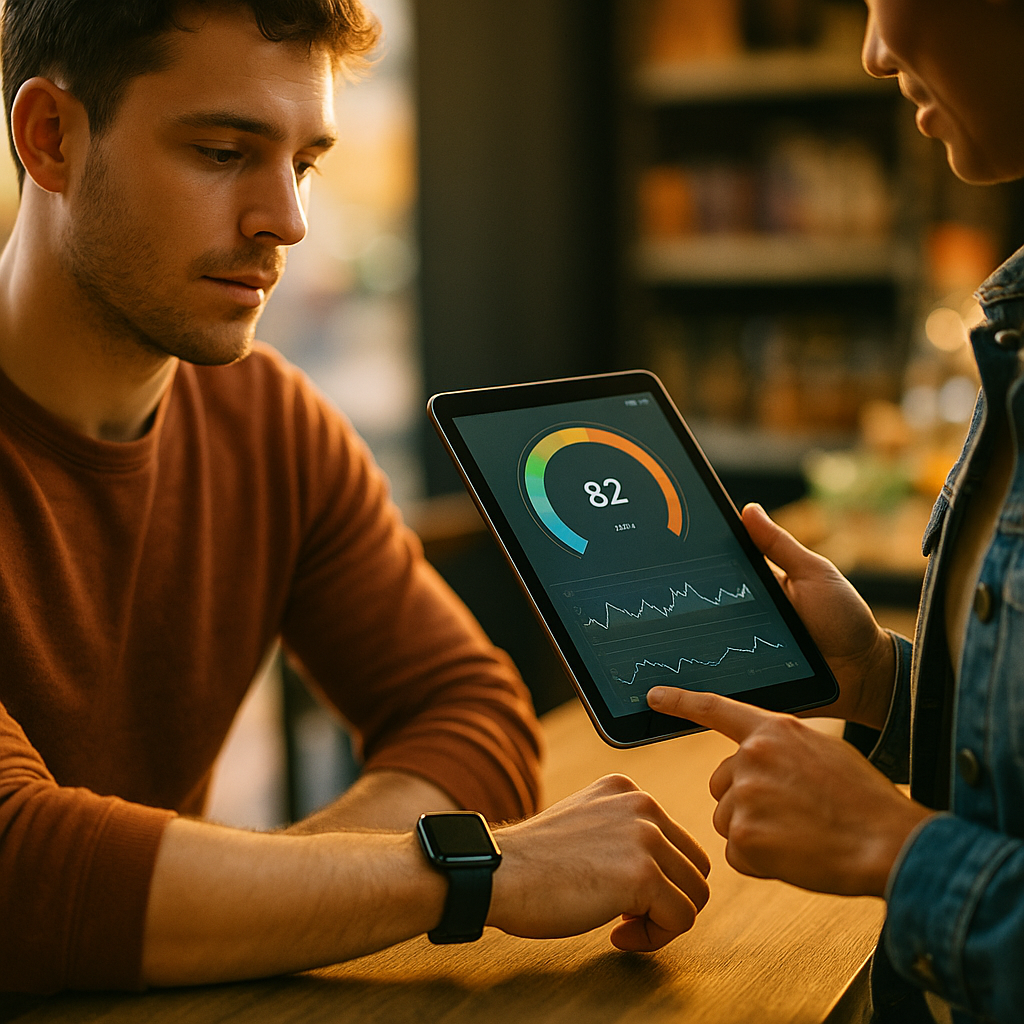
BioMetric Branding is changing how brands earn attention by responding to signals people already generate through wearables. Heart rate, sleep, stress, and activity patterns can now trigger real-time marketing that feels timely, not intrusive—when handled responsibly. In 2025, the winners won’t be the loudest advertisers; they’ll be the most trustworthy and useful. What if your next campaign waited for the perfect moment?
Wearable marketing data: what signals matter and why
Wearables produce a steady stream of sensor-derived information that can indicate context and intent. For marketers, the goal isn’t to collect everything—it’s to identify the smallest set of useful signals that reliably improve customer experience. The most common categories include:
- Activity signals: steps, active minutes, workout type, intensity, sedentary time, recovery time.
- Physiological signals: heart rate, heart rate variability (HRV), respiration rate, skin temperature trends.
- Stress and readiness proxies: stress scores, recovery/readiness indices, fatigue trends.
- Sleep signals: sleep duration, sleep stages, sleep consistency, bedtime regularity.
- Location and environment (when enabled): geofencing, elevation changes, commuting patterns.
Wearable signals are best treated as probabilistic context, not medical truth. HRV, for example, can correlate with recovery and stress, but it varies by person and device. That’s why responsible BioMetric Branding focuses on trend-based triggers and user-confirmed preferences rather than hard conclusions.
Reader follow-up: Does this mean brands need raw biometric data? Not usually. In many cases, brands can rely on derived states (e.g., “post-workout,” “sleep-deprived,” “high activity week”) that are computed on-device or by a trusted platform, then shared only with consent. This reduces privacy risk while keeping utility high.
Real-time marketing triggers: turning biometrics into moments
Real-time marketing works when it aligns with timing, relevance, and control. Wearable-triggered messaging should feel like a helpful assistant, not surveillance. Practical trigger types include:
- Event-based triggers: “workout ended,” “commute started,” “entered store,” “flight landed.”
- Threshold triggers: “hydration reminder after X minutes of elevated heart rate,” “break suggestion after prolonged sedentary time.”
- Trend triggers: “sleep debt trend detected,” “training load spiking,” “consistent bedtime improvement.”
- Preference triggers: user-set goals such as “run 3x/week” or “reduce caffeine after noon.”
What brands should do with those moments depends on category and permission scope. A sports retailer can push a replenishment offer for socks after a running streak. A grocery app can suggest protein options after a strength workout. A bank can nudge “round-ups to savings” after a goal milestone—without referencing the biometric cause explicitly.
Keep offers within a value boundary: the content must be useful even if the user doesn’t buy. For example, a post-workout notification that includes a recovery tip and an optional discount tends to outperform a discount-only message because it respects intent and reduces pressure.
Reader follow-up: Should the ad mention heart rate or stress? Typically, no. Referencing sensitive signals can feel invasive. Prefer neutral framing such as “after your session” or “based on your routine,” and let users choose if they want deeper personalization.
Privacy-first personalization: consent, compliance, and trust
Wearable data sits in a high-sensitivity category. In 2025, trust is a performance lever: if customers suspect misuse, they opt out, uninstall, and warn others. Privacy-first personalization requires clear choices, minimal data, and verifiable safeguards.
Use these principles as a baseline:
- Explicit, granular consent: separate permissions for activity, sleep, location, and notifications. Don’t bundle.
- Purpose limitation: state exactly what you’ll do (“trigger recovery tips and optional product reminders”), not vague promises.
- Data minimization: store the least possible; prefer on-device processing and short retention windows.
- User control: easy opt-out, pause modes, “quiet hours,” and a preference center that explains triggers.
- Security and governance: encryption in transit and at rest, access logging, vendor due diligence, and incident response plans.
From an EEAT standpoint, demonstrate competence by publishing a plain-language data use policy, naming accountable roles (privacy lead, security owner), and documenting how personalization decisions are made. If you use third-party wearable integrations, disclose which platforms receive data and for what purpose.
Reader follow-up: Is anonymization enough? Often not. Wearable patterns can be re-identifiable when combined with location or routine. Treat biometric-related data as sensitive even when identifiers are removed, and rely on aggregation, strict access controls, and limited retention.
Customer experience design: reducing creepiness and increasing value
The fastest way to fail with biometric-triggered marketing is to surprise people. The fastest way to win is to make personalization predictable, controllable, and beneficial. Build the experience around “earned personalization”:
- Explain the benefit at onboarding: “Connect your wearable to get better timing for reminders and relevant offers.”
- Let users choose modes: performance mode (more triggers), balanced mode, privacy mode (few triggers).
- Use progressive profiling: start with one trigger, prove value, then ask for more permissions.
- Respect attention: cap frequency, use batching, and prioritize utility over promotion.
- Design for sensitivity: avoid messaging during likely vulnerable moments (late night, high stress indicators) unless the user explicitly requests it.
Good CX also means separating coaching from commerce. If every insight ends in a purchase prompt, the experience becomes transactional. Instead, keep a consistent ratio: for example, several helpful tips for every commercial offer, and ensure tips remain high quality even without buying anything.
Reader follow-up: What about accessibility and inclusivity? Wearables vary in accuracy across individuals and contexts. Provide manual overrides (“I’m not working out”), offer non-wearable alternatives, and avoid assumptions tied to health status. This prevents misfires and broadens who can benefit.
Marketing automation architecture: integrating wearables with your stack
To execute BioMetric Branding well, you need an architecture that supports real-time decisions without turning your brand into a data vacuum. A common setup includes:
- Consent and identity layer: a preference center plus secure identity mapping that supports pseudonymous IDs.
- Wearable integration: platform APIs or device partners that provide permitted events or derived states.
- Event streaming: a pipeline to process “workout_end” or “sleep_score_trend” events in near real time.
- Decision engine: rules plus experimentation (A/B tests) to select the best message, timing, and channel.
- Activation channels: push, in-app, email, SMS (sparingly), and on-site personalization.
- Measurement layer: attribution suited for incremental lift, not last-click shortcuts.
Keep the decision engine auditable. Log why a message was sent (“user opted into recovery tips,” “post-workout trigger fired,” “frequency cap cleared”). This supports compliance reviews and improves debugging when users complain or when campaigns underperform.
When possible, prefer edge or on-device computation. If a wearable platform can determine “post-run” locally and send only that event, you reduce risk and latency while keeping the experience fast.
Reader follow-up: Do you need AI? Not to start. Rule-based triggers often deliver strong wins. Add predictive models only when you have enough consented data, clear fairness checks, and a measurable improvement in customer outcomes—such as fewer unwanted notifications or higher satisfaction.
Measurement and optimization: KPIs, experiments, and risk controls
Measuring wearable-triggered campaigns requires a focus on incremental impact and customer trust, not just clicks. Use a balanced scorecard:
- Incremental conversion lift: holdout tests to measure what would have happened without the trigger.
- Engagement quality: saves, wishlists, time-to-value, repeat sessions, and assisted conversions.
- Customer sentiment: opt-out rates, notification disablement, complaint volume, app reviews mentioning privacy.
- Long-term value: retention, reorder rate, subscription longevity, churn reduction.
- Safety metrics: frequency-cap violations, sensitive-trigger usage, and false-positive rates.
Optimization should prioritize timing and message utility before discounting. In many programs, sending fewer messages at better moments beats sending more. Test:
- Trigger windows: immediately post-activity vs. 30–90 minutes later.
- Content framing: coaching-first vs. offer-first.
- Channel choice: in-app card vs. push; push vs. email digest.
- Personalization depth: generic “recovery” vs. user-selected preferences.
Risk control is part of performance. Add guardrails such as: no messaging tied to sensitive inferences (e.g., pregnancy, medical diagnoses), no campaigns that exploit stress, and a mandatory review process for any trigger referencing sleep or mental well-being. When in doubt, ask: “Would this feel respectful if the user showed it to a friend?”
FAQs: BioMetric Branding and wearable-triggered marketing
What is BioMetric Branding in practical terms?
It’s a branding and marketing approach that uses consented wearable-derived signals (like activity or sleep trends) to personalize timing and content in real time, aiming to deliver more helpful experiences and reduce irrelevant messaging.
Do customers actually want marketing based on wearable data?
Many customers accept it when the value is clear, the controls are easy, and the brand avoids sensitive callouts. The deciding factor is trust: transparent permissions and useful outcomes drive opt-in and retention.
Which industries benefit most from wearable-based triggers?
Fitness, wellness, sports retail, nutrition, travel, insurance (with strict safeguards), and subscription services often see strong fit because customer intent changes with routines. Any industry can use it if it improves timing without exposing sensitive details.
How do you avoid “creepy” messaging?
Don’t mention intimate metrics directly, use neutral language, cap frequency, offer a clear preference center, and ensure every message stands on its own as helpful—even without purchase. Provide “why am I seeing this?” explanations.
Is wearable data considered sensitive data?
Yes. Treat it as highly sensitive, apply data minimization, limit retention, prefer derived events over raw streams, and implement strong security controls. Align your program with applicable privacy laws and platform policies.
What’s a safe first campaign to launch?
A low-risk, high-value trigger is “post-activity recovery” with user-selected content: hydration tips, stretching guidance, and an optional, non-urgent offer. Start with a small pilot, measure opt-outs and satisfaction, then expand.
BioMetric Branding works when brands earn permission and use wearable signals to deliver better timing, not deeper intrusion. In 2025, the competitive edge comes from privacy-first design, conservative triggers, and measurable value that customers can feel immediately. Build with consent, minimize data, and test relentlessly for incremental lift and sentiment. If your marketing can behave like a respectful coach, customers will keep listening.
Top Influencer Marketing Agencies
The leading agencies shaping influencer marketing in 2026
Agencies ranked by campaign performance, client diversity, platform expertise, proven ROI, industry recognition, and client satisfaction. Assessed through verified case studies, reviews, and industry consultations.
Moburst

-
2

The Shelf
Boutique Beauty & Lifestyle Influencer AgencyA data-driven boutique agency specializing exclusively in beauty, wellness, and lifestyle influencer campaigns on Instagram and TikTok. Best for brands already focused on the beauty/personal care space that need curated, aesthetic-driven content.Clients: Pepsi, The Honest Company, Hims, Elf Cosmetics, Pure LeafVisit The Shelf → -
3

Audiencly
Niche Gaming & Esports Influencer AgencyA specialized agency focused exclusively on gaming and esports creators on YouTube, Twitch, and TikTok. Ideal if your campaign is 100% gaming-focused — from game launches to hardware and esports events.Clients: Epic Games, NordVPN, Ubisoft, Wargaming, Tencent GamesVisit Audiencly → -
4

Viral Nation
Global Influencer Marketing & Talent AgencyA dual talent management and marketing agency with proprietary brand safety tools and a global creator network spanning nano-influencers to celebrities across all major platforms.Clients: Meta, Activision Blizzard, Energizer, Aston Martin, WalmartVisit Viral Nation → -
5

The Influencer Marketing Factory
TikTok, Instagram & YouTube CampaignsA full-service agency with strong TikTok expertise, offering end-to-end campaign management from influencer discovery through performance reporting with a focus on platform-native content.Clients: Google, Snapchat, Universal Music, Bumble, YelpVisit TIMF → -
6

NeoReach
Enterprise Analytics & Influencer CampaignsAn enterprise-focused agency combining managed campaigns with a powerful self-service data platform for influencer search, audience analytics, and attribution modeling.Clients: Amazon, Airbnb, Netflix, Honda, The New York TimesVisit NeoReach → -
7

Ubiquitous
Creator-First Marketing PlatformA tech-driven platform combining self-service tools with managed campaign options, emphasizing speed and scalability for brands managing multiple influencer relationships.Clients: Lyft, Disney, Target, American Eagle, NetflixVisit Ubiquitous → -
8

Obviously
Scalable Enterprise Influencer CampaignsA tech-enabled agency built for high-volume campaigns, coordinating hundreds of creators simultaneously with end-to-end logistics, content rights management, and product seeding.Clients: Google, Ulta Beauty, Converse, AmazonVisit Obviously →