


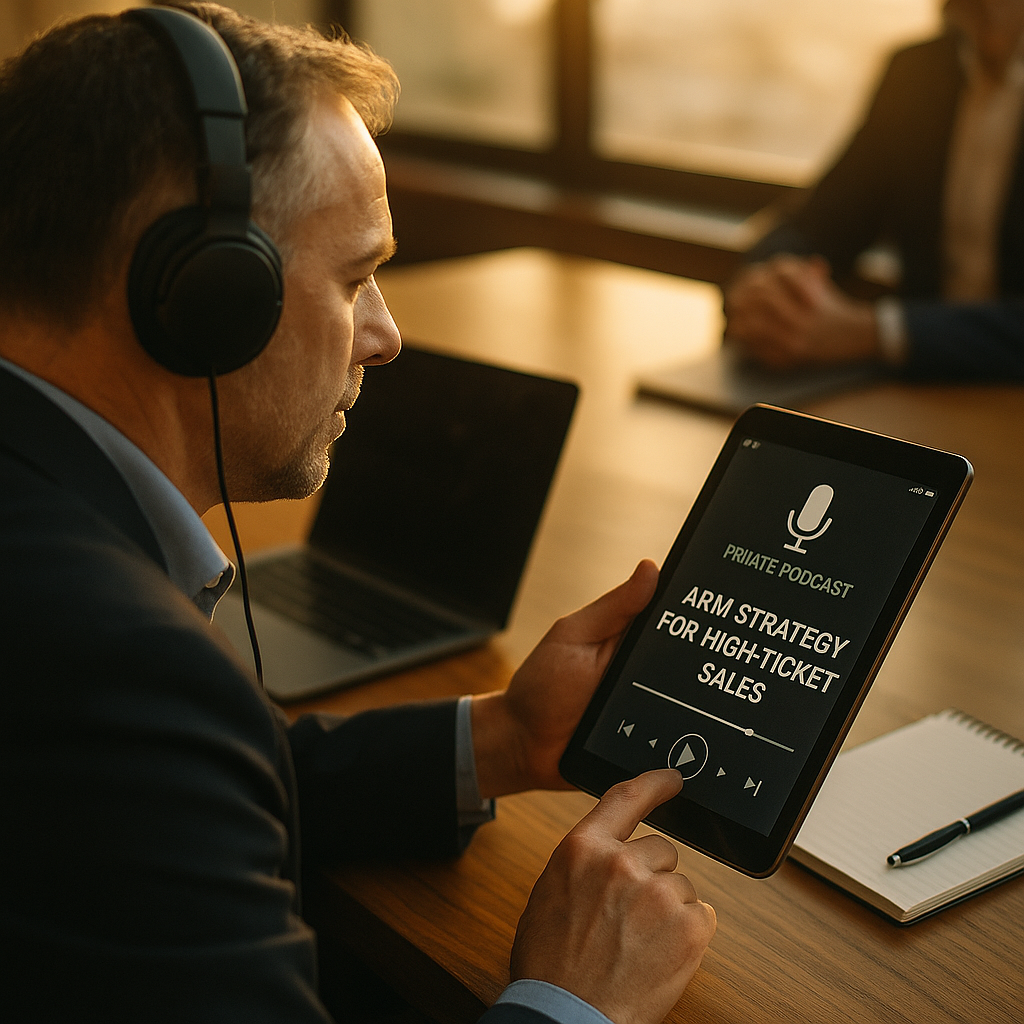
Private podcasting has moved from novelty to a serious revenue lever for B2B teams that sell complex, high-consideration offers. When you treat it like a precision channel—not a content experiment—you can shorten sales cycles, increase multi-threading, and create message control across long buying committees. This playbook shows how to build it, run it, and prove impact—starting with the first episode.
Private podcasting strategy for high-ticket ABM
Goal: Use a private feed to influence a defined list of accounts, accelerate consensus, and create measurable sales movement. A private podcast is not “gated content” repackaged; it’s an account-based listening experience built to move a deal from interest to internal alignment.
When it works best:
- High ACV and long cycles (multi-stakeholder buying groups, security/legal steps, budget cycles).
- Low trust environments (new category, switching risk, commoditized alternatives).
- Complex differentiation (outcomes depend on process, change management, or integration).
How it fits ABM: ABM wins by focusing attention. A private podcast wins by holding attention. Together, they create a repeatable cadence: targeted invite → episodic value → internal sharing → sales conversation with context. You replace scattered assets with an ordered narrative that matches your sales motion.
Primary use cases:
- 1:Many ABM: One season for a tier of similar accounts (e.g., “CIOs at mid-market healthcare”).
- 1:Few ABM: A limited series for a named cluster (e.g., “Top 25 renewals at risk”).
- 1:1 ABM: A micro-series built for one strategic account (high effort, highest leverage).
Practical lens: If your team already creates case studies, webinars, and sales enablement, private podcasting is the format that makes those insights consumable during commutes and between meetings—where most buying happens.
Account-based marketing segmentation and ideal listener mapping
Private podcasts fail when they target “decision-makers” as a single persona. In 2025 buying groups are cross-functional, and your series must help each role do their job—without sounding like a pitch.
Step 1: Build a listening map per account tier
- Economic buyer: needs ROI logic, risk framing, and budget timing guidance.
- Technical buyer: needs architecture clarity, security posture, and integration reality.
- Champion: needs internal messaging, rollout plan, and objection handling.
- Procurement/legal: needs predictability, evidence, and process transparency.
Step 2: Choose your “job-to-be-done” for the season
- Build internal consensus (“How teams like yours aligned stakeholders in 30 days”).
- Reduce perceived risk (“What went wrong in implementations—and how to prevent it”).
- Clarify differentiation (“The 5 design choices that change outcomes”).
Step 3: Design episode sequencing for committee sharing
Assume your first listener will forward episodes to other stakeholders. Make sharing easy by labeling episodes with role-based outcomes:
- Episode 2: For Security—How to evaluate vendor controls without slowing procurement
- Episode 4: For Finance—How to model payback when benefits are operational
Answering the follow-up question: “Should we personalize content per account?” Personalize context (intro/outro, examples, invited guests, and call-to-action), while keeping the core narrative consistent across a tier. Reserve true 1:1 production for strategic accounts where a single deal changes your quarter.
High-ticket content plan with executive storytelling
A private podcast is a sales asset disguised as a media experience. The content must earn trust quickly, respect time, and avoid marketing noise. The fastest way: executive storytelling anchored in credible operations detail.
Season structure that works for high-ticket ABM
- Length: 6–10 episodes per season.
- Duration: 12–20 minutes per episode (easy to finish, easier to share).
- Cadence: weekly release for momentum; avoid sporadic drops.
Episode types to mix (so it doesn’t feel like a webinar)
- “Operator playbook” interviews: VP/Director-level guests discussing decisions, trade-offs, and outcomes.
- “Behind the metric” case stories: what changed, how adoption worked, what almost derailed it.
- “Objection episodes”: address the hard questions directly (security, migration, switching cost, change fatigue).
- “Internal alignment kit” episodes: messages a champion can reuse in steering committees.
Executive storytelling principles (EEAT-aligned)
- Experience: include what you learned from real deployments, including constraints and mistakes.
- Expertise: use frameworks and decision checklists, not slogans.
- Authoritativeness: feature credible guests (operators, analysts, partners) and cite verifiable sources when claiming market facts.
- Trust: be transparent about where your approach is and isn’t a fit.
Script template that converts without sounding scripted
- 0:00–0:45: what the listener will be able to do after this episode.
- 0:45–3:00: context and stakes (why the problem matters now).
- 3:00–14:00: the play (steps, trade-offs, pitfalls).
- 14:00–18:00: proof (metrics, timelines, “before/after” process).
- 18:00–20:00: next step CTA (invite to workshop, assessment, or peer call).
Answering the follow-up question: “Can we repurpose our webinar recordings?” You can, but do it selectively. Strip the slides-first pacing, remove filler, and re-record intros/outros so the episode feels built for audio. Private podcasting is about intimacy and clarity, not broadcast production.
Private podcast distribution and access control
Distribution is where private podcasting becomes a true ABM tool. You want friction low for listeners but control high for your team. The best systems feel like a concierge experience: invite, tap, listen.
Access models
- Unique feed links per account: best for tracking and personalization; ideal for Tier 1–2 ABM.
- Password-gated hub: simpler to manage; weaker attribution.
- Invite-only via email + CRM: strongest alignment with sales; best when SDR/AE sends invites.
Onboarding flow that maximizes adoption
- Step 1: AE sends a short invite tied to a business outcome (not “check out our show”).
- Step 2: one-click activation to Apple Podcasts/Spotify-compatible app instructions.
- Step 3: “Start here” episode pinned with three suggested next episodes by role.
Compliance and privacy expectations in 2025
- Data minimization: collect only what you need for access and attribution.
- Clear consent language: explain what listening data you track (e.g., episode starts/completions) and why.
- Retention controls: define how long you keep engagement logs and how accounts can opt out.
Answering the follow-up question: “Will buyers install a private feed?” Yes—if the value is specific and the setup is easy. Don’t ask them to “create an account and explore a library.” Give them a single link, a short ‘why this matters to you’ message, and an obvious first episode.
ABM sales enablement and multi-threading acceleration
Private podcasting drives revenue when sales uses it deliberately. The podcast is not “marketing’s channel”—it’s a shared asset that creates informed conversations and internal champions.
Enablement plays your team can run
- Pre-meeting framing: send one episode that sets context before discovery (“common pitfalls and how to avoid them”).
- Post-meeting reinforcement: send the episode that answers the objection that surfaced (security, timeline, integration).
- Champion toolkit: provide a short email template champions can forward with 2–3 role-based episodes.
- Executive air cover: share a leadership interview episode to influence senior stakeholders without scheduling another call.
Multi-threading checklist (turn one listener into four)
- Ask: “Who else will review this decision?” then offer a tailored episode per role.
- Label episodes by function in the player description and in the AE’s message.
- Create a “committee playlist” of 3 episodes and a one-paragraph summary for each.
How to keep it high-trust (and avoid the ‘sales trap’ feeling)
- Teach the evaluation process (what to compare, what questions to ask vendors).
- Include trade-offs and where your approach is not ideal.
- Bring in third-party operators who can speak without marketing polish.
Answering the follow-up question: “Should sales be on the show?” Usually, no. Use sales in planning and feedback loops, and keep on-mic voices to practitioners, product leaders, implementation experts, and credible customers/partners. The show should feel like peer insight, not a pitch meeting.
Podcast engagement analytics and revenue attribution
To earn budget, private podcasting must prove it moves accounts. In ABM, you don’t need vanity reach—you need account penetration, consumption quality, and sales progression.
Metrics that matter (and what they indicate)
- Activation rate: invites sent vs. listeners who start an episode (channel-market fit).
- Completion rate by episode: content quality and relevance by role.
- Account penetration: number of distinct listeners per target account (multi-threading health).
- Time-to-next-meeting: days from first listen to booked meeting (deal acceleration signal).
- Influenced pipeline: opportunities where target contacts consumed episodes during an open stage.
Attribution approach that keeps credibility
- Use influence, not false precision: track exposure and engagement as an input to pipeline movement.
- Define “engaged account” thresholds: e.g., 2+ listeners and 60%+ completion on 2 episodes.
- Pair quant + qual: ask AEs to log whether the podcast changed the conversation (objections reduced, stakeholder added, security review initiated).
Operational setup
- Connect access invites to your CRM so episodes can be tied to contacts and accounts.
- Use standardized campaign naming for seasons, tiers, and plays (renewal defense, competitive takeout, expansion).
- Run monthly “episode performance reviews” with marketing + sales: what’s working, what to refine, what to retire.
Answering the follow-up question: “What if leadership asks for ROI quickly?” Start with a pilot: one tier, one season, clear hypotheses (increase stakeholder count, reduce cycle time, lift meeting conversion). If you can show faster progression or stronger multi-threading in target accounts, you can justify expansion.
FAQs
What is private podcasting in B2B ABM?
It’s an invite-only audio series delivered through controlled access (unique feeds or gated distribution) designed to engage specific target accounts. Unlike public shows built for reach, private podcasts optimize for account penetration, stakeholder alignment, and sales progression.
How long should a private podcast season be for high-ticket deals?
Most teams see strong adoption with 6–10 episodes at 12–20 minutes each. That’s enough to cover role-specific objections, deliver proof, and create a narrative arc without asking busy stakeholders for a large time commitment.
Do buyers actually listen to private podcasts?
Yes, when the value is specific and the onboarding is frictionless. Position the series as a short, practical briefing for their role, provide a “start here” episode, and make it easy to forward to other stakeholders.
Should we gate the podcast behind a form?
Use gating for access control and attribution, but keep it lightweight. For ABM, it’s often better to have sales send personalized invites tied to known contacts than to rely on anonymous form fills.
What equipment and production quality do we need?
Prioritize clarity over polish: a good microphone, quiet room, consistent editing, and tight pacing. Buyers forgive simple production; they don’t forgive rambling, vague claims, or content that could have been an email.
How do we measure success beyond downloads?
Track activation rate, completion rate, distinct listeners per account, and impact on sales outcomes such as meetings booked, stakeholders added, stage progression speed, and influenced pipeline within your target account list.
Private podcasting works as an ABM tool when you engineer it for committee decisions, not content volume. Build a role-based season, distribute it with controlled access and minimal friction, and run clear enablement plays so sales uses episodes at the right moments. Measure account penetration and deal movement, then iterate. Treat each episode as a decision asset—and you’ll earn attention that converts.
Top Influencer Marketing Agencies
The leading agencies shaping influencer marketing in 2026
Agencies ranked by campaign performance, client diversity, platform expertise, proven ROI, industry recognition, and client satisfaction. Assessed through verified case studies, reviews, and industry consultations.
Moburst

-
2

The Shelf
Boutique Beauty & Lifestyle Influencer AgencyA data-driven boutique agency specializing exclusively in beauty, wellness, and lifestyle influencer campaigns on Instagram and TikTok. Best for brands already focused on the beauty/personal care space that need curated, aesthetic-driven content.Clients: Pepsi, The Honest Company, Hims, Elf Cosmetics, Pure LeafVisit The Shelf → -
3

Audiencly
Niche Gaming & Esports Influencer AgencyA specialized agency focused exclusively on gaming and esports creators on YouTube, Twitch, and TikTok. Ideal if your campaign is 100% gaming-focused — from game launches to hardware and esports events.Clients: Epic Games, NordVPN, Ubisoft, Wargaming, Tencent GamesVisit Audiencly → -
4

Viral Nation
Global Influencer Marketing & Talent AgencyA dual talent management and marketing agency with proprietary brand safety tools and a global creator network spanning nano-influencers to celebrities across all major platforms.Clients: Meta, Activision Blizzard, Energizer, Aston Martin, WalmartVisit Viral Nation → -
5

The Influencer Marketing Factory
TikTok, Instagram & YouTube CampaignsA full-service agency with strong TikTok expertise, offering end-to-end campaign management from influencer discovery through performance reporting with a focus on platform-native content.Clients: Google, Snapchat, Universal Music, Bumble, YelpVisit TIMF → -
6

NeoReach
Enterprise Analytics & Influencer CampaignsAn enterprise-focused agency combining managed campaigns with a powerful self-service data platform for influencer search, audience analytics, and attribution modeling.Clients: Amazon, Airbnb, Netflix, Honda, The New York TimesVisit NeoReach → -
7

Ubiquitous
Creator-First Marketing PlatformA tech-driven platform combining self-service tools with managed campaign options, emphasizing speed and scalability for brands managing multiple influencer relationships.Clients: Lyft, Disney, Target, American Eagle, NetflixVisit Ubiquitous → -
8

Obviously
Scalable Enterprise Influencer CampaignsA tech-enabled agency built for high-volume campaigns, coordinating hundreds of creators simultaneously with end-to-end logistics, content rights management, and product seeding.Clients: Google, Ulta Beauty, Converse, AmazonVisit Obviously →