


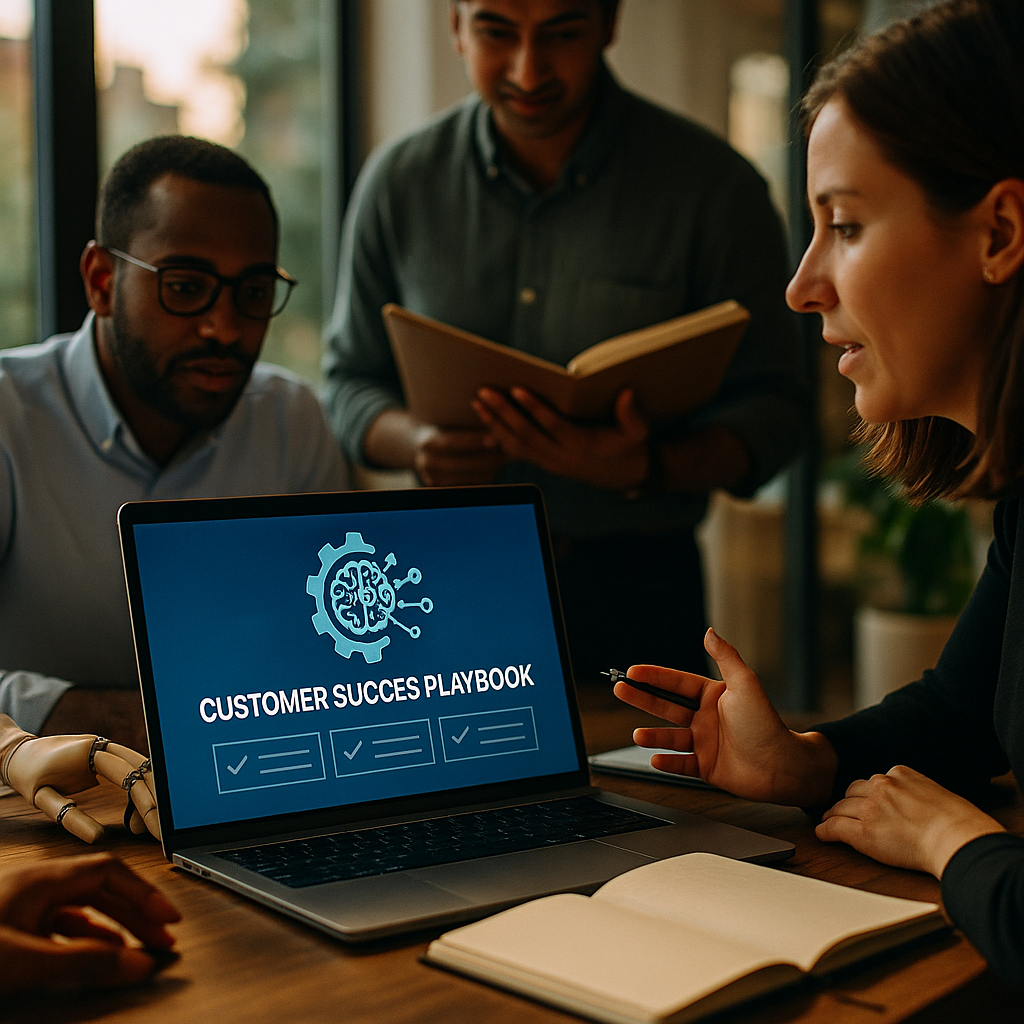
Using AI to personalize customer success playbooks is quickly becoming a competitive requirement for global SaaS, fintech, ecommerce, and enterprise service teams. As customer bases expand across regions, languages, and product lines, static playbooks fail to keep pace. AI helps teams tailor outreach, predict risk, and scale human expertise without sacrificing consistency. Here is what leaders need to know next.
Why AI customer success matters for global teams
Customer success leaders face a difficult balance in 2026: deliver high-touch guidance to every account while managing growth, regional complexity, and tighter operating expectations. Traditional playbooks were built for smaller books of business and more uniform customer journeys. At global scale, those same playbooks often become too generic to drive adoption, renewal, and expansion.
AI customer success changes that operating model. Instead of assigning the same onboarding sequence, risk review, or adoption checklist to broad segments, AI systems can identify patterns at the account, user, product, and regional levels. That allows teams to recommend the right action for the right customer at the right time.
For example, a global software company may serve enterprise customers in North America, mid-market customers in EMEA, and partner-led customers in APAC. Each group may differ in procurement cycles, product usage behavior, support expectations, and preferred communication styles. AI can analyze these differences continuously and trigger tailored playbook steps such as:
- Localized onboarding paths based on industry, maturity, and language
- Targeted training prompts when feature adoption stalls
- Renewal interventions when health scores decline
- Expansion recommendations based on role-level usage trends
- Executive business review preparation based on account-specific outcomes
This does not replace customer success managers. It makes them more effective. AI handles pattern detection, prioritization, and next-best-action recommendations, while human teams bring judgment, relationship context, and strategic guidance. That combination is what enables scale without making the customer experience feel automated in the wrong way.
Building personalized customer success playbooks with AI
The strongest personalized customer success playbooks are not simply collections of automated emails. They are structured operating frameworks that adapt to customer context. AI makes that adaptation possible by turning fragmented data into practical guidance for CS, sales, support, and product teams.
A useful playbook typically includes milestones, triggers, recommended actions, success metrics, and escalation paths. AI improves each of these components.
- Milestones: AI identifies whether a customer is progressing normally for their segment, region, and use case.
- Triggers: Machine learning detects leading indicators such as reduced logins, delayed integrations, support sentiment changes, or stakeholder turnover.
- Recommended actions: Generative AI can draft tailored emails, call briefs, meeting agendas, and success plans.
- Success metrics: AI highlights the KPIs most relevant to the customer’s business goals rather than generic adoption metrics alone.
- Escalation paths: Predictive models flag accounts that require specialist intervention before churn risk becomes obvious.
To make this work, start by mapping the lifecycle stages that matter most: onboarding, activation, adoption, value realization, renewal, and expansion. Then identify which decisions your team repeats at scale. Those repeated decisions are where AI can create the most immediate value.
Examples include deciding which accounts need proactive outreach this week, which users need training, which executive sponsors should receive a business review, and which accounts are likely to expand in the next quarter. Once those workflows are defined, AI can support them with recommendations grounded in your customer data.
A common follow-up question is whether every playbook must be unique. The answer is no. Most organizations do better with a modular framework. Create a core playbook architecture, then let AI personalize the sequence, message, content, and prioritization within that structure. This protects consistency while allowing relevance.
Key customer success automation use cases across the lifecycle
Customer success automation works best when it supports measurable outcomes across the full customer journey. The following use cases are among the most valuable for companies operating globally.
1. Intelligent onboarding
AI can assign onboarding paths based on customer size, technical maturity, use case, contract type, and historical similarity to previous accounts. It can also summarize implementation risks from sales notes and support documentation so the CS team starts with full context.
2. Dynamic health scoring
Static health scores often overweight simplistic metrics. AI-driven scoring models can combine product usage, support interactions, stakeholder engagement, sentiment, renewal patterns, and external signals. More importantly, they can explain why a score changed and suggest what to do next.
3. Proactive churn prevention
At scale, by the time a CSM notices disengagement manually, the account may already be at high risk. Predictive models help teams intervene earlier by flagging accounts showing subtle warning signals, such as incomplete rollout, declining executive engagement, or inconsistent feature adoption across departments.
4. Expansion identification
AI can surface cross-sell and upsell opportunities when product usage reaches thresholds associated with broader value. For instance, if multiple teams within an account begin using advanced features, AI can recommend outreach around additional seats, premium modules, or new regional deployments.
5. Localized communication at scale
Global teams need more than translation. They need communication adapted to regional expectations, compliance requirements, and business norms. Generative AI can help draft customer-ready materials in the appropriate language and tone, while human review ensures quality and accuracy.
6. Executive visibility and forecasting
Leadership teams need clear signals, not more dashboards. AI can summarize account portfolio changes, forecast renewal risk, and highlight the operational bottlenecks preventing customer outcomes. This supports better resource allocation across regions and segments.
These use cases are most effective when tied to specific business goals, such as reducing time to value, improving gross retention, increasing net revenue retention, or raising product adoption among strategic accounts.
How predictive analytics in customer success improves decisions
Predictive analytics in customer success is valuable because it shifts teams from reactive account management to informed decision-making. Instead of relying only on lagging indicators, customer success leaders can identify what is likely to happen next and prepare responses in advance.
That matters at global scale because human intuition does not scale evenly across thousands of accounts. Predictive systems can process far more inputs than any single team member, including:
- Product telemetry and feature-level usage trends
- Support ticket volume, themes, and sentiment
- CRM activity and stakeholder engagement
- Contract terms, renewal timing, and expansion history
- Training completion and implementation milestones
- Regional benchmarks and segment-specific patterns
However, not all models are equally useful. The best predictive systems are transparent enough for teams to trust. If an account is flagged as at risk, the CSM should understand the major drivers behind that prediction. Explainability is a practical requirement, not a nice-to-have. Teams act faster when the reasoning is visible.
Another common question is whether predictive analytics requires large data science teams. In many cases, no. Modern customer success platforms and data tools increasingly offer built-in modeling capabilities. The harder challenge is usually data discipline: clean account structures, consistent lifecycle definitions, and shared ownership across CS, product, sales, and operations.
Leaders should also validate models against real business outcomes. If your churn model flags many accounts that renew anyway, or misses strategic customers who later downgrade, it needs retraining. AI systems improve when they are treated as operational tools that require governance, review, and iteration.
Best practices for customer success AI strategy and governance
A strong customer success AI strategy combines technology, process design, and responsible governance. This is where EEAT principles matter most. Helpful content and trustworthy execution both depend on experience, expertise, authoritativeness, and trustworthiness. In practice, that means building systems your teams can validate and your customers can rely on.
Start with these best practices:
- Define the business problem first. Do not deploy AI because it is available. Focus on outcomes such as faster onboarding, lower churn, or improved CSM capacity.
- Use high-quality, permissioned data. AI recommendations are only as reliable as the data feeding them. Audit data sources, permissions, and freshness regularly.
- Keep humans in the loop. Customer-facing communication, risk escalations, and strategic recommendations should include human oversight, especially for high-value accounts.
- Document playbook logic. Teams need to know why actions are triggered, how scores are calculated, and when exceptions apply.
- Measure operational and customer outcomes. Track not just AI usage, but time saved, intervention accuracy, renewal impact, and customer satisfaction.
- Account for regional compliance. Global programs must align with privacy, security, and data residency requirements in the markets you serve.
Trust is especially important in customer success because these teams shape long-term relationships. If AI-generated recommendations feel inaccurate, biased, or intrusive, customers will notice. That is why leading organizations create review processes for model outputs, localized messaging, and sensitive account actions.
It is also wise to train CS teams on how to use AI recommendations effectively. Adoption often fails not because the technology is weak, but because teams do not know when to trust it, how to challenge it, or how to blend it with account knowledge.
Scaling global customer success operations without losing the human touch
The biggest concern many leaders have is straightforward: if customer success becomes too automated, will relationships suffer? The answer depends on implementation. The purpose of AI is not to remove the human layer. It is to reserve human attention for the moments where it creates the most value.
Well-designed global customer success operations use AI to handle repetitive analysis and orchestration, while CSMs focus on strategic conversations, stakeholder alignment, and business outcomes. That division of labor is what makes personalization sustainable.
To scale effectively, organizations should:
- Standardize lifecycle stages and account taxonomies globally
- Allow regional flexibility in messaging, success criteria, and engagement cadence
- Create reusable playbook modules by product, persona, and maturity level
- Use AI copilots to prepare CSMs for meetings with concise, account-specific summaries
- Review performance by segment and geography to spot gaps early
A practical rollout usually starts with one high-impact use case, such as onboarding personalization for a strategic segment or churn prediction for mid-market accounts. Once results are proven, the team can expand to additional lifecycle moments and geographies.
Success should be measured in both customer and operational terms. Look at time to first value, adoption depth, renewal rates, CSM portfolio efficiency, and customer sentiment. If those indicators improve together, your AI-enabled playbooks are working as intended.
In 2026, the companies leading customer success globally are not choosing between scale and personalization. They are building systems where AI amplifies experienced teams, sharpens decision-making, and keeps every customer journey relevant even as complexity grows.
FAQs about AI in customer success
What is the main benefit of using AI in customer success playbooks?
The main benefit is the ability to personalize actions at scale. AI helps teams identify risks, opportunities, and next-best actions for each customer without relying on one-size-fits-all workflows.
Can AI replace customer success managers?
No. AI supports customer success managers by analyzing data, prioritizing accounts, and drafting recommendations. Human teams are still essential for strategic conversations, empathy, and complex decision-making.
What data is needed to personalize customer success playbooks?
The most useful data includes product usage, CRM history, support interactions, onboarding milestones, training completion, contract details, and customer goals. Clean, connected data matters more than simply having more data.
How do you start implementing AI in customer success?
Start with one measurable use case, such as improving onboarding or predicting churn. Define the workflow, connect the necessary data, set success metrics, and keep human review in place while the model is tested.
Is AI personalization safe for global customer accounts?
It can be, if it is implemented responsibly. Teams need clear governance, privacy controls, regional compliance checks, and transparency around how recommendations are generated and used.
How should companies measure success after deploying AI playbooks?
Measure customer outcomes and operational efficiency together. Common metrics include time to value, product adoption, renewal rates, expansion revenue, CSM productivity, and customer satisfaction.
AI-driven personalization gives customer success teams a practical way to scale relevance across regions, segments, and lifecycle stages. The strongest approach combines predictive insight, modular playbooks, clean data, and human oversight. Companies that implement AI thoughtfully can improve retention, increase efficiency, and deliver more consistent value, proving that global scale does not have to come at the expense of customer trust.
Top Influencer Marketing Agencies
The leading agencies shaping influencer marketing in 2026
Agencies ranked by campaign performance, client diversity, platform expertise, proven ROI, industry recognition, and client satisfaction. Assessed through verified case studies, reviews, and industry consultations.
Moburst

-
2

The Shelf
Boutique Beauty & Lifestyle Influencer AgencyA data-driven boutique agency specializing exclusively in beauty, wellness, and lifestyle influencer campaigns on Instagram and TikTok. Best for brands already focused on the beauty/personal care space that need curated, aesthetic-driven content.Clients: Pepsi, The Honest Company, Hims, Elf Cosmetics, Pure LeafVisit The Shelf → -
3

Audiencly
Niche Gaming & Esports Influencer AgencyA specialized agency focused exclusively on gaming and esports creators on YouTube, Twitch, and TikTok. Ideal if your campaign is 100% gaming-focused — from game launches to hardware and esports events.Clients: Epic Games, NordVPN, Ubisoft, Wargaming, Tencent GamesVisit Audiencly → -
4

Viral Nation
Global Influencer Marketing & Talent AgencyA dual talent management and marketing agency with proprietary brand safety tools and a global creator network spanning nano-influencers to celebrities across all major platforms.Clients: Meta, Activision Blizzard, Energizer, Aston Martin, WalmartVisit Viral Nation → -
5

The Influencer Marketing Factory
TikTok, Instagram & YouTube CampaignsA full-service agency with strong TikTok expertise, offering end-to-end campaign management from influencer discovery through performance reporting with a focus on platform-native content.Clients: Google, Snapchat, Universal Music, Bumble, YelpVisit TIMF → -
6

NeoReach
Enterprise Analytics & Influencer CampaignsAn enterprise-focused agency combining managed campaigns with a powerful self-service data platform for influencer search, audience analytics, and attribution modeling.Clients: Amazon, Airbnb, Netflix, Honda, The New York TimesVisit NeoReach → -
7

Ubiquitous
Creator-First Marketing PlatformA tech-driven platform combining self-service tools with managed campaign options, emphasizing speed and scalability for brands managing multiple influencer relationships.Clients: Lyft, Disney, Target, American Eagle, NetflixVisit Ubiquitous → -
8

Obviously
Scalable Enterprise Influencer CampaignsA tech-enabled agency built for high-volume campaigns, coordinating hundreds of creators simultaneously with end-to-end logistics, content rights management, and product seeding.Clients: Google, Ulta Beauty, Converse, AmazonVisit Obviously →