


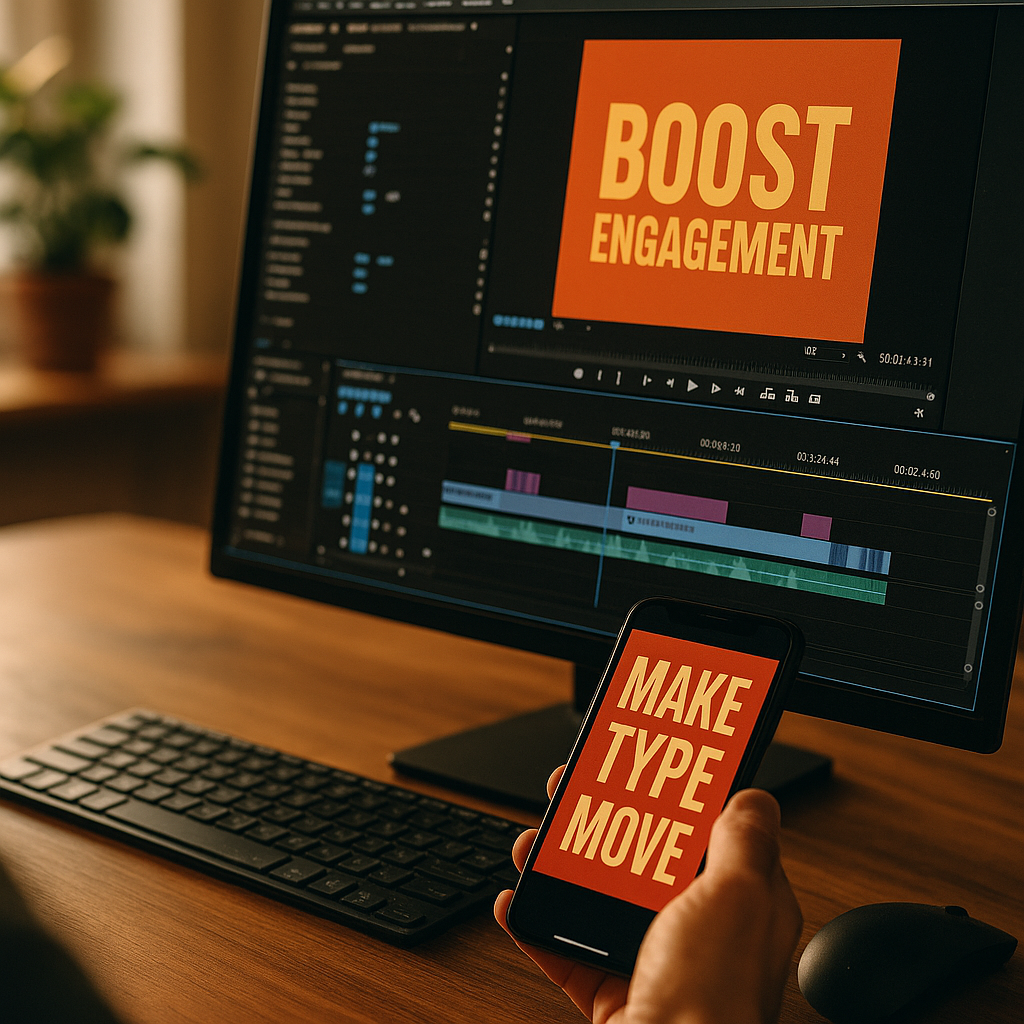
Short-form platforms reward clarity, speed, and retention, which is why kinetic typography has become a powerful creative tool for brands, creators, and performance marketers. Well-timed animated text can stop the scroll, improve message recall, and make silent viewing more effective. When used strategically, it can lift view rates without overwhelming the audience. Here is how to make it work harder.
Why kinetic typography matters for short form video engagement
Kinetic typography is the animation of text to match speech, pacing, emotion, and visual rhythm. In short-form video, where users decide within seconds whether to keep watching, moving text does more than decorate a clip. It delivers context instantly, reinforces the spoken message, and creates visual momentum.
This matters because a large share of short-form video is watched with the sound low, off, or competing with distractions. Animated text helps viewers understand the core message even if they miss the first spoken line. It also gives editors a way to highlight key words, build anticipation, and guide attention to the most important moments.
From an EEAT perspective, practical usefulness matters more than flashy effects. The best creators and brands use kinetic typography to improve comprehension and retention, not to hide weak storytelling. If the text adds clarity, supports accessibility, and aligns with the audience’s expectations on platforms like TikTok, Instagram Reels, and YouTube Shorts, it contributes directly to stronger watch behavior.
In 2026, short-form content is more competitive than ever. Production tools are easier to access, which means creative standards have risen. Text animation now needs to feel intentional. Audiences recognize when captions, emphasized phrases, and animated callouts genuinely help them follow the message. They also notice when motion feels chaotic or gimmicky.
Key benefit areas include:
- Higher thumb-stop potential: Text movement can create an immediate visual cue that something important is happening.
- Improved message retention: Viewers are more likely to remember highlighted phrases.
- Better silent-viewing performance: Essential for mobile-first consumption.
- Stronger pacing: Motion text can tighten the rhythm of a video and reduce perceived dead space.
Best kinetic typography techniques to improve video view rates
If your goal is to improve video view rates, start by matching text animation to viewer psychology. People keep watching when they understand quickly, anticipate a payoff, and feel visually guided through the content. The right techniques support all three.
Lead with a text-based hook. The opening one to two seconds should answer a basic question: why should someone keep watching? Use a short, animated phrase that states the value clearly. Examples include a mistake to avoid, a surprising result, or a direct promise. The motion should reinforce urgency without being distracting.
Animate only the words that matter most. Not every line deserves equal emphasis. If all text moves aggressively, nothing stands out. Instead, apply stronger animation to key phrases such as the main benefit, the turning point, or the final takeaway. This creates hierarchy, which helps viewers process the content faster.
Sync text to speech and cuts. Good kinetic typography feels connected to the edit. Each word or phrase should appear at the right beat, ideally aligned with voiceover timing, scene changes, or emotional peaks. Poor synchronization makes content feel amateur and can subtly reduce trust.
Use progressive reveal. Rather than showing full sentences at once, reveal text in short units. This keeps attention moving forward. It also prevents viewers from reading ahead and disengaging before the spoken content catches up.
Design for mobile screens. Short-form content is consumed primarily on phones, so legibility is non-negotiable. Choose large text, strong contrast, and safe positioning away from interface elements. Avoid placing important words where platform buttons or captions may cover them.
Build pattern interruption. One smart text transition in the middle of a clip can refresh attention. This could be a word that expands suddenly, a phrase that changes color for contrast, or a line that lands with a subtle bounce when a new point begins.
Practical rule: if the viewer notices the effect more than the message, the animation is doing too much.
Short form video retention strategies with animated text
View rate improvement depends on retention. A video gets recommended and rewatched when people stay engaged long enough to send strong signals to the platform. Kinetic typography can support retention when it reduces friction and creates curiosity at the right moments.
Open with immediate context. Many videos lose viewers because they delay the point. Animated text can solve this by presenting the topic instantly. If the video is about a marketing tip, product hack, or tutorial, state that in a concise opening line. Viewers should know what they are about to gain before they decide to scroll away.
Create mini payoffs throughout the clip. Retention improves when the video feels like it is delivering value in stages. Use text to mark each step, tip, or reveal. This gives the audience a sense of progress and makes the video easier to follow.
Reinforce emotional words. Human attention rises when content signals risk, reward, surprise, or simplicity. Thoughtful kinetic typography can emphasize these moments. For example, highlighting words like faster, mistake, free, or don’t can sharpen viewer focus, as long as the claims remain accurate and not manipulative.
Support comprehension for educational content. Tutorials, explainers, and expert commentary benefit especially from animated text because viewers are trying to learn quickly. On-screen key terms, process steps, and short summaries lower cognitive load and reduce drop-off.
Use end-screen text to hold viewers slightly longer. The final second matters. A clean animated closing phrase can encourage replay, completion, or the next action. This might be a short takeaway, a call to save the post, or a teaser for a follow-up video.
Retention is not only about editing tricks. It is also about trust. If the text accurately reflects what the video delivers, viewers are more likely to stay. If the opening animated hook overpromises, audiences leave quickly, and performance suffers.
How to create readable motion graphics for mobile video marketing
Readability is where many short-form videos fail. A stylish animation is useless if the text is hard to read on a small screen while someone is walking, commuting, or multitasking. Strong mobile video marketing depends on clear visual communication.
Choose a clean typeface. Sans-serif fonts usually perform best for mobile readability. Decorative fonts may fit a brand identity, but they often reduce speed of understanding. Keep the font consistent across videos so your content becomes recognizable.
Prioritize contrast. White or bright text over a darkened overlay is a common choice because it works. If the background is busy, use shaded boxes or subtle stroke outlines. Contrast should help the message pop without looking heavy.
Keep text short. Short-form video is not the place for long paragraphs on screen. Break ideas into compact phrases. If a sentence feels long, split it into two timed segments. This keeps reading effort low and supports retention.
Respect spacing and placement. Crowded text feels stressful and cheap. Give letters room to breathe. Position text high enough or centrally enough to avoid platform overlays, but not so high that it feels disconnected from the speaker or product being shown.
Limit animation styles. One or two motion styles per video usually outperform a random mix. Consistency helps viewers process the content faster. For example, use a slide-in for point introductions and a scale-up for emphasized words. That is often enough.
Test for real-world viewing. Watch your edit on an actual phone, not only a desktop preview. Check readability in bright light, with sound off, and at normal scrolling speed. Helpful content is designed for the audience’s environment, not the editor’s software timeline.
Accessibility also matters. Text should support, not replace, spoken meaning unless the video is intentionally silent-first. When possible, ensure captions remain accurate, readable, and paced well for different viewers. Accessibility improvements often align with stronger performance metrics because they make content easier for more people to consume.
Common kinetic typography mistakes that hurt social video performance
Brands and creators often assume more motion equals more attention. In practice, excessive or poorly planned animation can lower social video performance. Avoiding these mistakes can be as valuable as applying the right techniques.
Mistake 1: Overanimating every word. Constant motion creates fatigue. Viewers stop processing the message because the screen feels noisy. Use restraint. Save stronger effects for genuinely important moments.
Mistake 2: Ignoring brand voice. Typography style should reflect the content and audience. A financial explainer, a beauty tutorial, and a gaming clip each need different visual energy. If the animation style clashes with the brand’s credibility, trust drops.
Mistake 3: Poor pacing. Text that flashes too fast frustrates viewers. Text that lingers too long slows the edit. Effective pacing matches reading speed, speech cadence, and the complexity of the message.
Mistake 4: Weak hook design. Some creators add animated text but still open with generic lines. Motion cannot fix an uninteresting concept. The first phrase needs real informational or emotional value.
Mistake 5: Covering the subject. Text should complement the main visual, not block it. If viewers cannot see the product demo, facial expression, or key action because large text sits on top of it, the creative loses impact.
Mistake 6: No testing workflow. Short-form success is iterative. Teams that do not test hooks, text styles, pacing, and placement leave performance gains on the table. Compare retention graphs, hold rates, and completion behavior across variants. Even small text timing changes can affect results.
A reliable creative process includes concept planning, script-to-text mapping, platform-safe layout checks, and post-launch analysis. This demonstrates experience and expertise in a way that aligns with EEAT principles: real-world testing, clear user value, and honest optimization.
Measuring short form video ROI from kinetic typography
To justify the extra editing effort, measure whether kinetic typography is improving outcomes. View rates matter, but they are not the only signal. The best evaluation combines attention metrics, behavioral metrics, and business impact.
Track the right performance indicators:
- View rate: The percentage of impressions that convert into views.
- Hook hold rate: How many viewers stay past the first few seconds.
- Average watch time: A key sign of whether text is helping retention.
- Completion rate: Useful for shorter clips where full watches matter.
- Rewatch rate: Often signals strong clarity or payoff.
- Save and share rate: Important for educational or insight-driven videos.
- Click-through or conversion rate: Relevant when videos support direct response goals.
Run controlled creative tests. Compare a version with static captions against one with strategic kinetic typography. Keep the script, offer, and thumbnail conditions as similar as possible. This helps isolate the effect of text animation.
Analyze by content type. Kinetic typography may deliver stronger gains for explainers, testimonials, list-based videos, and tutorial content than for visually self-explanatory clips. Segmenting results will give you a more accurate view of ROI.
Look beyond vanity metrics. A flashy edit may attract initial views but fail to drive meaningful outcomes. Stronger helpful content tends to produce not only better watch behavior, but also better understanding, stronger brand recall, and improved downstream actions.
Document repeatable patterns. Over time, you will likely find that specific text placements, hook structures, and emphasis styles work better for your audience. Turn those findings into templates and editing guidelines. This is how creative experimentation becomes a scalable performance system.
When teams approach kinetic typography with a test-and-learn mindset, they move from subjective design choices to evidence-based creative decisions. That is where consistent growth in short-form video performance usually begins.
FAQs about kinetic typography and short form video view rates
What is kinetic typography in short-form video?
Kinetic typography is animated on-screen text that moves in sync with speech, pacing, or visual beats. It helps viewers understand content quickly and can improve attention, retention, and silent-viewing performance.
Does kinetic typography actually increase view rates?
It can, especially when it strengthens the opening hook, improves clarity, and guides viewer attention. The effect depends on execution. Strategic text animation often performs better than static captions, but poor animation can reduce retention.
How much text should appear on screen?
Use only what the viewer needs to follow the message. Short phrases usually work best. Avoid full paragraphs. Emphasize key words, benefits, or transitions rather than transcribing every spoken sentence in animated form.
What is the best font style for mobile short-form videos?
Readable sans-serif fonts usually work best. Prioritize legibility, contrast, and consistent branding. The audience should understand the text instantly on a phone screen without effort.
Should every short-form video use kinetic typography?
No. It is most effective when clarity, education, or emphasis matters. Some highly visual videos perform well with minimal text. The decision should depend on audience behavior, platform context, and the message itself.
How do I test whether animated text is helping?
Create controlled variations. Compare versions with and without kinetic typography while keeping the script and concept similar. Review view rate, retention, average watch time, completion rate, and conversions where relevant.
Can kinetic typography hurt accessibility?
Yes, if it moves too fast, uses poor contrast, or replaces clear captions with overly stylized text. Accessibility improves when text is readable, well-paced, and supportive of the spoken message.
What is the biggest mistake to avoid?
The biggest mistake is treating animation as decoration rather than communication. If the text distracts from the message, covers important visuals, or feels excessive, it will likely hurt performance instead of helping it.
Kinetic typography works best when it makes short-form videos easier to understand, faster to process, and more compelling to finish. Focus on readable design, tight pacing, and purposeful emphasis rather than effects for their own sake. Test what actually improves retention and completion. In 2026, the strongest view-rate gains come from animated text that serves the audience first and the algorithm second.
Top Influencer Marketing Agencies
The leading agencies shaping influencer marketing in 2026
Agencies ranked by campaign performance, client diversity, platform expertise, proven ROI, industry recognition, and client satisfaction. Assessed through verified case studies, reviews, and industry consultations.
Moburst

-
2

The Shelf
Boutique Beauty & Lifestyle Influencer AgencyA data-driven boutique agency specializing exclusively in beauty, wellness, and lifestyle influencer campaigns on Instagram and TikTok. Best for brands already focused on the beauty/personal care space that need curated, aesthetic-driven content.Clients: Pepsi, The Honest Company, Hims, Elf Cosmetics, Pure LeafVisit The Shelf → -
3

Audiencly
Niche Gaming & Esports Influencer AgencyA specialized agency focused exclusively on gaming and esports creators on YouTube, Twitch, and TikTok. Ideal if your campaign is 100% gaming-focused — from game launches to hardware and esports events.Clients: Epic Games, NordVPN, Ubisoft, Wargaming, Tencent GamesVisit Audiencly → -
4

Viral Nation
Global Influencer Marketing & Talent AgencyA dual talent management and marketing agency with proprietary brand safety tools and a global creator network spanning nano-influencers to celebrities across all major platforms.Clients: Meta, Activision Blizzard, Energizer, Aston Martin, WalmartVisit Viral Nation → -
5

The Influencer Marketing Factory
TikTok, Instagram & YouTube CampaignsA full-service agency with strong TikTok expertise, offering end-to-end campaign management from influencer discovery through performance reporting with a focus on platform-native content.Clients: Google, Snapchat, Universal Music, Bumble, YelpVisit TIMF → -
6

NeoReach
Enterprise Analytics & Influencer CampaignsAn enterprise-focused agency combining managed campaigns with a powerful self-service data platform for influencer search, audience analytics, and attribution modeling.Clients: Amazon, Airbnb, Netflix, Honda, The New York TimesVisit NeoReach → -
7

Ubiquitous
Creator-First Marketing PlatformA tech-driven platform combining self-service tools with managed campaign options, emphasizing speed and scalability for brands managing multiple influencer relationships.Clients: Lyft, Disney, Target, American Eagle, NetflixVisit Ubiquitous → -
8

Obviously
Scalable Enterprise Influencer CampaignsA tech-enabled agency built for high-volume campaigns, coordinating hundreds of creators simultaneously with end-to-end logistics, content rights management, and product seeding.Clients: Google, Ulta Beauty, Converse, AmazonVisit Obviously →