


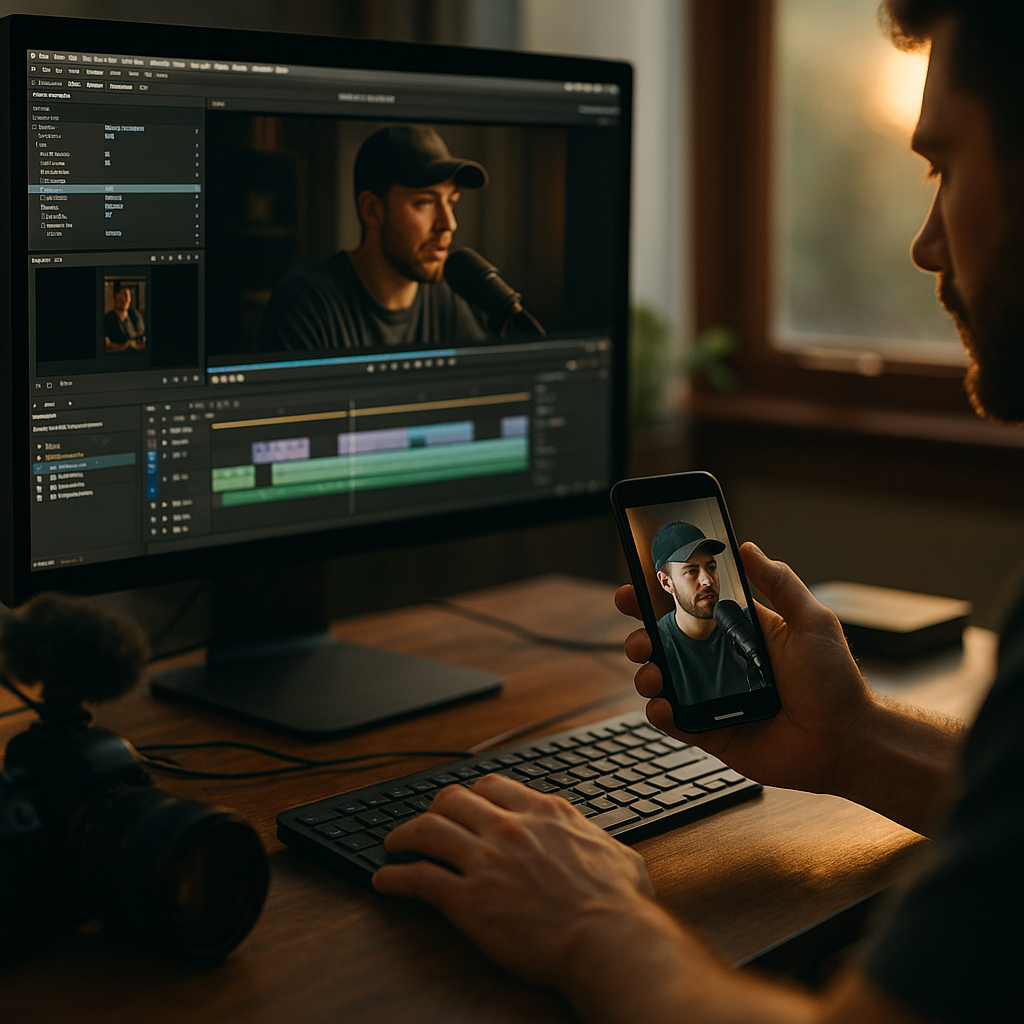
Your Live Stream Ended 30 Minutes Ago. Why Isn’t It on TikTok Yet?
Brands producing live video now generate 3–5x more raw footage than their post-production teams can process, according to Statista’s streaming data. The bottleneck isn’t creation — it’s reformatting. Automated live-to-short-form reformatting through services built on infrastructure like AWS Elemental is becoming the operational lever that separates brands shipping content in minutes from those drowning in a 72-hour editing queue.
What AWS Elemental Actually Does in the Vertical Video Pipeline
Let’s clear up a common misconception. AWS Elemental isn’t an editing suite. It’s a media processing backbone — a family of services (MediaLive, MediaConvert, MediaPackage) that handles ingest, transcoding, packaging, and delivery of video at scale. When people reference “AWS Elemental inference,” they’re typically talking about combining these media services with AWS’s machine learning inference capabilities (SageMaker endpoints, Rekognition, Bedrock) to automate decisions about what to clip, how to reframe, and where to distribute.
Think of it this way: the Elemental stack handles the heavy lifting of video transformation — resolution changes, bitrate optimization, container formatting — while ML models layered on top identify the “highlight-worthy” moments, detect speaker positions for smart cropping, and generate metadata for platform-specific publishing.
This architecture matters because it’s modular. You’re not locked into a single vendor’s vision of what “automated clipping” should look like. You can swap inference models, add custom brand-safety classifiers, or integrate third-party captioning APIs without rearchitecting the pipeline.
The real value of an AWS Elemental-based pipeline isn’t speed alone — it’s the ability to enforce brand governance rules programmatically at every stage of reformatting, from aspect ratio to caption placement to content safety scoring.
The Actual Cost of Manual Reformatting (It’s Worse Than You Think)
Most brand teams underestimate how much they’re spending on live-to-short-form conversion. A single 60-minute livestream destined for TikTok, Reels, and Shorts typically requires:
- Manual review and highlight selection: 2–4 hours
- Aspect ratio cropping and reframing per clip: 30–45 minutes each
- Caption generation and styling per platform: 20–30 minutes each
- Thumbnail creation and metadata tagging: 15–20 minutes per clip
- QA and compliance review: 1–2 hours total
For a brand running three livestreams per week and extracting five clips per stream, that’s roughly 40–60 hours of production labor weekly. At blended agency rates, you’re looking at $8,000–$15,000 per month in reformatting alone — before media spend, before talent costs, before platform management.
Automated pipelines can compress that cycle to near-real-time. Not perfect every time, but “good enough to ship with human spot-checks” represents an 80% reduction in hands-on hours for most teams. The question isn’t whether automation saves money. It’s whether your specific automation choice introduces new risks.
How to Evaluate Automated Reformatting Services: A Decision Framework
Not every solution built on cloud inference is worth your budget. Here’s what brand teams should pressure-test before signing.
1. Reframing intelligence vs. dumb cropping. The cheapest solutions simply center-crop a 16:9 feed to 9:16. That works for talking-head content. It fails catastrophically for product demos, multi-person panels, or anything with meaningful visual composition at the frame edges. Evaluate whether the service uses pose detection, object tracking, or scene-graph analysis to make reframing decisions. Ask vendors to process your actual footage — not their cherry-picked demos.
2. Platform-specific output compliance. TikTok, Reels, and Shorts each have different maximum durations, recommended bitrates, caption burn-in behaviors, and safe-zone requirements for UI overlays. A service worth paying for should maintain per-platform output profiles that update as TikTok’s ad specs and Meta’s Reels guidelines evolve. If you’re managing these mappings yourself, you’ve just bought infrastructure, not a solution.
3. Latency budget. “Real-time” means different things to different vendors. For a brand reacting to a live cultural moment, five-minute clip turnaround matters. For a weekly product livestream repurposing cycle, 30 minutes is fine. Define your latency requirement before evaluating, or you’ll overpay for speed you don’t need.
4. Human-in-the-loop architecture. Full automation sounds appealing until an AI clips a 45-second segment where your CEO misspoke. The best pipelines generate candidate clips ranked by confidence score and allow a human reviewer to approve, reject, or reorder before publishing. Look for approval workflow integrations with Slack, Teams, or your existing project management stack.
5. Rights and content governance. Automated pipelines can inadvertently include copyrighted music, third-party logos, or user-generated content captured in a livestream background. If you’re operating in regulated industries, you need content governance baked into the pipeline — not bolted on after. For deeper guidance on this, our coverage of content governance platforms provides a useful framework.
6. Total cost of ownership beyond sticker price. Cloud inference costs scale with usage. A service priced at $0.02 per minute of processed video sounds cheap until you’re running 200 hours of livestream footage monthly. Model your actual volume across a full quarter, including failed processing attempts and re-runs. Compare this against your MarTech rationalization strategy — does this tool consolidate existing spend or add another line item?
Where AWS Elemental Fits vs. Turnkey SaaS Alternatives
This is the fork in the road most brand teams face: build on AWS Elemental’s modular services, or buy a turnkey platform like Opus Clip, Vizard, or Munch?
Building on AWS gives you control. You own the pipeline, customize the inference models, and avoid vendor lock-in. But “building” requires engineering resources — ML ops experience, video encoding expertise, and ongoing maintenance. For brands with in-house engineering teams or agencies with dedicated technical capabilities, this path offers the best long-term economics and flexibility.
Turnkey SaaS platforms get you to market faster. Most offer drag-and-drop workflows, built-in caption generation, and one-click publishing to major platforms. The tradeoff? Limited customization, potential data residency concerns, and pricing that gets expensive at scale.
The hybrid approach is gaining traction: use AWS Elemental for ingest and transcoding (where its reliability is unmatched), then route processed video through a specialized AI clipping service for highlight detection and reframing, and finally push to a distribution layer. This “best-of-breed” architecture aligns with how enterprise teams are already approaching their enterprise AI stack decisions.
The brands winning the short-form distribution race aren’t choosing between building and buying — they’re assembling composable pipelines where each layer (ingest, intelligence, distribution) can be independently upgraded or swapped.
Distribution Speed as Competitive Advantage
Here’s the part that often gets lost in technical evaluations: the strategic why.
Short-form platforms reward recency. TikTok’s algorithm surfaces fresh content more aggressively than aged uploads. YouTube Shorts prioritizes creator velocity in its recommendation signals. When your livestream ends at 2:00 PM and your first clip hits platforms by 2:15 PM, you’re competing in a different league than the brand that publishes edited clips three days later.
This velocity compounds. Faster publishing means faster engagement data. Faster engagement data means faster iteration on what’s working. Over a quarter, a brand with a 15-minute reformatting pipeline generates 10–15x more performance data points than one with a 72-hour cycle — and that data feeds smarter creator program optimization.
Speed also changes what you can afford to produce. When reformatting costs drop from $200 per clip to $5, you can justify livestreaming events that previously couldn’t clear the ROI bar. Micro-events, behind-the-scenes walkthroughs, creator Q&As — all become viable content when the post-production cost approaches zero.
Risk Factors Worth Flagging
Automated reformatting isn’t risk-free. Three concerns deserve boardroom attention:
Quality variance. AI-generated clips will occasionally miss the mark — awkward cuts, cropped-out products, truncated sentences. Brands with premium positioning need tighter QA gates, which partially offsets the time savings. Plan for a 10–15% manual override rate.
Platform policy shifts. TikTok and Meta regularly update their content policies and format specifications. An automated pipeline that doesn’t monitor and adapt to these changes can produce non-compliant content at scale — a brand safety nightmare. Ensure your vendor or internal team has a process for tracking policy updates.
Over-reliance on automation. The most engaging short-form content still benefits from creative judgment — knowing which moment resonates emotionally, which cut creates tension, which opening hook stops the scroll. Automation handles the mechanical work. Creative direction remains irreplaceable. If you’re exploring AI-powered tools for the creative layer, our comparison of AI video generation tools maps the current landscape.
Your Next Move
Audit your current live-to-short-form cycle this week: measure the hours, the cost, and the time-to-publish gap. Then evaluate one automated reformatting pipeline against those benchmarks using real footage — not vendor demos. The brands that operationalize this transition in the next quarter will own a distribution speed advantage that’s genuinely difficult to reverse-engineer.
Frequently Asked Questions
What is AWS Elemental’s role in a vertical video pipeline?
AWS Elemental provides the media processing infrastructure — ingest, transcoding, and packaging — that forms the backbone of an automated video pipeline. It handles resolution changes, bitrate optimization, and container formatting. When combined with AWS machine learning services like Rekognition or SageMaker, it enables intelligent reframing, highlight detection, and automated clipping for short-form vertical formats required by TikTok, Reels, and Shorts.
How much can automated live-to-short-form reformatting reduce production costs?
Most brand teams report a 70–80% reduction in hands-on production hours when switching from manual reformatting to an automated pipeline with human-in-the-loop QA. For a brand running three livestreams per week and extracting five clips per stream, this can translate to saving $8,000–$15,000 per month in labor costs alone, depending on agency rates and content volume.
Should brands build a custom pipeline on AWS or use a turnkey SaaS clipping tool?
It depends on your technical resources and scale. Building on AWS Elemental offers maximum control, customization, and better long-term economics but requires ML ops and video engineering expertise. Turnkey SaaS platforms like Opus Clip or Vizard ship faster with minimal setup but offer less customization and can get expensive at volume. Many enterprise teams adopt a hybrid approach, using AWS for ingest and transcoding while layering specialized AI clipping services on top.
What are the biggest risks of automated video reformatting for brands?
The three primary risks are quality variance (AI producing awkward cuts or cropping out key visuals), platform policy non-compliance (format spec changes that automated systems fail to adapt to), and over-reliance on automation at the expense of creative judgment. Brands should plan for a 10–15% manual override rate and ensure their pipeline includes approval workflows before content goes live.
How fast can an automated pipeline publish short-form clips after a livestream ends?
Well-optimized automated pipelines can generate candidate clips within 5–15 minutes of a livestream segment completing. With a human approval step, total time-to-publish typically ranges from 15–30 minutes. This is a dramatic improvement over the 48–72 hour turnaround common with manual editing workflows and provides a significant algorithmic advantage on platforms that reward content recency.
Top Influencer Marketing Agencies
The leading agencies shaping influencer marketing in 2026
Agencies ranked by campaign performance, client diversity, platform expertise, proven ROI, industry recognition, and client satisfaction. Assessed through verified case studies, reviews, and industry consultations.
Moburst

-
2

The Shelf
Boutique Beauty & Lifestyle Influencer AgencyA data-driven boutique agency specializing exclusively in beauty, wellness, and lifestyle influencer campaigns on Instagram and TikTok. Best for brands already focused on the beauty/personal care space that need curated, aesthetic-driven content.Clients: Pepsi, The Honest Company, Hims, Elf Cosmetics, Pure LeafVisit The Shelf → -
3

Audiencly
Niche Gaming & Esports Influencer AgencyA specialized agency focused exclusively on gaming and esports creators on YouTube, Twitch, and TikTok. Ideal if your campaign is 100% gaming-focused — from game launches to hardware and esports events.Clients: Epic Games, NordVPN, Ubisoft, Wargaming, Tencent GamesVisit Audiencly → -
4

Viral Nation
Global Influencer Marketing & Talent AgencyA dual talent management and marketing agency with proprietary brand safety tools and a global creator network spanning nano-influencers to celebrities across all major platforms.Clients: Meta, Activision Blizzard, Energizer, Aston Martin, WalmartVisit Viral Nation → -
5

The Influencer Marketing Factory
TikTok, Instagram & YouTube CampaignsA full-service agency with strong TikTok expertise, offering end-to-end campaign management from influencer discovery through performance reporting with a focus on platform-native content.Clients: Google, Snapchat, Universal Music, Bumble, YelpVisit TIMF → -
6

NeoReach
Enterprise Analytics & Influencer CampaignsAn enterprise-focused agency combining managed campaigns with a powerful self-service data platform for influencer search, audience analytics, and attribution modeling.Clients: Amazon, Airbnb, Netflix, Honda, The New York TimesVisit NeoReach → -
7

Ubiquitous
Creator-First Marketing PlatformA tech-driven platform combining self-service tools with managed campaign options, emphasizing speed and scalability for brands managing multiple influencer relationships.Clients: Lyft, Disney, Target, American Eagle, NetflixVisit Ubiquitous → -
8

Obviously
Scalable Enterprise Influencer CampaignsA tech-enabled agency built for high-volume campaigns, coordinating hundreds of creators simultaneously with end-to-end logistics, content rights management, and product seeding.Clients: Google, Ulta Beauty, Converse, AmazonVisit Obviously →