


One Scripted Line Could Cost You Seven Figures
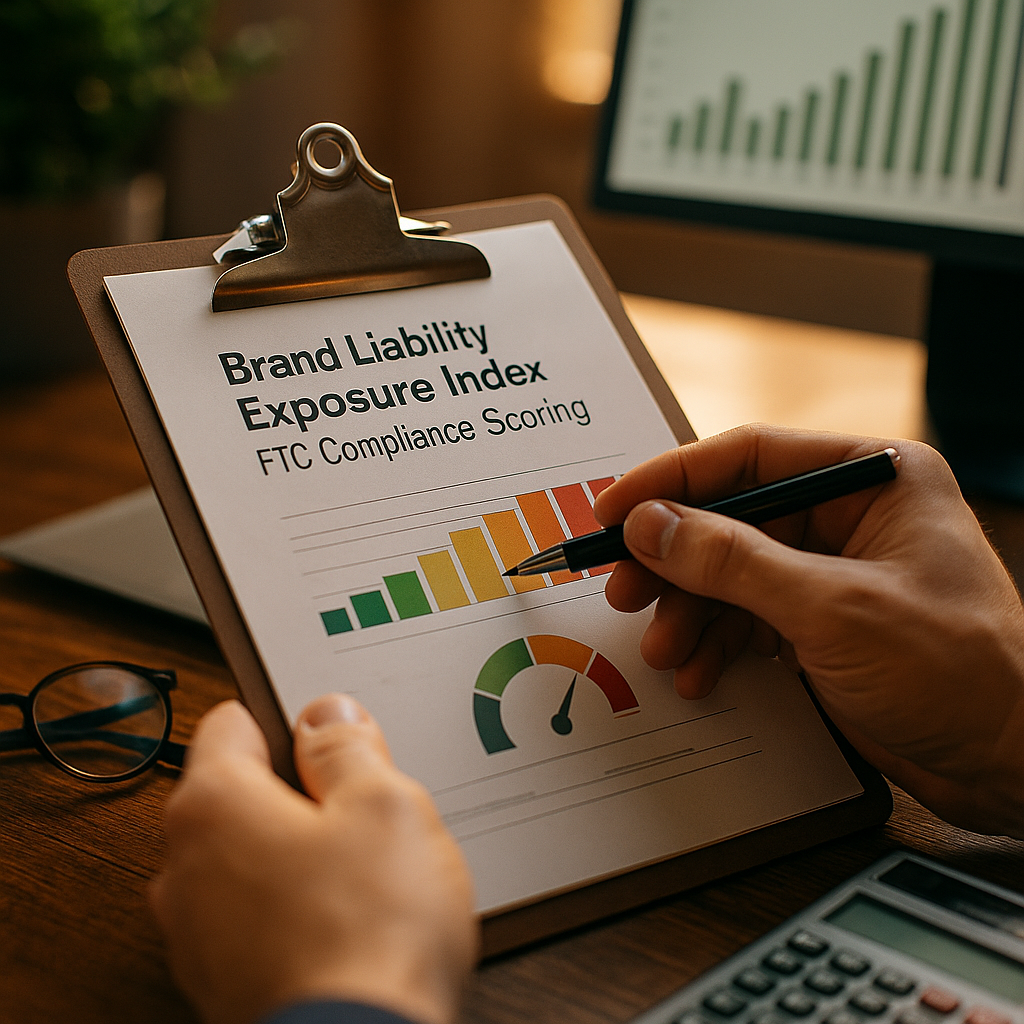
In 2024, the FTC issued enforcement actions against brands—not just creators—in 73% of influencer marketing cases involving scripted or heavily directed content. That number has climbed since. If your legal team isn’t scoring campaign involvement before a single post goes live, you’re operating on borrowed time. The Brand Liability Exposure Index gives marketing legal teams a structured self-assessment framework to measure exactly how much creative direction pushes a campaign from “sponsored collaboration” into “brand-authored advertisement”—and the dramatically different liability thresholds that come with each.
Why “Involvement Level” Is Now a Legal Variable
For years, the working assumption was straightforward: if a creator disclosed the sponsorship, the brand was largely shielded. That assumption is dead.
The FTC’s revised Endorsement Guides explicitly state that the more control an advertiser exercises over the content, the more responsibility they bear for every claim made within it. Courts have followed suit. In recent rulings, judges have treated detailed creative briefs, mandatory talking points, and brand-approved scripts as evidence that the brand—not the creator—is the “speaker” for liability purposes.
This matters because the legal consequences are categorically different. A creator making an independent endorsement triggers one set of obligations. A brand effectively authoring content through a creator’s mouth triggers another—one that includes strict liability for substantiation, potential Lanham Act exposure from competitors, and state-level consumer protection claims that bypass the FTC entirely.
The core legal question has shifted from “Did the creator disclose?” to “How much of this content did the brand actually create?” Your involvement level is your liability level.
If you haven’t already reviewed how creative control affects brand liability, that’s your prerequisite reading before implementing any scoring framework.
The Three Dimensions of Campaign Involvement
The Brand Liability Exposure Index evaluates campaigns across three dimensions. Each one maps to specific regulatory and judicial standards. Score them independently, then aggregate for your total exposure rating.
Dimension 1: Script Depth
This isn’t binary. “We gave them a script” versus “we didn’t” misses the spectrum that regulators actually evaluate. Here’s how to score it:
- Level 1 (Low — Score 1-2): Brand provides product information and key messages only. Creator writes all copy. No pre-approval of verbal content required.
- Level 2 (Moderate — Score 3-5): Brand supplies suggested language, sample phrases, or a loose script outline. Creator can deviate but is expected to hit specific message beats.
- Level 3 (High — Score 6-8): Brand provides a full script or detailed talking points that must be followed closely. Revisions requested when creator deviates.
- Level 4 (Maximum — Score 9-10): Brand writes verbatim script. Creator reads or paraphrases with minimal deviation. Multiple rounds of script approval.
At Level 3 and above, you’re almost certainly the “speaker” under FTC analysis. For a deeper dive into how brand-directed scripts create liability, we’ve covered the case law in detail.
Dimension 2: Talking Point Mandates
Talking points feel less controlling than scripts. They’re not—at least not to the FTC.
- Level 1 (Low — Score 1-2): General brand guidelines. “Mention that it’s cruelty-free.” No specific claims required.
- Level 2 (Moderate — Score 3-5): Specific claims must appear. “Must mention clinically proven results.” Creator chooses how to frame them.
- Level 3 (High — Score 6-8): Mandatory claims with specified language. “Must say ‘3x more effective than leading competitors.'” Brand reviews for compliance before posting.
- Level 4 (Maximum — Score 9-10): Exhaustive list of required and prohibited statements. Every substantive claim is brand-authored. Creator is essentially a delivery mechanism.
The distinction between Level 2 and Level 3 is where most brands get into trouble. Requiring a specific efficacy claim—even if you let the creator “put it in their own words”—means you own the substantiation burden for that claim. Period. The FTC’s enforcement record on this is unambiguous.
Dimension 3: Visual Direction
This is the dimension most legal teams underweight. They shouldn’t.
- Level 1 (Low — Score 1-2): Product must appear in content. No other visual requirements.
- Level 2 (Moderate — Score 3-5): Brand provides mood boards, color guidelines, or setting preferences. Creator retains editorial control over execution.
- Level 3 (High — Score 6-8): Brand specifies camera angles, backgrounds, wardrobe, demonstration sequences. Shot list provided.
- Level 4 (Maximum — Score 9-10): Brand or agency directs the shoot. Production crew involved. Creator follows a storyboard. Content is indistinguishable from a traditional ad.
Visual direction at Level 3+ increasingly factors into court analyses of whether content constitutes a “commercial message” under state advertising laws—not just FTC endorsement rules. This broadens your exposure surface considerably because state AG offices don’t need to prove the same elements the FTC does.
Scoring and What the Numbers Mean
Add your scores across all three dimensions. Maximum possible: 30.
- 3-8 (Green Zone): Standard influencer endorsement. Primary obligation is ensuring proper disclosure. Creator bears most content liability. Brand should still monitor for unsubstantiated claims.
- 9-16 (Yellow Zone): Shared liability territory. Brand likely co-responsible for specific mandated claims. Enhanced monitoring and substantiation documentation required.
- 17-24 (Orange Zone): Brand is the probable “speaker.” Full advertising substantiation standards apply. Treat as brand-authored content for legal review purposes.
- 25-30 (Red Zone): Functionally a brand advertisement delivered through a creator. All traditional advertising liability applies. Every claim needs the same review as a TV spot.
Most enterprise campaigns we’ve audited score between 14 and 22—squarely in the zone where brands bear significant liability but rarely apply the corresponding legal review. That gap is where enforcement actions live.
The framework isn’t about avoiding high scores. Some campaigns legitimately need tight creative control—product demonstrations with safety implications, regulated industries, pharma. The point is knowing your score so legal review depth matches actual exposure. A score of 25 with full advertising-level legal review is safer than a score of 15 with no review at all.
Operationalizing the Index Inside Your Workflow
A framework that lives in a PDF is worthless. Here’s how to embed it:
Step 1: Score at the brief stage. Before the creative brief reaches a creator, the marketing team fills out the three-dimension scoring sheet. Takes five minutes. This happens in your project management tool, not in a separate legal intake form nobody remembers to use.
Step 2: Route by score. Green Zone campaigns proceed with standard disclosure checks. Yellow Zone triggers a substantiation review of mandated claims. Orange and Red Zone campaigns get the same legal review as traditional advertising—claims substantiation, competitive review, regulatory pre-clearance where applicable.
Step 3: Re-score after revisions. Campaigns drift. A brief that started at Level 2 script depth can reach Level 4 after three rounds of revision notes. Build a re-scoring checkpoint before final content approval. The brand accountability audit process we’ve outlined provides a complementary checklist for this stage.
Step 4: Archive scores with campaign files. If enforcement ever comes, your documented scoring process demonstrates good-faith compliance effort. That matters both to the FTC—which considers compliance programs as mitigating factors—and to courts evaluating willfulness.
Brands running international campaigns need to layer additional considerations. EU and UK regulators apply their own frameworks for assessing commercial control, and what’s “Yellow Zone” under FTC standards might land differently under the cross-border liability framework.
The AI Complication
Here’s what’s making this harder in real time: AI tools are blurring the involvement lines.
When a brand uses an AI agent to generate draft scripts that creators then modify, who authored the content? When Meta’s advertising tools or TikTok’s ad platform auto-optimize creator content with AI-remixed variations, the brand’s involvement score can escalate without anyone deliberately choosing to increase control.
Your scoring framework needs to account for AI-mediated involvement. If an AI tool generates the initial script—even if a human creator modifies it—score the script depth based on how much of the AI-generated language survives in the final content, not based on the fact that a human touched it last. The FTC doesn’t care about your process; it cares about the output. For campaigns deploying autonomous AI tools, the liability risks in AI campaign management add a whole additional layer of complexity.
What Happens When You Don’t Score
The alternative to proactive scoring is reactive discovery. That means a regulator or plaintiff’s attorney reconstructs your involvement level from Slack messages, email chains, brief revisions, and approval workflows. They will always find the highest-involvement interpretation. Always.
Without a documented scoring process, you also lose the ability to argue proportional responsibility. “We only suggested language” is a weak defense when revision emails say “Please use this exact phrasing for the efficacy claim.” A contemporaneous score of 5 with documented creator autonomy tells a fundamentally different story than no documentation at all.
Your Next Step
Pull the last five creator campaigns your team ran. Score each one retroactively across all three dimensions. If more than two land in the Orange or Red Zone without having received advertising-level legal review, you have a systemic gap that needs closing before your next campaign launches.
FAQs
What is the Brand Liability Exposure Index?
The Brand Liability Exposure Index is a self-assessment scoring framework that helps marketing legal teams quantify how much creative control a brand exercises over influencer content across three dimensions—script depth, talking point mandates, and visual direction—and map that score to corresponding FTC and court liability standards before any creator publishes.
At what involvement score should brands apply full advertising legal review?
Campaigns scoring 17 or above on the 30-point scale (Orange and Red Zones) should receive the same legal review as traditional brand advertisements, including full claims substantiation, competitive review, and regulatory pre-clearance where applicable. Campaigns in the Yellow Zone (9-16) require substantiation review of any mandated claims.
Does the FTC hold brands liable for creator content even when creators write their own scripts?
Yes. Under the FTC’s Endorsement Guides, if a brand mandates specific claims, requires particular language, or exercises significant editorial control through revision rounds, the brand can be held liable as the “speaker” regardless of whether the creator technically drafted the content. The level of control determines liability, not the process used to create the content.
How does AI-generated content affect a brand’s liability exposure score?
AI-generated scripts, talking points, or visual direction created by brand-deployed tools should be scored based on how much AI-generated material appears in the final published content. If an AI tool produces a script that a creator uses largely intact, the brand’s script depth score should reflect that high level of involvement, even if a human creator made minor edits.
How often should brands re-score campaigns during production?
Brands should re-score campaigns at minimum once after the revision process and before final content approval. Creative briefs frequently escalate in involvement level through revision rounds, and a campaign that began as a low-involvement collaboration can become a high-involvement directed advertisement through iterative feedback.
Top Influencer Marketing Agencies
The leading agencies shaping influencer marketing in 2026
Agencies ranked by campaign performance, client diversity, platform expertise, proven ROI, industry recognition, and client satisfaction. Assessed through verified case studies, reviews, and industry consultations.
Moburst

-
2

The Shelf
Boutique Beauty & Lifestyle Influencer AgencyA data-driven boutique agency specializing exclusively in beauty, wellness, and lifestyle influencer campaigns on Instagram and TikTok. Best for brands already focused on the beauty/personal care space that need curated, aesthetic-driven content.Clients: Pepsi, The Honest Company, Hims, Elf Cosmetics, Pure LeafVisit The Shelf → -
3

Audiencly
Niche Gaming & Esports Influencer AgencyA specialized agency focused exclusively on gaming and esports creators on YouTube, Twitch, and TikTok. Ideal if your campaign is 100% gaming-focused — from game launches to hardware and esports events.Clients: Epic Games, NordVPN, Ubisoft, Wargaming, Tencent GamesVisit Audiencly → -
4

Viral Nation
Global Influencer Marketing & Talent AgencyA dual talent management and marketing agency with proprietary brand safety tools and a global creator network spanning nano-influencers to celebrities across all major platforms.Clients: Meta, Activision Blizzard, Energizer, Aston Martin, WalmartVisit Viral Nation → -
5

The Influencer Marketing Factory
TikTok, Instagram & YouTube CampaignsA full-service agency with strong TikTok expertise, offering end-to-end campaign management from influencer discovery through performance reporting with a focus on platform-native content.Clients: Google, Snapchat, Universal Music, Bumble, YelpVisit TIMF → -
6

NeoReach
Enterprise Analytics & Influencer CampaignsAn enterprise-focused agency combining managed campaigns with a powerful self-service data platform for influencer search, audience analytics, and attribution modeling.Clients: Amazon, Airbnb, Netflix, Honda, The New York TimesVisit NeoReach → -
7

Ubiquitous
Creator-First Marketing PlatformA tech-driven platform combining self-service tools with managed campaign options, emphasizing speed and scalability for brands managing multiple influencer relationships.Clients: Lyft, Disney, Target, American Eagle, NetflixVisit Ubiquitous → -
8

Obviously
Scalable Enterprise Influencer CampaignsA tech-enabled agency built for high-volume campaigns, coordinating hundreds of creators simultaneously with end-to-end logistics, content rights management, and product seeding.Clients: Google, Ulta Beauty, Converse, AmazonVisit Obviously →