


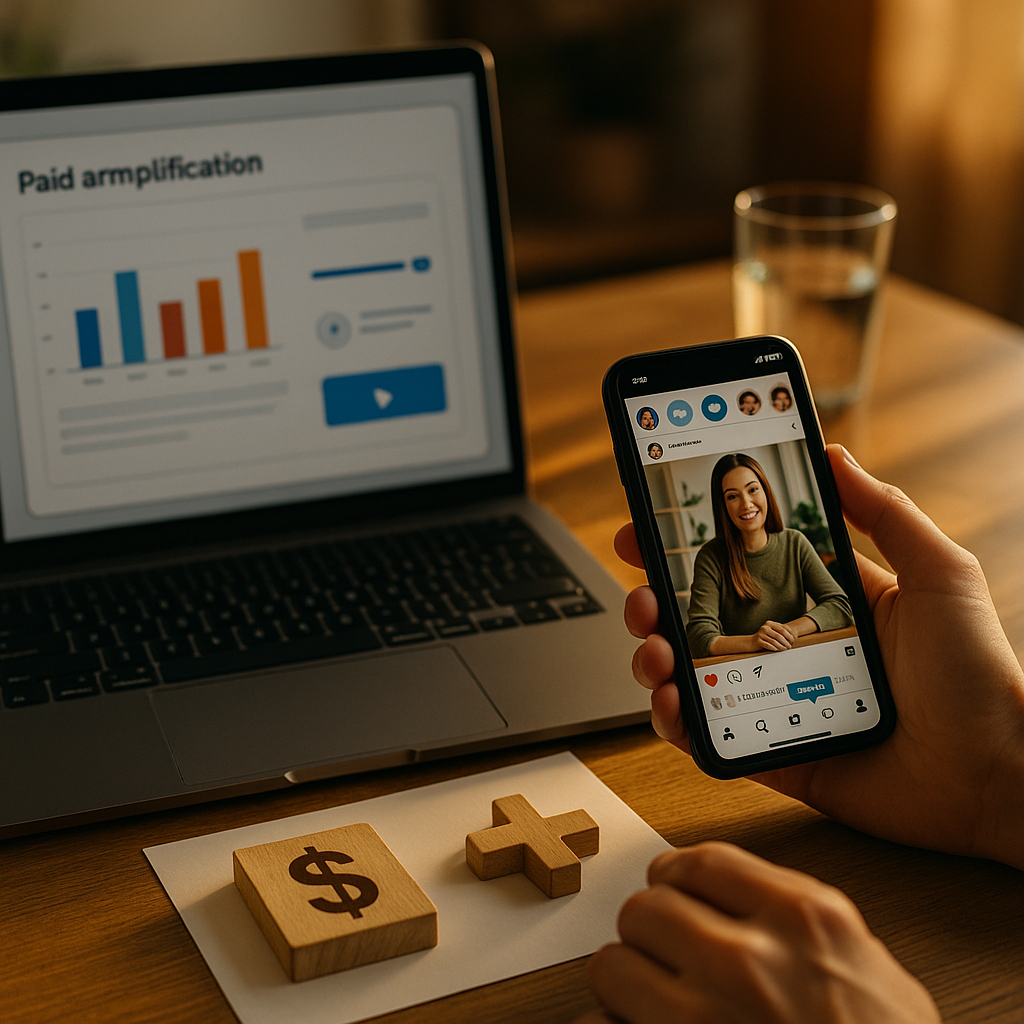
The Math Behind Paid Amplification as a Creator ROI Engine
Brands that boost top-performing creator content see a 2.8x average return on ad spend compared to running brand-produced ads through the same paid channels, according to Meta’s business insights. Yet most marketing teams still treat paid amplification and creator partnerships as separate line items, managed by separate teams, measured by separate dashboards. That disconnect is costing you money.
The question isn’t whether to use paid amplification as a creator ROI engine. It’s when — and how much.
The Core Trade-Off: More Creators or More Spend Behind Fewer?
Every brand with a creator program eventually faces this fork. You have budget. You can either activate ten additional micro-creators at $2,000 each or put $20,000 in paid spend behind the two creator posts already outperforming your benchmarks. Both paths have merit. Neither is universally correct.
The answer depends on three variables most teams fail to quantify:
- Content velocity needs: Do you need more creative assets for testing, or do you already have winners starving for distribution?
- Organic signal strength: Has any existing creator content already proven audience-market fit through organic engagement?
- Funnel stage priority: Are you solving for awareness (where more voices help) or conversion (where proven content boosted to lookalike audiences wins)?
If you’re managing a large roster, the scale-first budget model offers a useful starting framework. But the budget allocation question gets sharper once you layer in paid amplification economics.
The most efficient creator programs operate on a 70/20/10 allocation: 70% on creator fees and production, 20% on paid amplification of top-performing content, and 10% held in reserve for real-time boosts when organic content breaks out unexpectedly.
Cost-Per-Boosted-Impression Benchmarks Worth Memorizing
Let’s talk numbers. These benchmarks come from aggregated campaign data across Meta, TikTok, and YouTube Shorts, reflecting what mid-market and enterprise brands are actually paying — not what platforms quote in their pitch decks.
- Meta (Instagram/Facebook) whitelisted creator content: $4.50–$7.00 CPM for feed placements; $2.80–$4.50 CPM for Stories/Reels when using creator handles
- TikTok Spark Ads: $3.00–$6.00 CPM, with significant variance based on vertical. Beauty and fashion trend lower; B2B and finance trend higher. Check TikTok’s ads platform for current auction dynamics.
- YouTube Shorts boosted creator content: $5.00–$9.00 CPM, though completion rates justify the premium for longer consideration cycles
Compare these to typical brand-produced ad CPMs on the same platforms, which run 15–40% higher. The delta is your arbitrage. Creator content gets better engagement rates, which platforms reward with lower costs in auction-based systems.
One caveat: these benchmarks assume proper whitelisting and creator handle usage. Running creator content from a brand account without whitelisting typically erases 60–80% of the cost advantage. The content looks like an ad. The algorithm treats it like one.
For deeper thinking on measurement beyond CPM, pair these benchmarks with downstream conversion metrics. CPM alone lies.
Whitelisting Architecture: Getting the Plumbing Right
Whitelisting — also called creator licensing or partnership ads — is the technical backbone of any paid amplification strategy. Without it, you’re boosting screenshots. With it, you’re running ads from a creator’s handle with the targeting power of your brand’s ad account.
Here’s the architecture that works:
Step 1: Contractual foundation. Every creator agreement should include a paid amplification clause specifying the licensing window (typically 30–90 days), platforms covered, and whether the brand can modify captions or CTAs. Don’t bolt this on later. Negotiate it upfront. Your brand safety framework should directly inform these clauses.
Step 2: Platform-level access. On Meta, this means the creator grants your Business Manager partner-level access to their Instagram or Facebook page. On TikTok, creators authorize Spark Ads through a video code generated in their app. YouTube requires linking through Google Ads. Each platform has friction. Budget time for onboarding — especially with creators who haven’t whitelisted before.
Step 3: Ad account segmentation. Run whitelisted creator ads in a dedicated campaign structure, separate from your brand campaigns. This isn’t just organizational hygiene. It protects your attribution data. When creator ads and brand ads compete in the same campaign, the algorithm cannibalizes your spend allocation and muddies performance reads.
Step 4: Creative control hierarchy. Decide in advance what you can and can’t change. Best practice: brands can adjust targeting, bidding, and CTA buttons but cannot alter the creator’s video or caption without approval. This preserves authenticity — the exact thing that makes whitelisted content outperform brand creative.
Tools like Sprout Social and platforms such as Aspire, CreatorIQ, and Grin have built whitelisting workflows into their dashboards, reducing the manual coordination that used to make this process painful at scale.
Performance Thresholds That Signal Organic Content Has Earned Paid Spend
This is where most teams get it wrong. They either boost everything (wasting spend on mediocre content) or boost nothing (leaving proven winners under-distributed). You need a clear trigger system.
Here are the thresholds that high-performing brand teams use as go/no-go signals:
- Engagement rate exceeds your category benchmark by 1.5x or more within the first 24 hours. If your vertical averages a 3.2% engagement rate on Instagram Reels and a creator post hits 4.8% in the first day, that’s a signal. The content resonated. Feed it fuel.
- Save-to-like ratio exceeds 8%. Saves are the most underrated organic signal. They indicate intent, not just passive approval. A high save rate predicts strong downstream conversion performance when the content enters paid distribution.
- Comment sentiment is overwhelmingly product-curious. Scan for comments that ask “where can I get this?” or “does this work for [use case]?” — not just emoji reactions. This is purchase-adjacent behavior you can amplify.
- The content drives measurable site traffic or UTM clicks organically. If a creator post is already sending people to your site without paid support, amplification will compound that momentum rather than create it from scratch.
- Video completion rate exceeds 40% on TikTok or Reels. Completion rate is the algorithm’s favorite signal. Content that holds attention organically will hold it in paid — and the platform will reward you with lower CPMs.
A simple rule: never boost content to create performance. Boost content to multiply performance that already exists. Paid amplification is a megaphone, not a defibrillator.
If none of your current creator content hits these thresholds, the answer isn’t to boost harder — it’s to invest in better creator selection and vetting.
Building the Decision Framework Into Your Budget Cycle
Operationally, most brands plan creator budgets quarterly and paid media budgets monthly. That misalignment is the enemy. Paid amplification of creator content needs a rolling allocation that responds to real-time performance data.
Here’s a practical model:
Pre-campaign: Allocate 15–25% of total creator program budget as an amplification reserve. Don’t assign it to specific creators or posts in advance. This is your performance-contingent fund.
Week 1–2 of activation: Let all creator content run organically. Monitor against the threshold triggers above. Most content won’t qualify — and that’s fine. You’re looking for outliers.
Week 2–3: Move amplification spend behind the top 10–15% of posts that hit your thresholds. Start with a test budget ($500–$1,500 per post) and measure cost-per-click and cost-per-acquisition against your brand ad benchmarks.
Week 3–4: Scale spend on posts that outperform brand benchmarks by 20% or more. Kill spend on boosted posts that plateau. Reallocate unused amplification budget to the next flight of creator activations.
This approach aligns with the GEM budget framework many CMOs are already adopting, which treats creator spend, media spend, and earned media as interconnected rather than siloed.
One more thing: track your blended cost per result across organic and paid creator content. The brands winning right now aren’t optimizing organic or paid. They’re optimizing the blend — because a creator post that generates 200,000 organic impressions and then 800,000 paid impressions at $4 CPM delivers a blended CPM under $3.20. Good luck getting that from your performance marketing team alone.
Your Next Move
Audit your last quarter of creator content against the five performance thresholds above. Identify the posts that should have been boosted but weren’t — then calculate the impressions and conversions you left on the table. That number is your business case for building paid amplification into every creator brief from day one.
FAQs
What is paid amplification of creator content?
Paid amplification means putting advertising spend behind content that a creator has already published organically, typically through whitelisting or partnership ad formats. The brand uses its ad account to distribute the creator’s post to targeted audiences beyond the creator’s organic reach, while the ad appears under the creator’s handle rather than the brand’s page.
How do I decide between boosting creator posts and hiring more creators?
Evaluate three factors: whether you need more creative assets or better distribution of existing winners, whether any current content shows strong organic signals like high save rates or product-curious comments, and whether your campaign goal is awareness (more voices) or conversion (proven content to targeted audiences). If you have organic winners under-distributed, boost first. If you lack quality content entirely, invest in more creators.
What is a good CPM benchmark for whitelisted creator content?
On Meta platforms, expect $2.80–$7.00 CPM depending on placement. TikTok Spark Ads typically run $3.00–$6.00 CPM, and YouTube Shorts boosted content ranges from $5.00–$9.00 CPM. These figures are 15–40% lower than brand-produced ad CPMs on the same platforms, because creator content earns higher engagement rates that platforms reward with lower auction costs.
What organic performance signals should trigger a paid boost?
Look for engagement rates 1.5x above your category benchmark within 24 hours, save-to-like ratios above 8%, product-curious comments, measurable organic site traffic through UTM links, and video completion rates above 40% on short-form platforms. These signals indicate the content has proven audience resonance and will likely perform well under paid distribution.
How much of my creator budget should go toward paid amplification?
Most high-performing programs allocate 15–25% of their total creator budget as a paid amplification reserve. This amount is not pre-assigned to specific posts but held as a performance-contingent fund deployed behind the top 10–15% of organic content that meets predetermined threshold triggers during each campaign flight.
Top Influencer Marketing Agencies
The leading agencies shaping influencer marketing in 2026
Agencies ranked by campaign performance, client diversity, platform expertise, proven ROI, industry recognition, and client satisfaction. Assessed through verified case studies, reviews, and industry consultations.
Moburst

-
2

The Shelf
Boutique Beauty & Lifestyle Influencer AgencyA data-driven boutique agency specializing exclusively in beauty, wellness, and lifestyle influencer campaigns on Instagram and TikTok. Best for brands already focused on the beauty/personal care space that need curated, aesthetic-driven content.Clients: Pepsi, The Honest Company, Hims, Elf Cosmetics, Pure LeafVisit The Shelf → -
3

Audiencly
Niche Gaming & Esports Influencer AgencyA specialized agency focused exclusively on gaming and esports creators on YouTube, Twitch, and TikTok. Ideal if your campaign is 100% gaming-focused — from game launches to hardware and esports events.Clients: Epic Games, NordVPN, Ubisoft, Wargaming, Tencent GamesVisit Audiencly → -
4

Viral Nation
Global Influencer Marketing & Talent AgencyA dual talent management and marketing agency with proprietary brand safety tools and a global creator network spanning nano-influencers to celebrities across all major platforms.Clients: Meta, Activision Blizzard, Energizer, Aston Martin, WalmartVisit Viral Nation → -
5

The Influencer Marketing Factory
TikTok, Instagram & YouTube CampaignsA full-service agency with strong TikTok expertise, offering end-to-end campaign management from influencer discovery through performance reporting with a focus on platform-native content.Clients: Google, Snapchat, Universal Music, Bumble, YelpVisit TIMF → -
6

NeoReach
Enterprise Analytics & Influencer CampaignsAn enterprise-focused agency combining managed campaigns with a powerful self-service data platform for influencer search, audience analytics, and attribution modeling.Clients: Amazon, Airbnb, Netflix, Honda, The New York TimesVisit NeoReach → -
7

Ubiquitous
Creator-First Marketing PlatformA tech-driven platform combining self-service tools with managed campaign options, emphasizing speed and scalability for brands managing multiple influencer relationships.Clients: Lyft, Disney, Target, American Eagle, NetflixVisit Ubiquitous → -
8

Obviously
Scalable Enterprise Influencer CampaignsA tech-enabled agency built for high-volume campaigns, coordinating hundreds of creators simultaneously with end-to-end logistics, content rights management, and product seeding.Clients: Google, Ulta Beauty, Converse, AmazonVisit Obviously →