


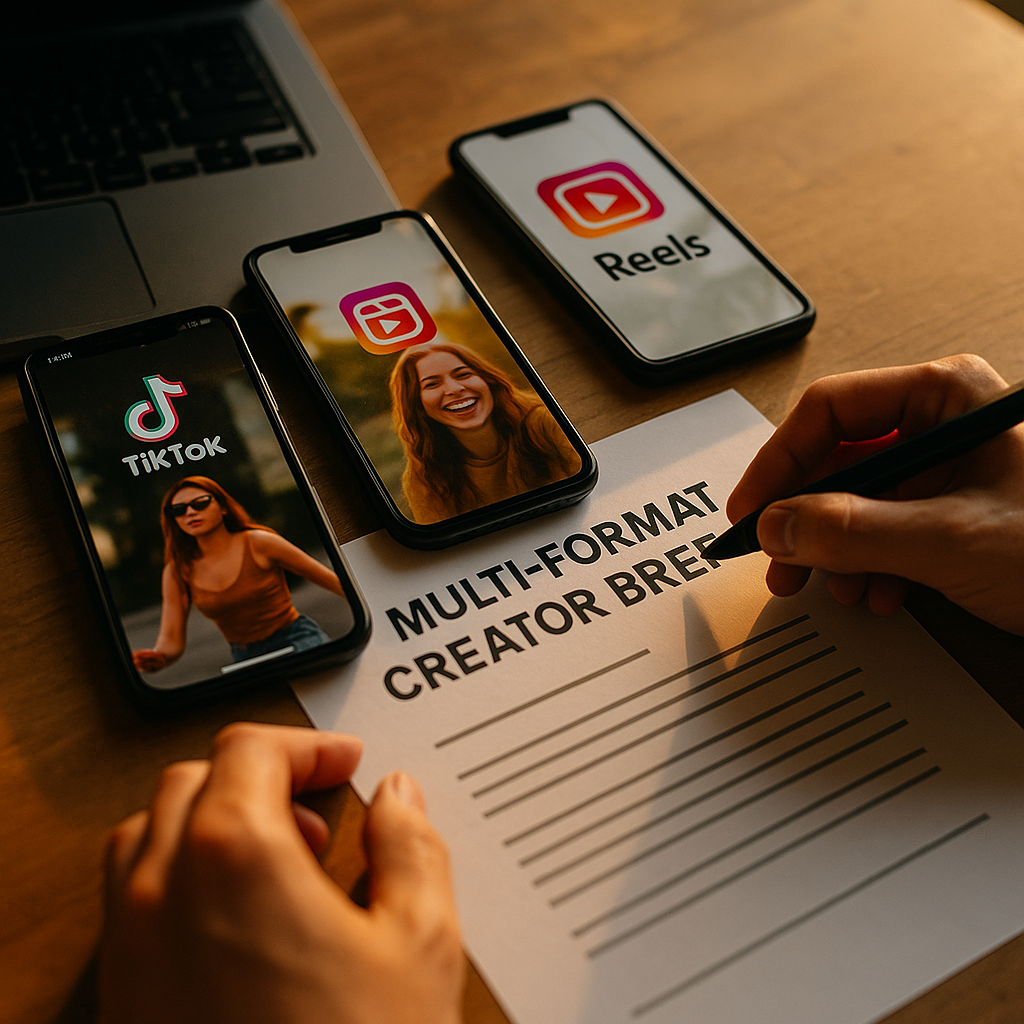
Brands running five separate shoots for five platforms are burning budget. The multi-format creator production session solves this, but only if your brief is engineered for it before the camera rolls.
Why Most Multi-Format Shoots Fail Before They Start
The promise is obvious: one creator, one day, five deliverables. The reality is usually a stack of vertical clips that feel identical, get penalized by platform algorithms, and convert at a fraction of their potential. The failure point is almost never the creator. It’s the brief.
Most creative briefs are written for a single platform, then stretched to cover others as an afterthought. “Just cut a LinkedIn version from the TikTok” is not a production strategy. LinkedIn’s algorithm rewards dwell time and professional context. TikTok rewards immediate pattern interrupts and sound-on engagement. TikTok watch-time signals operate on completely different logic than a 3-minute LinkedIn native video. Treating them as interchangeable formats is how you get mediocre performance everywhere.
The fix is a pre-production framework that bakes platform logic into the shoot itself, so the creator is capturing format-native moments in real time, not reconstructing them in post.
The Architecture of a Multi-Format Brief
Think of the brief as a modular script, not a linear one. Each section of the shoot serves a primary format while simultaneously generating B-roll and reaction material for secondary formats. This requires the creative director to map deliverables against shot requirements before writing a single word of messaging guidance.
Start with a deliverable matrix. Across the top: TikTok, Instagram Reels, YouTube Shorts, LinkedIn Video, Video Podcast Clip. Down the side: hook shot, main value beat, CTA or close, B-roll needs, caption/audio strategy. Fill every cell before you brief the creator. If a cell is empty, you’re going to end up improvising on set, and improvisation on a multi-format shoot produces generic content.
A deliverable matrix filled before the shoot starts is the difference between a strategic production session and an expensive content lottery.
For a practical reference on budget-conscious multi-format execution, the multi-format creator brief framework covers how to allocate a single budget across format variants without cannibalizing performance.
Platform-Specific Format Signals: What the Brief Must Capture
This is where most briefs fall short. Each platform has behavioral and algorithmic signals that content must trigger to earn distribution. Those signals need to be embedded in the creator’s instructions, not left to editorial judgment after the shoot.
TikTok: The hook must land within the first 1.5 seconds. Not two seconds. Not three. The opening frame needs a visual or audio disruption. Brief the creator to film three to five distinct hook variants on the same core content. Sound-on performance matters enormously here; ambient audio or a creator-specific verbal hook outperforms silence with text overlay.
Instagram Reels: Reels rewards content that drives saves and shares over raw views. That means the value density has to be higher. Brief for a “screenshot moment” — a single frame that works as a static share. The creator should deliver a punchline or insight at roughly the 60 to 70 percent mark, not the end. Meta’s business resources confirm that Reels with high save rates see compounding distribution over time.
YouTube Shorts: Unlike TikTok, YouTube Shorts benefits from a slightly slower pace and explicit verbal CTAs driving channel subscriptions or long-form video views. The brief should include a specific verbal line that bridges to a longer YouTube asset if one exists. YouTube’s creator documentation is explicit that Shorts performance feeds into channel authority, so the creator needs to reference the channel brand verbally.
LinkedIn Video: This is the format most brands botch in a multi-format session. LinkedIn’s audience expects professional context and a point of view, not just product content. The brief must include a “professional framing line” — one sentence the creator delivers at the top that positions the content in a B2B or career-relevant context. Captions are non-negotiable; LinkedIn’s own data shows over 80 percent of professional video is watched without sound in-feed.
Video Podcast Clips: These require the most distinct shoot setup. Podcast clip performance depends on conversational framing, not broadcast framing. The creator should be briefed to record at least one segment in a seated, dialogue-style format, even if no co-host is present. Use a mid-shot rather than the extreme close crops that work on TikTok. For brands investing in podcast integration, the AI video podcast sponsorship brief framework covers CPM logic and how to brief for clip-worthiness from the start.
Directing the Session: Four Practical Rules
The brief is the document. The session direction is what makes it real. Here are four rules that experienced creative directors use to keep a multi-format shoot from collapsing into chaos.
Rule 1: Shoot formats in reverse complexity order. Start with the podcast clip setup (highest production intensity, locked frame, requires concentration), then move to LinkedIn (medium energy), then Reels, then TikTok. Creators warm up through the session; TikTok’s high-energy hooks perform better when the creator is loose, not stiff from the first takes of the day.
Rule 2: Brief three hook variants minimum. For TikTok and Reels especially, brief the creator to deliver the same core message with three distinct openers: a question hook, a bold claim hook, and a visual action hook. This costs maybe 15 minutes on set and gives you A/B testing material across platforms without a reshoot.
Rule 3: Keep platform labels out of the creator’s head during filming. Telling a creator “this take is for LinkedIn” mid-session causes over-performance and stiffness. Instead, brief against energy levels: “deliver this beat at 60 percent energy, professional tone, slower pace” versus “deliver this at 90 percent energy, fast, direct to camera.” Map those energy levels to platforms in your post-production guide, not on set.
Rule 4: Capture audience-aware B-roll. Every format needs B-roll, but the audience context differs. LinkedIn B-roll should show professional environments or product-in-use in a work context. TikTok B-roll can be faster, more chaotic, and benefit from trending visual styles. Brief these explicitly. Undirected B-roll shot on a multi-format session usually defaults to one visual language, and it’s usually TikTok native, which looks amateurish on LinkedIn.
For brands running cross-platform creator campaigns with streaming or long-form components, the principles in cross-platform creator briefs apply directly to how you sequence deliverables and manage approval workflows.
Post-Production: Where Format Signals Are Finalized
The session produces raw material. Post-production is where platform specificity is fully activated. Your post-production brief (yes, this is a separate document) should specify aspect ratios and safe zones, caption style per platform, music or audio treatment, and whether native-text overlays are added in-platform or baked into the export.
One consistent mistake: brands use identical captions across platforms. LinkedIn captions should front-load a professional insight in the first line, since only the first two lines display before “see more.” TikTok captions should include searchable keywords because TikTok’s ad and organic search now treats caption text as indexable content. Instagram Reels captions should use a conversational opening that mirrors how the creator speaks.
The post-production brief is not optional — it’s where the format signals your creator captured on set are either preserved or accidentally neutralized.
Consider building a post-production checklist into your standard entertainment-first brief template so format compliance is verified before any asset goes live.
Compliance and Rights Management Across Formats
Multi-format shoots create multi-platform usage rights questions. If music is cleared for TikTok through a native sound license, it may not cover YouTube Shorts. If a creator uses a trending audio clip on set, you need written confirmation of rights before that audio appears on LinkedIn or a podcast clip syndicated to Spotify. FTC disclosure requirements apply to every platform independently; a disclosure visible in a TikTok caption does not automatically satisfy the requirement on a YouTube Shorts description.
Build a rights clearance checklist into the pre-production phase, not post. By the time you’re editing, it’s too late to re-brief audio choices.
Platform-specific disclosure formats are increasingly scrutinized. Work with your legal team to confirm that “#ad” in a TikTok caption meets the standard for LinkedIn native video, where the audience and content context differ enough that regulators may expect more prominent disclosure language.
For teams running large-scale creator programs with fast turnaround needs, the reactive UGC approval frameworks offer useful templates for scaling compliance review without slowing down deployment.
The Metric Layer: What to Measure Per Format
Measuring a multi-format session against a single KPI defeats the purpose. Each platform’s output should be evaluated against platform-native benchmarks. TikTok: average watch time percentage and share rate. Reels: saves and profile visits from Reels viewers. YouTube Shorts: subscriber conversion rate. LinkedIn: dwell time, comment depth (qualitative engagement from professional audiences), and profile clicks. Podcast clips: click-through rate to full episode and listener attribution.
Build this measurement framework into the campaign debrief template. If you can’t attribute performance improvements to specific format decisions made in the brief, you can’t optimize the next session. The whole point of the framework is compounding efficiency: each shoot should make the next brief smarter. Sprout Social’s benchmark data is a useful calibration point for platform-level engagement norms when setting realistic targets for multi-format campaigns.
The next step: take your current standard creator brief, add a deliverable matrix and a platform signal section before the messaging guidance, and run one session against it. The gap between what you currently produce and what this framework produces will be visible in the first set of platform analytics.
Frequently Asked Questions
How long should a multi-format creator production session take?
A well-briefed session producing five format variants can be completed in four to six hours, including setup and breakdown. The key is sequencing by format complexity (start with podcast clip, end with TikTok) and ensuring all hook variants and B-roll requirements are documented in the brief before the shoot day. Without pre-production planning, the same session can stretch to a full day with diminishing returns.
Can one creator authentically produce content for both TikTok and LinkedIn in the same session?
Yes, but it requires explicit energy and tone direction in the brief. The creative director’s role is to coach the creator through distinct delivery modes rather than expecting them to self-direct across platforms. Brief against energy levels (60 percent for LinkedIn, 90 percent for TikTok) rather than platform labels, which can cause overthinking during filming.
What is the most common mistake brands make when briefing multi-format shoots?
Using a single-platform brief stretched to cover additional deliverables. This produces content with one platform’s native logic applied uniformly, which underperforms on every other platform. The solution is building a deliverable matrix before writing any messaging guidance, so platform-specific shot requirements drive the production plan from the start.
Do music rights need to be cleared separately for each platform?
Yes. A license obtained through TikTok’s native sound library does not automatically cover YouTube Shorts, LinkedIn, or podcast syndication. Music rights must be cleared for each distribution channel before the session, or creators should be briefed to use original audio or brand-cleared music libraries for multi-platform shoots.
How do you measure ROI on a multi-format production session?
Measure each format’s output against platform-native KPIs: watch time percentage for TikTok, save rate for Reels, subscriber conversion for YouTube Shorts, dwell time for LinkedIn, and click-through to full episode for podcast clips. Aggregate the cost of the single session against the combined performance value of all five outputs and compare it to the cost of five separate shoots producing equivalent distribution.
Top Influencer Marketing Agencies
The leading agencies shaping influencer marketing in 2026
Agencies ranked by campaign performance, client diversity, platform expertise, proven ROI, industry recognition, and client satisfaction. Assessed through verified case studies, reviews, and industry consultations.
Moburst

-
2

The Shelf
Boutique Beauty & Lifestyle Influencer AgencyA data-driven boutique agency specializing exclusively in beauty, wellness, and lifestyle influencer campaigns on Instagram and TikTok. Best for brands already focused on the beauty/personal care space that need curated, aesthetic-driven content.Clients: Pepsi, The Honest Company, Hims, Elf Cosmetics, Pure LeafVisit The Shelf → -
3

Audiencly
Niche Gaming & Esports Influencer AgencyA specialized agency focused exclusively on gaming and esports creators on YouTube, Twitch, and TikTok. Ideal if your campaign is 100% gaming-focused — from game launches to hardware and esports events.Clients: Epic Games, NordVPN, Ubisoft, Wargaming, Tencent GamesVisit Audiencly → -
4

Viral Nation
Global Influencer Marketing & Talent AgencyA dual talent management and marketing agency with proprietary brand safety tools and a global creator network spanning nano-influencers to celebrities across all major platforms.Clients: Meta, Activision Blizzard, Energizer, Aston Martin, WalmartVisit Viral Nation → -
5

The Influencer Marketing Factory
TikTok, Instagram & YouTube CampaignsA full-service agency with strong TikTok expertise, offering end-to-end campaign management from influencer discovery through performance reporting with a focus on platform-native content.Clients: Google, Snapchat, Universal Music, Bumble, YelpVisit TIMF → -
6

NeoReach
Enterprise Analytics & Influencer CampaignsAn enterprise-focused agency combining managed campaigns with a powerful self-service data platform for influencer search, audience analytics, and attribution modeling.Clients: Amazon, Airbnb, Netflix, Honda, The New York TimesVisit NeoReach → -
7

Ubiquitous
Creator-First Marketing PlatformA tech-driven platform combining self-service tools with managed campaign options, emphasizing speed and scalability for brands managing multiple influencer relationships.Clients: Lyft, Disney, Target, American Eagle, NetflixVisit Ubiquitous → -
8

Obviously
Scalable Enterprise Influencer CampaignsA tech-enabled agency built for high-volume campaigns, coordinating hundreds of creators simultaneously with end-to-end logistics, content rights management, and product seeding.Clients: Google, Ulta Beauty, Converse, AmazonVisit Obviously →