


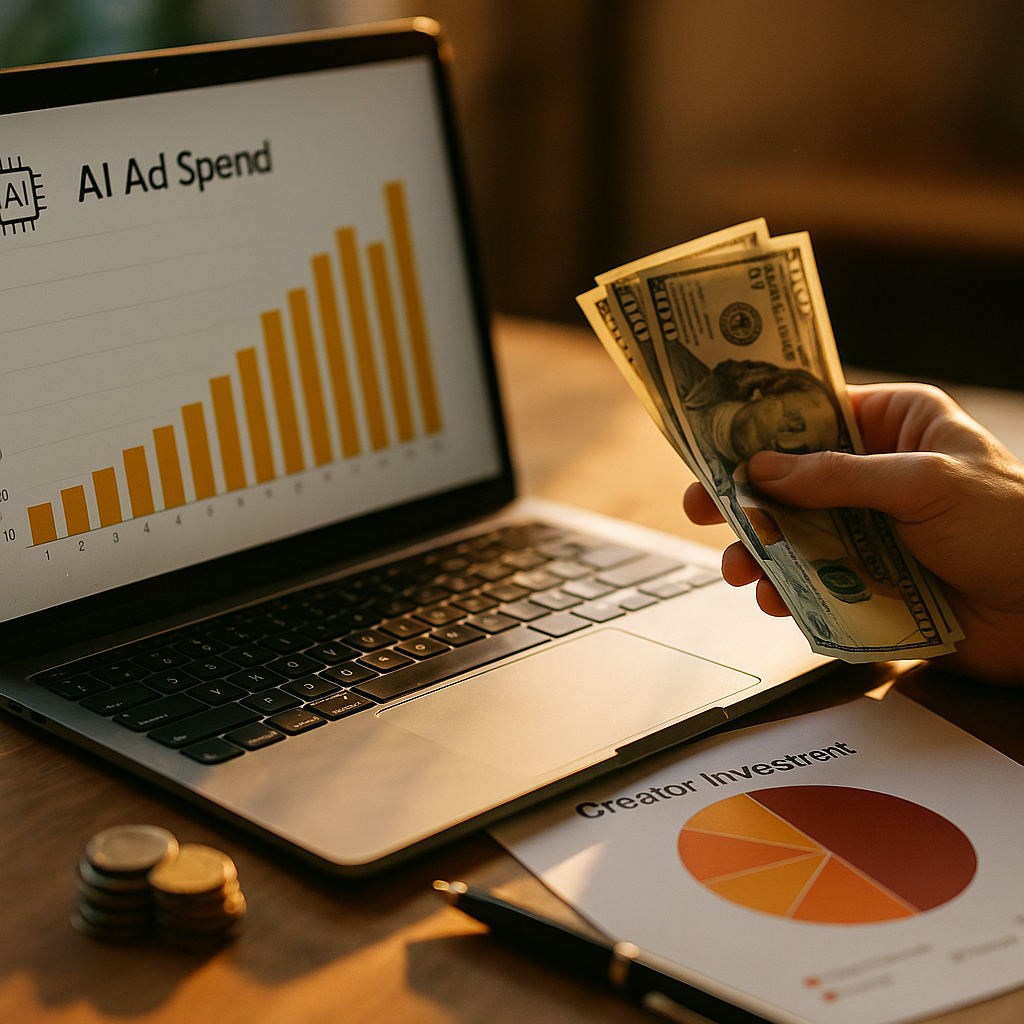
The IAB projects AI-driven advertising will reach £18 billion by 2030. Brand teams that treat this as a future problem will find themselves four years behind competitors who started sequencing their investments now. The sequencing question, specifically when to prioritise human creator output versus AI-generated ad formats, is where the real strategic risk sits.
Why Sequencing Matters More Than the Mix
Most internal debates about AI ad formats versus creator content are framed as an either/or budget conversation. That framing is wrong. The more productive question is: which input do you need first to make the other one work?
AI-generated ad formats, whether dynamic creative optimisation (DCO), synthetic spokesperson video, or generative image-to-video tools like Google’s Veo or Runway, require training signals. Those signals come from creative that has already proven itself with real audiences. Human creators generate that proof. Without it, you are optimising noise.
AI ad tools are multipliers, not originators. Feed them weak creative signals and you will scale mediocrity faster than ever before.
This is not a philosophical argument for human creativity. It is an operational one. The brands extracting measurable returns from AI ad formats today, including those running sophisticated DCO on Meta and programmatic video at scale, built their signal libraries from creator-led campaigns first. They are now using tools like Meta Advantage+ and Google’s Performance Max to amplify what already converted.
The Four-Year Investment Arc
Working backward from the £18 billion projection, brand teams need a phased approach rather than an annual budget toggle. Here is how the sequencing should play out across four investment horizons.
Phase one: Build your creative signal library (now through 18 months out). Commission creator content at volume across formats: short-form video, episodic social series, long-form YouTube, and shoppable content. The objective is not reach. It is generating a large pool of creative variations with measurable performance data. creator amplification spend has already hit $14.15 billion globally, meaning your competitors are already in this phase. If you are not, you are behind.
Phase two: Identify your highest-performing creative signals (months 12 to 24). Systematically analyse which creator-originated assets drove the strongest downstream outcomes: completion rate, click-through, and ideally attributed revenue. Segment by audience cohort, not just by creator tier. This is where creator platform analytics standards become a genuine commercial concern, because inconsistent measurement frameworks will corrupt your signal data.
Phase three: Introduce AI formats as creative extensions (months 18 to 36). Use your validated creative signals to brief generative tools. This includes feeding high-performing visual and tonal assets into DCO platforms, using AI voiceover and synthetic variation to extend the shelf life of creator content without additional creator fees, and testing AI-generated iterations against the human-made originals to measure performance decay. Brands like L’Oréal and Unilever are already running this playbook, using creator content as the creative backbone and AI tooling for production scale and personalisation.
Phase four: Rebalance toward AI formats where signals are mature (months 30 to 48). At this stage, certain audience segments and funnel stages may be well served by AI-generated formats at significantly lower cost-per-asset. Shift budget from creator production toward creator strategy: fewer but higher-value creator relationships focused on generating new signals, while AI handles creative volume. This is not the end of creator investment. It is its structural evolution.
Where Creator Investment Stays Non-Negotiable
There are specific contexts where AI-generated formats will not replace human creator output, regardless of how mature the technology becomes by 2030.
Community trust is the first. Niche audiences, especially in health, parenting, finance, and faith, respond to perceived authenticity in ways that synthetic content cannot replicate at equivalent conversion rates. The FTC’s ongoing guidance on AI-generated endorsements adds a compliance layer here that brand legal teams are only beginning to fully process.
Cultural fluency is the second. Trends in music, language, and visual culture move faster than any AI training cycle. Creators who live inside these cultures produce content that lands with the timing and texture AI simply cannot simulate in real time. For brands running episodic TikTok and Meta series, this cultural agility is the entire product.
New audience acquisition is the third. When entering a market segment where you have no prior creative signal data, human creators are the only viable starting point. AI formats require a hypothesis about what will work. Creators generate the hypothesis through lived audience relationships.
Budget Modelling for the Transition
The temptation for finance-conscious brand teams will be to use AI format deployment as a justification for cutting creator budgets early. Resist this strongly. The signal library you are building now has a shelf life, and if you stop refreshing it before your AI tooling is mature enough to generate its own performance variants, you will face a creative gap with nothing to fill it.
A workable budget model for most mid-market brand teams: maintain creator production investment at current levels through the first 24 months, add AI tooling as an incremental line item funded from production efficiency savings (faster edits, reduced reshoots, AI-assisted scripting), and only begin transitioning creator spend toward strategy-versus-production after month 30 when signal data is sufficiently deep.
If your current budget restructure planning has not accounted for this transition arc, the £18 billion projection will arrive as a disruption rather than an opportunity.
The brands that will capture the most value from AI ad spend growth are the ones investing in creator signal libraries today, not the ones waiting to see which AI tools win the market.
Operational Readiness: What Your Team Needs Now
The strategic sequencing only holds if your internal operations can execute it. Three capabilities are non-negotiable.
- Clean first-party data infrastructure. AI creative tools are only as effective as the audience data feeding them. If your CRM, pixel data, and clean room integrations are fragmented, your AI ad formats will underperform regardless of creative quality. Clean, unified data is a prerequisite, not a nice-to-have.
- Creative rights management at scale. As creator assets become training inputs for AI tools, licensing agreements need to explicitly address synthetic derivatives. Most standard creator contracts written before the current AI tooling landscape do not cover this. Audit your contracts now.
- Internal AI fluency at the strategy level. Brand managers who cannot evaluate AI creative output critically will make poor briefing decisions. Investing in AI fluency for senior brand leaders is directly tied to how well your team can manage the human-to-AI creative handoff.
The data on AI marketing adoption consistently shows that capability gaps, not technology gaps, are what slow enterprise brands down. The tools are largely available now. The teams to run them are not.
One final note on vendor selection: as the AI ad format market consolidates, the platforms and agencies managing your creator programmes will increasingly offer AI creative services as bundled additions. Evaluate these carefully. A vendor whose AI tooling is trained on generic creative data will not serve your brand-specific signal library. Specificity is the competitive advantage.
Start your signal library now. The £18 billion opportunity belongs to the brands that treated creator investment as infrastructure, not as campaign-by-campaign spend.
Frequently Asked Questions
What is the IAB’s £18 billion AI ad spend projection and what does it cover?
The IAB projects that AI-driven advertising investment will reach £18 billion by 2030 across the UK and broader European markets. This figure encompasses AI-generated creative formats, dynamic creative optimisation (DCO), programmatic AI buying tools, synthetic media production, and AI-powered personalisation at scale. It does not represent a single ad format but a category of AI-enabled advertising technology spending across brand and performance budgets.
Should brands reduce creator investment as AI ad formats mature?
Not in the near term. Creator investment should shift in nature rather than decrease in absolute terms. The primary value of human creator content is generating the creative signal data that AI tools need to perform effectively. Brands that cut creator budgets before their AI signal libraries are mature will face a creative gap. The recommended approach is to maintain creator production investment for at least 24-30 months while introducing AI tooling as an incremental capability funded from production efficiency gains.
Which AI ad formats are most relevant for brand teams to evaluate now?
The highest-priority formats to evaluate are dynamic creative optimisation (DCO) on Meta and Google, AI-assisted video production tools such as Google Veo and Runway for extending creator asset shelf life, and generative image-to-video for social ad variations. AI voiceover and synthetic spokesperson technology is also maturing rapidly but carries disclosure and compliance considerations under FTC guidance that brand legal teams should review before deployment.
How does creator content function as a training signal for AI ad tools?
When creator-produced content is run through paid media channels, the performance data it generates (completion rates, click-through rates, conversion rates, audience engagement patterns) creates a dataset that AI creative tools can use to identify which visual, tonal, and narrative elements drive outcomes. DCO platforms use these signals to generate and test creative variations automatically. The richer and more diverse the original creator content pool, the more accurate and effective the AI optimisation becomes.
What contract changes do brands need to make for AI creative use of creator content?
Most creator contracts written before the widespread adoption of generative AI tools do not include licensing terms for synthetic derivatives, AI training use, or generative variations of creator likeness or creative output. Brand legal teams should audit existing agreements and update standard contracts to explicitly address: whether creator assets can be used as AI training inputs, whether AI-generated variations derived from creator content require additional compensation, and how synthetic derivatives must be disclosed to audiences in line with FTC and ICO guidance.
Top Influencer Marketing Agencies
The leading agencies shaping influencer marketing in 2026
Agencies ranked by campaign performance, client diversity, platform expertise, proven ROI, industry recognition, and client satisfaction. Assessed through verified case studies, reviews, and industry consultations.
Moburst

-
2

The Shelf
Boutique Beauty & Lifestyle Influencer AgencyA data-driven boutique agency specializing exclusively in beauty, wellness, and lifestyle influencer campaigns on Instagram and TikTok. Best for brands already focused on the beauty/personal care space that need curated, aesthetic-driven content.Clients: Pepsi, The Honest Company, Hims, Elf Cosmetics, Pure LeafVisit The Shelf → -
3

Audiencly
Niche Gaming & Esports Influencer AgencyA specialized agency focused exclusively on gaming and esports creators on YouTube, Twitch, and TikTok. Ideal if your campaign is 100% gaming-focused — from game launches to hardware and esports events.Clients: Epic Games, NordVPN, Ubisoft, Wargaming, Tencent GamesVisit Audiencly → -
4

Viral Nation
Global Influencer Marketing & Talent AgencyA dual talent management and marketing agency with proprietary brand safety tools and a global creator network spanning nano-influencers to celebrities across all major platforms.Clients: Meta, Activision Blizzard, Energizer, Aston Martin, WalmartVisit Viral Nation → -
5

The Influencer Marketing Factory
TikTok, Instagram & YouTube CampaignsA full-service agency with strong TikTok expertise, offering end-to-end campaign management from influencer discovery through performance reporting with a focus on platform-native content.Clients: Google, Snapchat, Universal Music, Bumble, YelpVisit TIMF → -
6

NeoReach
Enterprise Analytics & Influencer CampaignsAn enterprise-focused agency combining managed campaigns with a powerful self-service data platform for influencer search, audience analytics, and attribution modeling.Clients: Amazon, Airbnb, Netflix, Honda, The New York TimesVisit NeoReach → -
7

Ubiquitous
Creator-First Marketing PlatformA tech-driven platform combining self-service tools with managed campaign options, emphasizing speed and scalability for brands managing multiple influencer relationships.Clients: Lyft, Disney, Target, American Eagle, NetflixVisit Ubiquitous → -
8

Obviously
Scalable Enterprise Influencer CampaignsA tech-enabled agency built for high-volume campaigns, coordinating hundreds of creators simultaneously with end-to-end logistics, content rights management, and product seeding.Clients: Google, Ulta Beauty, Converse, AmazonVisit Obviously →