


The Targeting Advantage Most B2B Marketers Are Ignoring
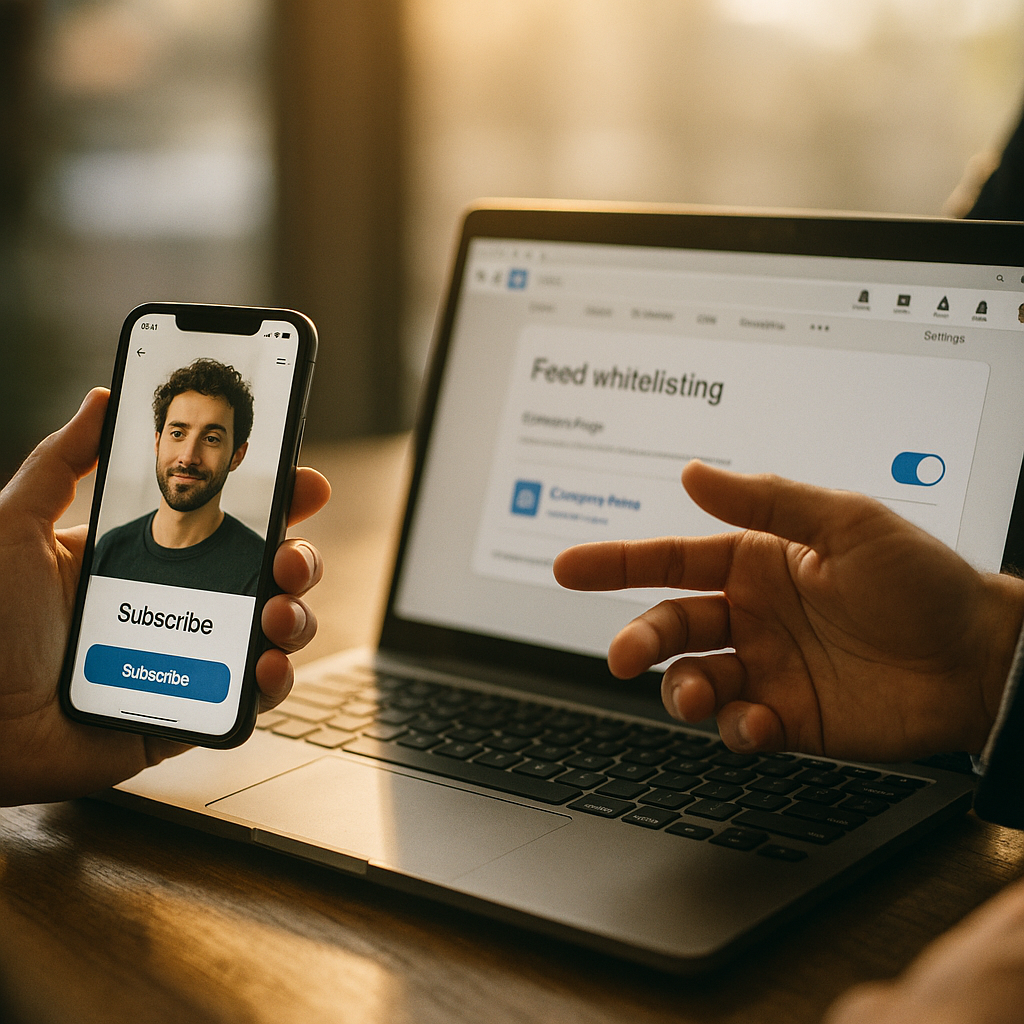
LinkedIn’s paid creator subscription model now gives brands access to something that standard feed placements never could: a self-selected professional audience that has already raised its hand for depth. If you’re still defaulting to feed whitelisting as your only LinkedIn influence play, you’re leaving serious pipeline signal on the table.
The premise is simple. When a procurement director, CFO, or head of growth pays a monthly fee to access a creator’s exclusive content, they are signaling genuine professional intent. That’s not a demographic filter applied in Campaign Manager — it’s self-declared relevance at the individual level.
Yet most brand teams haven’t built a framework for evaluating this channel against the whitelisting strategies they already know. This article builds that framework.
What LinkedIn Creator Subscriptions Actually Offer Sponsors
LinkedIn’s subscription feature allows creators to gate premium content, typically newsletters, long-form analysis, private community posts, or exclusive video, behind a monthly paywall. Subscribers opt in knowing the content will be professional and substantive. That’s the core value proposition for brands: you’re not interrupting — you’re contextually adjacent to something a professional chose to pay for.
From a sponsorship standpoint, brands have two primary entry points. First, direct integration: the creator mentions, features, or builds content around your product or service within a subscriber-only piece. Second, subscriber list co-targeting: some creators will surface brand messages directly within their subscription newsletters or posts, similar to how a B2B email newsletter sponsor operates.
Neither of these mechanisms has a clean equivalent inside LinkedIn’s standard ad infrastructure. They’re negotiated directly, which means more complexity but also more creative control and contextual alignment.
For a deeper look at how the contracts around these arrangements are evolving, see our analysis of B2B sponsorship contracts to renegotiate as the subscription model matures.
Feed Whitelisting: Proven but Increasingly Commoditized
Standard feed whitelisting on LinkedIn, where a brand runs paid ads from a creator’s personal profile using LinkedIn’s Sponsored Content tools, remains the dominant playbook for B2B influencer activation. It works. Ads served from a credible individual account consistently outperform brand page ads on engagement metrics, and the targeting granularity available through LinkedIn Campaign Manager is genuinely superior for job title, seniority, and company size segmentation.
But whitelisting has a ceiling. The content still appears in a scrollable feed that users have been trained to swipe past. Engagement rates for sponsored content on LinkedIn average around 0.44% according to Sprout Social benchmarks, which is respectable by platform standards but modest relative to the CPMs brands are paying to reach senior decision-makers.
More critically, whitelisting gives you reach without intent signal. You can target a CFO by job title, but you don’t know whether that CFO is actively seeking solutions in your category. Subscriber-only sponsorships flip that equation.
Our overview of LinkedIn creator whitelisting covers the operational mechanics in detail, including how to structure agreements and measure incrementality.
The Real Evaluation Criteria for Subscription Sponsorships
Before committing budget to a subscription-channel sponsorship, brands need to stress-test four things:
- Subscriber count and composition: A creator with 3,000 paid subscribers, all senior operators in SaaS finance, is more valuable than one with 30,000 general followers. Ask for subscriber demographic breakdowns before signing. LinkedIn does surface some creator analytics, but you’ll need to negotiate data access in the contract itself.
- Churn rate and subscriber longevity: A stable subscription base signals genuine content quality. High churn suggests the creator is running on novelty, not sustained authority. Ask for 90-day retention data.
- Editorial fit: Can the creator integrate your message without it feeling transactional? Subscriber content is intimate. Forced sponsorship integrations erode trust faster here than in any other format.
- Exclusivity terms: If the creator is simultaneously sponsoring three competing vendors in the same subscriber newsletter, your brand’s signal is noise. Negotiate category exclusivity, especially for high-ticket or considered-purchase products.
The most important question you can ask before sponsoring subscriber-only content is not “how many subscribers does this creator have?” It’s “how many subscribers are actively in my buying committee?”
When to Use Each Channel: A Decision Framework
This isn’t a binary choice. The most sophisticated B2B programs are using both formats in deliberate sequence.
Use subscription sponsorships for: late-funnel or considered-purchase messaging, account-based marketing plays where the creator’s subscriber base maps to your ICP, thought leadership positioning for complex or high-ticket offerings, and any scenario where your message requires more than 15 seconds to land.
Use feed whitelisting for: top-of-funnel awareness at scale, event promotion with a defined date and CTA, retargeting audiences already familiar with your brand, and scenarios where algorithmic distribution and reach volume are the primary objectives.
The sequence that works in practice: use whitelisting to build awareness and create a retargetable audience, then layer subscription sponsorships to convert the high-intent subset of that audience with deeper, more substantive content. Think of whitelisting as net-casting and subscription sponsorship as spearfishing.
LinkedIn’s evolving relationship with Amazon’s ad infrastructure also opens new targeting possibilities that interact with both formats. Our coverage of the LinkedIn-Amazon B2B targeting partnership explains how first-party data layers are beginning to change audience matching for professional campaigns.
Compliance, Disclosure, and Brand Safety Considerations
Sponsored content within gated environments does not exempt brands from FTC disclosure requirements. The FTC’s endorsement guidelines apply regardless of whether the content is publicly visible or subscriber-only. Brands must require explicit sponsorship disclosure in the content itself, not buried in a subscriber-welcome email or profile bio.
Brand safety in subscription contexts is harder to audit than in standard feed placements. With whitelisted ads, you can review the exact creative before it runs. With subscription content, the creator is often writing or recording in near real-time for a community built on perceived authenticity. Build approval windows into your contracts. A 48-hour pre-publication review clause is a reasonable standard and shouldn’t deter quality creators who have nothing to hide.
GDPR and CCPA considerations also apply if subscriber data is shared with your brand for retargeting purposes. Work with your legal team on data processing agreements before any subscriber list activation. The ICO’s guidance on data sharing is a useful reference point for any brand operating with European subscribers in scope.
Measuring What Actually Matters
Standard CTR and CPM benchmarks don’t adequately capture the value of subscription sponsorships. A subscriber-only integration reaching 2,000 decision-makers with a 6-minute read time and a direct mention in a professional context is not comparable to a feed impression, even if the raw numbers look unimpressive on a dashboard.
Build a parallel measurement framework. Track direct attribution (UTM links, dedicated landing pages, custom offer codes) alongside qualitative signals like sales team feedback on deal conversations where the creator’s content was mentioned, increases in branded search volume in the weeks following a sponsorship, and LinkedIn profile visit spikes for your company page.
For subscription sponsorships, pipeline influence reporting will almost always outperform last-click attribution. Build that expectation into how you present ROI to stakeholders before the campaign runs, not after.
Platforms like HubSpot CRM can help tie content interaction signals to deal progression if you’re feeding the right UTM data and contact enrichment into your pipeline tracking. This is where the operational investment pays off.
For brands running cross-channel influencer programs, the structural lessons from managing creator concentration risk apply here too. Don’t let a single LinkedIn creator’s subscriber base become the bottleneck for an entire B2B influence strategy.
Start by auditing one creator in your current LinkedIn roster who already has a subscription offering. Map their subscriber composition against your ICP. If the overlap exceeds 40%, that’s your pilot.
Frequently Asked Questions
What is the difference between LinkedIn creator subscription sponsorships and standard feed whitelisting?
Subscription sponsorships place brand messages within gated, paid content that subscribers have opted into, offering a high-intent audience context. Standard feed whitelisting runs paid ads from a creator’s profile into the open LinkedIn feed using Campaign Manager targeting, offering broader reach but less audience intent signal. Both have distinct strengths depending on funnel stage and campaign objectives.
How do brands negotiate access to subscriber demographic data before signing a deal?
Brands should request subscriber analytics as part of the pre-deal vetting process, specifically job title distribution, seniority levels, company size, and industry breakdown. Not all creators will have this granularity readily available in LinkedIn’s native analytics, so contracts should specify what data will be shared, in what format, and under what privacy compliance terms before activation.
Are FTC disclosure rules enforceable in subscriber-only gated content?
Yes. FTC disclosure requirements apply to all sponsored content regardless of whether it is publicly visible or gated behind a paywall. Brands must require creators to include clear sponsorship disclosures within the content itself, not solely in account bios or subscription welcome sequences.
What subscriber count threshold makes a LinkedIn creator’s subscription channel worth sponsoring?
Raw subscriber count is less important than ICP alignment. A creator with 1,500 paid subscribers, the majority of whom are senior decision-makers in your target vertical, can generate more qualified pipeline influence than one with 20,000 broadly professional subscribers. Focus on composition and engagement depth, not headline numbers.
Can subscription sponsorships be layered with LinkedIn’s paid targeting tools?
Not directly through LinkedIn’s self-serve ad platform, since subscription content is outside Campaign Manager’s inventory. However, brands can run complementary whitelisted campaigns targeting the same professional segments to create a surround-sound effect. Some creators also offer newsletter-based retargeting arrangements where brand messages are sent specifically to engaged subscriber segments.
Top Influencer Marketing Agencies
The leading agencies shaping influencer marketing in 2026
Agencies ranked by campaign performance, client diversity, platform expertise, proven ROI, industry recognition, and client satisfaction. Assessed through verified case studies, reviews, and industry consultations.
Moburst

-
2

The Shelf
Boutique Beauty & Lifestyle Influencer AgencyA data-driven boutique agency specializing exclusively in beauty, wellness, and lifestyle influencer campaigns on Instagram and TikTok. Best for brands already focused on the beauty/personal care space that need curated, aesthetic-driven content.Clients: Pepsi, The Honest Company, Hims, Elf Cosmetics, Pure LeafVisit The Shelf → -
3

Audiencly
Niche Gaming & Esports Influencer AgencyA specialized agency focused exclusively on gaming and esports creators on YouTube, Twitch, and TikTok. Ideal if your campaign is 100% gaming-focused — from game launches to hardware and esports events.Clients: Epic Games, NordVPN, Ubisoft, Wargaming, Tencent GamesVisit Audiencly → -
4

Viral Nation
Global Influencer Marketing & Talent AgencyA dual talent management and marketing agency with proprietary brand safety tools and a global creator network spanning nano-influencers to celebrities across all major platforms.Clients: Meta, Activision Blizzard, Energizer, Aston Martin, WalmartVisit Viral Nation → -
5

The Influencer Marketing Factory
TikTok, Instagram & YouTube CampaignsA full-service agency with strong TikTok expertise, offering end-to-end campaign management from influencer discovery through performance reporting with a focus on platform-native content.Clients: Google, Snapchat, Universal Music, Bumble, YelpVisit TIMF → -
6

NeoReach
Enterprise Analytics & Influencer CampaignsAn enterprise-focused agency combining managed campaigns with a powerful self-service data platform for influencer search, audience analytics, and attribution modeling.Clients: Amazon, Airbnb, Netflix, Honda, The New York TimesVisit NeoReach → -
7

Ubiquitous
Creator-First Marketing PlatformA tech-driven platform combining self-service tools with managed campaign options, emphasizing speed and scalability for brands managing multiple influencer relationships.Clients: Lyft, Disney, Target, American Eagle, NetflixVisit Ubiquitous → -
8

Obviously
Scalable Enterprise Influencer CampaignsA tech-enabled agency built for high-volume campaigns, coordinating hundreds of creators simultaneously with end-to-end logistics, content rights management, and product seeding.Clients: Google, Ulta Beauty, Converse, AmazonVisit Obviously →