


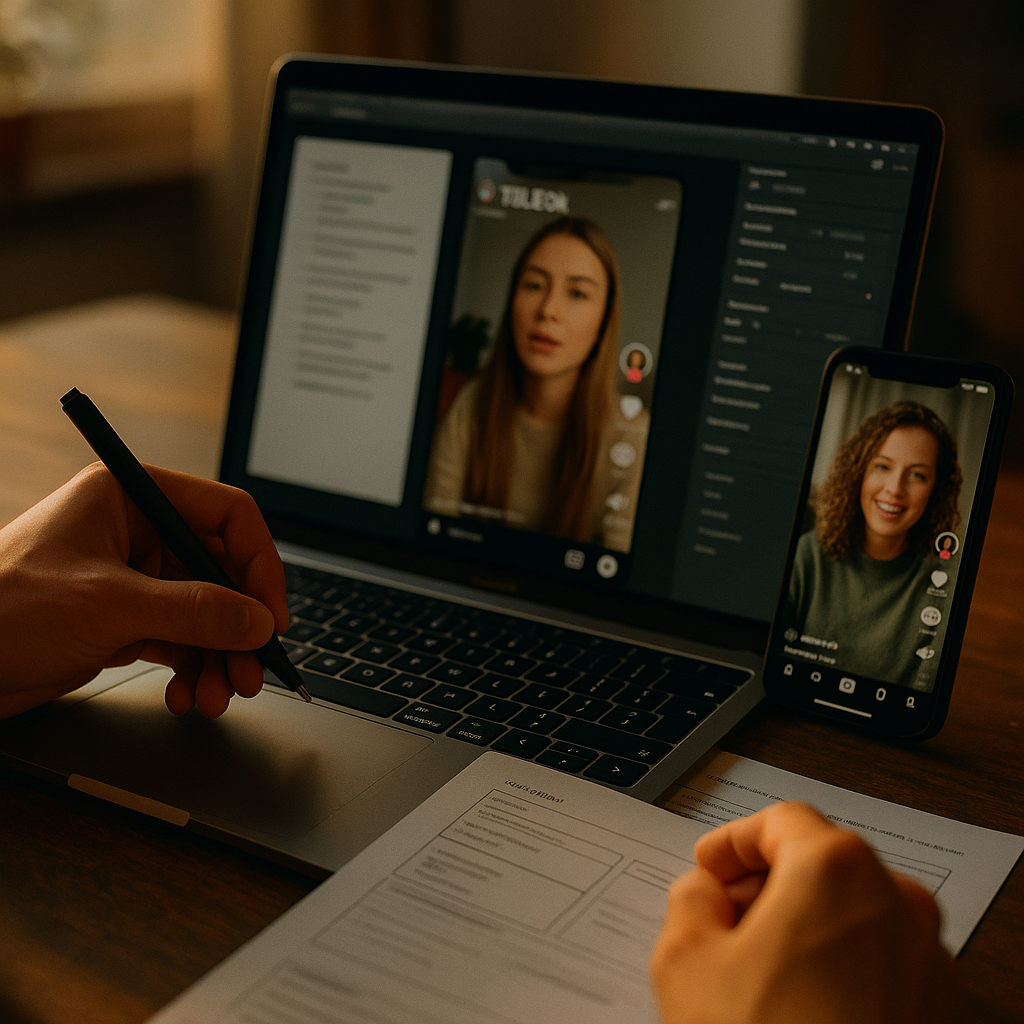
Brands running three separate production sessions for TikTok, Reels, and Meta feed are burning budget on a problem that a smarter brief solves once. The multi-platform short-form video brief is the operational fix most creative teams haven’t implemented yet, and the gap is costing them reach, consistency, and margin.
Why Three Platforms Don’t Need Three Briefs
The common assumption is that TikTok, Instagram Reels, and Meta’s 1:1 feed are so algorithmically different that they demand entirely separate creative strategies. That assumption is expensive. According to Sprout Social, brands that maintain consistent creative direction across platforms see significantly higher audience recall than those running fully siloed campaigns. The signal is clear: creative coherence scales, fragmentation doesn’t.
What actually differs across these three surfaces isn’t the story. It’s the delivery mechanics. Ratio, hook timing, pacing cadence, caption real estate — these are variables, not foundations. If your brief treats them as foundations, you’re rebuilding the house every time you switch channels.
The goal of a unified multi-platform brief is to lock the creative core once: the brand message, the product truth, the emotional hook, the CTA logic. Then it annotates the surface-specific adaptations as conditional instructions within the same document.
The Anatomy of a Single Brief That Works Across All Three
A well-constructed multi-platform brief has two layers. The first is the platform-agnostic core. This is where you define the campaign idea, the single-minded message, the creator persona, the tone, and the compliance requirements. Everything in this layer applies regardless of where the content lands. Think of it as the brief’s skeleton.
The second layer is the surface-specific modifier table. This is a structured block, ideally a three-column table inside the brief document, where each platform gets its own row of conditional instructions. Ratio. Hook window. Pacing notes. Caption strategy. Safe zones for text overlay. This table doesn’t replace the creative direction. It translates it.
Here’s what that modifier table looks like in practice:
- TikTok (9:16, 60s max for most brand accounts): Hook must land in the first 1.5 seconds. Pacing should be fast-cut with audio-driven rhythm. Native caption overlays should carry the message because a significant share of FYP viewers watch without sound before committing. CTAs go in the final 5 seconds, not mid-roll.
- Instagram Reels (9:16, up to 90s): Hook window extends slightly to 2-3 seconds. Algorithm rewards completion rate, so pacing can breathe more than TikTok. On-screen text is critical because Reels are frequently saved and rewatched. Hashtag strategy lives in the caption, not the overlay.
- Meta 1:1 Feed (1:1, 15-60s): This surface operates in a fundamentally different context. Users are scrolling a curated feed, not a discovery engine. The hook needs to function visually before the audio kicks in. Ratio forces composition rethinking: subjects need to be centered, and lower-third text must account for the caption truncation Meta applies. This is also where conversion-focused CTAs perform best, particularly for retargeting audiences.
A brief that separates “what we’re saying” from “how each platform hears it” is the structural unlock that eliminates redundant production without sacrificing platform-native performance.
For teams already exploring Meta 1:1 feed briefing in isolation, integrating it into a unified brief structure is the next logical step rather than running parallel workflows.
Hook Architecture: One Idea, Three Entry Points
The hook is where most multi-platform briefs fall apart. Creative directors write one hook and assume it travels. It doesn’t, because the algorithm surfaces are reading different behavioral signals in those first seconds.
TikTok’s FYP is optimizing for retention from frame one. The hook has to earn attention before the viewer has decided to stay. That means pattern interruption, a bold visual, or a spoken statement that creates an open loop. Studying hook structures for TikTok and Reels shows that the highest-performing FYP hooks tend to pose a question or make a counterintuitive claim within 1.2 seconds.
Reels audiences are warmer. They often see content from accounts they follow or accounts in their network. A hook can lead with identity (the creator’s face, a recognizable setting) before pivoting to the open loop. That 0.5-second buffer matters for composition, not just copy.
The 1:1 Meta feed hook is visual-first, always. Because the feed is silent until tapped, the first frame needs to carry the entire weight of the hook. Bold text overlays, high-contrast visuals, and expressive facial reactions all outperform talking-head openers in this environment. The brief should specify this explicitly: “Hook must function as a static image before audio begins.”
A unified brief handles this by writing one core hook concept (“challenge the assumption that X”) and then branching it: here’s how you deliver this on TikTok, here’s the Reels execution, here’s the 1:1 feed adaptation. Same idea. Three entry points. One production session.
Pacing, Ratio, and What Creators Actually Need in the Document
Pacing is underspecified in most briefs. Saying “keep it energetic” tells a creator nothing actionable. A multi-platform brief should express pacing as a cut rhythm: for TikTok, cuts every 1.5-2 seconds for the first 10 seconds; for Reels, a slightly slower rhythm of 2-3 seconds per cut is acceptable and can feel more premium; for 1:1, static or slow-pan compositions often outperform rapid cuts because the feed context rewards visual clarity over kinetic energy.
Ratio affects framing decisions during shoot, not just export. This is the brief’s most operational function. If a creator is shooting for all three platforms in a single session, the brief needs to specify the safe zone for each format within the same frame. The standard approach is to shoot in 9:16 and designate a centered 4:5 or 1:1 safe zone that will crop cleanly for Meta feed. The brief should include a simple diagram, or at minimum a written description: “Keep all key action and on-screen text within the center 80% of the frame to allow safe 1:1 crop.”
Teams working on aspect-ratio-agnostic briefs are ahead of this curve, using AI-assisted framing tools to automate the crop logic post-shoot. For most brand teams, the interim solution is clear compositional guidance in the brief itself.
What creators actually need from this document: no ambiguity about which element serves which platform, and no requirement to make format judgment calls on set. The brief absorbs that cognitive load so the creator can focus on performance.
Compliance and Disclosure Across Surfaces
One briefing session doesn’t mean one disclosure approach. FTC guidelines require clear and conspicuous disclosure of material connections, and “conspicuous” has a platform-specific meaning. On TikTok, the platform’s native Paid Partnership label plus a verbal disclosure in the first 30 seconds is the current standard. On Reels, Meta’s branded content tag is mandatory and creators should also include a written disclosure in the caption. On 1:1 feed placements that run as ads, the “Sponsored” label is applied automatically, but creators should still understand the compliance context so they don’t inadvertently undermine it with conflicting language.
The multi-platform brief should include a compliance block that specifies required disclosures per surface. This protects the brand, removes ambiguity for the creator, and makes the review cycle faster for your legal team.
Streamlining Review Without Multiplying Approval Rounds
One of the hidden costs of siloed platform briefs is the review multiplication effect. Three briefs generate three creative review cycles, three sets of stakeholder feedback, and three opportunities for message drift. A unified brief compresses this to one creative review with surface-specific annotations flagged for relevant stakeholders.
The practical structure: share the full brief for brand and legal review. Then share only the platform-specific modifier table with the relevant platform managers for tactical sign-off. This way the creative director isn’t fielding conflicting feedback from three different channel owners, each operating from their own document.
For teams managing cross-platform creator briefs at scale, this consolidation can meaningfully reduce turnaround time. Less document proliferation, fewer review rounds, faster activation.
AI-assisted brief tools are increasingly useful here. Platforms like HubSpot‘s content operations suite and dedicated creator brief software are starting to support modular brief structures where a core document can generate platform-specific summaries. Worth evaluating for teams running high-volume campaigns.
The review cycle is where unified briefs pay their biggest operational dividend: one source of truth means one round of stakeholder alignment, not three.
Testing and Iteration Without Starting Over
A unified brief also makes variant testing more systematic. When hooks, pacing, and format instructions are documented in a single modular structure, testing one variable on one platform doesn’t require rebuilding the entire creative direction. You isolate the variable, update the relevant modifier cell in the brief, and retest without disrupting the other surfaces.
This connects directly to how AI-driven UGC variant testing is being deployed by more sophisticated brand teams. The brief becomes the input template for automated variant generation: swap the hook, keep the pacing, test CTA placement on the 1:1 feed. Structured briefs make structured testing possible.
For performance marketers tracking down-funnel metrics, the eMarketer data on short-form video attribution continues to show that consistent creative frameworks across platforms drive stronger cross-device attribution, likely because brand elements are being encoded more reliably in memory when message architecture stays stable. The unified brief is the operational mechanism that keeps that architecture intact.
For social commerce campaigns in particular, the modifier table approach enables creators to adapt the product integration naturally to each surface’s shopping behavior without improvising the core message. That’s explored further in guidance on social commerce creator briefs built specifically for TikTok and Instagram purchase flows.
Start with one campaign. Build the modifier table for your next brief, run one production session against it, and measure whether platform performance holds relative to your siloed baseline. The data will make the case faster than any internal pitch deck.
FAQs
What is a multi-platform short-form video brief?
A multi-platform short-form video brief is a single creative document that defines a unified brand message, hook concept, and creative direction, then includes platform-specific adaptation instructions for each surface, such as TikTok, Instagram Reels, and Meta 1:1 feed. It allows one production session to serve all three formats without separate briefing or creative development cycles.
How do I write a hook that works on TikTok, Reels, and Meta feed simultaneously?
Write one core hook concept that captures the central open loop or tension, then branch it into three platform-specific executions within the brief. TikTok requires the hook to land within 1.5 seconds using spoken audio or pattern interruption. Reels allow a slightly longer 2-3 second window and can lead with creator identity. Meta 1:1 feed hooks must function as a static image before audio, so bold text overlays and high-contrast visuals are essential. The concept stays the same; the delivery mechanics differ per surface.
Can one creator shoot content for all three platforms in a single session?
Yes, and that is the entire operational point of a unified multi-platform brief. The key is specifying a safe framing zone during the shoot, typically keeping all key action within the center 80% of a 9:16 frame so a clean 1:1 crop is possible in post. The brief should include explicit compositional guidance so the creator doesn’t have to make format decisions on set.
How does pacing differ across TikTok, Reels, and Meta 1:1 feed?
TikTok favors fast cuts every 1.5-2 seconds in the opening ten seconds. Reels can sustain a slightly slower rhythm of 2-3 seconds per cut and reward completion rate, so pacing can breathe more. Meta 1:1 feed often performs better with static or slow-pan compositions because the feed context rewards visual clarity. Specifying cut rhythm as a concrete number in the brief, rather than a vague tone descriptor, gives creators actionable direction.
Do disclosure requirements change across these three platforms?
Yes. TikTok requires the platform’s native Paid Partnership label plus verbal disclosure within the first 30 seconds. Instagram Reels requires Meta’s branded content tag and a written disclosure in the caption. Meta 1:1 feed placements running as paid ads receive an automatic Sponsored label from the platform, but the creative should not include language that conflicts with or contradicts that disclosure. A well-structured brief includes a compliance block that specifies the exact disclosure requirement per surface.
How does a unified brief reduce production costs?
By consolidating creative direction into one document with platform-specific modifier annotations, teams eliminate redundant production sessions, reduce stakeholder review cycles from three to one, and prevent message drift that occurs when separate briefs are developed in parallel. The unified brief also makes AI-assisted variant testing more efficient because the core creative framework is already structured for modular iteration.
Top Influencer Marketing Agencies
The leading agencies shaping influencer marketing in 2026
Agencies ranked by campaign performance, client diversity, platform expertise, proven ROI, industry recognition, and client satisfaction. Assessed through verified case studies, reviews, and industry consultations.
Moburst

-
2

The Shelf
Boutique Beauty & Lifestyle Influencer AgencyA data-driven boutique agency specializing exclusively in beauty, wellness, and lifestyle influencer campaigns on Instagram and TikTok. Best for brands already focused on the beauty/personal care space that need curated, aesthetic-driven content.Clients: Pepsi, The Honest Company, Hims, Elf Cosmetics, Pure LeafVisit The Shelf → -
3

Audiencly
Niche Gaming & Esports Influencer AgencyA specialized agency focused exclusively on gaming and esports creators on YouTube, Twitch, and TikTok. Ideal if your campaign is 100% gaming-focused — from game launches to hardware and esports events.Clients: Epic Games, NordVPN, Ubisoft, Wargaming, Tencent GamesVisit Audiencly → -
4

Viral Nation
Global Influencer Marketing & Talent AgencyA dual talent management and marketing agency with proprietary brand safety tools and a global creator network spanning nano-influencers to celebrities across all major platforms.Clients: Meta, Activision Blizzard, Energizer, Aston Martin, WalmartVisit Viral Nation → -
5

The Influencer Marketing Factory
TikTok, Instagram & YouTube CampaignsA full-service agency with strong TikTok expertise, offering end-to-end campaign management from influencer discovery through performance reporting with a focus on platform-native content.Clients: Google, Snapchat, Universal Music, Bumble, YelpVisit TIMF → -
6

NeoReach
Enterprise Analytics & Influencer CampaignsAn enterprise-focused agency combining managed campaigns with a powerful self-service data platform for influencer search, audience analytics, and attribution modeling.Clients: Amazon, Airbnb, Netflix, Honda, The New York TimesVisit NeoReach → -
7

Ubiquitous
Creator-First Marketing PlatformA tech-driven platform combining self-service tools with managed campaign options, emphasizing speed and scalability for brands managing multiple influencer relationships.Clients: Lyft, Disney, Target, American Eagle, NetflixVisit Ubiquitous → -
8

Obviously
Scalable Enterprise Influencer CampaignsA tech-enabled agency built for high-volume campaigns, coordinating hundreds of creators simultaneously with end-to-end logistics, content rights management, and product seeding.Clients: Google, Ulta Beauty, Converse, AmazonVisit Obviously →