


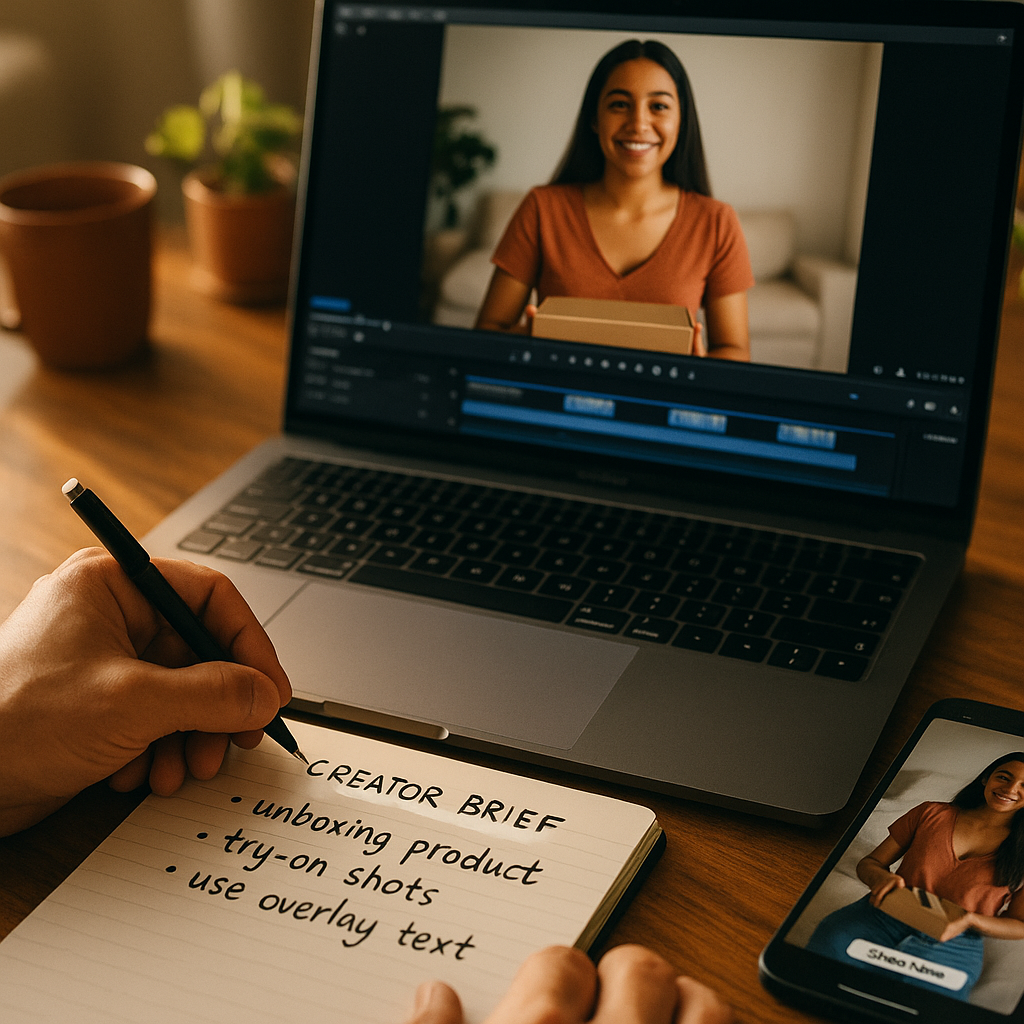
Most DTC Brands Are Feeding AI Video Agents Garbage Input
Brands using AI video editing pipelines are getting mediocre output — and the brief is almost always the problem. According to eMarketer, over 60% of DTC brands now use some form of AI-assisted creative production, yet conversion rates on AI-generated video ads lag human-produced creative by 20-30% on most platforms. The gap is not the AI. It is the creative direction going into it. This guide covers how to write an e-commerce DTC creator brief for AI-powered video ad pipelines that actually produces platform-ready variants worth running.
Why Standard Creative Briefs Break AI Pipelines
Traditional creator briefs were designed for human interpretation. A copywriter or video editor reads between the lines. They infer tone from a mood board, extrapolate CTA placement from brand guidelines, and improvise when instructions are vague. AI video agents — tools like Runway, Pika, or Meta’s own creative automation systems — do not improvise. They execute instructions literally. Ambiguity in a human brief produces a charming, slightly-off video. Ambiguity in an AI brief produces garbage at scale.
The structural failure is usually one of three things: the brief conflates platforms instead of separating them, it describes a feeling instead of a format, or it gives the AI no decision logic for variant generation. When you tell an AI agent “make it feel energetic and authentic,” you get random pacing choices and inconsistent visual rhythm across every output. When you say “cut every 1.8 seconds for the first 4 seconds, open on product contact with skin, no music fade-in before frame 3” — now you have a brief an AI can actually execute.
AI video agents execute instructions literally. Vague creative direction that a human editor might interpret charitably becomes a liability at scale. Specificity is not a constraint — it is the product.
The Anatomy of a Product-Specific AI Creative Brief
An effective DTC creator brief for AI video ad pipelines needs six core components. Each one solves a different failure mode.
1. Product Truth Layer. Before any platform specifications, define the single most conversion-relevant truth about the product. Not three truths. One. For a skincare DTC brand, it might be: “This serum visibly reduces redness in 72 hours, which is twice the speed of the category average.” That claim anchors every hook variant, every CTA, and every platform-specific treatment. AI agents with access to this layer will pull from it consistently rather than inventing product language.
2. Hook Matrix. Specify at least three distinct hook types, each mapped to a different audience entry point. A problem-led hook (“Your moisturizer is probably making your redness worse”), a curiosity hook (“Dermatologists are quietly recommending this instead”), and a social proof hook (“47,000 people switched last month”). Each hook should include the exact opening line, the visual that accompanies it in frame one, and the emotional register it targets. For deeper hook architecture, the framework covered in hook structures for short-form briefs translates directly into AI-readable instruction sets.
3. Platform Format Spec Block. This is where most brands underinvest. Each platform gets its own discrete block with non-negotiable technical parameters:
- TikTok (9:16, 15-30 seconds): Hook delivers within 1.5 seconds. On-screen text at 90% opacity, positioned top third to avoid UI overlap. CTA verbal and text overlay at second 22-25. No fade-out; hard cut to product close-up for final 3 seconds.
- Instagram Reels (9:16, 15-30 seconds): Hook within 2 seconds. Bottom-third text safe zone. CTA overlay paired with audio spike at second 20. Allow 0.5-second loop-back buffer.
- Meta Feed (1:1 or 4:5, 15-60 seconds): Slower pacing acceptable. Product demonstration can begin at second 4. CTA card as final frame. For Meta feed format specifics, format logic differs meaningfully from vertical placements.
- YouTube Pre-Roll (16:9, 6-15 seconds): Skip-proof moment required by second 4. Brand mention in first 2 seconds. Product visual before second 6.
4. CTA Variant Logic. Define at least two CTA variants per platform: a primary conversion CTA (“Shop now — 20% off ends tonight”) and a lower-friction engagement CTA (“See the full 72-hour results”). Specify which to use against cold audiences versus retargeting audiences. AI agents running dynamic creative optimization need this decision tree built into the brief, not left to inference. This approach aligns with the scaling logic covered in AI UGC variant testing at scale.
5. Visual Grammar Rules. Describe what the AI should and should not show. Include: preferred shot types (close-up on texture, overhead product flat-lay, before/after split-screen), prohibited visual elements (competitor packaging in frame, hands holding product from below which reads as unconfident), and color temperature guidance (warm 4500K for lifestyle frames, cooler 6500K for clinical or ingredient shots). This prevents the AI from generating technically competent but brand-incoherent visuals.
6. Compliance Guardrails. Build these directly into the brief, not as a separate legal review step. FTC disclosure placement, prohibited claims by platform, and any ingredient or health claim restrictions should appear as explicit rules the AI agent cannot override. The FTC’s guidance on endorsements has tightened, and AI-generated ad content is not exempt from disclosure requirements.
Structuring Variant Logic for Multi-Platform Output
The goal of a well-structured AI brief is not one good video. It is a variant tree. Think of the brief as a branching decision document: Hook A + Platform TikTok + CTA Primary = Variant 1. Hook B + Platform Meta Feed + CTA Retargeting = Variant 6. A brief covering three hooks, four platforms, and two CTA types generates 24 potential combinations. Not all 24 will be worth producing, but the brief should make it possible for an AI pipeline to generate any of them without additional human input per variant.
For brands running social commerce video briefs across both human creators and AI agents simultaneously, the variant logic also needs to account for how AI-generated assets will sit alongside creator-produced content in the same campaign. Consistency in product truth and CTA language across both production types matters for attribution clarity.
There is also a practical efficiency argument. According to HubSpot’s research, teams that brief AI creative tools with structured variant logic reduce revision cycles by 40% compared to teams using open-ended prompts. The upfront investment in brief architecture pays back in production velocity.
Format Agnosticism Is Not the Goal
A common mistake is writing an “aspect-ratio-agnostic” brief in the hope that one document scales everywhere. It does not. The aspect-ratio-agnostic brief framework is useful for defining a shared creative backbone, but each platform’s variant still requires discrete pacing, hook timing, and CTA placement rules. A 9:16 TikTok and a 1:1 Meta feed ad are not just the same content reformatted — they are different cognitive contracts with the viewer. Treat them accordingly in your brief.
TikTok’s creative guidelines and Meta’s ad specifications both publish platform-specific creative best practices. Build those constraints directly into your brief blocks so the AI agent is working within guardrails that match actual platform delivery requirements.
One brief, many variants — but each variant must reflect the distinct cognitive contract each platform has with its viewer. The AI cannot know this unless the brief teaches it.
The Testing Layer: Brief for Learning, Not Just Output
The best AI video ad pipelines are not just production systems. They are learning systems. Build a testing hypothesis into the brief itself. For each hook variant, state what signal you are trying to learn: “Hook A tests whether pain-point framing outperforms social proof in cold audiences on TikTok. Success metric: 3-second view rate above 55%.” This turns the brief into a creative learning document, not just a production spec.
Over time, the hypotheses from previous briefs compound. You are not just producing ads — you are building a proprietary creative intelligence layer specific to your product category, audience, and platform mix. That is a durable competitive advantage most DTC competitors cannot replicate quickly.
For brands developing multi-format campaigns that span social and longer-form placements, the structural approach described in multi-platform short-form briefs provides a compatible architecture for extending this system beyond paid social into organic and earned media contexts.
Start With One Product, One Hook Matrix, One Full Brief
Build your first AI-ready DTC brief for a single hero product, write three hooks with the exact opening line and frame-one visual for each, define two CTA variants per platform, and run it through your AI pipeline before scaling the template. The gaps you discover in that first run will teach you more about brief architecture than any framework.
FAQs
What makes a DTC creator brief different from a standard AI video prompt?
A DTC creator brief for AI video pipelines is a structured document with discrete sections covering product truth, hook variants, platform-specific format specifications, CTA logic, visual grammar rules, and compliance guardrails. A standard AI prompt is a single instruction. The brief functions as a decision tree that allows an AI video agent to generate multiple platform-ready variants without additional human input per variant.
How many hook variants should a DTC AI video brief include?
A minimum of three hook variants is recommended: a problem-led hook, a curiosity hook, and a social proof hook. Each hook should include the exact opening line, the frame-one visual description, and the target emotional register. More hooks increase variant volume but also require proportionally more CTA and platform spec combinations to fully map out.
Do AI-generated video ads still require FTC disclosures?
Yes. AI-generated video ads are subject to the same FTC endorsement and disclosure requirements as human-produced content. The brief should include explicit compliance guardrails specifying disclosure placement, prohibited health or performance claims, and any platform-specific advertising policy requirements. These rules should be built into the brief as non-negotiable constraints the AI pipeline cannot override.
How do you handle platform format differences in a single brief?
Each platform should have its own discrete format spec block within the brief. This block specifies aspect ratio, video duration, hook delivery timing, text overlay safe zones, CTA placement timing, and any platform-specific pacing requirements. Writing platform specs as a single combined block is a common error that produces inconsistent output across placements.
Can the same brief work for both AI-generated and human-created content?
With modification, yes. The product truth layer, hook matrix, CTA variant logic, and compliance guardrails are directly usable by human creators. Platform format spec blocks may need to be reframed as creative guidance rather than technical execution parameters. Running parallel AI and human production from a shared brief foundation also improves CTA and messaging consistency across the full campaign, which benefits attribution analysis.
Top Influencer Marketing Agencies
The leading agencies shaping influencer marketing in 2026
Agencies ranked by campaign performance, client diversity, platform expertise, proven ROI, industry recognition, and client satisfaction. Assessed through verified case studies, reviews, and industry consultations.
Moburst

-
2

The Shelf
Boutique Beauty & Lifestyle Influencer AgencyA data-driven boutique agency specializing exclusively in beauty, wellness, and lifestyle influencer campaigns on Instagram and TikTok. Best for brands already focused on the beauty/personal care space that need curated, aesthetic-driven content.Clients: Pepsi, The Honest Company, Hims, Elf Cosmetics, Pure LeafVisit The Shelf → -
3

Audiencly
Niche Gaming & Esports Influencer AgencyA specialized agency focused exclusively on gaming and esports creators on YouTube, Twitch, and TikTok. Ideal if your campaign is 100% gaming-focused — from game launches to hardware and esports events.Clients: Epic Games, NordVPN, Ubisoft, Wargaming, Tencent GamesVisit Audiencly → -
4

Viral Nation
Global Influencer Marketing & Talent AgencyA dual talent management and marketing agency with proprietary brand safety tools and a global creator network spanning nano-influencers to celebrities across all major platforms.Clients: Meta, Activision Blizzard, Energizer, Aston Martin, WalmartVisit Viral Nation → -
5

The Influencer Marketing Factory
TikTok, Instagram & YouTube CampaignsA full-service agency with strong TikTok expertise, offering end-to-end campaign management from influencer discovery through performance reporting with a focus on platform-native content.Clients: Google, Snapchat, Universal Music, Bumble, YelpVisit TIMF → -
6

NeoReach
Enterprise Analytics & Influencer CampaignsAn enterprise-focused agency combining managed campaigns with a powerful self-service data platform for influencer search, audience analytics, and attribution modeling.Clients: Amazon, Airbnb, Netflix, Honda, The New York TimesVisit NeoReach → -
7

Ubiquitous
Creator-First Marketing PlatformA tech-driven platform combining self-service tools with managed campaign options, emphasizing speed and scalability for brands managing multiple influencer relationships.Clients: Lyft, Disney, Target, American Eagle, NetflixVisit Ubiquitous → -
8

Obviously
Scalable Enterprise Influencer CampaignsA tech-enabled agency built for high-volume campaigns, coordinating hundreds of creators simultaneously with end-to-end logistics, content rights management, and product seeding.Clients: Google, Ulta Beauty, Converse, AmazonVisit Obviously →