


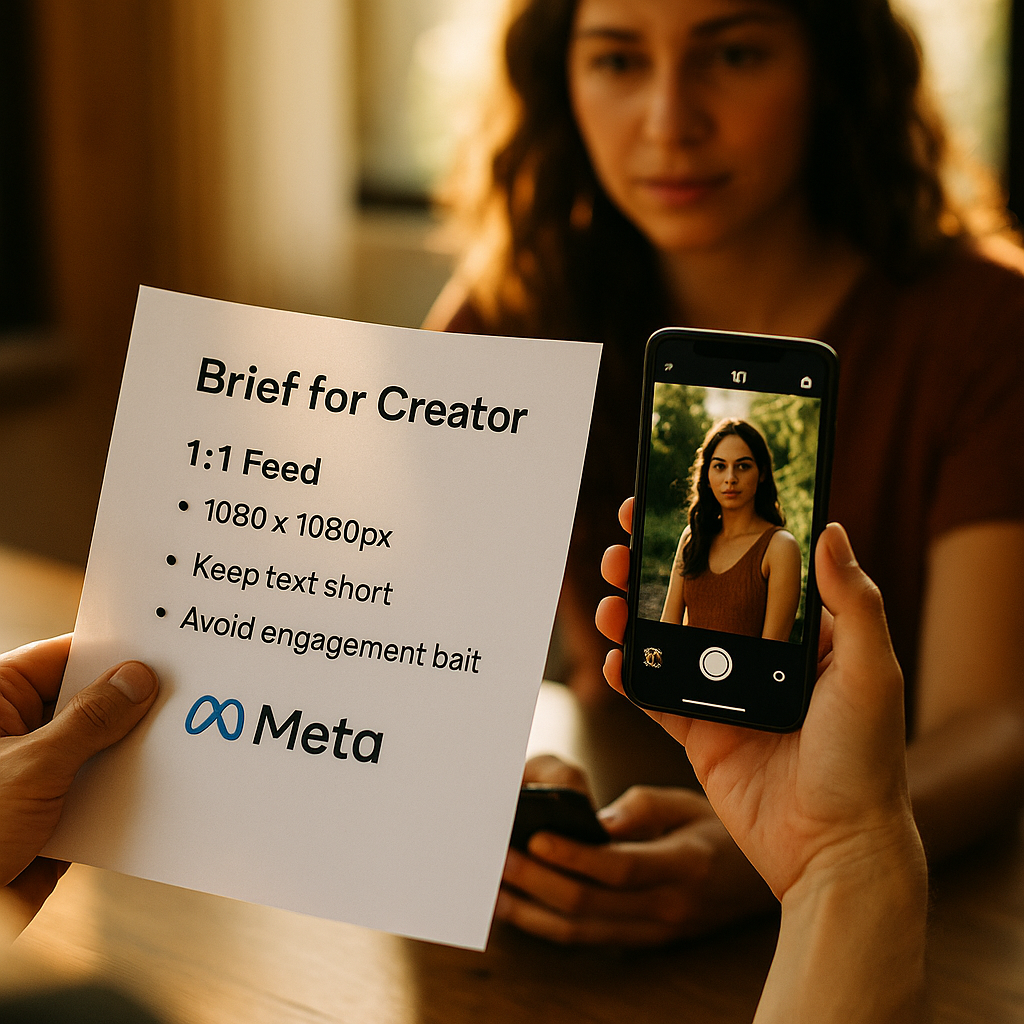
Most Sponsored Feed Posts Are Being Suppressed. Here’s Why.
Instagram’s feed algorithm now deprioritizes content it identifies as overtly promotional, and the 1:1 square format sits at the exact intersection of reach and risk for brand-sponsored posts. If your creator briefs were written for Reels and you’re repurposing that content into feed placements, you are leaving distribution on the table.
The format matters more than most brand teams realize. Square-ratio vertical hybrids — posts shot and framed to work at 1:1 while carrying the visual pacing of short-form vertical content — are outperforming both static square images and repackaged Reels clips in feed placements. But producing them requires a brief that most agencies haven’t written yet.
Why the 1:1 Format Is Having a Moment
Meta’s feed has been quietly shifting its content composition. Reels dominate discovery, but the home feed, especially for users who follow a brand’s creator partners, still surfaces square and near-square posts at meaningful frequency. According to data published by Sprout Social, 1:1 images and videos consistently generate higher engagement rates than landscape content across Instagram placements. That’s not a coincidence. Square content fills more vertical screen real estate on mobile without requiring the user to rotate or expand, and it doesn’t trigger the “this feels like an ad” pattern recognition that a 9:16 Reel repurposed into feed placement often does.
The hybrid part is where the strategy gets nuanced. A square-ratio vertical hybrid means the creator shoots primary action in a vertical framing, then the content is edited to a 1:1 crop that preserves the visual energy of short-form video: motion in the first two seconds, text overlays within the safe zone, and a clear focal point that works without sound. The result reads native to the feed, not recycled from Reels or Stories.
Content that reads as native to the feed format receives measurably better organic amplification before paid spend is layered on — which means your CPM efficiency improves before you touch the media budget.
What “Native Aesthetic” Actually Means for Sponsored Content
This is the phrase that gets thrown around without enough operational definition. For Meta’s feed placement, native aesthetic has four specific components that your brief needs to address explicitly.
1. No cinematic color grading. Heavily color-graded footage signals production spend, which signals advertisement. Creators should use natural or lightly adjusted color profiles. Think iPhone default processing, not agency post-production.
2. Caption copy that mirrors organic behavior. Sponsored posts with caption structures that mimic brand press releases, complete with campaign hashtags, CTAs stacked three deep, and legal disclosures buried at the end, perform significantly worse than posts where the FTC disclosure sits naturally in the first line and the rest reads like something the creator would genuinely write. For compliance guidance on disclosure placement, refer to the FTC’s endorsement guidelines, which are enforceable and not optional.
3. Motion without production tells. Jump cuts, handheld movement, and casual zooms tell the algorithm (and the user) that this was made by a person, not a production team. Brief your creators on this explicitly. If your brand instinct is to request a tripod-stable, perfectly lit product reveal, you are briefs-ing for a television commercial, not for a feed post.
4. Sound-off legibility with sound-on reward. The majority of feed content is initially consumed without sound. Your creator brief must specify that the visual content communicates the core message independently. If the sound is on, there should be a payoff, whether through the creator’s voice, ambient audio, or a music choice that adds emotional context.
If you want a framework for structuring these briefs more systematically, the approach covered in briefing creators for the 1:1 Meta feed format offers a solid operational starting point.
Writing the Brief: What to Specify and What to Leave Open
The most common brief failure is over-specification of the wrong variables. Brand teams lock down background colors, product placement angles, and script language, then leave the format, pacing, and framing entirely up to the creator. That’s backwards.
For square-ratio vertical hybrids, your brief should lock:
- Crop safe zone: All essential visual elements (product, creator’s face, key text) must stay within the center 80% of the frame. This protects the content when Meta’s algorithm previews a cropped thumbnail.
- First-frame specification: What is visible in frame zero? This is non-negotiable. It determines scroll-stop performance. Specify the subject, approximate composition, and whether the creator or the product leads.
- Duration: For feed video posts, 15-30 seconds is the functional sweet spot. Under 15 seconds reads like a Reel repurpose. Over 45 seconds sees significant drop-off in feed (as opposed to saved content or DM shares).
- Text overlay placement: Specify that text must stay in the upper 60% of the frame, clear of the bottom engagement bar.
Your brief should leave open:
- The creator’s specific language and cadence
- Background setting (with general guidance on lighting, not a mandated location)
- Caption voice and structure beyond the disclosure requirement
- B-roll selection and transition style
This balance is what protects the native aesthetic while maintaining brand control over what actually affects performance. For more on hook structures in creator briefs, the same principles around frame-zero composition apply directly to feed placements.
Algorithm Suppression: What Triggers It and How to Avoid It
Meta’s content ranking system evaluates sponsored posts on multiple signals beyond the paid label. Organic engagement velocity in the first 30-60 minutes after posting is a significant ranking factor. If a sponsored post generates early negative signals (hiding the post, scrolling past immediately, or low save and share rates), the algorithm reduces its feed distribution even with paid amplification behind it.
The practical implication: a creator’s organic audience is your first performance jury. If the content reads as an ad to followers who opted in to see that creator’s content, your paid reach will cost more and deliver less. Meta’s business resources confirm that organic signals influence paid delivery efficiency. Your brief, therefore, is a performance document, not just a compliance document.
Three specific brief requirements that reduce suppression risk:
- Require the creator to post from their personal creator account, not a brand-managed or co-managed account, unless you’re running Branded Content Ads specifically designed for the partnership framework.
- Specify that the creator should not include external URLs in the caption body. Link-in-bio references are acceptable; inline URLs to product pages trigger reduced reach in organic feed distribution.
- Ask creators to stagger posting time with their existing content schedule, not to batch-post sponsored content alongside organic content on the same day.
For brands running content across multiple platforms simultaneously, the considerations around multi-platform short-form briefs are relevant here, particularly around how brief language needs to be format-specific rather than platform-agnostic.
Production Specs Your Creative Team Needs to Know
Operationally, the square-ratio vertical hybrid requires a specific shooting protocol that your creator brief must communicate clearly, especially for creators who primarily shoot in 9:16 for Reels or TikTok.
Shoot in 4K vertical (9:16) and edit to 1:1. This preserves resolution after the crop. Shooting natively in 1:1 on most smartphones yields a lower-quality output than cropping from a vertical 4K source. The creator should understand this before they shoot, not after delivery.
Safe zone framing: the key visual action should be composed for the center 1080×1080 pixels of a 1080×1920 frame. Anything outside that zone may be used for visual context but should not carry essential information.
If you’re scaling this across multiple creators with AI-assisted editing tools, the workflow considerations around aspect-ratio-agnostic creator briefs are worth reviewing. AI crop tools from platforms like Adobe and CapCut’s business suite can automate the 9:16 to 1:1 conversion, but only if the source footage was framed with the safe zone in mind from the shoot.
Brief the shoot, not just the edit. A creator who frames for 1:1 during production gives you a feed post that looks intentional. A creator who crops a Reels clip gives you a feed post that looks repurposed.
Measurement: What Good Looks Like for This Format
Standard engagement rate metrics don’t fully capture feed post performance for sponsored content. Track saves and shares separately from likes. Saves indicate content perceived as useful or bookmark-worthy. Shares into DMs indicate content that feels personal enough to send directly. Both signals are more algorithmically valuable than likes and more predictive of downstream conversion behavior.
For brands running this format as part of a broader commerce funnel, the connection between feed content and lower-funnel outcomes is increasingly trackable through Meta’s Meta Pixel and Conversions API. A creator’s feed post that drives a save, a profile visit, and then a link-in-bio click is a three-step attribution chain that most brand analytics setups are not capturing correctly. Fix the attribution before you optimize the creative.
For teams managing creator programs at scale, the brief frameworks in influencer creative planning and brief templates offer structured approaches to testing hook variations across format types, including feed-specific placements.
Start your next campaign cycle by auditing your existing creator briefs specifically for format language. If the word “square” or “1:1” does not appear alongside explicit safe zone guidance and first-frame specifications, your brief is not ready for Meta’s feed.
FAQ
What is a square-ratio vertical hybrid for Instagram feed?
A square-ratio vertical hybrid is a short-form video shot in vertical (9:16) format and edited down to a 1:1 (square) crop for Instagram feed placement. It combines the visual energy and pacing of vertical short-form content — motion, text overlays, quick hooks — with the square dimensions that perform best in Instagram’s home feed.
Why does Meta’s algorithm suppress some sponsored content in the feed?
Meta’s feed algorithm evaluates early organic engagement signals like saves, shares, and watch time within the first 30-60 minutes after posting. If a sponsored post receives low engagement or negative signals (users hiding or skipping it), the algorithm reduces its distribution even with paid budget behind it. Content that looks like a repurposed ad rather than native creator content tends to trigger these negative signals.
How should the FTC disclosure appear in Instagram feed posts?
According to FTC guidelines, the disclosure must be clear and conspicuous. For Instagram feed posts, placing the disclosure at the beginning of the caption (e.g., #ad or #sponsored as the first element) is the most compliant approach. Disclosures buried after “more” truncation or stacked at the end of long captions do not meet FTC standards.
What frame dimensions should creators shoot for a 1:1 Meta feed post?
Creators should shoot in 4K vertical (9:16) and frame their primary action within the center 1080×1080 pixels of the frame. This approach preserves resolution after the crop to 1:1 and ensures that key visual elements — the creator’s face, product, and any text overlays — remain fully visible in the final square output.
What metrics should brands track for sponsored creator feed posts?
Beyond standard engagement rate, brands should prioritize saves and shares (particularly DM shares), as these signals carry more algorithmic weight in Meta’s feed ranking. Profile visits driven by feed posts and subsequent link-in-bio clicks are also important indicators of lower-funnel intent. Setting up proper attribution through Meta Pixel or Conversions API is essential for connecting feed post performance to actual conversion outcomes.
Can you repurpose a Reels clip as a 1:1 feed post?
Technically yes, but it typically underperforms. Reels content is framed and paced for 9:16 full-screen viewing. When cropped to 1:1, important visual elements are often cut off, and the content frequently reads as recycled rather than intentional. Brands and creators who brief and shoot specifically for 1:1 from the start consistently see better feed performance than those repurposing vertical Reels clips.
Top Influencer Marketing Agencies
The leading agencies shaping influencer marketing in 2026
Agencies ranked by campaign performance, client diversity, platform expertise, proven ROI, industry recognition, and client satisfaction. Assessed through verified case studies, reviews, and industry consultations.
Moburst

-
2

The Shelf
Boutique Beauty & Lifestyle Influencer AgencyA data-driven boutique agency specializing exclusively in beauty, wellness, and lifestyle influencer campaigns on Instagram and TikTok. Best for brands already focused on the beauty/personal care space that need curated, aesthetic-driven content.Clients: Pepsi, The Honest Company, Hims, Elf Cosmetics, Pure LeafVisit The Shelf → -
3

Audiencly
Niche Gaming & Esports Influencer AgencyA specialized agency focused exclusively on gaming and esports creators on YouTube, Twitch, and TikTok. Ideal if your campaign is 100% gaming-focused — from game launches to hardware and esports events.Clients: Epic Games, NordVPN, Ubisoft, Wargaming, Tencent GamesVisit Audiencly → -
4

Viral Nation
Global Influencer Marketing & Talent AgencyA dual talent management and marketing agency with proprietary brand safety tools and a global creator network spanning nano-influencers to celebrities across all major platforms.Clients: Meta, Activision Blizzard, Energizer, Aston Martin, WalmartVisit Viral Nation → -
5

The Influencer Marketing Factory
TikTok, Instagram & YouTube CampaignsA full-service agency with strong TikTok expertise, offering end-to-end campaign management from influencer discovery through performance reporting with a focus on platform-native content.Clients: Google, Snapchat, Universal Music, Bumble, YelpVisit TIMF → -
6

NeoReach
Enterprise Analytics & Influencer CampaignsAn enterprise-focused agency combining managed campaigns with a powerful self-service data platform for influencer search, audience analytics, and attribution modeling.Clients: Amazon, Airbnb, Netflix, Honda, The New York TimesVisit NeoReach → -
7

Ubiquitous
Creator-First Marketing PlatformA tech-driven platform combining self-service tools with managed campaign options, emphasizing speed and scalability for brands managing multiple influencer relationships.Clients: Lyft, Disney, Target, American Eagle, NetflixVisit Ubiquitous → -
8

Obviously
Scalable Enterprise Influencer CampaignsA tech-enabled agency built for high-volume campaigns, coordinating hundreds of creators simultaneously with end-to-end logistics, content rights management, and product seeding.Clients: Google, Ulta Beauty, Converse, AmazonVisit Obviously →