


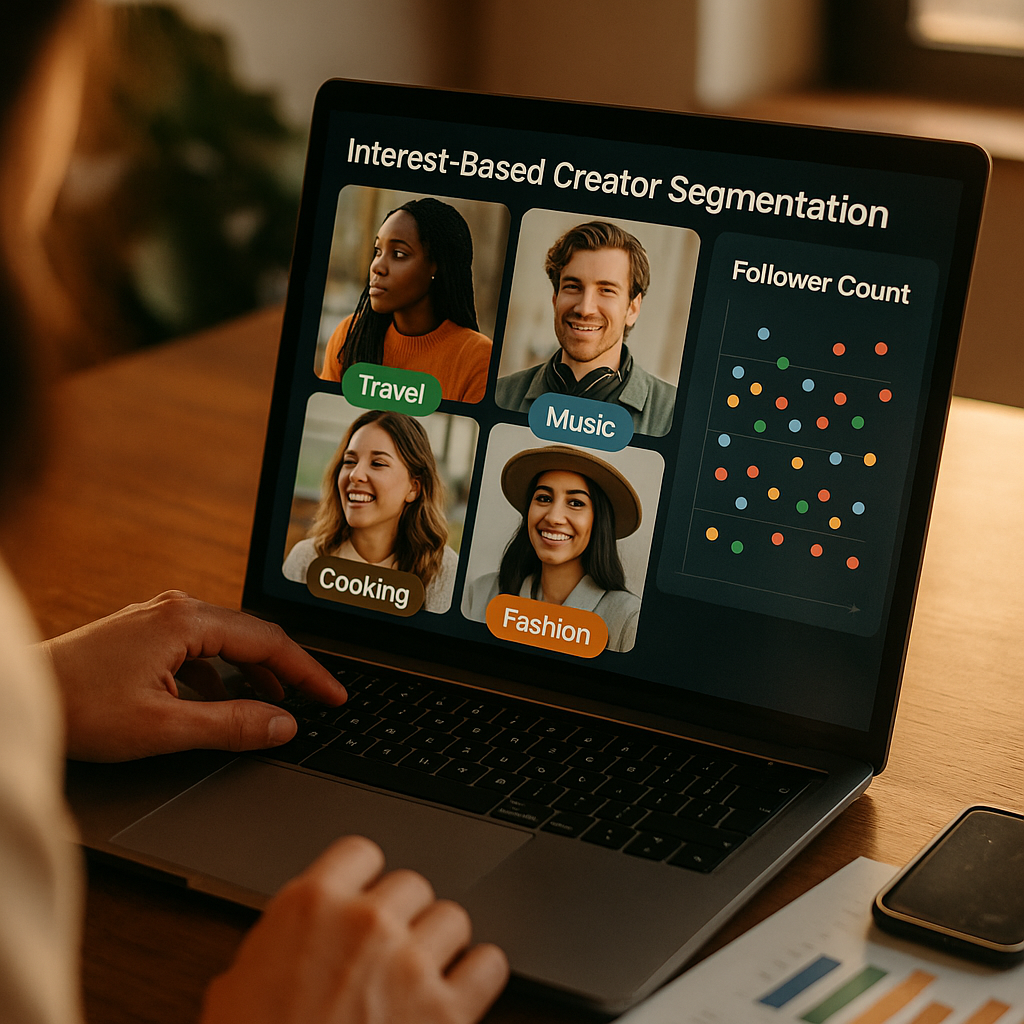
Follower count is a vanity metric that platforms quietly retired. When Statista data shows engagement rates for mega-creators dropping below 1% while niche creators in tight interest clusters routinely hit 6-12%, the implication is clear: interest-based creator segmentation is no longer optional for mid-market brands. It’s the operating model.
Why Your Discovery Workflow Is Probably Broken
Most mid-market influencer programs were built around a follower-first logic. Reach a big number, assume reach equals impressions, negotiate a rate, ship the brief. That model made sense when platforms surfaced content to followers first. It doesn’t anymore.
TikTok’s interest graph reshaped the distribution assumption for every platform. Instagram Reels, YouTube Shorts, and even LinkedIn’s feed have all migrated toward topic-signal distribution. The algorithm now asks: what does this content cluster mean, and who wants it, regardless of whether they follow the creator? A creator with 40,000 followers deeply embedded in a narrowly defined interest cluster — say, fermentation home-cooking or rucking fitness — can outperform a lifestyle creator with 800,000 followers on a product relevant to that cluster. Every time.
Platform algorithms now route content by interest signal, not audience size. A creator’s topic cluster depth has become a stronger reach predictor than follower count for brands targeting defined consumer segments.
If your discovery workflow still opens with a follower filter, you’re optimizing for a distribution model that no longer exists.
The Four Dimensions of Interest-Based Segmentation
Rebuilding your workflow requires a different set of qualifying variables. Here’s the framework that’s proving most durable across mid-market programs right now.
1. Topic cluster depth. Not just the topic a creator covers, but how consistently and specifically they cover it. A fitness creator who posts broadly about exercise is not in the same cluster as a creator who has published 200 pieces of content specifically about low-impact training for people over 40. Tools like Sprout Social and Modash allow you to filter by content theme and posting consistency. Use them to identify creators whose last 90 days of content sits tightly within a defined semantic neighborhood.
2. Audience interest overlap. This is different from audience demographics. You want to know what else the creator’s audience actively engages with. Most serious influencer platforms (Grin, Traackr, CreatorIQ) now expose audience psychographic data, including interest affinities beyond the creator’s primary niche. A creator’s audience that over-indexes for “sustainable home goods” and “DIY repair” tells you something specific about purchase intent that age and location data cannot.
3. Algorithmic surface rate. How often does the platform push this creator’s content beyond their existing followers? This isn’t always labeled explicitly, but you can proxy it: calculate the ratio of average views to follower count on non-sponsored content. Consistently above 1:1 suggests strong interest-graph pickup. Below 0.3:1 means the creator is mostly talking to people who already follow them. That’s a fundamentally different distribution scenario.
4. Content format alignment by cluster. Algorithms weight content format signals alongside topic signals. A creator who posts long-form tutorials in a knowledge-dense cluster will surface differently than one posting short reactive takes on the same topic. Match your content type requirements to what the algorithm is already rewarding in that cluster before you brief the creator.
Building Topic Cluster Maps Before You Run Discovery
The tactical shift most teams skip: define your cluster architecture before you open any discovery tool. Start with your product or service’s core use cases. Then map two to three layers of adjacent interest territory. A B2C supplement brand, for instance, might anchor to “sports recovery” but find stronger interest-graph traction in “sleep optimization,” “biohacking on a budget,” and “endurance training for non-athletes.” Those adjacent clusters often have higher content-to-engagement density because they’re slightly less saturated by brand activity.
This matters operationally because your discovery queries need to match the language the algorithm uses to categorize content, not the language your brand uses internally. If your brief calls it “wellness recovery” but the platform clusters it under “active recovery routines,” you’ll miss the right creators entirely.
For a structured approach to measuring performance within these clusters, see how interest cluster KPIs map to procurement benchmarks — especially useful when justifying the discovery methodology to finance or procurement stakeholders who still expect follower-based CPM logic.
Operationalizing the New Workflow
Theory is easy. Here’s what the updated discovery workflow actually looks like in practice for a mid-market team running programs at 30-100 creators per quarter.
Step 1: Build your cluster taxonomy. Three to five primary clusters, each with five to eight semantic subtopics. Document these before touching any tool.
Step 2: Run keyword-weighted discovery queries. Use your cluster subtopics as search terms, not category filters. Most platforms allow hashtag and keyword-based content search. Filter for posting frequency within those terms over the past 60-90 days.
Step 3: Score on depth, not size. Flag creators whose content within your cluster represents 60%+ of their recent output. Discard creators for whom your topic is occasional content. You want cluster specialists, not generalists who touched the topic once.
Step 4: Validate algorithmic surface rate. Pull the view-to-follower ratio for organic (non-boosted) posts in the last 30 days. Anything above 0.8:1 is worth pursuing. Below 0.4:1 warrants serious scrutiny regardless of how aligned their content looks.
Step 5: Audit audience interest overlap. Cross-check against your ICP. If audience affinities don’t align with your buyer’s adjacent interests, the follower match doesn’t matter.
For teams scaling this process beyond 50 creators, manual scoring becomes untenable fast. The systems approach to scaling micro-creators addresses exactly this bottleneck, including how to templatize scoring rubrics so that junior team members can qualify creators against cluster criteria without needing a senior strategist on every review.
Mid-market brands that replace follower filters with cluster-depth scoring consistently report higher content reach per dollar spent, because they’re working with the algorithm’s logic rather than against it.
Where AI Tools Fit — and Where They Don’t
AI-powered discovery tools are genuinely useful for the first two steps of this workflow. Platforms like HubSpot’s AI content tools or standalone influencer AI stacks can automate cluster taxonomy matching and initial scoring at volume. What they cannot reliably do is validate genuine cluster authority versus superficial keyword presence. That still requires a human reviewing actual content.
The risk of over-automating discovery is real. A creator who tags content with your cluster keywords but whose audience doesn’t genuinely care about the topic will look clean in an automated audit and fail in execution. For guidance on where human judgment should remain non-negotiable in AI-assisted programs, the framework in CMO human judgment minimums is directly applicable to creator vetting decisions.
Connecting Cluster Strategy to Budget Logic
One friction point mid-market brands consistently hit: finance and procurement teams still think in CPM and follower-based rate cards. When you shift to interest-based segmentation, you’re often working with smaller creators commanding lower absolute fees but delivering stronger cluster-specific reach. The budget math looks different and needs translating.
For CPC benchmarks by creator category, the data is clear that cluster-specialized micro and nano creators frequently deliver lower cost-per-click than larger generalist accounts, which gives you the finance-facing argument you need. Pair this with performance floor standards to build a defensible gating model that finance will accept as a replacement for the follower-count minimum they’re used to requiring.
External benchmarking from eMarketer consistently supports the cost efficiency of niche-creator programs when cluster alignment is strong, which gives you third-party validation to accompany internal data in budget conversations.
The bigger structural shift is this: interest-based segmentation should eventually reshape how you allocate budget across your entire creator roster, not just how you discover new creators. If you’re running an always-on program, the cluster architecture becomes the budget architecture. For a working model of how to structure that, see the always-on budget allocation model.
The hardest part of this transition isn’t the framework. It’s convincing stakeholders that a creator with 35,000 followers who owns a cluster is worth more than a creator with 350,000 followers who grazes it. Build that case with data from your first cluster-aligned campaign, and the conversation becomes much easier from there. Start with one cluster, measure rigorously, and let the results make the argument for you.
Frequently Asked Questions
What is interest-based creator segmentation?
Interest-based creator segmentation is the practice of identifying and grouping influencers based on the specific topic clusters they consistently create content within, rather than their total follower count or broad content category. It prioritizes depth of audience interest alignment and algorithmic cluster authority over audience size metrics.
Why does follower count no longer reliably predict reach?
Major platforms including TikTok, Instagram, and YouTube have shifted from follower-based content distribution to interest-graph distribution. Content is now surfaced to users based on their demonstrated topic interests, not primarily to a creator’s existing followers. This means a creator deeply embedded in a tight interest cluster can reach far more relevant users than a large-account creator whose audience has broad but shallow interests.
How do I measure whether a creator has genuine cluster authority?
Look at three indicators: the percentage of their recent content (last 90 days) that falls within your target cluster, their view-to-follower ratio on organic posts (above 0.8:1 suggests strong algorithmic pickup), and audience interest overlap data available through platforms like Traackr, CreatorIQ, or Modash. Creators who score well on all three are genuine cluster authorities, not opportunistic taggers.
What tools support interest-based creator discovery workflows?
Tools like CreatorIQ, Traackr, Modash, and Grin offer content-keyword filtering, audience psychographic data, and posting consistency metrics that support cluster-based discovery. For cluster taxonomy mapping before running queries, traditional keyword research tools can be useful for understanding how platforms semantically categorize your topic area.
How should mid-market brands present this methodology to finance teams?
Replace follower-based CPM arguments with CPC and conversion rate data benchmarked against cluster-specialized creators. Micro and nano creators within tight interest clusters consistently demonstrate lower cost-per-click and higher conversion intent than larger generalist accounts. Use third-party benchmarking data alongside your own campaign results to build the internal business case for shifting evaluation criteria.
Can AI tools automate interest-based creator discovery?
AI tools can accelerate cluster taxonomy matching and initial creator scoring at scale, but they should not fully replace human review. Automated systems can miss the difference between a creator who tags content with relevant keywords and one who genuinely owns authority within a cluster. Human judgment remains important at the content quality and cluster-depth validation stage, particularly for brand-safety and strategic fit assessments.
Top Influencer Marketing Agencies
The leading agencies shaping influencer marketing in 2026
Agencies ranked by campaign performance, client diversity, platform expertise, proven ROI, industry recognition, and client satisfaction. Assessed through verified case studies, reviews, and industry consultations.
Moburst

-
2

The Shelf
Boutique Beauty & Lifestyle Influencer AgencyA data-driven boutique agency specializing exclusively in beauty, wellness, and lifestyle influencer campaigns on Instagram and TikTok. Best for brands already focused on the beauty/personal care space that need curated, aesthetic-driven content.Clients: Pepsi, The Honest Company, Hims, Elf Cosmetics, Pure LeafVisit The Shelf → -
3

Audiencly
Niche Gaming & Esports Influencer AgencyA specialized agency focused exclusively on gaming and esports creators on YouTube, Twitch, and TikTok. Ideal if your campaign is 100% gaming-focused — from game launches to hardware and esports events.Clients: Epic Games, NordVPN, Ubisoft, Wargaming, Tencent GamesVisit Audiencly → -
4

Viral Nation
Global Influencer Marketing & Talent AgencyA dual talent management and marketing agency with proprietary brand safety tools and a global creator network spanning nano-influencers to celebrities across all major platforms.Clients: Meta, Activision Blizzard, Energizer, Aston Martin, WalmartVisit Viral Nation → -
5

The Influencer Marketing Factory
TikTok, Instagram & YouTube CampaignsA full-service agency with strong TikTok expertise, offering end-to-end campaign management from influencer discovery through performance reporting with a focus on platform-native content.Clients: Google, Snapchat, Universal Music, Bumble, YelpVisit TIMF → -
6

NeoReach
Enterprise Analytics & Influencer CampaignsAn enterprise-focused agency combining managed campaigns with a powerful self-service data platform for influencer search, audience analytics, and attribution modeling.Clients: Amazon, Airbnb, Netflix, Honda, The New York TimesVisit NeoReach → -
7

Ubiquitous
Creator-First Marketing PlatformA tech-driven platform combining self-service tools with managed campaign options, emphasizing speed and scalability for brands managing multiple influencer relationships.Clients: Lyft, Disney, Target, American Eagle, NetflixVisit Ubiquitous → -
8

Obviously
Scalable Enterprise Influencer CampaignsA tech-enabled agency built for high-volume campaigns, coordinating hundreds of creators simultaneously with end-to-end logistics, content rights management, and product seeding.Clients: Google, Ulta Beauty, Converse, AmazonVisit Obviously →