


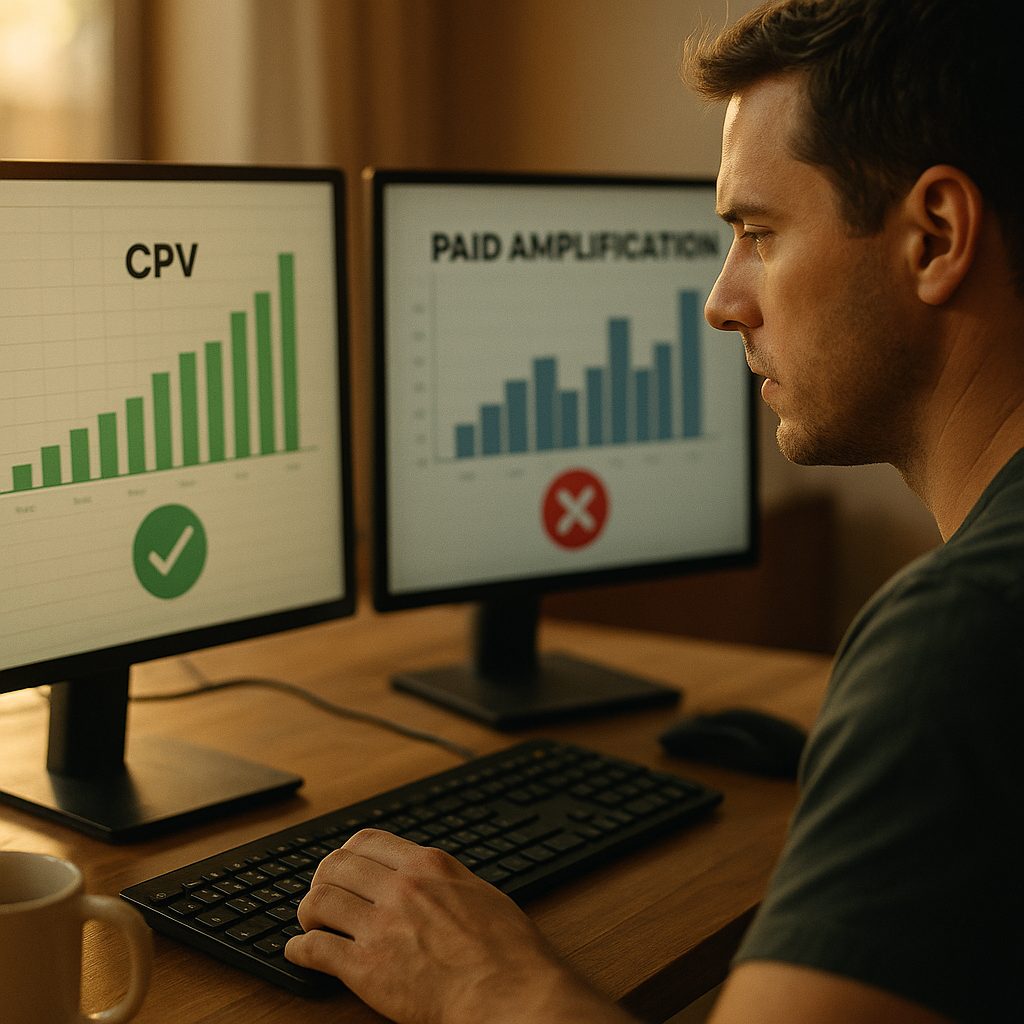
Brands are paying $0.03–$0.08 CPV for paid social amplification while clipping networks are delivering views at a fraction of that cost. The question brand strategists should be asking isn’t whether clipping network CPV benchmarks look attractive on paper — it’s whether the economics hold up under operational scrutiny and at scale.
The CPV Problem Most Brand Strategists Are Ignoring
Paid amplification has a familiarity bias problem. Media buyers trust Meta and YouTube auction dynamics because those numbers are auditable, predictable, and defensible in a budget review. UGD infrastructure — user-generated distribution, or what clipping networks enable — feels less controllable, so it gets underfunded relative to its actual performance potential.
That’s a costly assumption. When brands overspend on creation and underspend on distribution, the entire campaign efficiency curve bends in the wrong direction. And when paid CPMs on Meta hover around $10–$18 for broad audiences, you’re often getting a CPV on video content north of $0.05 once you factor in skip rates and partial-view thresholds. Clipping network economics can undercut that significantly — but only if you measure them correctly.
What UGD Infrastructure Actually Means for Brand Distribution
Let’s be precise. UGD (user-generated distribution) infrastructure refers to coordinated networks of creators — often micro or nano-tier — who clip, remix, and redistribute brand-relevant content across TikTok, YouTube Shorts, Instagram Reels, and X. Unlike traditional UGC, UGD is organized. It has operational architecture behind it: brief templates, approval workflows, CPV incentive structures, and compliance checkpoints.
Platforms like Clip.co and Blerp have helped formalize this model, connecting brands to active clipping communities. The creators aren’t producing original long-form content. They’re taking existing brand assets or partner content and deploying short, authentic-feeling clips to their own audiences. The distribution cost per view can fall into the $0.005–$0.015 range depending on niche, engagement quality, and network scale.
That’s a meaningful delta. But CPV alone doesn’t close the case for UGD. You need to interrogate what kind of view you’re buying.
A $0.005 CPV from a clipping network isn’t worth comparing to a $0.05 paid CPV unless you’ve standardized what “view” means across both channels: minimum duration, completion rate, and audience match quality all affect the real cost of attention.
Building a Comparable CPV Framework
Brand strategists evaluating clipping networks against paid amplification need a normalized measurement layer. Here’s the framework that works in practice:
- Define your view threshold: Are you counting a 2-second impression, a 6-second view, or a 15-second completion? Paid platforms use inconsistent defaults. Set your own standard and apply it to both channels.
- Segment by audience quality: A clipping network pushing your content through gaming micro-creators to an irrelevant demographic is not comparable to a targeted paid placement. Score each distribution channel by audience-to-ICP match rate.
- Add operational overhead to both sides: Paid amplification has media agency fees, creative adaptation costs, and platform minimums. UGD has coordinator labor, brief development, creator vetting, and compliance review. Both have real cost stacks.
- Measure downstream signals: Click-through rate, search lift, branded query volume, and conversion path attribution all matter more than raw view count. Clipping networks tend to produce higher engagement-per-view ratios on platforms like TikTok where the algorithm rewards authentic-feeling content.
The relationship between algorithmic reach and distribution ROI is critical here. Clipping networks benefit from organic amplification layers that paid placements don’t. When a clip gains momentum organically, the effective CPV drops further — sometimes dramatically. That compounding effect doesn’t exist in traditional paid channels.
Where Clipping Networks Win the CPV Comparison
There are specific scenarios where UGD infrastructure consistently beats paid amplification on CPV economics.
Top-of-funnel awareness campaigns in high-CPM categories. Financial services, pharma, and B2B tech brands pay premium CPMs on Meta and LinkedIn. A coordinated clipping network can reach the same professional demographics through finance creators on TikTok or YouTube at a fraction of the auction price.
Content with natural virality potential. Product launches, event recaps, and tutorial-adjacent content clip well. When the source material has shareability built in, clipping networks amplify it more efficiently than a paid boost because the content earns organic distribution on top of the coordinated layer.
Brands with platform ad fatigue issues. Audiences that have been retargeted heavily will tune out paid placements. Fresh creators distributing clips through their own audiences bypass ad blindness entirely.
Across all three scenarios, the underlying principle is the same: paid amplification rents attention. Clipping networks, when structured well, earn it. The CPV difference reflects that fundamental dynamic. For a deeper look at how this plays out operationally, the analysis of how clipping networks reshape distribution ops is worth reading alongside this framework.
The Risks Brands Underestimate
UGD is not a free lunch. Three risk categories deserve honest attention before you shift budget.
Brand safety variance. When dozens of micro-creators are distributing clips, quality control is harder than running a single paid ad set. A creator with a problematic history can put your brand adjacent to content you haven’t approved. Rigorous vetting protocols and kill-switch clauses in creator agreements are non-negotiable. The IAB-UK’s creator vetting and disclosure filters provide a useful baseline for structuring these safeguards.
Attribution gaps. Clipping networks generate distributed, organic-feeling touchpoints that are difficult to track in standard MTA models. If your attribution infrastructure relies on last-click or even linear models, you’ll systematically undercount the value UGD contributes. This is a measurement problem, not a performance problem — but it can kill budget justification in a finance review.
Network quality decay. Not all clipping networks maintain creator quality over time. If the incentive structure pays purely on volume (raw views), creators will game it. Look for networks that tier compensation by engagement rate and completion percentage, not just view count.
What the Budget Allocation Math Actually Looks Like
Consider a mid-tier consumer brand running a product awareness campaign with a $250,000 distribution budget. A traditional paid split might put $180,000 into Meta/Instagram video placements and $70,000 into YouTube pre-roll. At blended CPVs of $0.04–$0.06, that buys roughly 3–4.5 million qualified views.
A hybrid model redirecting $60,000 of that paid budget into a coordinated clipping network — assuming $0.01 CPV at quality thresholds — generates 6 million additional views with a compounding organic multiplier. Total reach expands significantly while paid spend either holds or decreases. This is the core argument behind the creation versus distribution budget rebalancing conversation happening across the industry.
The brands winning on CPV efficiency in UGD programs aren’t replacing paid media — they’re using clipping networks to extend reach beyond what auction-based platforms can deliver at equivalent cost.
Platforms like Meta Business and TikTok Ads continue to raise floor CPMs as inventory tightens. Meanwhile, Statista data consistently shows creator-driven content outperforming brand-produced ads on engagement rates. The structural economics favor hybrid models. And as Sprout Social‘s engagement benchmarks reinforce, authentic content formats drive completion rates well above industry averages for equivalent spend.
The UGD networks delivering superior CPV results aren’t doing it through volume tricks. They’re engineering authentic distribution at scale. That’s a different capability than paid media buying, and it requires different internal skills to evaluate and manage. Brands that have explored how UGD networks compete with paid CPMs at scale are already building the operational muscle to capitalize on this shift.
Start by running a controlled test: allocate 15–20% of one campaign’s distribution budget to a vetted clipping network, normalize your CPV measurement methodology across both channels, and read the downstream engagement signals, not just the view count. That’s the benchmark that will either justify scaling UGD or redirect you back to paid with better data than you had before.
Frequently Asked Questions
What is a clipping network CPV benchmark and how is it calculated?
A clipping network CPV (cost-per-view) benchmark measures the average cost a brand pays for each qualified view generated through a coordinated network of creators who clip, remix, and distribute brand content. It’s calculated by dividing total network spend (including creator incentives, coordinator labor, and compliance costs) by the total number of views meeting your defined threshold — typically a minimum of 6 or 15 seconds watched.
How do clipping network CPVs typically compare to paid social amplification?
Well-structured clipping networks can deliver CPVs in the $0.005–$0.015 range, compared to $0.03–$0.08 for paid social video placements on platforms like Meta and YouTube. However, direct comparison requires normalizing for view duration thresholds, audience quality, and attribution methodology — raw CPV numbers aren’t directly comparable without a standardized measurement framework.
What is UGD infrastructure and how does it differ from traditional UGC?
UGD (user-generated distribution) infrastructure is an organized, brief-driven system where micro and nano creators systematically clip and redistribute brand-relevant content to their audiences. Unlike traditional UGC, which is spontaneous and uncoordinated, UGD involves structured workflows, creator agreements, performance incentives, compliance review, and brand safety controls. It delivers authentic-feeling content at operational scale.
What are the biggest risks of using clipping networks for brand distribution?
The three main risks are brand safety variance (multiple creators increase content adjacency risk), attribution gaps (distributed organic touchpoints are harder to track in standard MTA models), and network quality decay (volume-based incentive structures can encourage view gaming rather than genuine engagement). Mitigation requires strong vetting, tiered compensation tied to engagement metrics, and updated attribution infrastructure.
How should brand strategists allocate budget between UGD and paid amplification?
Most mid-tier brands benefit from a hybrid model rather than a full replacement strategy. A practical starting point is allocating 15–20% of a single campaign’s distribution budget to a vetted clipping network while maintaining paid channels. This allows parallel measurement under identical campaign conditions before making larger reallocations. The right split depends on category CPM rates, content shareability, and the brand’s existing attribution capabilities.
Top Influencer Marketing Agencies
The leading agencies shaping influencer marketing in 2026
Agencies ranked by campaign performance, client diversity, platform expertise, proven ROI, industry recognition, and client satisfaction. Assessed through verified case studies, reviews, and industry consultations.
Moburst

-
2

The Shelf
Boutique Beauty & Lifestyle Influencer AgencyA data-driven boutique agency specializing exclusively in beauty, wellness, and lifestyle influencer campaigns on Instagram and TikTok. Best for brands already focused on the beauty/personal care space that need curated, aesthetic-driven content.Clients: Pepsi, The Honest Company, Hims, Elf Cosmetics, Pure LeafVisit The Shelf → -
3

Audiencly
Niche Gaming & Esports Influencer AgencyA specialized agency focused exclusively on gaming and esports creators on YouTube, Twitch, and TikTok. Ideal if your campaign is 100% gaming-focused — from game launches to hardware and esports events.Clients: Epic Games, NordVPN, Ubisoft, Wargaming, Tencent GamesVisit Audiencly → -
4

Viral Nation
Global Influencer Marketing & Talent AgencyA dual talent management and marketing agency with proprietary brand safety tools and a global creator network spanning nano-influencers to celebrities across all major platforms.Clients: Meta, Activision Blizzard, Energizer, Aston Martin, WalmartVisit Viral Nation → -
5

The Influencer Marketing Factory
TikTok, Instagram & YouTube CampaignsA full-service agency with strong TikTok expertise, offering end-to-end campaign management from influencer discovery through performance reporting with a focus on platform-native content.Clients: Google, Snapchat, Universal Music, Bumble, YelpVisit TIMF → -
6

NeoReach
Enterprise Analytics & Influencer CampaignsAn enterprise-focused agency combining managed campaigns with a powerful self-service data platform for influencer search, audience analytics, and attribution modeling.Clients: Amazon, Airbnb, Netflix, Honda, The New York TimesVisit NeoReach → -
7

Ubiquitous
Creator-First Marketing PlatformA tech-driven platform combining self-service tools with managed campaign options, emphasizing speed and scalability for brands managing multiple influencer relationships.Clients: Lyft, Disney, Target, American Eagle, NetflixVisit Ubiquitous → -
8

Obviously
Scalable Enterprise Influencer CampaignsA tech-enabled agency built for high-volume campaigns, coordinating hundreds of creators simultaneously with end-to-end logistics, content rights management, and product seeding.Clients: Google, Ulta Beauty, Converse, AmazonVisit Obviously →