


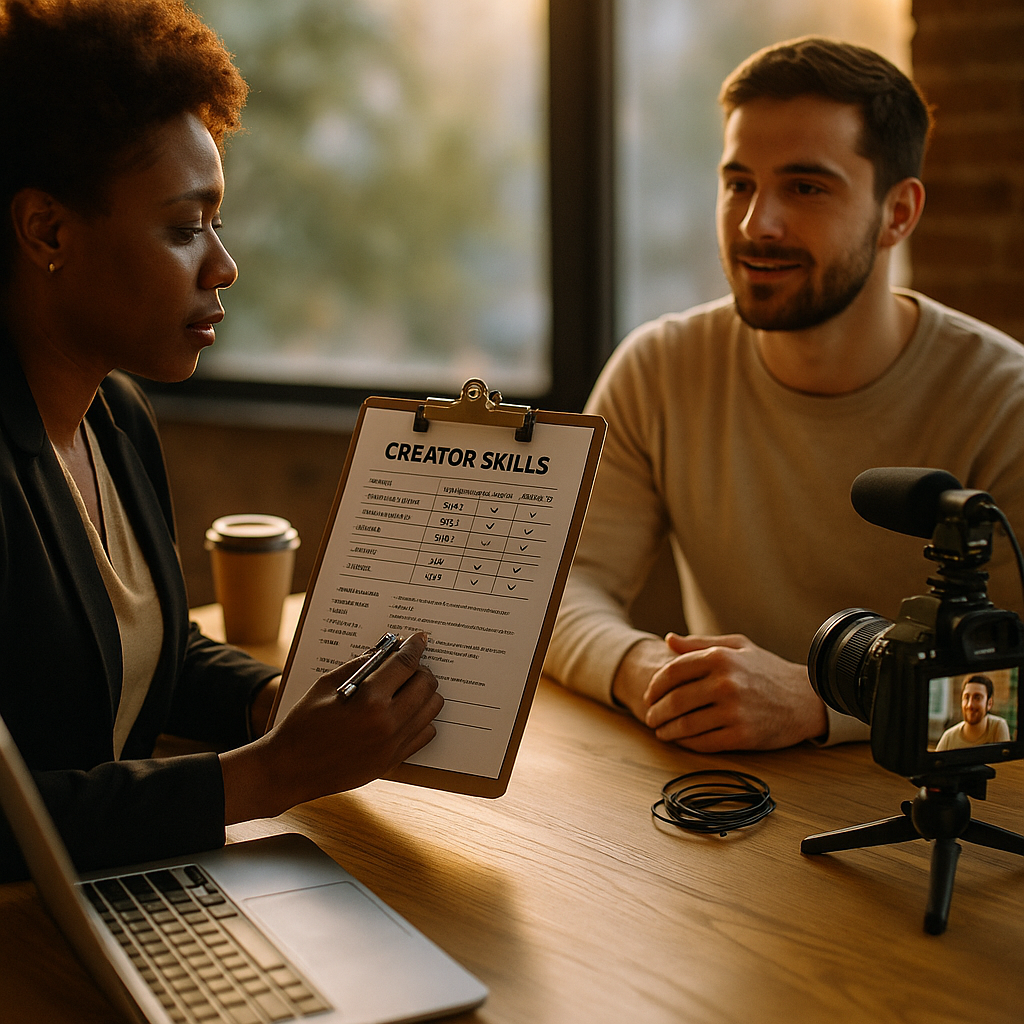
Most Creator Program Job Descriptions Are Hiring for 2019
Only 14% of brand-side marketing job postings for influencer or creator roles explicitly require video production fluency, according to LinkedIn Talent Insights data. The creator economy skills framework underpinning most hiring pipelines is a relic. CMOs running serious creator programs are staffing those programs with generalists who can write a brief but cannot evaluate a hook structure, read an audience-retention graph, or govern an AI-assisted content workflow. That mismatch is costing programs real money.
The Three Competency Gaps Killing Creator Program Performance
Before redesigning job specs, you need to name what’s actually missing. Three gaps appear consistently across underperforming brand creator programs.
Video production competency. This does not mean hiring a videographer. It means hiring someone who understands why a 2.3-second hook outperforms a 4-second one on TikTok, how aspect ratio affects completion rate on Reels versus YouTube Shorts, and how to give a creator feedback that improves the edit without killing their voice. Most brand marketers cannot do this. They evaluate content aesthetically, not technically. The result: endless revision cycles, creator churn, and assets that underperform because the person managing the relationship cannot diagnose the actual problem.
Audience-state targeting literacy. This is the ability to match content type to where an audience is in their purchase psychology — awareness, consideration, intent — and to translate that into creator brief architecture and distribution decisions. It goes beyond funnel basics. A candidate with real audience-state literacy can look at a short-form vs long-form budget split and explain exactly why the allocation makes or breaks a specific campaign objective. Most cannot.
AI governance fluency. This is the newest and most urgently ignored gap. As AI tools accelerate content ideation, script generation, and synthetic asset creation inside creator workflows, brand teams need people who can set and enforce policy guardrails. The FTC’s updated endorsement guidelines create liability when AI-generated content is not disclosed properly. Someone on your team needs to own that. The human creative minimum standard is a real operational concept, not a theoretical one, and your job specs should reflect it.
A creator program manager who cannot distinguish between AI-assisted ideation and AI-generated output cannot protect your brand from disclosure liability or creative commoditization. That’s a compliance risk, not just a quality concern.
Redesigning Job Specifications That Actually Screen for These Skills
The current template for a “Creator Partnerships Manager” or “Influencer Marketing Manager” job description typically lists platform familiarity, project management experience, and relationship skills. That is table stakes. It screens for coordination ability, not program intelligence.
Here is what revised job specifications should require:
- Video production literacy: “Able to evaluate short-form video creative against platform-specific retention benchmarks; comfortable giving technical feedback on hook structure, pacing, and format optimization without directing creative decisions.”
- Audience-state targeting: “Demonstrated ability to map creator content type to funnel stage; experience allocating or recommending budget based on audience purchase psychology, not just reach metrics.”
- AI governance: “Familiarity with brand AI content policies; able to audit creator deliverables for synthetic content disclosure requirements per FTC guidelines and internal policy.”
- Attribution literacy: “Experience reading multi-touch attribution dashboards; can connect creator content performance to downstream conversion data, not just vanity metrics.”
- Contract and rights fluency: “Understands whitelisting, usage rights, and performance-bonus contract structures.” (Candidates who have worked with hybrid creator contracts are significantly more operationally ready than those who have not.)
Each of these requirements needs a corresponding screening question or skills test in your interview process, not just a line in the job description.
Interview Criteria That Surface Real Competency
Behavioral interviews alone will not work here. Smart candidates will narrate generic campaign stories that sound competent but reveal nothing about technical judgment. You need task-based and diagnostic assessments.
For video production competency, show candidates two versions of the same TikTok or Reel, one high-performing and one underperforming, with metrics attached. Ask them to explain the performance difference and what feedback they would give the creator. Watch for specificity: weak candidates describe aesthetic preferences. Strong candidates identify hook timing, caption strategy, CTA placement, or format-audience mismatch.
For audience-state targeting literacy, present a hypothetical campaign brief and ask the candidate to design a creator tier structure and content-type mix across funnel stages. Can they explain why a nano-creator dense-coverage strategy serves awareness while a mid-tier creator with strong community trust serves consideration? This connects directly to how nano creator programs and broader portfolio strategies operate in practice.
For AI governance fluency, present a scenario: a creator submits a video where the voiceover was generated with an AI voice clone and the background imagery was AI-synthesized. Ask the candidate what their review process catches, what your brand policy should require for disclosure, and how they would handle a creator who disputes the finding. Candidates who treat this as a legal problem to escalate rather than an operational process to design are not ready for this role.
For attribution and ROI literacy, reference the blended intelligence governance approach and ask how they would establish a measurement baseline for a new creator program with no historical data. Watch whether they reach for earned media value as a primary metric or whether they think in terms of conversion-linked signals.
Career Ladders: Building a Creator Economy Competency Path
Right now, most brand marketing career ladders treat creator program roles as a subspecialty of social media management or content marketing. That framing limits who applies, how candidates develop, and what mastery looks like at each level.
A creator economy competency ladder should have at least four distinct levels:
- Creator Program Coordinator: Executes briefs, manages deliverable timelines, handles basic performance reporting. Required: platform literacy, basic video feedback ability, familiarity with creator contracts.
- Creator Partnerships Manager: Designs brief architecture, selects and tiers creators, manages multi-creator campaigns, owns attribution reporting. Required: audience-state targeting literacy, intermediate video production judgment, working knowledge of AI disclosure policy.
- Creator Strategy Lead: Owns program design, budget allocation, creator co-development relationships, and governance frameworks. Required: advanced video competency, full AI governance ownership, integration with paid media and product teams. This role should be able to connect creator co-design strategy to measurable funnel outcomes.
- Head of Creator Economy / VP Creator Partnerships: Sets org-wide creator strategy, owns vendor and platform relationships (think Meta Business and TikTok for Business partnerships), and reports creator program ROI at the executive level. Required: full competency across all three frameworks, plus commercial negotiation and cross-functional influence.
Each level should have a defined competency rubric, not just a list of responsibilities. Without rubrics, managers default to promoting people who are agreeable and organized, not people who are genuinely advancing creator program intelligence.
If your creator program career ladder does not have a distinct competency milestone for AI governance fluency, you are already one regulatory cycle behind.
Why This Is a CMO-Level Decision, Not an HR Afterthought
Redesigning job specs and career ladders sounds like HR work. It is not. The competency composition of your creator team is a direct determinant of program ROI. Brands spending $500K or more annually on creator programs and staffing those programs with coordinators who cannot read a retention curve are essentially running a high-budget operation with low-resolution judgment at every decision point.
CMOs who have rebuilt their creator team hiring frameworks report faster brief cycles, lower creator churn, stronger whitelisting outcomes (the CPA reduction from pre-negotiated whitelisting alone can justify the hiring investment), and cleaner AI compliance postures. The talent investment pays back inside a single campaign cycle when the team can actually execute at the level the program demands.
The Sprout Social 2026 influencer marketing index shows brands with dedicated, specialized creator roles outperforming generalist-staffed programs by more than 30% on engagement-to-conversion rates. Specialization is no longer a luxury spend. It is a baseline competitive requirement.
Start with a single role audit this quarter: pull the job description for your most senior creator program role and score it against the three competency domains above. If it does not explicitly require video production judgment, audience-state targeting literacy, and AI governance fluency, rewrite it before the next hire cycle opens.
FAQs
What is a creator economy skills framework for brand hiring?
A creator economy skills framework is a structured set of competency standards used to define, evaluate, and develop talent in brand-side creator program roles. It goes beyond platform familiarity to include video production literacy, audience-state targeting ability, AI governance knowledge, and attribution fluency. CMOs use these frameworks to redesign job specifications and career ladders so hiring decisions reflect the actual skills needed to run high-performing creator programs.
Why does video production competency matter for a brand marketing hire?
Brand-side creator program managers who lack video production literacy cannot give actionable feedback to creators, cannot diagnose performance problems in deliverables, and cannot distinguish between an aesthetic preference and a technical issue. This leads to longer revision cycles, weaker creative output, and higher creator churn. Video production competency does not mean knowing how to shoot or edit video; it means understanding how format, pacing, hook structure, and platform mechanics affect content performance.
What is audience-state targeting literacy and how should it be assessed in interviews?
Audience-state targeting literacy is the ability to match content type, creator tier, and distribution strategy to where an audience sits in their purchase psychology — awareness, consideration, or intent. In interviews, it should be assessed with scenario-based tasks: give candidates a campaign brief and ask them to design a creator content mix across funnel stages, with reasoning. Strong candidates connect creator selection and content format to specific conversion objectives rather than defaulting to reach-first logic.
What does AI governance fluency mean for a creator program role?
AI governance fluency means the ability to audit creator deliverables for AI-generated content, apply brand policy on synthetic content disclosure in line with FTC guidelines, and design internal review workflows that catch compliance risks before content is published. As AI tools become embedded in creator production workflows, brand teams without someone who owns this function are exposed to disclosure liability and brand safety risks. It is an operational competency, not just legal awareness.
How should a creator economy career ladder differ from a standard social media career path?
A creator economy career ladder should have distinct competency milestones at each level, including specific thresholds for video production judgment, audience-state targeting sophistication, and AI governance ownership. A standard social media career path typically emphasizes content publishing, community management, and reporting. Creator economy roles require deeper commercial literacy, closer integration with paid media and attribution systems, and the ability to manage complex creator relationships involving contract structures and whitelisting rights.
Top Influencer Marketing Agencies
The leading agencies shaping influencer marketing in 2026
Agencies ranked by campaign performance, client diversity, platform expertise, proven ROI, industry recognition, and client satisfaction. Assessed through verified case studies, reviews, and industry consultations.
Moburst

-
2

The Shelf
Boutique Beauty & Lifestyle Influencer AgencyA data-driven boutique agency specializing exclusively in beauty, wellness, and lifestyle influencer campaigns on Instagram and TikTok. Best for brands already focused on the beauty/personal care space that need curated, aesthetic-driven content.Clients: Pepsi, The Honest Company, Hims, Elf Cosmetics, Pure LeafVisit The Shelf → -
3

Audiencly
Niche Gaming & Esports Influencer AgencyA specialized agency focused exclusively on gaming and esports creators on YouTube, Twitch, and TikTok. Ideal if your campaign is 100% gaming-focused — from game launches to hardware and esports events.Clients: Epic Games, NordVPN, Ubisoft, Wargaming, Tencent GamesVisit Audiencly → -
4

Viral Nation
Global Influencer Marketing & Talent AgencyA dual talent management and marketing agency with proprietary brand safety tools and a global creator network spanning nano-influencers to celebrities across all major platforms.Clients: Meta, Activision Blizzard, Energizer, Aston Martin, WalmartVisit Viral Nation → -
5

The Influencer Marketing Factory
TikTok, Instagram & YouTube CampaignsA full-service agency with strong TikTok expertise, offering end-to-end campaign management from influencer discovery through performance reporting with a focus on platform-native content.Clients: Google, Snapchat, Universal Music, Bumble, YelpVisit TIMF → -
6

NeoReach
Enterprise Analytics & Influencer CampaignsAn enterprise-focused agency combining managed campaigns with a powerful self-service data platform for influencer search, audience analytics, and attribution modeling.Clients: Amazon, Airbnb, Netflix, Honda, The New York TimesVisit NeoReach → -
7

Ubiquitous
Creator-First Marketing PlatformA tech-driven platform combining self-service tools with managed campaign options, emphasizing speed and scalability for brands managing multiple influencer relationships.Clients: Lyft, Disney, Target, American Eagle, NetflixVisit Ubiquitous → -
8

Obviously
Scalable Enterprise Influencer CampaignsA tech-enabled agency built for high-volume campaigns, coordinating hundreds of creators simultaneously with end-to-end logistics, content rights management, and product seeding.Clients: Google, Ulta Beauty, Converse, AmazonVisit Obviously →