


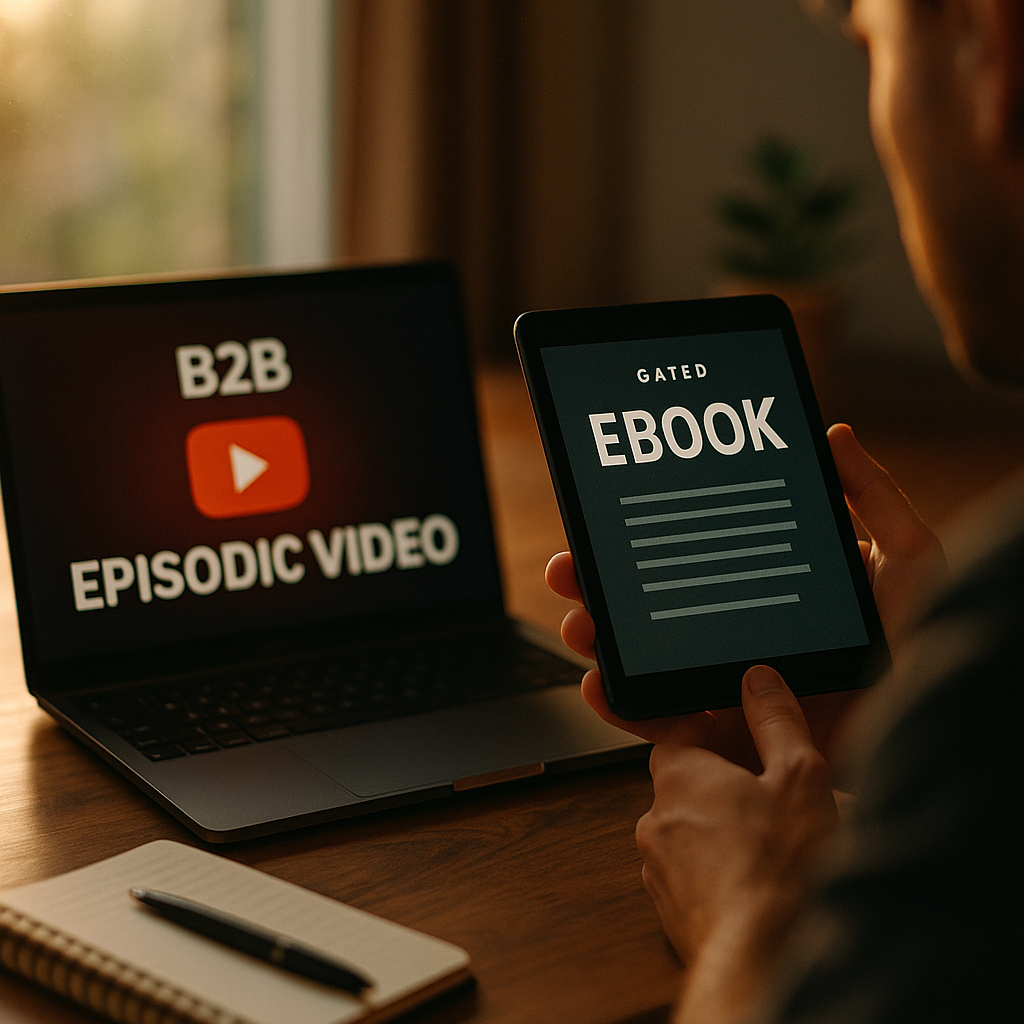
Your eBook Isn’t a Lead Magnet Anymore
Sixty-two percent of B2B buyers now complete more than half their purchase research before speaking to a vendor, according to data from HubSpot. If the content they find during that self-directed research phase is a gated PDF requiring a form fill, most of them will simply move on. The era of the eBook as a mid-funnel workhorse is over. Vertical short-form drama and platform-native episodic video are replacing it — and professional services and enterprise technology brands that recognize this shift early will own the intent moments their competitors are still gate-crashing.
What “Vertical Short-Form Drama” Actually Means in B2B
Strip away the consumer-facing associations. Vertical short-form drama in a B2B context is episodic, narrative-driven video content, typically 60 to 180 seconds per episode, built natively for LinkedIn, YouTube Shorts, or TikTok’s business-facing inventory. Each episode dramatizes a recognizable professional pain point: the CTO fielding a board question about AI governance, the procurement lead navigating a vendor contract dispute, the IT director drowning in a cloud migration that’s three months behind schedule.
The “drama” is functional. It’s not entertainment for its own sake. It’s a storytelling mechanism that mirrors the buyer’s internal reality closely enough to trigger recognition and, critically, continued watching. Viewers who recognize themselves in episode one return for episode two. That return behavior is what makes episodic structure so valuable for mid-funnel: it recreates the sequential engagement that a well-structured long-form asset was supposed to deliver, but never reliably did.
Think about how Salesforce used narrative-driven video series to humanize enterprise CRM adoption, or how Slack built short episodic content around “a day in the life” workplace scenarios before its enterprise push. These weren’t one-off videos. They were designed for re-engagement across a viewing arc.
Why Gated Long-Form Assets Are Losing the Mid-Funnel Battle
The gated eBook model was built on a flawed assumption: that a buyer willing to trade their email address was demonstrating meaningful intent. The reality is that form fills measure friction tolerance, not purchase readiness. Marketing automation platforms like HubSpot and Marketo have generated enormous datasets showing that the average gated asset converts between 2% and 5% of page visitors, with the majority of “leads” produced never progressing past the first nurture email.
Gated content measures friction tolerance, not purchase readiness. The distinction matters enormously when you’re trying to model pipeline quality from mid-funnel engagement.
Meanwhile, the buyers who do have genuine intent are increasingly finding their answers elsewhere. AI-assisted search tools like Perplexity and Google’s AI Overviews are surfacing summarized answers directly, eliminating the need to find and download a vendor eBook. If your mid-funnel content strategy depends on buyers choosing to fill out a form when they can get a synthesized answer in seconds, you’re competing against a model that will always beat you on convenience.
Distribution is the other failure point. Gated assets require buyers to arrive at your domain with intent already formed. Platform-native episodic video distributes into feeds where buyers spend passive attention time, creating intent rather than just capturing it. For a deeper look at why this distinction reshapes content ROI, see our analysis of distribution vs. production strategy.
Platform Selection Is a Strategic Decision, Not a Tactical One
LinkedIn remains the default for enterprise B2B, but the platform’s algorithm heavily favors native video, especially content that generates early dwell time and saves. A three-episode series about cybersecurity incident response, published as native LinkedIn video rather than a link to a landing page, will reach significantly more of a target audience’s feed. LinkedIn’s own advertising data consistently shows native video generating 5x more engagement than static posts or external link posts.
YouTube Shorts is underused by B2B brands despite the fact that YouTube is the second largest search engine in the world and is increasingly surfaced in Google Search results. A short-form episodic series targeting “enterprise cloud migration mistakes” or “SaaS procurement red flags” can appear in both YouTube search and Google SERP simultaneously, giving it SEO value that LinkedIn video cannot replicate.
TikTok’s B2B potential remains underdeveloped but real. Brands like Adobe, Shopify, and HubSpot have built followings on TikTok by addressing practitioner-level problems in short-form format. The TikTok for Business platform has expanded its targeting capabilities for professional audiences significantly. If your buyers are mid-career professionals under 40, dismissing TikTok as a consumer channel is a competitive error. For platform-specific creator procurement strategy, our breakdown of TikTok creator pricing and reach provides useful benchmarks.
Reallocation Framework: From eBook Budget to Episodic Video
The most common objection is production cost. Enterprise brands that have invested in research, design, and copywriting for a flagship eBook often assume that episodic video requires equivalent or greater spend. It doesn’t, when produced correctly.
Here’s a practical reallocation framework:
- Audit your gated asset library. Identify the top five assets by form fill volume and measure each against downstream pipeline conversion, not just lead volume. Most audits reveal that two or three assets drive almost no qualified pipeline despite significant download numbers.
- Strip the core insight from each asset. Every eBook has three to five genuinely useful insight clusters. These become episode briefs. The eBook’s research budget funds the episodic series without additional investment.
- Define a minimum viable series. Four to six episodes is a viable first season for testing. One central character or scenario thread, one clear practitioner problem per episode, one resolved payoff per season arc.
- Produce for the platform, not the production reel. LinkedIn and YouTube Shorts reward authentic, talking-head formats as readily as high-production drama. The narrative structure matters more than the production value, especially for a pilot season.
- Gate the retrospective, not the content itself. Publish the episodes openly. Gate the companion guide, the benchmark data, or the “season summary” PDF. This preserves lead capture while removing friction from the primary content experience.
For a structured approach to quarterly content investment planning, the CMO quarterly planning framework offers a replicable budget allocation model.
Measurement: What Replaces the Form Fill
If you remove the gate, what do you measure? This is where most enterprise marketing teams stall. The answer is to replace single-event conversion metrics with engagement progression signals.
Track episode completion rates by series position (drop-off between episode one and episode three tells you whether your narrative hook is sustaining). Track return viewers as a percentage of total viewers per episode. Track saves and shares separately from views, because saves indicate intent to return and shares indicate advocacy. Use UTM-tagged CTAs within episodes to measure how many viewers move to product pages, case study pages, or demo request flows. eMarketer’s B2B video data shows that completion rate is a stronger predictor of sales conversation quality than form fill volume.
LinkedIn’s Campaign Manager provides series-level audience insights when you publish episodic content under a consistent content theme. YouTube Studio gives you cohort retention data at the episode level. Neither requires a gate to generate actionable measurement.
Episode completion rate and return viewer percentage are more predictive of pipeline quality than gated asset download volume. Retool your measurement stack before you retool your content calendar.
The Risk of Getting This Wrong
The primary risk isn’t producing bad episodic video. It’s producing episodic video that’s formatted like a repurposed webinar. Long pauses, slide-deck transitions, presentational language, no narrative tension. These fail not because of the format but because they weren’t written for the format. Episodic B2B video requires a writer who understands story structure, not just subject matter expertise. That’s a hiring and briefing challenge, not a budget challenge.
Compliance is a secondary risk worth flagging for financial services and healthcare technology brands specifically. Episodic video that portrays specific regulatory scenarios, financial outcomes, or clinical decisions may fall under FTC endorsement and disclosure guidelines or sector-specific compliance frameworks. Build legal review into your production process from episode one, not as a post-production step.
For brands considering co-produced episodic content with external creators or subject matter experts, compliance standards for certified creators are worth reviewing. Our coverage of IAB-UK certified creator standards is directly applicable to B2B content partnerships.
The deeper strategic question for enterprise technology and professional services brands is whether this shift is optional. It isn’t. Buyers are already watching episodic professional content from media brands, independent creators, and forward-thinking competitors. The question is whether your brand is in that feed or still waiting behind a form fill. For a broader view of how this fits a content reallocation strategy, our deep dive into rebuilding your B2B asset mix lays out the structural argument in full.
Start with one series, one platform, one pain point. Measure completion and return viewers. Let the data make the case for the second season budget.
Frequently Asked Questions
What is vertical short-form drama in B2B marketing?
Vertical short-form drama in B2B marketing refers to episodic, narrative-driven video content, typically 60 to 180 seconds per episode, produced natively for vertical-format platforms like LinkedIn, YouTube Shorts, or TikTok. Each episode dramatizes a recognizable professional pain point relevant to the target buyer persona, using story structure to sustain engagement across a series rather than delivering information in a single standalone format.
Why are gated eBooks losing effectiveness as mid-funnel B2B assets?
Gated eBooks require buyers to proactively seek out vendor content and trade personal data for access. AI-powered search tools now surface summarized answers directly, reducing the incentive to download vendor PDFs. Additionally, form fill volume poorly predicts pipeline quality: most downloaded assets generate leads that never progress to a sales conversation. Platform-native video reaches buyers in their existing content feeds, creating intent rather than simply capturing it from buyers who already have intent formed.
Which platforms work best for B2B episodic short-form video?
LinkedIn is the primary platform for enterprise B2B audiences because of its professional targeting and strong native video algorithmic preference. YouTube Shorts provides additional SEO value because episodes can surface in both YouTube search and Google Search results. TikTok is increasingly viable for brands targeting mid-career professionals under 40, particularly in technology, marketing, and creative industries. Platform selection should be driven by where your specific buyer persona spends attention, not by general assumptions about B2B channels.
How do you measure ROI on ungated episodic video content?
Replace single-event form fill metrics with engagement progression signals: episode completion rate, return viewer percentage, saves and shares per episode, and UTM-tracked clicks from in-video CTAs to product or demo pages. Episode completion rate is a particularly strong predictor of sales conversation quality. LinkedIn Campaign Manager and YouTube Studio both provide cohort-level retention data at the series and episode level without requiring any gating of the content itself.
How much does it cost to produce a B2B episodic short-form series?
Production cost is lower than most enterprise marketing teams assume when content is built for platform-native formats. Authentic talking-head episodes on LinkedIn perform comparably to high-production drama formats. A viable minimum series is four to six episodes. The most effective cost reallocation strategy is to strip the core insight clusters from existing eBook research and use those as episode briefs, effectively funding the series from the same research budget that previously produced the gated asset.
Are there compliance risks with B2B episodic video content?
Yes, particularly for financial services and healthcare technology brands. Episodic video portraying specific regulatory scenarios, financial outcomes, or clinical decisions may fall under FTC endorsement and disclosure guidelines or sector-specific compliance frameworks. Legal review should be built into the production process from the first episode, not applied as a post-production step. For co-produced content with external creators or subject matter experts, reviewing certified creator compliance standards before briefing is also advisable.
Top Influencer Marketing Agencies
The leading agencies shaping influencer marketing in 2026
Agencies ranked by campaign performance, client diversity, platform expertise, proven ROI, industry recognition, and client satisfaction. Assessed through verified case studies, reviews, and industry consultations.
Moburst

-
2

The Shelf
Boutique Beauty & Lifestyle Influencer AgencyA data-driven boutique agency specializing exclusively in beauty, wellness, and lifestyle influencer campaigns on Instagram and TikTok. Best for brands already focused on the beauty/personal care space that need curated, aesthetic-driven content.Clients: Pepsi, The Honest Company, Hims, Elf Cosmetics, Pure LeafVisit The Shelf → -
3

Audiencly
Niche Gaming & Esports Influencer AgencyA specialized agency focused exclusively on gaming and esports creators on YouTube, Twitch, and TikTok. Ideal if your campaign is 100% gaming-focused — from game launches to hardware and esports events.Clients: Epic Games, NordVPN, Ubisoft, Wargaming, Tencent GamesVisit Audiencly → -
4

Viral Nation
Global Influencer Marketing & Talent AgencyA dual talent management and marketing agency with proprietary brand safety tools and a global creator network spanning nano-influencers to celebrities across all major platforms.Clients: Meta, Activision Blizzard, Energizer, Aston Martin, WalmartVisit Viral Nation → -
5

The Influencer Marketing Factory
TikTok, Instagram & YouTube CampaignsA full-service agency with strong TikTok expertise, offering end-to-end campaign management from influencer discovery through performance reporting with a focus on platform-native content.Clients: Google, Snapchat, Universal Music, Bumble, YelpVisit TIMF → -
6

NeoReach
Enterprise Analytics & Influencer CampaignsAn enterprise-focused agency combining managed campaigns with a powerful self-service data platform for influencer search, audience analytics, and attribution modeling.Clients: Amazon, Airbnb, Netflix, Honda, The New York TimesVisit NeoReach → -
7

Ubiquitous
Creator-First Marketing PlatformA tech-driven platform combining self-service tools with managed campaign options, emphasizing speed and scalability for brands managing multiple influencer relationships.Clients: Lyft, Disney, Target, American Eagle, NetflixVisit Ubiquitous → -
8

Obviously
Scalable Enterprise Influencer CampaignsA tech-enabled agency built for high-volume campaigns, coordinating hundreds of creators simultaneously with end-to-end logistics, content rights management, and product seeding.Clients: Google, Ulta Beauty, Converse, AmazonVisit Obviously →