


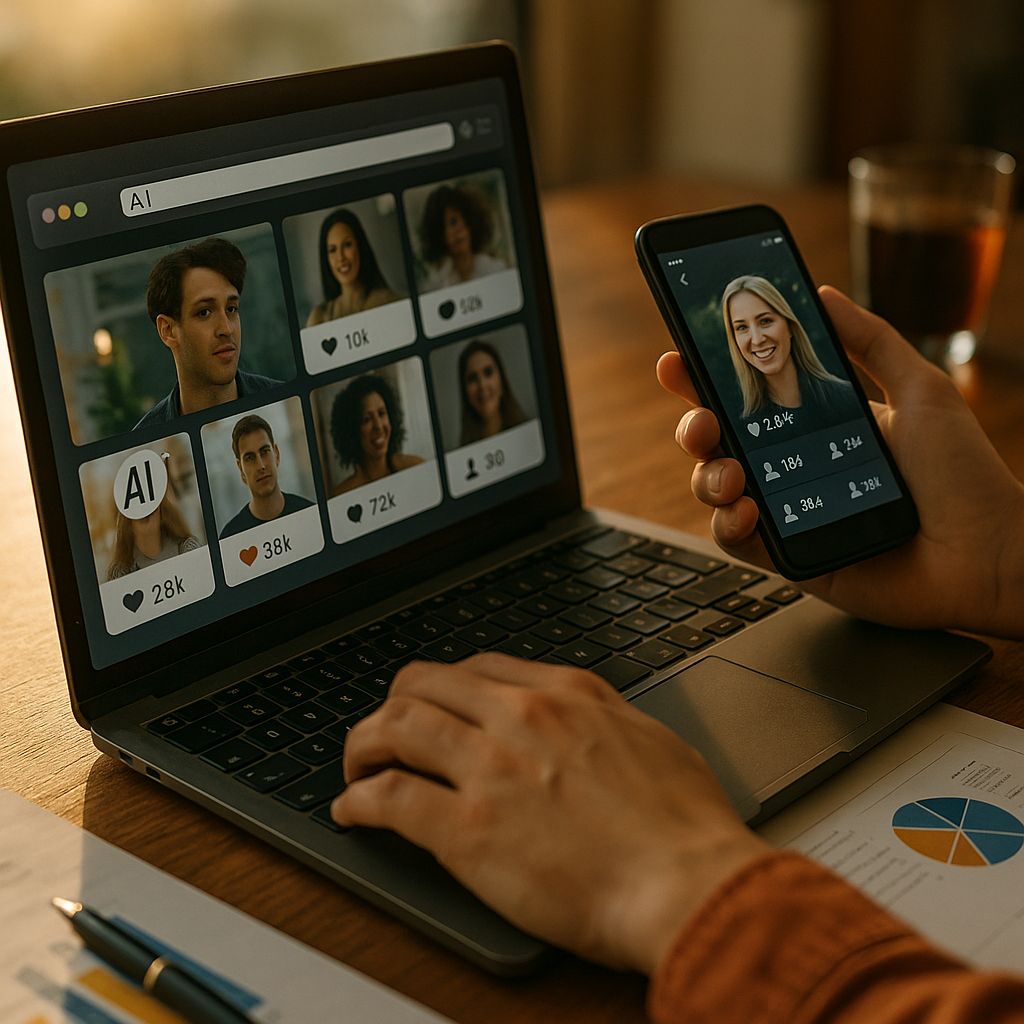
Brands using AI-powered creator discovery report up to 60% faster time-to-match versus manual outreach, yet procurement teams are still approving platforms based on demo decks rather than structured vendor evaluation criteria. If your martech committee is treating creator matchmaking software like a SaaS subscription renewal, you’re carrying risk you haven’t priced.
What “AI Discovery” Actually Means in Vendor Pitches
Every platform in this space claims AI. Most mean one of three things: keyword-based filtering with a machine learning label slapped on it, collaborative filtering borrowed from recommendation engine logic, or genuine multimodal content analysis that reads visual, audio, and semantic signals simultaneously. The gap between these capabilities is enormous, and it matters for niche category discovery specifically.
Behavioral affinity modeling, when done properly, maps a creator’s audience behavior patterns against your known customer base. Platforms like Influential (now operating under Publicis), Grin, and Brandwatch’s creator intelligence layer each approach this differently. Influential leans heavily on IBM Watson-derived psychographic overlap. Grin focuses on CRM-native audience matching. Neither approach is universally superior — the right fit depends on whether you already have rich first-party customer data or you’re building cold.
Audience intent signals are a more recent evolution. Rather than asking “does this creator’s audience look like my customers,” intent-driven platforms ask “is this creator’s audience actively shopping in my category?” That’s a fundamentally different question, and it’s where platforms connecting to cookieless identity resolution are pulling ahead.
The Niche Specialist Problem Manual Discovery Gets Right
Here’s the honest counterargument: for genuinely specialized verticals — industrial safety equipment, rare plant cultivation, professional audio engineering — manual discovery by a category expert still beats algorithmic matching in most cases. Not because AI is incapable, but because the training data is thin.
AI models are only as good as the signal volume they were trained on. A platform trained predominantly on fashion, beauty, and CPG categories will struggle to surface the right creator for a B2B cybersecurity brand or a clinical nutrition product. The behavioral affinity signals simply don’t exist in sufficient density to generate reliable matches.
For categories with fewer than 5,000 active creators on any given platform, algorithmic discovery often generates statistically confident but contextually meaningless matches. A human researcher who actually consumes content in that niche will outperform the algorithm on precision, if not on scale.
Procurement teams evaluating platforms for niche specialist use cases should ask vendors directly: what is the minimum creator pool size in a given category before your confidence scoring becomes unreliable? Vendors who can’t answer that question are not ready for enterprise procurement.
Six Evaluation Criteria That Actually Differentiate Platforms
Most RFP templates for creator platforms ask the wrong questions. Follower count filters, platform coverage, and API integration specs matter, but they don’t separate a genuinely AI-capable platform from one with a sophisticated UI on top of a database query. Use these instead:
- Content analysis modality: Does the platform analyze video frames, audio transcripts, and text simultaneously, or just metadata and captions? Multimodal analysis is the threshold capability for accurate category detection in emerging or niche verticals.
- Affinity model transparency: Can the vendor explain, at a feature level, what inputs drive a high affinity score? “Audience overlap” is not an explanation. You need to know whether psychographic, behavioral, or transactional signals are weighted, and how.
- Intent signal sourcing: Where does the platform pull intent data? First-party integrations with your CRM, third-party data partnerships, or platform-native engagement signals? Each has different GDPR and privacy implications, particularly if you’re operating in regulated categories. Review frameworks from the ICO and the FTC before approving any data-sharing arrangement.
- Category cold-start performance: Ask vendors to run a live demo against a category you know well. Compare their top 20 results against your team’s manual shortlist. The precision delta tells you everything.
- Attribution integration: Can the platform connect to your downstream creator attribution dashboard to close the loop between discovery quality and campaign performance? Discovery quality is unmeasurable without post-campaign data flowing back.
- Vendor lock-in architecture: How portable is your match history, creator relationship data, and campaign performance data if you switch vendors? This is a procurement-level concern that marketing teams consistently underweight. The same evaluation logic covered in AI vendor lock-in risks applies directly here.
When to Run a Hybrid Model
The most operationally mature brand teams in 2026 are not choosing between AI discovery and manual discovery. They’re running a tiered model: AI for scale and initial screening across broad categories, human specialists for validation and final selection in niche verticals or high-stakes campaigns.
This mirrors the logic behind hybrid AI-human routing that’s become standard in UGC operations. The same principle applies upstream at the discovery stage. AI removes the 80% of candidates who clearly don’t fit. Humans make the judgment calls on the 20% where brand voice, category authority, and audience trust are genuinely difficult to quantify.
A financial services brand, for example, might use an AI platform like Traackr or Creator.co to surface a broad pool of personal finance creators ranked by audience income demographics, then assign a compliance-aware strategist to evaluate regulatory risk, content history, and actual expertise before any outreach. The AI layer saves 30+ research hours per campaign. The human layer prevents a reputational or regulatory incident that no algorithm is designed to catch.
For brands operating at scale across multiple categories simultaneously, the AI creator vetting stack matters as much as the discovery stack. These are two different procurement decisions that most teams collapse into one, often to their detriment.
What the ROI Calculus Looks Like
Enterprise AI discovery platforms range from roughly $2,000 to $25,000 per month depending on data depth, API access, and seat count. Manual discovery through a specialist agency or in-house researcher for a niche vertical runs $150 to $300 per hour, with a comprehensive shortlist for a single campaign requiring 15 to 40 hours of work.
At face value, AI wins on cost at scale. But factor in false positive rate (matches that get through the AI screen and fail post-campaign), onboarding time, and the categories where AI underperforms, and the math gets more complicated. According to eMarketer, influencer marketing spend is projected to continue accelerating through the late 2020s, which means the volume justification for AI investment grows stronger. But volume alone doesn’t solve the precision problem in specialist categories.
Procurement teams should build a dual-track cost model: AI platform TCO versus manual specialist cost, segmented by category type and campaign frequency. The answer will differ by brand portfolio. A CPG company running 200 campaigns annually across mainstream categories has a different answer than a B2B SaaS company running 12 campaigns in a narrow vertical. For teams building attribution frameworks that can capture this data, the creator commerce attribution stack provides a finance-ready structure for modeling ROI by discovery method.
The procurement question is not “which platform finds the most creators” — it’s “which discovery method generates the highest campaign ROI per dollar spent, segmented by category complexity.” That’s a different RFP entirely.
Platforms worth deeper evaluation in 2026 include Modash for data transparency, Traackr for enterprise workflow integration, and Kolsquare for European market depth. Reference benchmarks from Sprout Social and HubSpot‘s influencer marketing research when presenting business cases internally, as finance teams respond better to third-party data than vendor-supplied benchmarks.
Before your next vendor review, build a category complexity matrix: plot each of your target verticals by creator pool density and content analysis difficulty. That single exercise will tell you where AI discovery adds unambiguous value and where a specialist researcher is still the better procurement decision.
FAQs
What is behavioral affinity modeling in creator discovery platforms?
Behavioral affinity modeling maps patterns in a creator’s audience behavior, such as purchase signals, content engagement habits, and psychographic indicators, against a brand’s known customer profile. Platforms use this to surface creators whose audiences are most likely to respond to a brand’s product or message, rather than relying solely on demographic overlap or follower count.
When does manual creator discovery outperform AI matching?
Manual discovery typically outperforms AI in niche or emerging categories where the creator pool is small and training data for AI models is insufficient. Categories with fewer than 5,000 active creators on a given platform often produce statistically confident but contextually weak AI matches. A human expert who consumes content in that niche will deliver higher precision, even if not the same scale.
What data privacy considerations apply to AI creator discovery platforms?
Platforms that use audience intent data, behavioral signals, or CRM integration must comply with applicable data protection regulations, including GDPR in Europe and FTC guidelines in the US. Procurement teams should audit the vendor’s data sourcing methods, third-party data partnerships, and any audience-level data sharing before contract execution, particularly in regulated categories like health, finance, or children’s products.
How should procurement teams evaluate AI discovery vendor claims?
Run a category cold-start test: provide the vendor with a category you know well and compare their top 20 creator results against your team’s manually researched shortlist. Ask vendors to explain what specific inputs drive affinity scores, not just the output label. Require clarity on data portability before signing, and ensure the platform can integrate with your attribution infrastructure to measure discovery quality post-campaign.
Is a hybrid AI-plus-human discovery model practical for enterprise brands?
Yes, and it has become the operational standard for sophisticated brand teams. AI handles large-scale initial screening across broad categories, while human specialists validate and make final selections for niche verticals, high-stakes campaigns, or categories with compliance sensitivity. The hybrid model captures efficiency gains from AI without sacrificing the contextual judgment that algorithms currently cannot replicate in specialist markets.
Top Influencer Marketing Agencies
The leading agencies shaping influencer marketing in 2026
Agencies ranked by campaign performance, client diversity, platform expertise, proven ROI, industry recognition, and client satisfaction. Assessed through verified case studies, reviews, and industry consultations.
Moburst

-
2

The Shelf
Boutique Beauty & Lifestyle Influencer AgencyA data-driven boutique agency specializing exclusively in beauty, wellness, and lifestyle influencer campaigns on Instagram and TikTok. Best for brands already focused on the beauty/personal care space that need curated, aesthetic-driven content.Clients: Pepsi, The Honest Company, Hims, Elf Cosmetics, Pure LeafVisit The Shelf → -
3

Audiencly
Niche Gaming & Esports Influencer AgencyA specialized agency focused exclusively on gaming and esports creators on YouTube, Twitch, and TikTok. Ideal if your campaign is 100% gaming-focused — from game launches to hardware and esports events.Clients: Epic Games, NordVPN, Ubisoft, Wargaming, Tencent GamesVisit Audiencly → -
4

Viral Nation
Global Influencer Marketing & Talent AgencyA dual talent management and marketing agency with proprietary brand safety tools and a global creator network spanning nano-influencers to celebrities across all major platforms.Clients: Meta, Activision Blizzard, Energizer, Aston Martin, WalmartVisit Viral Nation → -
5

The Influencer Marketing Factory
TikTok, Instagram & YouTube CampaignsA full-service agency with strong TikTok expertise, offering end-to-end campaign management from influencer discovery through performance reporting with a focus on platform-native content.Clients: Google, Snapchat, Universal Music, Bumble, YelpVisit TIMF → -
6

NeoReach
Enterprise Analytics & Influencer CampaignsAn enterprise-focused agency combining managed campaigns with a powerful self-service data platform for influencer search, audience analytics, and attribution modeling.Clients: Amazon, Airbnb, Netflix, Honda, The New York TimesVisit NeoReach → -
7

Ubiquitous
Creator-First Marketing PlatformA tech-driven platform combining self-service tools with managed campaign options, emphasizing speed and scalability for brands managing multiple influencer relationships.Clients: Lyft, Disney, Target, American Eagle, NetflixVisit Ubiquitous → -
8

Obviously
Scalable Enterprise Influencer CampaignsA tech-enabled agency built for high-volume campaigns, coordinating hundreds of creators simultaneously with end-to-end logistics, content rights management, and product seeding.Clients: Google, Ulta Beauty, Converse, AmazonVisit Obviously →