


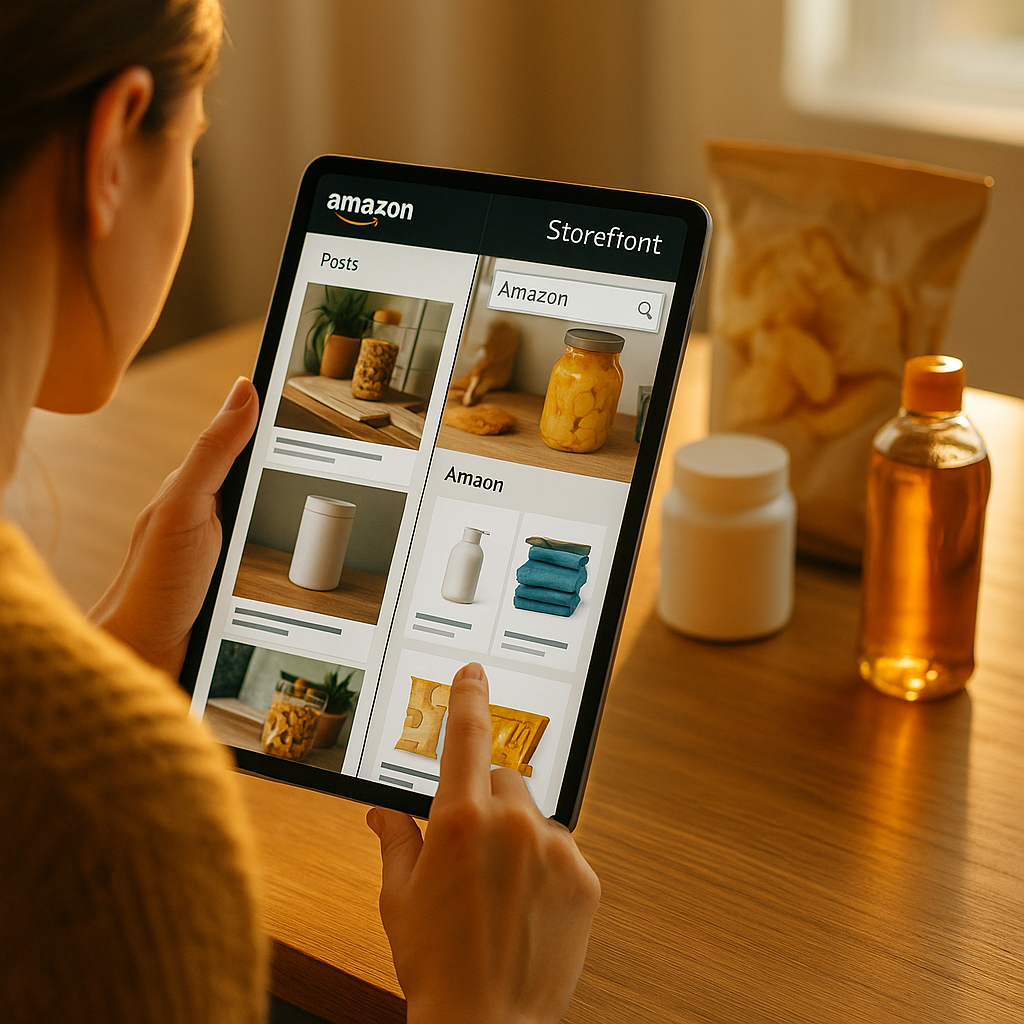
Fewer than 20% of eligible brands actively post to Amazon Posts. That statistic alone should stop every CPG marketer scrolling past this article. You’re paying for Amazon traffic, fighting for Sponsored Product placements, and ignoring a free content surface sitting right on your product detail pages. Amazon Posts and Storefront content are the most underused corners of the world’s largest retail search engine — and that’s an opportunity most competitors haven’t noticed yet.
What Amazon Posts and Storefronts Actually Are (And Why They’re Different From Social)
Amazon Posts is Amazon’s native, Instagram-style feed feature. Brands upload lifestyle images with captions, and those posts surface on competitor product pages, category feeds, and your own brand page. Storefronts, meanwhile, are your owned real estate on Amazon — a multi-page mini-site where you control layout, navigation, and merchandising within Amazon’s template constraints.
Neither requires ad spend to exist. Both requires Brand Registry enrollment. And both get treated by most CPG teams as a compliance checkbox rather than a growth lever.
That’s the mistake. Amazon’s own algorithm rewards content density on brand pages, and Storefronts with rich media, comparison charts, and video see measurably higher dwell time — a signal that correlates with better organic placement in Amazon search. Posts function differently: they’re discovery content, appearing in front of shoppers who are already browsing adjacent or competing products. Think of it as organic influencer-style content, except the “feed” is Amazon’s shopping surface instead of Instagram’s.
The ROI Case Nobody’s Making to Leadership
Ask most brand directors why they haven’t invested in Amazon Posts and the answer is usually “we didn’t know it existed” or “it seemed low priority.” Fair. But run the math: Posts and Storefronts require no media spend, just content production — and CPG brands are already producing that content for retail media, DTC sites, and social.
The real cost is repurposing time, not creative budget. A brand already running an influencer program has a stockpile of usable assets. The gap is operational, not creative.
Amazon Posts and Storefront pages convert existing content into incremental organic reach, at zero media cost, on the platform where purchase intent is already highest.
Compare that to the CPM inflation happening across Sponsored Products and Sponsored Brands placements. According to eMarketer’s retail media forecasts, Amazon’s ad pricing has climbed steadily as more CPG budget floods in. Posts and Storefronts sit outside that auction entirely. If you’re optimizing for cost-per-acquisition across the full funnel, this is one of the few remaining levers that doesn’t get more expensive every quarter.
Repurposing Creator Content Into Amazon Posts
Here’s where influencer marketing teams should perk up. If you’re running an Amazon Inspire content program or working with creators through the Amazon Influencer Program, you already have short-form video and lifestyle imagery built for shopping-intent audiences. That same content, with minor cropping and caption edits, works directly as Amazon Posts.
The workflow looks like this:
- Pull top-performing creator assets from Inspire, TikTok Shop, or Instagram Reels campaigns
- Strip platform-specific branding (watermarks, handles) that violates Amazon content guidelines
- Reformat captions to lead with product benefit, not lifestyle narrative — Amazon shoppers scan for utility faster than social audiences do
- Schedule posts to align with launch weeks or promotional windows for compounding visibility
Brands running Amazon Live streams have an even richer well to draw from. Livestream clips, trimmed to 15-30 seconds, make excellent Posts content because they already demonstrate product use in a retail-native tone.
Storefront Design: Stop Building a Brochure, Start Building a Funnel
Most CPG Storefronts look like a static PDF got turned into a webpage. Hero banner, product grid, maybe a brand story tile. Functional, forgettable, and doing almost nothing to move a shopper toward conversion.
A better approach treats the Storefront like a landing page with merchandising intelligence baked in. That means:
- Category-first navigation — organize by use case (e.g., “Sensitive Skin,” “Overnight Formulas”) rather than just product line, mirroring how shoppers actually search
- Comparison modules — Amazon’s template supports side-by-side product comparisons; use them to reduce decision fatigue and cross-sell within your own catalog before a shopper bounces to a competitor
- Video-first hero sections — Amazon reports higher engagement on Storefronts using autoplay video versus static hero images, particularly for beauty, food, and supplement categories
- Seasonal refresh cadence — a Storefront updated quarterly signals an active brand; a stale one signals the opposite, both to shoppers and to Amazon’s ranking signals
One packaged food brand I’ve seen cited in retail media case studies restructured its Storefront around recipe use-cases instead of product SKUs, and saw a meaningful lift in session duration. Small structural change, disproportionate behavioral impact.
Compliance Isn’t Optional — And It’s Different From Social Compliance
Marketing and legal teams accustomed to FTC disclosure guidance for influencer content need to recalibrate for Amazon’s own rulebook. Amazon prohibits:
- Pricing or promotional claims in Posts imagery (no “50% off” overlays)
- External links driving traffic off Amazon
- Testimonial content that hasn’t been vetted for Amazon’s review-manipulation policies
- Any claim that isn’t substantiated on the actual product detail page
This matters more than it sounds. Brands that repurpose influencer content without stripping promotional overlays risk having entire Posts accounts suspended, which also affects Storefront visibility. If your legal team already has a disclosure review process for creator content — similar to what’s outlined in brand risk frameworks for other platforms — extend that same rigor here. Build a lightweight Amazon-specific checklist before content goes live, not after a takedown notice.
The brands getting suspended from Amazon Posts aren’t running scams — they’re just reusing social content without re-checking it against retail marketplace rules.
Measurement: What to Actually Track
Amazon doesn’t give Posts and Storefronts the same granular reporting as Sponsored ads, which is part of why teams undervalue the channel. But the data that exists is still useful:
- Storefront visits and traffic source — available in Brand Analytics, segmented by whether traffic came from Posts, organic search, or off-Amazon links
- Follower growth on your brand’s Posts feed — a slow but compounding audience asset few competitors are cultivating
- Repeat purchase rate for Storefront-attributed sessions — often higher than average because Storefront visitors tend to be higher-intent, later-funnel shoppers
- Post-to-detail-page click-through rate — the closest proxy Amazon offers for Posts-specific engagement
Tools like Sprout Social and other social listening platforms are starting to add Amazon Posts tracking into their retail media dashboards, which helps teams unify reporting across channels rather than treating Amazon as a silo.
If your team is already benchmarking creator content performance across platforms — say, comparing Instagram Reels performance against TikTok Shop conversion data — add Amazon Posts as a line item in that same dashboard. It’s a rounding error in effort and a meaningful gap in most competitive intelligence right now.
Where This Fits in the Broader Retail Media Stack
Posts and Storefronts aren’t a replacement for Sponsored Products or DSP spend. They’re the organic layer underneath the paid stack, the same way SEO underpins paid search. Brands treating Amazon purely as an auction are leaving a content layer completely unmanaged, while competitors who figure this out first get compounding, no-cost visibility that’s hard to displace once established.
The category precedent is clear across retail media generally: organic content investment is undervalued industry-wide, not just on Amazon. The same logic that’s driving brands toward creator UGC on Google Business Profiles for AI-driven search visibility applies here. Owned, structured content on retail platforms is becoming a ranking signal in its own right, not just a nice-to-have.
Next step: audit your last 90 days of influencer and Amazon Live content, identify five assets that meet Amazon’s content policy, and publish them as Posts this week. Then schedule a Storefront structure review before your next seasonal push — most brands are one afternoon of work away from a measurably better page.
FAQs
Do I need Brand Registry to use Amazon Posts and Storefronts?
Yes. Both features require enrollment in Amazon Brand Registry, which means you need a registered trademark and verified brand ownership on Amazon.
Does posting on Amazon Posts cost anything?
No. Amazon Posts and Storefronts are free features available to Brand Registry members. The only cost is content production and internal time to manage them.
Can I reuse influencer content from Instagram or TikTok directly on Amazon Posts?
You can, but you must remove platform watermarks, handles, and any promotional pricing claims first. Amazon’s content policies differ from social platform disclosure rules, so review each asset before publishing.
How do Amazon Posts affect product ranking?
Amazon hasn’t confirmed Posts directly influence organic search ranking, but engagement signals like click-through and dwell time on brand pages are believed to contribute to broader visibility algorithms.
What’s the difference between a Storefront and a standard product listing page?
A product listing page is a single SKU’s detail page. A Storefront is a multi-page, brand-controlled destination where you can organize products by category, tell a brand story, and cross-merchandise your full catalog.
How often should a CPG brand update its Storefront?
At minimum, quarterly, aligned with seasonal promotions or new product launches. Stale Storefronts underperform on engagement metrics compared to regularly refreshed ones.
FAQs
Do I need Brand Registry to use Amazon Posts and Storefronts?
Yes. Both features require enrollment in Amazon Brand Registry, which means you need a registered trademark and verified brand ownership on Amazon.
Does posting on Amazon Posts cost anything?
No. Amazon Posts and Storefronts are free features available to Brand Registry members. The only cost is content production and internal time to manage them.
Can I reuse influencer content from Instagram or TikTok directly on Amazon Posts?
You can, but you must remove platform watermarks, handles, and any promotional pricing claims first. Amazon’s content policies differ from social platform disclosure rules, so review each asset before publishing.
How do Amazon Posts affect product ranking?
Amazon hasn’t confirmed Posts directly influence organic search ranking, but engagement signals like click-through and dwell time on brand pages are believed to contribute to broader visibility algorithms.
What’s the difference between a Storefront and a standard product listing page?
A product listing page is a single SKU’s detail page. A Storefront is a multi-page, brand-controlled destination where you can organize products by category, tell a brand story, and cross-merchandise your full catalog.
How often should a CPG brand update its Storefront?
At minimum, quarterly, aligned with seasonal promotions or new product launches. Stale Storefronts underperform on engagement metrics compared to regularly refreshed ones.
Top Influencer Marketing Agencies
The leading agencies shaping influencer marketing in 2026
Agencies ranked by campaign performance, client diversity, platform expertise, proven ROI, industry recognition, and client satisfaction. Assessed through verified case studies, reviews, and industry consultations.
Moburst

-
2

The Shelf
Boutique Beauty & Lifestyle Influencer AgencyA data-driven boutique agency specializing exclusively in beauty, wellness, and lifestyle influencer campaigns on Instagram and TikTok. Best for brands already focused on the beauty/personal care space that need curated, aesthetic-driven content.Clients: Pepsi, The Honest Company, Hims, Elf Cosmetics, Pure LeafVisit The Shelf → -
3

Audiencly
Niche Gaming & Esports Influencer AgencyA specialized agency focused exclusively on gaming and esports creators on YouTube, Twitch, and TikTok. Ideal if your campaign is 100% gaming-focused — from game launches to hardware and esports events.Clients: Epic Games, NordVPN, Ubisoft, Wargaming, Tencent GamesVisit Audiencly → -
4

Viral Nation
Global Influencer Marketing & Talent AgencyA dual talent management and marketing agency with proprietary brand safety tools and a global creator network spanning nano-influencers to celebrities across all major platforms.Clients: Meta, Activision Blizzard, Energizer, Aston Martin, WalmartVisit Viral Nation → -
5

The Influencer Marketing Factory
TikTok, Instagram & YouTube CampaignsA full-service agency with strong TikTok expertise, offering end-to-end campaign management from influencer discovery through performance reporting with a focus on platform-native content.Clients: Google, Snapchat, Universal Music, Bumble, YelpVisit TIMF → -
6

NeoReach
Enterprise Analytics & Influencer CampaignsAn enterprise-focused agency combining managed campaigns with a powerful self-service data platform for influencer search, audience analytics, and attribution modeling.Clients: Amazon, Airbnb, Netflix, Honda, The New York TimesVisit NeoReach → -
7

Ubiquitous
Creator-First Marketing PlatformA tech-driven platform combining self-service tools with managed campaign options, emphasizing speed and scalability for brands managing multiple influencer relationships.Clients: Lyft, Disney, Target, American Eagle, NetflixVisit Ubiquitous → -
8

Obviously
Scalable Enterprise Influencer CampaignsA tech-enabled agency built for high-volume campaigns, coordinating hundreds of creators simultaneously with end-to-end logistics, content rights management, and product seeding.Clients: Google, Ulta Beauty, Converse, AmazonVisit Obviously →