


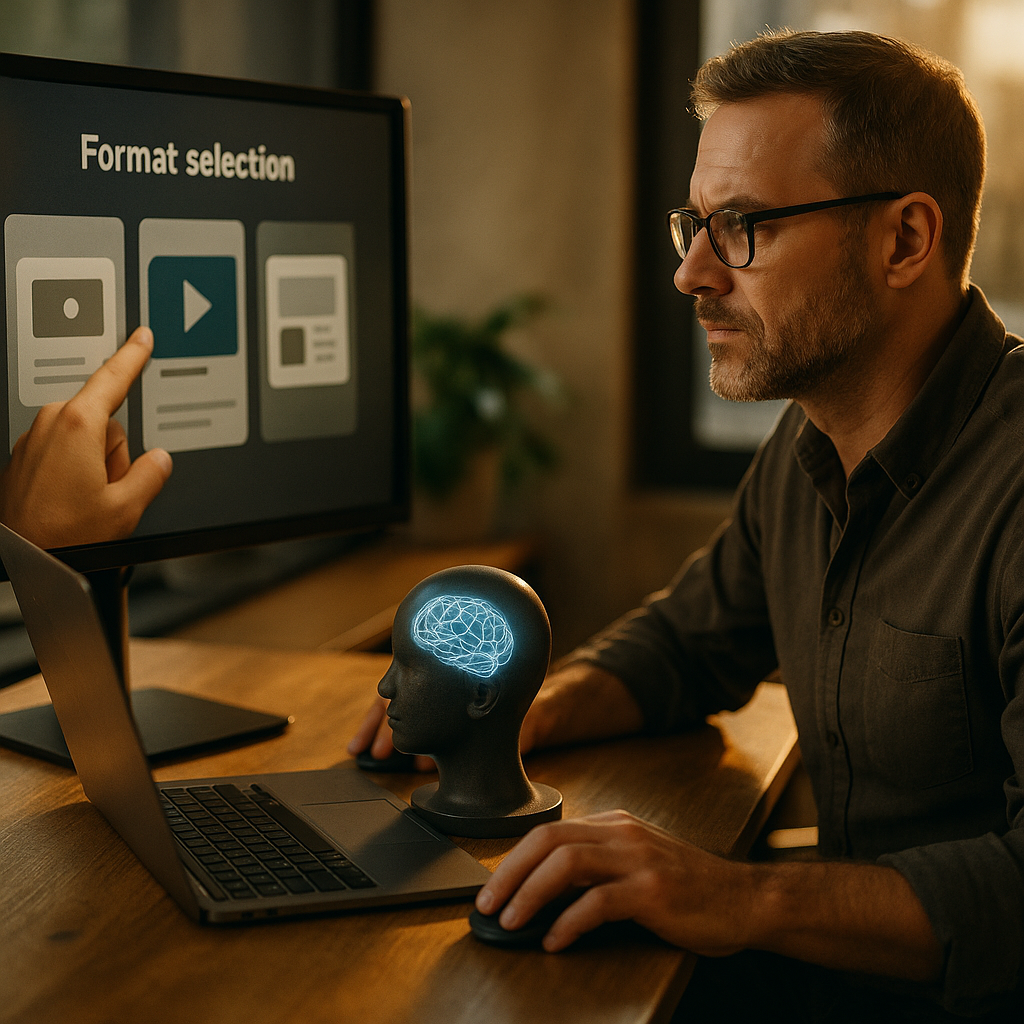
Sixty-three percent of media buyers say they’ve already deployed some form of autonomous campaign optimization, according to recent industry surveys — yet most can’t explain how their AI picked a 15-second vertical video over a static carousel. That’s the uncomfortable truth about agentic media buying: the automation works, but the reasoning is often a black box. Welcome to the era where AI agents decide your creative format for you.
What Agentic Media Buying Actually Means
Forget the old programmatic model, where humans set rules and machines executed bids. Agentic systems go further. They observe, decide, and act with minimal human input, choosing not just where an ad runs but what shape it takes when it gets there.
An agent might look at a single creative asset, a 30-second product demo, and decide it should become a 6-second bumper on YouTube, a static image on LinkedIn, a Reels-native vertical cut on Instagram, and a UGC-style remix for TikTok. All from one source file. All without a human touching the export settings.
This isn’t hypothetical. Meta’s Advantage+ suite already auto-generates and tests creative variants across placements. Google’s Performance Max does something similar across Search, Display, YouTube, and Discover. TikTok’s Smart+ has followed suit. The difference now is scope: these agents are increasingly making cross-channel format calls, not just within-platform tweaks.
The shift isn’t from manual to automated bidding — that happened years ago. It’s from automated bidding to autonomous creative judgment, where the machine decides what the ad should look like, not just where it should appear.
Why Format Selection Became the New Battleground
Media buyers spent the last decade obsessing over targeting and bidding. That fight is largely settled. Algorithms now handle audience discovery better than most humans, and admitting otherwise just wastes budget.
Format is the next frontier because it’s messier. A square image that crushes it on Facebook Feed can flop on Stories. A talking-head video that works on YouTube pre-roll feels stiff on TikTok’s For You Page. Every channel has its own visual grammar, and until recently, adapting creative to match that grammar required a human editor, a brief, and days of turnaround.
AI agents collapse that timeline to minutes. They also do something humans structurally can’t: test dozens of format-channel combinations simultaneously and reallocate spend toward whichever variant is winning, in near real time. Our earlier coverage of AI format selection routing creative across TV, CTV, and social broke down exactly how these systems route the same base asset differently depending on channel signals.
The Data Behind the Shift
eMarketer has tracked steady growth in advertiser spend routed through automated creative tools over the past two years, and platform vendors report that advertisers using auto-format tools see meaningful lifts in click-through rate compared to single-format campaigns. The exact numbers vary by platform and vertical, but the direction is consistent: brands that let agents handle format-channel matching are outperforming those that hand-pick formats manually.
That doesn’t mean the outputs are always good. It means they’re statistically better on the metrics the agent was told to optimize for. Those aren’t always the same thing — a distinction brand teams keep learning the hard way.
How the Agents Actually Decide
Under the hood, most agentic format-selection tools run on a layered pipeline:
- Asset ingestion: the system pulls in raw creative — video, image, copy variants, product feed data — and tags it by visual and semantic attributes.
- Channel modeling: historical performance data per placement (Reels vs. in-stream vs. Search image extensions) informs a prediction of which format-channel pairing is likely to perform.
- Dynamic assembly: the agent crops, re-cuts, resizes, or regenerates elements (captions, aspect ratio, pacing) to fit the predicted winning format.
- Live testing and reallocation: budget shifts toward whichever variant is converting, often within hours rather than the weekly cadence of manual A/B tests.
This is essentially the same logic behind agentic creative testing pipelines built for faster hook A/B tests, extended from copy and hooks to full format and channel decisions. If you’ve already adopted agentic testing for headlines, format automation is the natural next layer.
Not every prediction tool is created equal, though. Some vendors overstate their model’s accuracy, and plenty of “AI-powered format selection” is just a rules engine with a marketing wrapper. We’ve previously walked through how to vet these AI format-prediction tools before trusting them with real budget — worth revisiting before you sign a new platform contract.
Where It’s Working Best Right Now
Retail and DTC brands running high-SKU catalogs are seeing the clearest wins. When you have thousands of products and limited creative resources, an agent that can auto-generate and route format variants at scale isn’t a nice-to-have. It’s the only way to compete. Fashion, CPG, and app-install advertisers report the fastest agentic adoption, largely because their creative needs are high-volume and repetitive enough for agents to learn patterns quickly.
B2B and considered-purchase categories are moving slower, and for good reason. Format experimentation matters less when your buying committee has six people and a 90-day sales cycle. The stakes per impression are different.
The Risk Nobody’s Pricing In
Here’s the part brand safety teams should be losing sleep over: when an agent auto-generates a format variant, who approved the final creative that actually ran?
If your agency’s agent auto-crops a video ad and the crop accidentally cuts off a required disclosure, that’s not a hypothetical FTC problem — it’s a real one. The FTC’s endorsement and advertising guidance doesn’t have a carve-out for “the AI did it.” Brands remain liable for what runs under their name, regardless of how autonomously it was assembled.
Authentication is another emerging issue. As agents remix and regenerate creative across channels, provenance gets harder to track. That’s part of why platforms are pushing content credentials standards — see our breakdown of TikTok’s C2PA rollout and what brand teams must do now. If your format-selection agent is generating dozens of derivative assets per day, you need a system that can trace each one back to source.
An agent that can select and assemble creative formats without oversight is also an agent that can distribute a compliance failure across every channel simultaneously, before a human ever sees it.
This is why governance frameworks matter more than the technology itself right now. Our piece on AI media buying governance, spend caps, and override triggers lays out a practical structure: hard limits on daily spend per agent, mandatory human review thresholds for new format types, and automatic pause triggers when performance metrics move outside expected bands. If you’re deploying agentic format selection without something similar in place, you’re one bad auto-generated asset away from a very public problem.
Hallucination risk deserves a mention too. Generative components inside these pipelines — auto-written captions, AI-assembled product descriptions embedded in dynamic creative — can fabricate claims nobody approved. We covered detection methods in AI hallucination detection before autonomous media-buying spend, and it’s directly applicable here. Format automation and content generation are increasingly bundled in the same tool, so the same scrutiny applies to both.
Vendor Selection: What to Actually Ask
Before signing with a platform or agency partner offering agentic format selection, push past the demo reel. Ask these questions directly:
- Can the system explain, in plain language, why it selected a given format for a given channel?
- What’s the human review checkpoint before a new format type goes live with real spend?
- How does the tool handle regulated categories (finance, health, alcohol) where format changes might affect required disclosures?
- Is there an audit trail linking every generated asset back to its source file and approval record?
- What happens when the model’s confidence score is low — does it default to a human-reviewed format, or guess anyway?
Vendors who can’t answer the last two clearly aren’t ready for enterprise budgets, no matter how good their case studies look.
Where This Is Headed
Expect the next wave of agentic tools to extend beyond format selection into full cross-channel orchestration — deciding not just what an ad looks like, but which channel gets budget priority hour by hour based on live signal. That’s already happening at the edges with platforms like TikTok Ads and Meta Business Suite, both of which are pushing deeper automation into their respective ad managers.
The practical implication for brand teams: the skill that matters is shifting from “which format should we use” to “how do we govern a system that decides that for us.” Media buyers who spend the next year building strong review workflows, clear escalation paths, and format-approval guardrails will be the ones scaling agentic buying safely. Teams that just flip the automation switch and walk away will be the ones explaining a compliance incident to legal.
Worth noting: this mirrors a broader pattern across marketing AI adoption generally. As covered in how AI marketing tools changed while strategy fundamentals didn’t, the tools evolve fast but the underlying discipline — clear objectives, defined guardrails, measurable outcomes — doesn’t change. Agentic format selection is powerful. It’s not a replacement for strategic clarity about what your brand is actually trying to say.
Frequently Asked Questions
What is agentic media buying?
Agentic media buying refers to AI systems that autonomously make decisions across the media buying process — including audience targeting, budget allocation, and increasingly, creative format selection — with minimal ongoing human input beyond initial goals and guardrails.
How is agentic media buying different from programmatic advertising?
Traditional programmatic advertising automates bidding and placement based on rules humans define upfront. Agentic systems go further, actively deciding what creative format to use, generating or assembling variants, and reallocating budget based on live performance without waiting for human sign-off at each step.
Can AI agents choose the wrong creative format?
Yes. Agents optimize for the metrics they’re given, which don’t always align with brand safety, compliance, or long-term brand equity goals. A format that maximizes click-through rate can still misrepresent a product, omit a required disclosure, or clash with brand guidelines.
Who is legally responsible if an AI-selected format violates advertising rules?
The advertiser remains responsible. Regulatory bodies like the FTC do not exempt brands from compliance obligations simply because an AI system generated or selected the final creative.
What industries are adopting agentic format selection fastest?
Retail, DTC, fashion, CPG, and app-install advertisers are leading adoption, largely because their high-volume, high-SKU creative needs make automated format testing especially valuable. B2B and considered-purchase categories are adopting more cautiously.
What governance should brands put in place before using agentic tools?
At minimum: spend caps per agent, mandatory human review for new format types, audit trails linking generated assets to source files, and automatic pause triggers when performance moves outside expected ranges.
Next step: before handing format decisions to an agent, run a 30-day pilot with hard spend caps and mandatory human review on every new format type — then measure not just performance lift, but how many outputs would have failed a compliance check if left unreviewed.
Frequently Asked Questions
What is agentic media buying?
Agentic media buying refers to AI systems that autonomously make decisions across the media buying process — including audience targeting, budget allocation, and increasingly, creative format selection — with minimal ongoing human input beyond initial goals and guardrails.
How is agentic media buying different from programmatic advertising?
Traditional programmatic advertising automates bidding and placement based on rules humans define upfront. Agentic systems go further, actively deciding what creative format to use, generating or assembling variants, and reallocating budget based on live performance without waiting for human sign-off at each step.
Can AI agents choose the wrong creative format?
Yes. Agents optimize for the metrics they’re given, which don’t always align with brand safety, compliance, or long-term brand equity goals. A format that maximizes click-through rate can still misrepresent a product, omit a required disclosure, or clash with brand guidelines.
Who is legally responsible if an AI-selected format violates advertising rules?
The advertiser remains responsible. Regulatory bodies like the FTC do not exempt brands from compliance obligations simply because an AI system generated or selected the final creative.
What industries are adopting agentic format selection fastest?
Retail, DTC, fashion, CPG, and app-install advertisers are leading adoption, largely because their high-volume, high-SKU creative needs make automated format testing especially valuable. B2B and considered-purchase categories are adopting more cautiously.
What governance should brands put in place before using agentic tools?
At minimum: spend caps per agent, mandatory human review for new format types, audit trails linking generated assets to source files, and automatic pause triggers when performance moves outside expected ranges.
Top Influencer Marketing Agencies
The leading agencies shaping influencer marketing in 2026
Agencies ranked by campaign performance, client diversity, platform expertise, proven ROI, industry recognition, and client satisfaction. Assessed through verified case studies, reviews, and industry consultations.
Moburst

-
2

The Shelf
Boutique Beauty & Lifestyle Influencer AgencyA data-driven boutique agency specializing exclusively in beauty, wellness, and lifestyle influencer campaigns on Instagram and TikTok. Best for brands already focused on the beauty/personal care space that need curated, aesthetic-driven content.Clients: Pepsi, The Honest Company, Hims, Elf Cosmetics, Pure LeafVisit The Shelf → -
3

Audiencly
Niche Gaming & Esports Influencer AgencyA specialized agency focused exclusively on gaming and esports creators on YouTube, Twitch, and TikTok. Ideal if your campaign is 100% gaming-focused — from game launches to hardware and esports events.Clients: Epic Games, NordVPN, Ubisoft, Wargaming, Tencent GamesVisit Audiencly → -
4

Viral Nation
Global Influencer Marketing & Talent AgencyA dual talent management and marketing agency with proprietary brand safety tools and a global creator network spanning nano-influencers to celebrities across all major platforms.Clients: Meta, Activision Blizzard, Energizer, Aston Martin, WalmartVisit Viral Nation → -
5

The Influencer Marketing Factory
TikTok, Instagram & YouTube CampaignsA full-service agency with strong TikTok expertise, offering end-to-end campaign management from influencer discovery through performance reporting with a focus on platform-native content.Clients: Google, Snapchat, Universal Music, Bumble, YelpVisit TIMF → -
6

NeoReach
Enterprise Analytics & Influencer CampaignsAn enterprise-focused agency combining managed campaigns with a powerful self-service data platform for influencer search, audience analytics, and attribution modeling.Clients: Amazon, Airbnb, Netflix, Honda, The New York TimesVisit NeoReach → -
7

Ubiquitous
Creator-First Marketing PlatformA tech-driven platform combining self-service tools with managed campaign options, emphasizing speed and scalability for brands managing multiple influencer relationships.Clients: Lyft, Disney, Target, American Eagle, NetflixVisit Ubiquitous → -
8

Obviously
Scalable Enterprise Influencer CampaignsA tech-enabled agency built for high-volume campaigns, coordinating hundreds of creators simultaneously with end-to-end logistics, content rights management, and product seeding.Clients: Google, Ulta Beauty, Converse, AmazonVisit Obviously →