


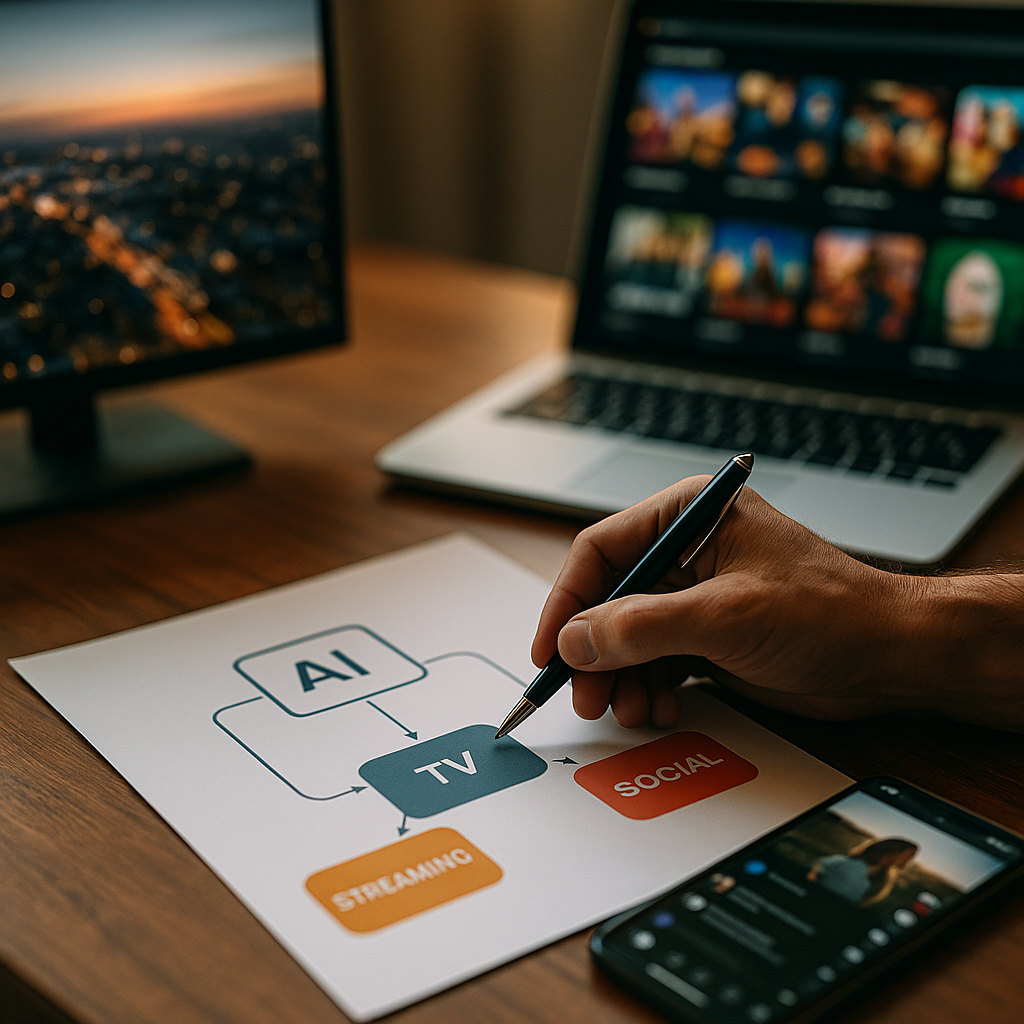
Nielsen puts streaming’s share of U.S. TV time above 44%, while linear keeps bleeding viewers and Reddit threads outperform six-figure ad buys on cost-per-engagement. So why do most media plans still treat broadcast, streaming, and social as three separate budgets, three separate teams, and three separate scorecards? An AI-optimized distribution plan is how the smartest brands are closing that gap, and it’s rewriting how media dollars get justified in the boardroom.
The Silo Problem Nobody Budgeted For
Most organizations still run broadcast, streaming, and social out of separate departments with separate agencies, separate KPIs, and separate reporting cadences. The TV buyer optimizes for GRPs. The social team optimizes for engagement rate. The streaming specialist chases completion rates on connected TV inventory nobody else on the team fully understands. Nobody’s optimizing for the thing that actually matters: total addressable reach against a single business outcome.
This isn’t a new complaint. Marketers have grumbled about channel silos for a decade. What’s changed is the cost of ignoring it. Digital ad spend growth is decelerating even as inventory fragments across more platforms, which means every wasted impression matters more than it did five years ago. If you’re still planning channel-by-channel instead of outcome-by-outcome, you’re paying a premium for redundant reach you can’t even measure. Our breakdown of why digital ad spend growth is slowing covers the underlying math.
What “AI-Optimized” Actually Means Here
Strip away the marketing gloss and AI-optimized distribution means three concrete things: unified audience modeling across channels, automated bid and placement adjustments in near real time, and predictive creative matching that decides which asset runs where based on performance signals, not gut instinct.
Platforms like The Trade Desk, Google’s Performance Max, and Meta Advantage+ already do version of this within their own walled gardens. The frontier now is doing it across gardens — pairing a linear TV buy with a YouTube CTV campaign and a TikTok creator push, then letting a unified measurement layer tell you which combination actually drove the sale, the sign-up, or the store visit.
The brands winning this shift aren’t necessarily spending more. They’re spending the same budget with 20-30% less waste because AI models are catching overlap and redundancy that human planners miss at scale.
Why Blend Broadcast and Streaming With Social at All?
Skeptics will ask a fair question: if streaming and social already reach most of your audience, why bother with broadcast at all? The answer is context and trust. Nielsen and eMarketer data consistently show that broadcast and premium streaming still carry a credibility halo that social content doesn’t fully replicate, especially for considered purchases like financial services, automotive, or healthcare. Social, meanwhile, delivers speed, targeting precision, and creator-driven authenticity that legacy media simply can’t match.
Blending them isn’t nostalgia for the media mix of the past. It’s recognizing that reach, trust, and speed each live in different channels, and no single channel does all three well.
- Broadcast and premium streaming: mass reach, brand safety, credibility for high-consideration categories.
- Connected TV and addressable streaming: household-level targeting with broadcast-quality creative.
- Social and creator content: speed, authenticity, and direct response at a fraction of the CPM.
The attention recession makes this blending non-negotiable rather than optional. Audiences are spreading thinner across more surfaces, and reach planning built for a three-network world simply doesn’t hold up. Our piece on the attention recession and reach planning lays out why frequency assumptions from even three years ago are already stale.
The Measurement Problem Is Really an Identity Problem
Here’s the uncomfortable truth: you can’t optimize across channels if you can’t identify the same person across channels. Cookie deprecation, walled-garden data restrictions, and privacy regulation have made cross-channel identity resolution genuinely hard.
This is where AI earns its keep. Probabilistic matching models, clean room infrastructure (think Google Ads Data Hub or Amazon Marketing Cloud), and unified marketing measurement platforms are stitching together signal that used to live in disconnected silos. It’s imperfect. Nobody should pretend it’s a solved problem. But it’s dramatically better than the deterministic guesswork brands relied on even eighteen months ago.
Brands still treating AI-driven personalization as a black box are running into a related issue: consumers increasingly distrust ads they suspect are AI-optimized without disclosure. That trust gap caps ROI even when the targeting itself is technically sound, a dynamic we’ve covered in depth around the AI-personalized ads trust gap.
Creators Are the Connective Tissue
Nobody talks about this enough: creators are increasingly the asset that moves across all three channels without losing authenticity. A creator’s UGC ad can run on TikTok, get cut down for a CTV pre-roll, and even anchor a broadcast spot during a live sports moment. This isn’t hypothetical. State Farm, Duolingo, and dozens of DTC brands have already blurred the line between “influencer content” and “brand media” to the point where viewers can’t tell which budget line paid for what.
Micro and mid-tier creators are especially well suited to this cross-channel repurposing because their content already looks native and unpolished, which travels better across format changes than a glossy broadcast spot ever could. That’s part of why micro-creators now claim roughly half of influencer budgets at many brands, a shift that’s as much about media flexibility as it is about cost.
Affiliate-driven and performance-based creator deals also make blending easier operationally, because you’re not locked into a single flat-fee usage window that restricts where content can run. Brands moving toward affiliate monetization models are, often without realizing it, building more distribution-flexible content libraries by default.
What Happens When You Don’t Coordinate Content Volume
Blending distribution channels sounds great until your production team realizes they now need three or four times the creative variants: 15-second vertical cuts for social, 30-second CTV spots, 6-second bumper ads, and full broadcast versions, all from the same campaign concept.
This is exactly the content volume crisis dragging down teams that haven’t restructured their workflows. Nearly 80% of marketers report facing a content volume crunch on flat or shrinking budgets, according to recent industry surveys, and cross-channel distribution plans make that worse before AI tooling makes it better. Generative repurposing tools (Adobe Firefly, Runway, Google’s Veo) are closing the gap, but only for teams that have already fixed their approval workflows. If yours are still bottlenecked by manual sign-off chains, read our breakdown of the content volume crisis and the related piece on fixing creative waste in approval workflows before you scale a cross-channel plan.
Building the Plan: A Practical Framework
Skip the vendor pitch deck for a second. Here’s what actually needs to happen operationally to blend these three channels without creating chaos.
- Unify the measurement layer first. Pick one attribution framework or clean room approach before you touch media buying. If broadcast, streaming, and social all report success differently, you’ll never compare them honestly.
- Map creative modularity into production, not after it. Brief every asset for repurposing across formats from day one. Retrofitting a 30-second broadcast spot into a vertical social cut after the fact is where budgets quietly overrun, a pattern detailed in our look at why production budgets overrun.
- Let AI handle allocation, not strategy. Automated bidding and placement tools are excellent at reallocating spend toward what’s working. They’re bad at deciding what your brand should stand for. Keep humans in charge of message and mission; let algorithms handle pacing and delivery.
- Build in a trust and disclosure check. As AI-generated and AI-optimized content spreads across more channels, disclosure expectations from regulators and consumers are tightening. The FTC’s endorsement guidance already applies across social and streaming alike, and enforcement is only getting more active.
- Set a quarterly reallocation cadence. Cross-channel plans go stale fast. Review performance data monthly, but commit to structural budget shifts quarterly, not annually.
Platforms worth evaluating for the unified layer include TikTok’s ad platform for social-to-CTV crossover, Meta’s business tools for identity-based targeting, and enterprise measurement partners increasingly cited in eMarketer research on cross-channel attribution accuracy.
Where Brand Safety and Compliance Fit In
Blending channels multiplies your compliance surface area. A disclosure that satisfies FTC rules on Instagram may not automatically satisfy broadcast standards or the streaming platform’s own ad policies. Legal and compliance teams need a seat at the planning table from the start, not a review stage at the end. This matters even more given recent rulings that have expanded brand liability for algorithmically surfaced content; the details in our coverage of the rabbit-hole ruling and paid social risk are directly relevant if any part of your cross-channel plan relies on programmatic or recommendation-driven placement.
Cross-channel blending isn’t just a media efficiency play anymore. It’s a compliance surface that grows with every new platform you add, and most legal teams haven’t caught up.
None of this works without leadership buy-in, and CFOs in particular want proof that blended spend outperforms siloed spend before they’ll approve it. That’s driving the shift toward CFO-friendly deal structures that tie creator and channel spend to measurable outcomes rather than flat fees, giving finance a clearer line of sight into what the blended plan is actually buying.
Next step: Audit your current media plan for channel overlap this quarter. Pull impression and reach data from broadcast, streaming, and social side by side, identify where you’re paying twice for the same eyeballs, and redirect that overlap budget into a single AI-driven measurement pilot before your next planning cycle locks in.
FAQs
What does an AI-optimized distribution plan actually involve?
It combines unified audience identity resolution, automated media buying and placement across channels, and predictive creative matching that determines which asset performs best on which platform, all coordinated through a shared measurement framework rather than channel-specific metrics.
Is blending broadcast, streaming, and social worth it for smaller brands?
Yes, though the scale differs. Smaller brands can start with connected TV and social blending alone, since CTV inventory is now accessible at lower minimums than traditional broadcast buys, and layer in linear later once measurement infrastructure is proven.
How do you measure ROI across channels that report success differently?
You need a common attribution layer, typically a data clean room or unified measurement platform, that normalizes metrics like reach, completion rate, and engagement into a shared outcome metric such as incremental sales or sign-ups.
Does this approach require replacing our existing agency structure?
Not necessarily, but it usually requires restructuring reporting lines so that broadcast, streaming, and social teams share KPIs and data access instead of operating as fully separate accounts.
What’s the biggest operational risk in cross-channel blending?
Creative production bottlenecks. Teams underestimate how many format variants a single campaign concept needs once it’s distributed across broadcast, CTV, and social, which strains budgets and timelines if not planned for upfront.
Top Influencer Marketing Agencies
The leading agencies shaping influencer marketing in 2026
Agencies ranked by campaign performance, client diversity, platform expertise, proven ROI, industry recognition, and client satisfaction. Assessed through verified case studies, reviews, and industry consultations.
Moburst

-
2

The Shelf
Boutique Beauty & Lifestyle Influencer AgencyA data-driven boutique agency specializing exclusively in beauty, wellness, and lifestyle influencer campaigns on Instagram and TikTok. Best for brands already focused on the beauty/personal care space that need curated, aesthetic-driven content.Clients: Pepsi, The Honest Company, Hims, Elf Cosmetics, Pure LeafVisit The Shelf → -
3

Audiencly
Niche Gaming & Esports Influencer AgencyA specialized agency focused exclusively on gaming and esports creators on YouTube, Twitch, and TikTok. Ideal if your campaign is 100% gaming-focused — from game launches to hardware and esports events.Clients: Epic Games, NordVPN, Ubisoft, Wargaming, Tencent GamesVisit Audiencly → -
4

Viral Nation
Global Influencer Marketing & Talent AgencyA dual talent management and marketing agency with proprietary brand safety tools and a global creator network spanning nano-influencers to celebrities across all major platforms.Clients: Meta, Activision Blizzard, Energizer, Aston Martin, WalmartVisit Viral Nation → -
5

The Influencer Marketing Factory
TikTok, Instagram & YouTube CampaignsA full-service agency with strong TikTok expertise, offering end-to-end campaign management from influencer discovery through performance reporting with a focus on platform-native content.Clients: Google, Snapchat, Universal Music, Bumble, YelpVisit TIMF → -
6

NeoReach
Enterprise Analytics & Influencer CampaignsAn enterprise-focused agency combining managed campaigns with a powerful self-service data platform for influencer search, audience analytics, and attribution modeling.Clients: Amazon, Airbnb, Netflix, Honda, The New York TimesVisit NeoReach → -
7

Ubiquitous
Creator-First Marketing PlatformA tech-driven platform combining self-service tools with managed campaign options, emphasizing speed and scalability for brands managing multiple influencer relationships.Clients: Lyft, Disney, Target, American Eagle, NetflixVisit Ubiquitous → -
8

Obviously
Scalable Enterprise Influencer CampaignsA tech-enabled agency built for high-volume campaigns, coordinating hundreds of creators simultaneously with end-to-end logistics, content rights management, and product seeding.Clients: Google, Ulta Beauty, Converse, AmazonVisit Obviously →