


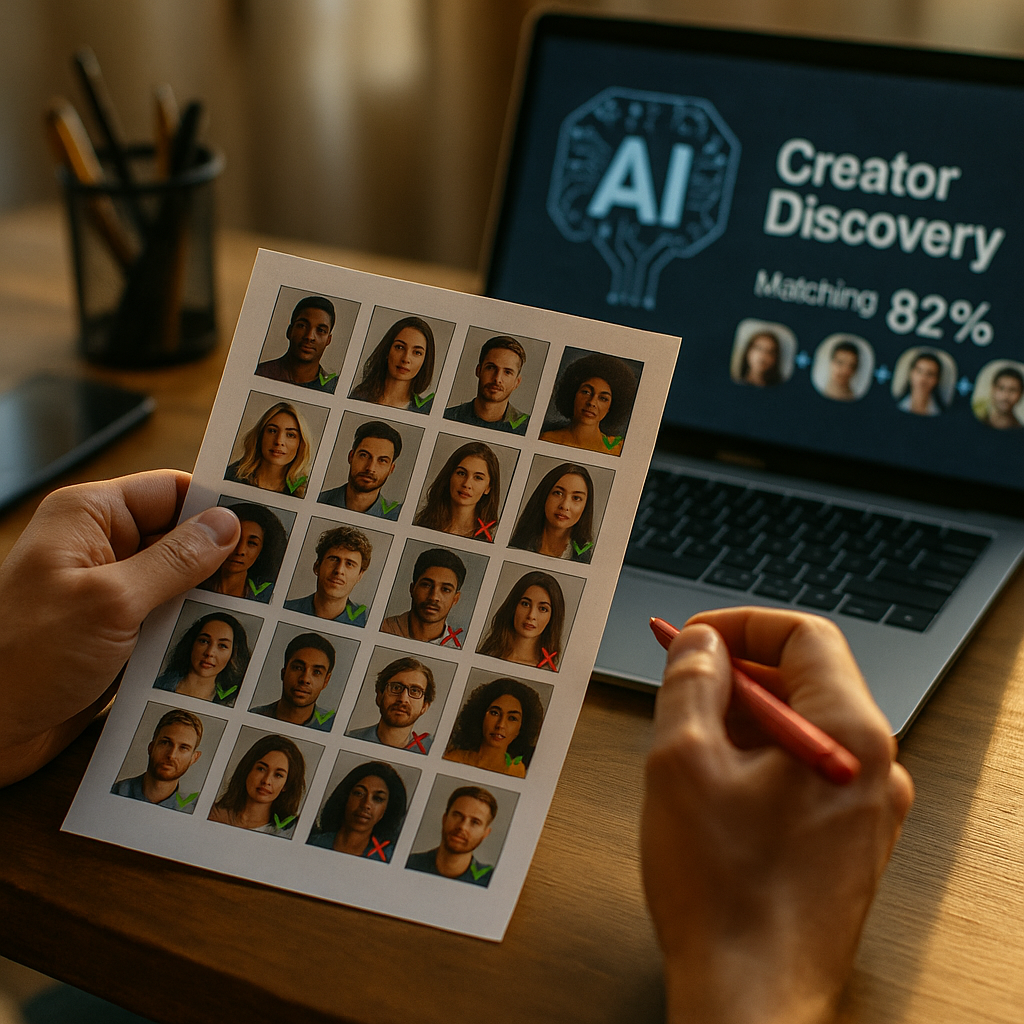
Vendors claim 90%+ match accuracy for AI-powered creator discovery. Nobody agrees on what “accuracy” even measures. Ask three platforms how they validate a creator-brand match, and you’ll get three incompatible methodologies, three different sample sizes, and zero third-party audits. That’s the state of the market heading into next year’s budget cycle, and it’s costing brands real money in mismatched partnerships.
This isn’t a knock on the technology. Affinity scoring has genuinely improved. The problem is marketing claims have outpaced measurement standards, and buyers are left comparing apples to press releases.
Why “Match Accuracy” Is a Slippery Metric
Every discovery platform wants credit for finding “the right” creator. But right by what definition? Audience overlap? Brand-safety alignment? Historical conversion lift? Semantic content fit? Vendors pick whichever definition makes their number look best, then publish it without context.
Aspire, for instance, leans heavily on audience demographic and interest-graph matching, pulling from its network of vetted creators and past campaign performance data. CreatorIQ, by contrast, emphasizes its Discovery module’s ability to cross-reference historical brand-lift data with creator content categorization, drawing on a much larger indexed creator database. Both are legitimate approaches. Neither is directly comparable to the other’s stated accuracy percentage, because the denominators aren’t the same.
If a vendor can’t tell you the validation methodology behind their match-accuracy number, treat that number as marketing copy, not a benchmark.
Then there’s the newer wave: affinity-scoring startups like Modash’s newer AI layers, Upfluence’s predictive-fit models, and a handful of venture-backed entrants building purely on LLM-based content analysis rather than historical campaign data. These tools often claim higher precision because they’re scoring a narrower slice of the problem — semantic content-brand fit — rather than the messier, multi-variable question of whether a partnership will actually drive sales.
What Buyers Actually Need to Compare
Instead of chasing a single accuracy percentage, mid-to-senior marketers evaluating these platforms should demand answers to five questions:
- What data trains the affinity model — historical campaign outcomes, audience demographics, content semantics, or a blend?
- How was the accuracy claim validated — internal backtesting, a third-party audit, or a live A/B campaign?
- What’s the sample size and industry vertical of the validation set?
- Does the score predict engagement, conversion, or brand-safety fit — and which one matters most for your program?
- How often is the model retrained, and does performance degrade between refreshes?
Most vendors answer maybe two of these clearly in a sales deck. Push for the rest before you sign anything.
Aspire vs CreatorIQ: Where the Claims Actually Diverge
Aspire markets itself around creator relationship management with discovery layered on top, and its match scoring tends to weight past collaboration success and audience psychographics fairly heavily. Brands running lower-funnel, conversion-focused programs (think DTC beauty or supplement brands) often report the tool surfaces creators whose audiences already behave like buyers, not just like fans.
CreatorIQ, meanwhile, has invested heavily in its enterprise-grade indexing, claiming visibility into a far larger pool of creators across platforms, with AI scoring built to flag brand-safety risk alongside affinity. That’s a meaningfully different value proposition for a Fortune 500 brand managing reputational exposure across hundreds of simultaneous partnerships versus a mid-market brand chasing performance.
Neither platform publishes a peer-reviewed accuracy study. Both rely on client testimonials and internal case studies, which is standard for the industry but should temper how much weight you put on any single percentage they quote in a pitch. If you’re already running fraud and safety checks elsewhere in your stack, it’s worth cross-referencing platform claims against independent tools — see our breakdown of AI fraud detection for creator vetting for how those numbers get validated (or don’t).
The Emerging Affinity-Scoring Startups
A crop of smaller players is trying to out-flank the incumbents on precision rather than scale. These startups typically use LLM-based content classification to score creator-brand fit at a granular level, sometimes down to individual post tone, visual style, or even sentiment trajectory over a creator’s last 50 posts.
The pitch is compelling: narrower scope, sharper signal. And in isolated tests, some of these tools do outperform legacy platforms on pure content-affinity matching. But affinity isn’t the same as performance. A creator can be a near-perfect semantic match for your brand voice and still convert at half the rate of a slightly “off-brand” creator whose audience simply buys more.
This is the gap most emerging vendors haven’t closed yet: connecting affinity scores to downstream business outcomes. Until they do, their accuracy claims — however impressive on paper — remain unvalidated against the metric that actually matters to a CMO signing the check.
Building Your Own Benchmark (Because Vendors Won’t)
Given the lack of standardization, the smartest brands aren’t waiting for the industry to agree on a shared methodology. They’re building internal benchmarks instead.
Here’s a practical approach that several mid-market and enterprise teams have adopted:
- Run the same creator brief through two or three platforms simultaneously.
- Compare the top 20 recommended creators from each, scoring overlap and divergence.
- Launch small test campaigns (5-10 creators each) sourced from each platform’s top picks.
- Measure actual performance — engagement rate, click-through, conversion, and CAC — against the platform’s predicted affinity score.
- Repeat quarterly, since creator audiences shift and models get retrained.
This kind of parallel testing takes time and budget most teams don’t love allocating. But it’s the only way to get a real accuracy number specific to your vertical, your audience, and your KPIs. Industry-wide benchmarks, even when they exist, rarely translate cleanly across categories — a match-accuracy score validated on beauty and wellness campaigns won’t necessarily hold for B2B SaaS or financial services creators.
Treat vendor-published accuracy percentages as a starting hypothesis, not a purchase decision. The only benchmark that matters is the one built on your own campaign data.
Where AI Discovery Fits Into the Bigger Martech Stack
Creator discovery doesn’t operate in a vacuum. It feeds into attribution, identity resolution, and eventually CRM systems tracking lifetime value from creator-driven acquisition. If your discovery platform’s affinity scores can’t be cross-referenced against your attribution stack, you’re flying partially blind regardless of how accurate the initial match claims to be.
This is why more brands are asking discovery vendors about API integrations with their broader identity and attribution infrastructure before signing multi-year contracts. Our guide on CRM attribution and identity resolution covers the questions worth raising with any vendor claiming AI-driven precision, and the same due diligence applies here. Similarly, if you’re consolidating tools ahead of a renewal cycle, the AI vendor consolidation checklist is a useful gut-check before locking into a multi-year discovery platform contract based on accuracy claims alone.
It’s also worth remembering that discovery accuracy and fraud detection are related but separate problems. A platform can nail affinity scoring and still miss bot-inflated follower counts or engagement pods. Pairing your discovery tool with dedicated vetting infrastructure, as outlined in our fraud-detection platform comparison, closes a gap that pure affinity scoring tends to leave open.
What Analysts and Regulators Are Watching
Industry researchers tracking the creator economy, including analysts at eMarketer, have flagged the lack of standardized measurement as a recurring friction point for brands scaling influencer budgets. Meanwhile, bodies like the FTC continue tightening disclosure and endorsement guidance, which indirectly pressures discovery platforms to factor compliance risk into their scoring models, not just audience fit.
On the data side, platforms like Sprout Social and reporting from Statista continue to show influencer marketing budgets climbing year over year, which only raises the stakes on getting discovery right. Bigger budgets, bigger blind spots if the underlying match-accuracy claims don’t hold up under scrutiny.
None of this means AI discovery tools are overhyped or not worth the investment. It means the industry is still early in developing shared standards, similar to where identity resolution vendors were a few years back before third-party match-rate testing became more common. Our identity resolution vendor shootout is a good reference point for how that maturation process tends to unfold — expect creator discovery benchmarking to follow a similar arc over the next few product cycles.
Bottom line for budget owners: don’t buy the accuracy percentage. Buy the methodology behind it, then validate it against your own campaign data before renewal season locks you into another year of unverified claims.
Next Step
Before your next platform demo, ask the vendor to walk you through their validation methodology line by line — if they can’t, run a parallel pilot against a competitor and let your own conversion data settle the argument.
Frequently Asked Questions
What does “match accuracy” mean in AI creator discovery tools?
It typically refers to how well a platform’s algorithm predicts creator-brand fit, but the definition varies by vendor — some measure audience demographic overlap, others measure content semantic alignment, and some tie it to historical campaign performance. There’s no industry-wide standard yet, so the same percentage claim can mean very different things across platforms.
How do Aspire and CreatorIQ differ in their approach to affinity scoring?
Aspire tends to weight audience psychographics and past collaboration performance, favoring brands focused on conversion-driven programs. CreatorIQ emphasizes broader creator indexing and brand-safety flagging alongside affinity, which suits enterprise brands managing reputational risk across large-scale programs.
Are newer affinity-scoring startups more accurate than established platforms?
Some outperform legacy tools on narrow content-affinity matching, particularly using LLM-based semantic analysis. But they often haven’t yet proven their scores correlate with actual campaign performance, which is the metric brands ultimately care about.
How can a brand validate a vendor’s match-accuracy claim?
Run parallel pilots: source creators from two or three platforms for the same brief, launch small test campaigns, and compare actual performance against each platform’s predicted score. Repeat quarterly since creator audiences and models both shift over time.
Does higher match accuracy guarantee better campaign ROI?
No. Affinity and performance are correlated but not identical. A creator can score as a near-perfect brand-content match and still underperform commercially compared to a less “on-brand” creator whose audience converts more readily.
FAQs
What does “match accuracy” mean in AI creator discovery tools?
It typically refers to how well a platform’s algorithm predicts creator-brand fit, but the definition varies by vendor — some measure audience demographic overlap, others measure content semantic alignment, and some tie it to historical campaign performance. There’s no industry-wide standard yet, so the same percentage claim can mean very different things across platforms.
Top Influencer Marketing Agencies
The leading agencies shaping influencer marketing in 2026
Agencies ranked by campaign performance, client diversity, platform expertise, proven ROI, industry recognition, and client satisfaction. Assessed through verified case studies, reviews, and industry consultations.
Moburst

-
2

The Shelf
Boutique Beauty & Lifestyle Influencer AgencyA data-driven boutique agency specializing exclusively in beauty, wellness, and lifestyle influencer campaigns on Instagram and TikTok. Best for brands already focused on the beauty/personal care space that need curated, aesthetic-driven content.Clients: Pepsi, The Honest Company, Hims, Elf Cosmetics, Pure LeafVisit The Shelf → -
3

Audiencly
Niche Gaming & Esports Influencer AgencyA specialized agency focused exclusively on gaming and esports creators on YouTube, Twitch, and TikTok. Ideal if your campaign is 100% gaming-focused — from game launches to hardware and esports events.Clients: Epic Games, NordVPN, Ubisoft, Wargaming, Tencent GamesVisit Audiencly → -
4

Viral Nation
Global Influencer Marketing & Talent AgencyA dual talent management and marketing agency with proprietary brand safety tools and a global creator network spanning nano-influencers to celebrities across all major platforms.Clients: Meta, Activision Blizzard, Energizer, Aston Martin, WalmartVisit Viral Nation → -
5

The Influencer Marketing Factory
TikTok, Instagram & YouTube CampaignsA full-service agency with strong TikTok expertise, offering end-to-end campaign management from influencer discovery through performance reporting with a focus on platform-native content.Clients: Google, Snapchat, Universal Music, Bumble, YelpVisit TIMF → -
6

NeoReach
Enterprise Analytics & Influencer CampaignsAn enterprise-focused agency combining managed campaigns with a powerful self-service data platform for influencer search, audience analytics, and attribution modeling.Clients: Amazon, Airbnb, Netflix, Honda, The New York TimesVisit NeoReach → -
7

Ubiquitous
Creator-First Marketing PlatformA tech-driven platform combining self-service tools with managed campaign options, emphasizing speed and scalability for brands managing multiple influencer relationships.Clients: Lyft, Disney, Target, American Eagle, NetflixVisit Ubiquitous → -
8

Obviously
Scalable Enterprise Influencer CampaignsA tech-enabled agency built for high-volume campaigns, coordinating hundreds of creators simultaneously with end-to-end logistics, content rights management, and product seeding.Clients: Google, Ulta Beauty, Converse, AmazonVisit Obviously →