


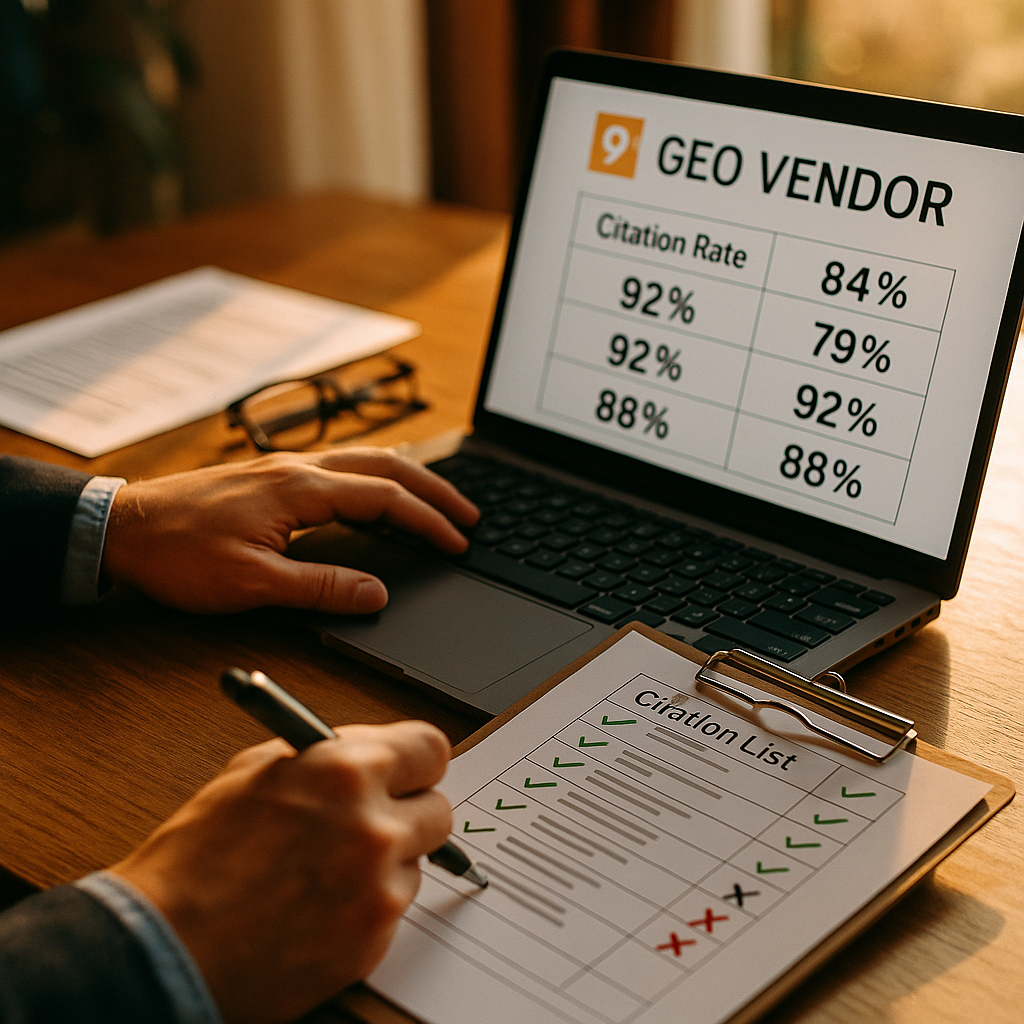
One GEO agency told a Series B fintech brand it could guarantee a “40% citation rate increase across ChatGPT, Perplexity, and Gemini within 90 days.” No methodology attached. No baseline defined. Just a number, a contract, and a retainer invoice. If you’ve sat in a pitch meeting and heard something similar, you already know why evaluating GEO vendor claims has become a required skill, not an optional one.
Why Citation-Rate Claims Are the New Vanity Metric
Generative engine optimization is barely out of its infancy, and the vendor landscape already looks like early-2010s SEO: overpromising, underdocumenting, and hoping clients don’t ask too many questions. Citation rate — how often a brand gets referenced in AI-generated answers — sounds precise. It isn’t. There’s no industry-standard definition of what counts as a “citation,” no agreed-upon sampling methodology, and no third-party auditor checking vendor math.
That ambiguity is exactly what lets agencies quote numbers that sound authoritative but collapse under scrutiny. A citation rate of “62%” means nothing without knowing the query set, the sample size, the AI platforms tested, and the time window. Ask five GEO vendors how they calculate this figure and you’ll likely get five different answers — some of which are essentially guesses dressed up in dashboards.
A citation rate without a disclosed methodology is a marketing claim, not a metric. Treat it accordingly during vendor evaluation.
The Verification Framework: Five Checkpoints Before You Sign
Brands need a repeatable diligence process, not gut instinct. Here’s the framework we recommend to marketing teams evaluating GEO vendors, whether you’re a CMO vetting an agency of record or a brand strategist running a pilot.
1. Demand the Query Set, Not Just the Score
Any legitimate GEO vendor should hand over the exact prompts used to measure citations — not a summary, the actual list. If they won’t share it, that’s your answer. Ask how many queries were tested (fewer than 50 is a red flag for any claim spanning multiple categories), whether queries were brand-specific or category-generic, and who wrote them. Vendors sometimes stack the deck with branded queries (“best [Client Name] alternative”) that inflate citation odds artificially.
2. Pin Down the Baseline
A 40% “increase” is meaningless without knowing the starting point. Was the baseline measured before the engagement began, using the same query set and same AI platforms? Or is the vendor comparing apples to oranges — a narrow pre-engagement snapshot against a broader post-engagement sweep? Insist on side-by-side baseline and current-state reports with timestamps.
3. Check Platform Coverage and Weighting
ChatGPT, Perplexity, Gemini, and Copilot don’t source information the same way, and they don’t carry equal commercial weight for every industry. A vendor claiming aggregate citation lift should break results out by platform. If 90% of the reported gain came from one obscure engine with minimal consumer traffic, the headline number is misleading. This matters more as AI answer engines diverge in retrieval architecture — some lean heavily on real-time web indexes, others on cached training data plus limited retrieval augmentation.
4. Ask for Raw Screenshots or API Logs
Dashboards can be built to show whatever a vendor wants a client to see. Raw screenshots of actual AI responses, or API call logs with timestamps, are much harder to fabricate convincingly. If a vendor resists providing raw evidence and only offers a proprietary “visibility score,” push back. Tools like AI visibility platforms exist specifically to give brands independent verification rather than relying solely on agency-reported numbers.
5. Separate Correlation From Causation
This is the big one. Even if citation rate genuinely rose during an engagement, did the vendor’s activity cause it? AI models get updated constantly. Google’s Gemini and OpenAI’s retrieval systems shift indexing behavior without warning. A citation bump might reflect a model update, seasonal query shifts, or a competitor’s site going down for maintenance — not the vendor’s content optimization work. Reputable vendors acknowledge this uncertainty rather than claiming full credit.
What “Good” Documentation Actually Looks Like
Vendors serious about accountability will typically provide:
- A documented query taxonomy (branded, category, comparison, problem-aware) with volume per category
- Platform-by-platform citation tracking with consistent testing cadence
- Confidence intervals or variance ranges, not single-point numbers
- A clear separation between “recommended” mentions and “cited/linked” mentions
- Third-party tool cross-verification, not just proprietary internal dashboards
If a vendor’s reporting reads more like a highlight reel than an audit trail, that’s diagnostic. Good agencies want scrutiny because their numbers hold up. Weak ones deflect with jargon.
Contract Language That Actually Protects You
Verbal assurances evaporate the moment a renewal conversation gets awkward. Build verification rights directly into the statement of work. Specify the query set upfront, jointly agreed upon by both parties. Require monthly raw-data exports, not just summary dashboards. Include a clause defining how “citation” is measured, and lock that definition for the contract term, so a vendor can’t quietly redefine success mid-engagement when results disappoint.
It’s also worth tying a portion of vendor compensation to independently verified outcomes rather than self-reported metrics. This is standard practice in performance marketing already; there’s no reason GEO should be exempt. For teams already building attribution dashboards for creator programs, the same rigor should extend to generative search vendors — the underlying discipline of separating real signal from reported signal is identical.
If a GEO vendor won’t agree to a jointly defined measurement methodology in the contract, assume the numbers they report later will favor them, not you.
Where This Connects to Broader Martech Diligence
GEO vendor evaluation isn’t happening in isolation. It’s part of a bigger shift where marketing teams are demanding harder proof across every AI-adjacent purchase — from marketing mix modeling tools to creator ROI measurement platforms. The pattern is consistent: vendors selling AI-adjacent services often lean on the technology’s novelty to avoid the measurement rigor applied to traditional channels. Brands that let that slide are the ones getting burned on renewal.
This also connects to how organizations are approaching martech procurement audits more broadly — testing vendor claims before signing rather than discovering gaps six months into a contract. GEO agencies should be held to the same pre-purchase evaluation standard as any CDP, attribution platform, or CRM vendor. There’s nothing exceptional about generative search that should exempt it from due diligence.
Industry data on AI search adoption is still catching up to the hype. eMarketer’s research on AI search behavior shows adoption climbing but still fragmented across platforms and demographics, which reinforces why single-number citation claims deserve skepticism. Similarly, Statista’s data on generative AI usage highlights how quickly platform preferences shift, meaning any citation-rate claim has a shelf life measured in months, not years.
Red Flags Worth Walking Away From
A few patterns should end a vendor conversation immediately, no matter how polished the pitch deck:
- Refusal to disclose the query set used for measurement
- Guaranteed citation percentages with no confidence range or caveat
- No differentiation between AI platforms in reporting
- Pricing tied to citation rate without an agreed, contractual measurement definition
- Case studies with no client names, industries, or verifiable timeframes
None of this means GEO work is worthless. It means the measurement infrastructure hasn’t matured fast enough to match vendor sales pitches. Brands sophisticated enough to demand documentation, much like they already do with EMV accuracy claims in influencer measurement, will separate credible partners from opportunists fast.
A Compliance Angle Marketers Often Skip
There’s also a regulatory dimension worth flagging. If a GEO vendor’s optimization tactics involve manipulating AI training data, gaming citation signals through undisclosed paid placements, or misrepresenting brand claims to increase mention frequency, that overlaps with deceptive advertising territory. The FTC’s guidance on endorsements and advertising already applies broadly to AI-generated content promotion, and brands relying on vendor claims without verification carry reputational and legal exposure if those tactics surface later.
Final Word
Treat every GEO vendor citation claim the way a skeptical CFO would treat a revenue projection: show the model, show the assumptions, show the raw data. Build verification into the contract before you build it into the relationship, and you’ll spend a lot less time renegotiating after the numbers don’t hold up.
Frequently Asked Questions
What is a citation rate in generative engine optimization?
Citation rate refers to how often a brand, product, or piece of content is referenced or linked within AI-generated answers on platforms like ChatGPT, Perplexity, or Gemini. There is no standardized industry definition, which is why methodology transparency matters more than the headline number.
How can I verify a GEO vendor’s citation-rate claims?
Request the exact query set used, the baseline measurement date, platform-by-platform breakdowns, and raw screenshots or API logs rather than summarized dashboards. Cross-check results using an independent AI visibility tool before accepting vendor-reported figures.
Why do GEO vendors report different citation rates for the same brand?
Differences usually stem from inconsistent query sets, varying sample sizes, different AI platforms tested, or timing differences tied to model updates. Without a shared measurement standard, two vendors can produce wildly different numbers for identical brands.
Should GEO vendor contracts include performance guarantees?
Performance guarantees are reasonable only when tied to a jointly defined, contractually locked measurement methodology. Guarantees based on vague or self-reported metrics offer little real protection and can create disputes at renewal.
Is citation rate a reliable standalone metric for GEO success?
Not on its own. Citation rate should be paired with sentiment analysis, referral traffic from AI platforms where trackable, and downstream conversion data to confirm that increased visibility translates into actual business impact.
Visible FAQ
What is a citation rate in generative engine optimization?
Citation rate refers to how often a brand, product, or piece of content is referenced or linked within AI-generated answers on platforms like ChatGPT, Perplexity, or Gemini. There is no standardized industry definition, which is why methodology transparency matters more than the headline number.
How can I verify a GEO vendor’s citation-rate claims?
Request the exact query set used, the baseline measurement date, platform-by-platform breakdowns, and raw screenshots or API logs rather than summarized dashboards. Cross-check results using an independent AI visibility tool before accepting vendor-reported figures.
Why do GEO vendors report different citation rates for the same brand?
Differences usually stem from inconsistent query sets, varying sample sizes, different AI platforms tested, or timing differences tied to model updates. Without a shared measurement standard, two vendors can produce wildly different numbers for identical brands.
Should GEO vendor contracts include performance guarantees?
Performance guarantees are reasonable only when tied to a jointly defined, contractually locked measurement methodology. Guarantees based on vague or self-reported metrics offer little real protection and can create disputes at renewal.
Is citation rate a reliable standalone metric for GEO success?
Not on its own. Citation rate should be paired with sentiment analysis, referral traffic from AI platforms where trackable, and downstream conversion data to confirm that increased visibility translates into actual business impact.
Top Influencer Marketing Agencies
The leading agencies shaping influencer marketing in 2026
Agencies ranked by campaign performance, client diversity, platform expertise, proven ROI, industry recognition, and client satisfaction. Assessed through verified case studies, reviews, and industry consultations.
Moburst

-
2

The Shelf
Boutique Beauty & Lifestyle Influencer AgencyA data-driven boutique agency specializing exclusively in beauty, wellness, and lifestyle influencer campaigns on Instagram and TikTok. Best for brands already focused on the beauty/personal care space that need curated, aesthetic-driven content.Clients: Pepsi, The Honest Company, Hims, Elf Cosmetics, Pure LeafVisit The Shelf → -
3

Audiencly
Niche Gaming & Esports Influencer AgencyA specialized agency focused exclusively on gaming and esports creators on YouTube, Twitch, and TikTok. Ideal if your campaign is 100% gaming-focused — from game launches to hardware and esports events.Clients: Epic Games, NordVPN, Ubisoft, Wargaming, Tencent GamesVisit Audiencly → -
4

Viral Nation
Global Influencer Marketing & Talent AgencyA dual talent management and marketing agency with proprietary brand safety tools and a global creator network spanning nano-influencers to celebrities across all major platforms.Clients: Meta, Activision Blizzard, Energizer, Aston Martin, WalmartVisit Viral Nation → -
5

The Influencer Marketing Factory
TikTok, Instagram & YouTube CampaignsA full-service agency with strong TikTok expertise, offering end-to-end campaign management from influencer discovery through performance reporting with a focus on platform-native content.Clients: Google, Snapchat, Universal Music, Bumble, YelpVisit TIMF → -
6

NeoReach
Enterprise Analytics & Influencer CampaignsAn enterprise-focused agency combining managed campaigns with a powerful self-service data platform for influencer search, audience analytics, and attribution modeling.Clients: Amazon, Airbnb, Netflix, Honda, The New York TimesVisit NeoReach → -
7

Ubiquitous
Creator-First Marketing PlatformA tech-driven platform combining self-service tools with managed campaign options, emphasizing speed and scalability for brands managing multiple influencer relationships.Clients: Lyft, Disney, Target, American Eagle, NetflixVisit Ubiquitous → -
8

Obviously
Scalable Enterprise Influencer CampaignsA tech-enabled agency built for high-volume campaigns, coordinating hundreds of creators simultaneously with end-to-end logistics, content rights management, and product seeding.Clients: Google, Ulta Beauty, Converse, AmazonVisit Obviously →