


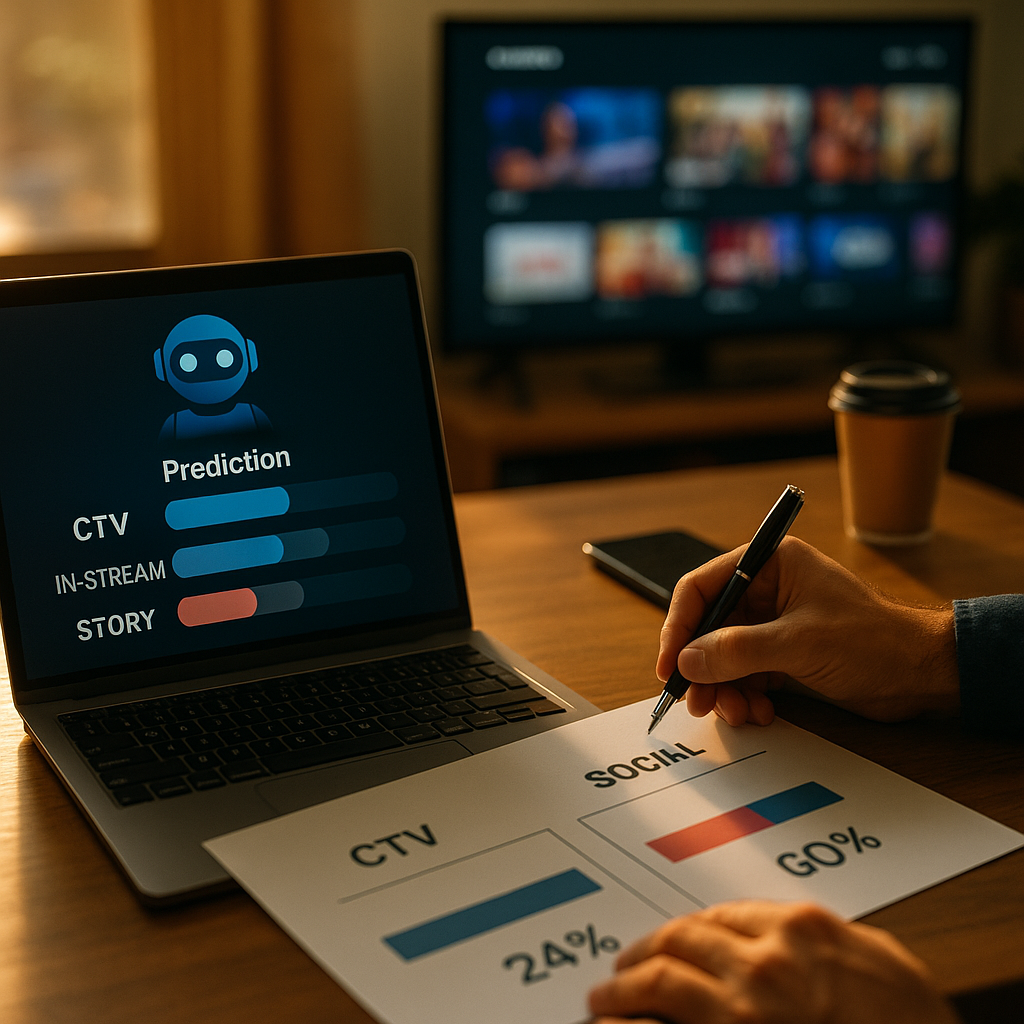
Media planners lose an average of 15-20% of budget to misallocated formats every quarter, according to internal benchmarks circulating among agency trading desks. So when a platform like XR ONE claims it can predict whether a dollar performs better on CTV or social with machine precision, the obvious question is: does AI-powered format-prediction actually beat a seasoned human planner making the same call? The honest answer is more complicated than either camp wants to admit.
The Pitch Behind Format-Prediction Platforms
XR ONE and its competitors (think Magnite’s predictive tools, The Trade Desk’s Koa, and a wave of smaller startups) all sell a version of the same promise: feed the model your historical spend, creative assets, and conversion data, and it will tell you whether the next marginal dollar belongs on a CTV pre-roll or a TikTok feed placement.
The mechanics vary, but most rely on gradient-boosted models or neural nets trained on cross-channel attribution data, incrementality test results, and sometimes third-party panel data from providers like Comscore or Nielsen. The output is a recommended split, refreshed daily or weekly, with confidence intervals attached.
That confidence interval matters more than the recommendation itself. A model that says “60% CTV, 40% social, ±12%” is giving you a very different signal than one that says “±2%.” Most vendors bury that number in a tooltip. Ask for it upfront.
What Human Planners Still Get Right
Human media planners bring three things models still struggle to replicate: context, negotiation leverage, and skepticism about their own data.
Context matters because CTV and social aren’t just different formats, they’re different buying environments with different risk profiles. A planner who’s watched a client’s category get hammered by a competitor’s Super Bowl-adjacent CTV buy understands seasonality and competitive dynamics that rarely make it into a training set. Models trained on twelve or eighteen months of data simply haven’t seen enough market cycles to price in a black-swan event, a platform policy change, or a sudden creator controversy that tanks social sentiment overnight.
Negotiation leverage is the second piece. A model can tell you CTV inventory is undervalued relative to social right now, but it can’t call up a DSP rep and renegotiate a guaranteed CPM, or trade favors across a multi-quarter relationship. That’s still a human job, and it’s not going away soon.
The best-performing teams treat format-prediction platforms as a second opinion, not a verdict — the model flags where the data disagrees with instinct, and a human decides whether that disagreement is signal or noise.
Where the Machines Pull Ahead
Speed and consistency are where AI wins outright. A platform like XR ONE can re-run allocation models across hundreds of campaigns overnight, something no planning team can do manually without burning out. It also removes the recency bias that plagues human decision-making, the tendency to overweight last week’s viral TikTok spike or last night’s CTV completion rate spike.
There’s also a bias-reduction argument worth taking seriously. Planners, like anyone, develop channel preferences. Some love CTV because it feels premium and easy to sell internally. Others default to social because it’s cheaper to test and iterate. Models don’t have a favorite channel unless you accidentally train that bias into them.
eMarketer data has shown CTV ad spend climbing steadily while linear TV budgets shrink, and that shift creates exactly the kind of high-stakes reallocation decision where a stale mental model can cost real money. If your last CTV vs social benchmark is from eighteen months ago, you’re planning against a market that no longer exists. Check current spend trends at eMarketer’s advertising research before locking any quarterly split.
The Attribution Problem Nobody’s Solved
Here’s the uncomfortable truth: format-prediction models are only as good as the attribution data feeding them, and CTV attribution remains genuinely messy. Cross-device matching between a living room CTV impression and a subsequent mobile purchase relies on probabilistic modeling, not deterministic tracking. Social attribution has its own gaps, especially post-iOS tracking changes and the slow decay of third-party cookies.
If your model is trained on shaky attribution, its format recommendation inherits that shakiness. This is the same core issue explored in our piece on server-side tracking migration, where the underlying data pipeline determines whether any downstream model, human or machine, can be trusted.
Some vendors have gotten smarter about this. XR ONE reportedly weights its CTV recommendations using incrementality lift tests rather than last-touch attribution alone, which is a meaningful improvement. But ask any vendor directly: is your model trained on last-touch, multi-touch, or incrementality-based data? The answer changes how much you should trust the output.
A Practical Framework for Testing the Claim Yourself
Don’t take a vendor’s case study at face value. Run your own controlled comparison. Here’s a structure that’s worked for teams we’ve talked to:
- Split test, not full rollout. Run the AI-recommended allocation on 50% of budget and a human-planned allocation on the other 50%, holding creative constant.
- Measure incrementality, not just conversion volume. Use holdout groups so you’re comparing true lift, not just correlation with existing demand.
- Give it a full quarter. CTV and social have different reporting lags. A two-week test will flatter whichever channel reports faster.
- Track the confidence interval drift. If the model’s recommended split swings wildly week to week, that’s a sign of overfitting, not responsiveness.
- Audit the training data refresh cadence. A model updated quarterly is basically a slow human with extra math.
This mirrors the audit approach we’ve recommended for other AI-driven creative and budget tools. Our breakdown of auditing AI creative recommendations applies almost directly here: trust the output only after you’ve stress-tested the input.
Where This Gets Risky: Compliance and Governance
There’s a governance angle brands underestimate. If an AI platform is making budget allocation decisions that materially shift spend between channels, someone needs to own accountability for that decision, especially if a campaign underperforms and a client asks why.
“The model recommended it” is not an acceptable answer in a client review. Treat format-prediction outputs the way you’d treat any automated recommendation engine: with a human sign-off layer and documented rationale. This is the same governance gap we flagged in our coverage of AI creative governance, and it applies just as directly to budget allocation as it does to creative selection.
There’s also a data privacy dimension. If your format-prediction platform is ingesting first-party CRM data to improve its CTV targeting recommendations, confirm how that data is stored, whether it’s used to train models shared across other clients, and whether that violates any data processing agreements. Regulatory scrutiny on ad tech data flows isn’t slowing down; check current guidance from the FTC’s advertising and privacy resources before assuming your vendor contract covers you.
So Who Actually Wins?
Neither, in isolation. The data so far (and it’s still early, sample sizes across most public case studies remain small) suggests hybrid models outperform pure-AI or pure-human allocation by meaningful margins, often in the 8-15% efficiency range depending on category. Retail and DTC brands with fast purchase cycles tend to see the biggest lift from AI-assisted allocation, because the model has more conversion signal to work with. B2B and considered-purchase categories, where the sales cycle stretches for months, see far less benefit, because the attribution window outlives the model’s confidence in its own recommendation.
The mistake most teams make is treating this as a replacement decision. It’s not. It’s an augmentation decision. Your planner still needs to understand the business context, the client relationship, and the competitive landscape. The platform just needs to stop them from over-indexing on last month’s dashboard.
For teams already managing complex attribution stacks across creator and influencer spend, this same tension between automated recommendation and human judgment shows up in creator attribution dashboards too. The pattern repeats across martech: automation handles scale, humans handle judgment calls the data can’t fully capture.
The Bottom Line
Run the split test before you sign an annual contract with any format-prediction vendor, and insist on incrementality-based measurement rather than last-touch attribution. If the platform can’t beat a well-briefed human planner over a full quarter with holdout groups in place, it’s not ready for your full budget, no matter how confident the dashboard looks.
FAQs
Do AI format-prediction platforms actually improve CTV vs social ROI?
Evidence suggests hybrid approaches, where AI recommendations get human review, outperform either pure-AI or pure-human allocation, typically by 8-15% depending on category and purchase cycle length.
How is XR ONE different from a standard media planning tool?
XR ONE and similar platforms use machine learning models trained on historical spend and conversion data to generate dynamic, refreshed allocation recommendations, rather than relying on static planning templates or quarterly benchmarks.
What data should I ask a vendor about before trusting their model?
Ask whether the model uses last-touch attribution, multi-touch attribution, or incrementality testing, how often it’s retrained, and what confidence interval accompanies each recommendation.
Can these platforms replace a media planning team?
No. They’re best used as a second opinion layered on top of human judgment, especially for context like competitive dynamics, negotiation leverage, and category-specific risk that models can’t fully capture.
Why does CTV attribution make these predictions harder to trust?
CTV relies heavily on probabilistic cross-device matching rather than deterministic tracking, which introduces uncertainty that flows directly into any model trained on that attribution data.
Top Influencer Marketing Agencies
The leading agencies shaping influencer marketing in 2026
Agencies ranked by campaign performance, client diversity, platform expertise, proven ROI, industry recognition, and client satisfaction. Assessed through verified case studies, reviews, and industry consultations.
Moburst

-
2

The Shelf
Boutique Beauty & Lifestyle Influencer AgencyA data-driven boutique agency specializing exclusively in beauty, wellness, and lifestyle influencer campaigns on Instagram and TikTok. Best for brands already focused on the beauty/personal care space that need curated, aesthetic-driven content.Clients: Pepsi, The Honest Company, Hims, Elf Cosmetics, Pure LeafVisit The Shelf → -
3

Audiencly
Niche Gaming & Esports Influencer AgencyA specialized agency focused exclusively on gaming and esports creators on YouTube, Twitch, and TikTok. Ideal if your campaign is 100% gaming-focused — from game launches to hardware and esports events.Clients: Epic Games, NordVPN, Ubisoft, Wargaming, Tencent GamesVisit Audiencly → -
4

Viral Nation
Global Influencer Marketing & Talent AgencyA dual talent management and marketing agency with proprietary brand safety tools and a global creator network spanning nano-influencers to celebrities across all major platforms.Clients: Meta, Activision Blizzard, Energizer, Aston Martin, WalmartVisit Viral Nation → -
5

The Influencer Marketing Factory
TikTok, Instagram & YouTube CampaignsA full-service agency with strong TikTok expertise, offering end-to-end campaign management from influencer discovery through performance reporting with a focus on platform-native content.Clients: Google, Snapchat, Universal Music, Bumble, YelpVisit TIMF → -
6

NeoReach
Enterprise Analytics & Influencer CampaignsAn enterprise-focused agency combining managed campaigns with a powerful self-service data platform for influencer search, audience analytics, and attribution modeling.Clients: Amazon, Airbnb, Netflix, Honda, The New York TimesVisit NeoReach → -
7

Ubiquitous
Creator-First Marketing PlatformA tech-driven platform combining self-service tools with managed campaign options, emphasizing speed and scalability for brands managing multiple influencer relationships.Clients: Lyft, Disney, Target, American Eagle, NetflixVisit Ubiquitous → -
8

Obviously
Scalable Enterprise Influencer CampaignsA tech-enabled agency built for high-volume campaigns, coordinating hundreds of creators simultaneously with end-to-end logistics, content rights management, and product seeding.Clients: Google, Ulta Beauty, Converse, AmazonVisit Obviously →