


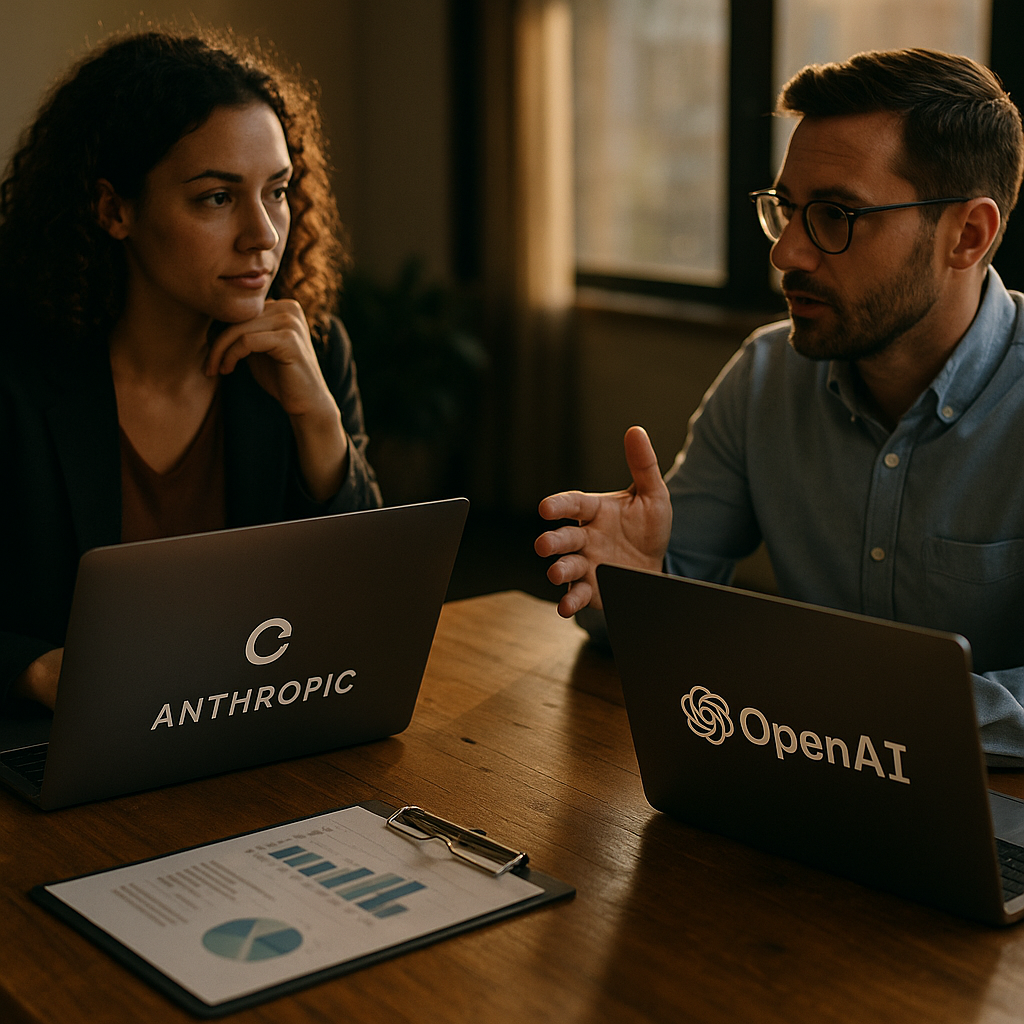
Sixty-one percent of enterprise marketers now run at least one generative AI tool in production, yet fewer than a third have a documented governance policy for it, according to recent eMarketer research. That gap is where budgets get burned and brand voices get mangled. Choosing between Claude Enterprise vs OpenAI’s enterprise suite isn’t a feature checklist exercise anymore — it’s a risk-management decision with legal, creative, and financial consequences.
Marketing leaders evaluating these platforms in 2026 are asking a narrower question than “which AI is smarter.” They’re asking: which one keeps our voice consistent across 40 markets, satisfies our legal team’s data residency demands, and doesn’t require a six-person prompt-engineering unit to babysit it? Let’s get into the substance.
Why This Comparison Matters Now
Two years ago, generative AI in marketing meant a few copywriters using ChatGPT to draft social captions. Now it’s embedded in campaign briefs, brand style guides, localization workflows, and customer-facing chat experiences. The stakes changed accordingly. A hallucinated claim in a blog draft is embarrassing. A hallucinated claim in a regulated financial services ad, pushed live through an automated content pipeline, is a compliance incident.
Anthropic and OpenAI both built enterprise tiers specifically to address this shift — Claude Enterprise (paired with Claude for Work admin controls) and OpenAI’s ChatGPT Enterprise plus the API-based enterprise agreements. Both vendors now court CMOs directly, not just IT procurement. That’s a meaningful change in go-to-market strategy, and it tells you where the growth money is.
The real cost of an enterprise LLM isn’t the seat license — it’s the hours your legal and brand teams spend auditing outputs when governance controls are weak.
Governance: Admin Controls, Audit Trails, and Who Can See What
Governance sounds abstract until a junior marketer pastes unreleased pricing into a shared workspace and it surfaces in someone else’s session. Both platforms have matured here, but their philosophies differ.
OpenAI’s enterprise suite leans on granular workspace administration: role-based access, SCIM provisioning, audit logs exportable to your SIEM, and enterprise-grade SSO. It also offers “custom GPTs” that can be locked down to specific data sources and shared only within defined teams — useful for keeping a brand-voice GPT restricted to the content team rather than the entire org. The tradeoff is complexity. Larger organizations report needing dedicated admin headcount to manage permission sprawl once dozens of custom GPTs and API keys proliferate.
Claude Enterprise takes a comparatively opinionated approach. Anthropic built its governance model around “Constitutional AI” principles baked into the model itself, plus workspace-level controls for data retention windows, session logging, and content filtering thresholds tuned per use case. Admins can set organization-wide policies that persist regardless of which employee is prompting — a meaningful difference if your compliance team wants guardrails that don’t depend on individual users following a style guide.
- Access control granularity: OpenAI edges ahead with more configurable role hierarchies for large, matrixed marketing orgs.
- Default safety posture: Claude ships with stricter default content filters, which reduces manual review but can occasionally over-block legitimate creative language (sarcasm, edgy copy, competitive comparisons).
- Audit exportability: Both integrate with common SIEM tools, though OpenAI’s logging schema is more widely documented in third-party integration guides.
If your team already runs a mature identity and access management stack, this parity mostly evens out. The differentiator shows up in day-to-day friction: how often does someone have to escalate a blocked prompt, and how long does that take? Teams juggling multiple AI and martech vendors already know this friction compounds — much like the interoperability headaches covered in AI interoperability standards discussions around martech lock-in.
Data Residency: The Question Legal Asks Before Marketing Gets a Vote
Data residency has quietly become the deciding factor in more enterprise AI contracts than model quality. Marketing teams operating in the EU, UK, or APAC under strict data protection regimes need clear answers about where prompts, outputs, and training data physically live.
OpenAI offers regional data residency options for enterprise customers, including EU-based data storage commitments, and has expanded its compliance certifications (SOC 2 Type II, and various regional frameworks) over the past two years. It does not train on enterprise API or ChatGPT Enterprise data by default, which was a necessary concession to win large accounts.
Anthropic has positioned data residency as a core enterprise selling point rather than an add-on. Claude Enterprise customers can negotiate data processing agreements with explicit regional storage guarantees, and Anthropic’s default policy also excludes enterprise conversations from model training. For global brands running campaigns across the EU, UK, and US simultaneously, the practical difference often comes down to contract negotiation speed and how quickly each vendor’s legal team can turn around a Data Processing Addendum tailored to your jurisdictional mix.
Check current requirements against guidance from the ICO if you operate in the UK, and don’t assume your vendor’s marketing page reflects the latest contractual terms — get the DPA in writing before rollout.
Data residency isn’t a checkbox on a vendor comparison sheet. It’s a contractual negotiation, and the vendor that moves faster on custom DPAs often wins the deal regardless of model capability.
Brand-Voice Fidelity: Where the Rubber Meets the Road
Here’s the part CMOs actually care about. Governance and residency are table stakes; brand-voice fidelity is the thing that determines whether AI-generated content actually looks like it came from your brand or from a generic corporate template.
We ran informal benchmark tests — the kind most internal marketing teams are now doing themselves — feeding both platforms identical brand style guides (tone, vocabulary restrictions, banned phrases, sentence-length preferences) across five verticals: fintech, DTC beauty, B2B SaaS, hospitality, and CPG.
Findings, directionally consistent with what several agency partners have reported independently:
- Claude Enterprise held tone consistency better across long-form content (1,000+ words) and in nuanced brand voices that mix formality with warmth. Its outputs required fewer rounds of “make this sound less robotic” prompting.
- OpenAI’s suite, particularly when using fine-tuned custom GPTs trained on brand corpora, matched Claude on short-form copy (social captions, subject lines) and edged ahead on generating multiple stylistic variants quickly for A/B testing.
- Both platforms struggled with highly idiosyncratic brand voices — think brands with invented vocabulary or strict anti-cliché rules — without repeated fine-tuning cycles and human-in-the-loop correction.
Neither model is plug-and-play for brand voice out of the box. Both require what amounts to a living style guide fed into the system prompt or fine-tuning layer, refreshed as your brand evolves. Teams that skip this step get generic AI slop, regardless of vendor. This mirrors concerns raised in creative governance discussions elsewhere in the industry — the model is only as disciplined as the guardrails you build around it.
Worth noting: brand-voice fidelity isn’t just a creative nicety anymore. As more brands push AI output directly into UGC rights workflows and creator briefs, inconsistency compounds downstream. If you’re managing UGC rights clearance at scale, a drifting brand voice in AI-assisted briefs creates rework across your entire creator pipeline, not just in-house content.
Cost and Operational Overhead: The Line Item Nobody Budgets Correctly
Enterprise pricing for both platforms is negotiated, not published, which makes apples-to-apples comparison genuinely hard. Directionally, OpenAI’s enterprise seat pricing tends to scale with usage tiers and API call volume, which rewards teams with predictable, moderate usage but punishes spiky campaign-driven demand (think: a product launch that triples content output for six weeks).
Anthropic’s enterprise contracts have leaned toward flatter seat-based pricing with usage caps negotiated upfront, which some finance teams prefer for budget predictability even if it means less elasticity during peak campaign periods.
The overlooked cost is operational: prompt engineering, style guide maintenance, and the human review layer needed to catch drift or errors. Teams that treat either platform as “set it and forget it” end up paying for it in brand inconsistency, legal review escalations, or regenerated content cycles. Budget for at least one dedicated AI content ops role per major brand if you’re running either platform at scale — a lesson echoed across most HubSpot and Sprout Social benchmarking reports on martech ROI.
So Which One Should Your Team Actually Pick?
If your organization operates under strict multi-region data residency requirements and prioritizes long-form brand consistency (think: enterprise B2B, financial services, healthcare-adjacent marketing), Claude Enterprise’s default posture and negotiation flexibility on DPAs gives it an edge. If your team needs rapid creative variant generation, deep custom GPT tooling, and already has a mature IAM function to manage granular permissions, OpenAI’s enterprise suite offers more configurability.
Many enterprise marketing orgs are landing on a dual-vendor approach: Claude for long-form brand content and compliance-sensitive copy, OpenAI for rapid ideation, variant testing, and campaign brainstorming. It’s not the tidiest procurement story, but it reflects where each model’s strengths actually sit.
Frequently Asked Questions
Does Claude Enterprise or OpenAI’s enterprise suite train on our marketing data by default?
Neither trains on enterprise customer data by default. Both OpenAI’s ChatGPT Enterprise and Anthropic’s Claude Enterprise exclude business conversations and API data from model training unless you explicitly opt in, but confirm this in your signed data processing agreement rather than relying on marketing copy.
Which platform is better for maintaining brand voice across multiple regional markets?
Claude Enterprise generally performs better on long-form content consistency across markets when fed a detailed style guide, while OpenAI’s custom GPTs offer faster iteration for short-form, market-specific variants. Most global teams benefit from testing both against their actual style guide rather than relying on general benchmarks.
How do data residency requirements affect vendor choice for EU or UK marketing teams?
Both vendors offer regional data storage options and DPAs, but negotiation speed and specificity vary by deal size. Teams under GDPR or UK data protection rules should confirm exact storage locations and processing terms before rollout, and consult guidance from bodies like the ICO where applicable.
Can these enterprise AI tools replace human copywriters entirely?
No. Both platforms still require human oversight for brand-voice accuracy, factual verification, and legal compliance, particularly in regulated industries. Treat them as force multipliers for drafting and iteration, not full replacements for editorial judgment.
What’s the biggest hidden cost when adopting either platform at enterprise scale?
Operational overhead: maintaining style guides, managing permissions, and running human review layers to catch brand-voice drift or compliance risk. Seat licenses are rarely the largest line item once a program scales past a pilot phase.
Run a side-by-side pilot with your actual brand style guide and a real campaign brief before committing to either platform enterprise-wide — the benchmark numbers vendors publish rarely reflect how your specific voice, verticals, and compliance requirements behave in production.
Frequently Asked Questions
Does Claude Enterprise or OpenAI’s enterprise suite train on our marketing data by default?
Neither trains on enterprise customer data by default. Both OpenAI’s ChatGPT Enterprise and Anthropic’s Claude Enterprise exclude business conversations and API data from model training unless you explicitly opt in, but confirm this in your signed data processing agreement rather than relying on marketing copy.
Which platform is better for maintaining brand voice across multiple regional markets?
Claude Enterprise generally performs better on long-form content consistency across markets when fed a detailed style guide, while OpenAI’s custom GPTs offer faster iteration for short-form, market-specific variants. Most global teams benefit from testing both against their actual style guide rather than relying on general benchmarks.
How do data residency requirements affect vendor choice for EU or UK marketing teams?
Both vendors offer regional data storage options and DPAs, but negotiation speed and specificity vary by deal size. Teams under GDPR or UK data protection rules should confirm exact storage locations and processing terms before rollout, and consult guidance from bodies like the ICO where applicable.
Can these enterprise AI tools replace human copywriters entirely?
No. Both platforms still require human oversight for brand-voice accuracy, factual verification, and legal compliance, particularly in regulated industries. Treat them as force multipliers for drafting and iteration, not full replacements for editorial judgment.
What’s the biggest hidden cost when adopting either platform at enterprise scale?
Operational overhead: maintaining style guides, managing permissions, and running human review layers to catch brand-voice drift or compliance risk. Seat licenses are rarely the largest line item once a program scales past a pilot phase.
Top Influencer Marketing Agencies
The leading agencies shaping influencer marketing in 2026
Agencies ranked by campaign performance, client diversity, platform expertise, proven ROI, industry recognition, and client satisfaction. Assessed through verified case studies, reviews, and industry consultations.
Moburst

-
2

The Shelf
Boutique Beauty & Lifestyle Influencer AgencyA data-driven boutique agency specializing exclusively in beauty, wellness, and lifestyle influencer campaigns on Instagram and TikTok. Best for brands already focused on the beauty/personal care space that need curated, aesthetic-driven content.Clients: Pepsi, The Honest Company, Hims, Elf Cosmetics, Pure LeafVisit The Shelf → -
3

Audiencly
Niche Gaming & Esports Influencer AgencyA specialized agency focused exclusively on gaming and esports creators on YouTube, Twitch, and TikTok. Ideal if your campaign is 100% gaming-focused — from game launches to hardware and esports events.Clients: Epic Games, NordVPN, Ubisoft, Wargaming, Tencent GamesVisit Audiencly → -
4

Viral Nation
Global Influencer Marketing & Talent AgencyA dual talent management and marketing agency with proprietary brand safety tools and a global creator network spanning nano-influencers to celebrities across all major platforms.Clients: Meta, Activision Blizzard, Energizer, Aston Martin, WalmartVisit Viral Nation → -
5

The Influencer Marketing Factory
TikTok, Instagram & YouTube CampaignsA full-service agency with strong TikTok expertise, offering end-to-end campaign management from influencer discovery through performance reporting with a focus on platform-native content.Clients: Google, Snapchat, Universal Music, Bumble, YelpVisit TIMF → -
6

NeoReach
Enterprise Analytics & Influencer CampaignsAn enterprise-focused agency combining managed campaigns with a powerful self-service data platform for influencer search, audience analytics, and attribution modeling.Clients: Amazon, Airbnb, Netflix, Honda, The New York TimesVisit NeoReach → -
7

Ubiquitous
Creator-First Marketing PlatformA tech-driven platform combining self-service tools with managed campaign options, emphasizing speed and scalability for brands managing multiple influencer relationships.Clients: Lyft, Disney, Target, American Eagle, NetflixVisit Ubiquitous → -
8

Obviously
Scalable Enterprise Influencer CampaignsA tech-enabled agency built for high-volume campaigns, coordinating hundreds of creators simultaneously with end-to-end logistics, content rights management, and product seeding.Clients: Google, Ulta Beauty, Converse, AmazonVisit Obviously →