


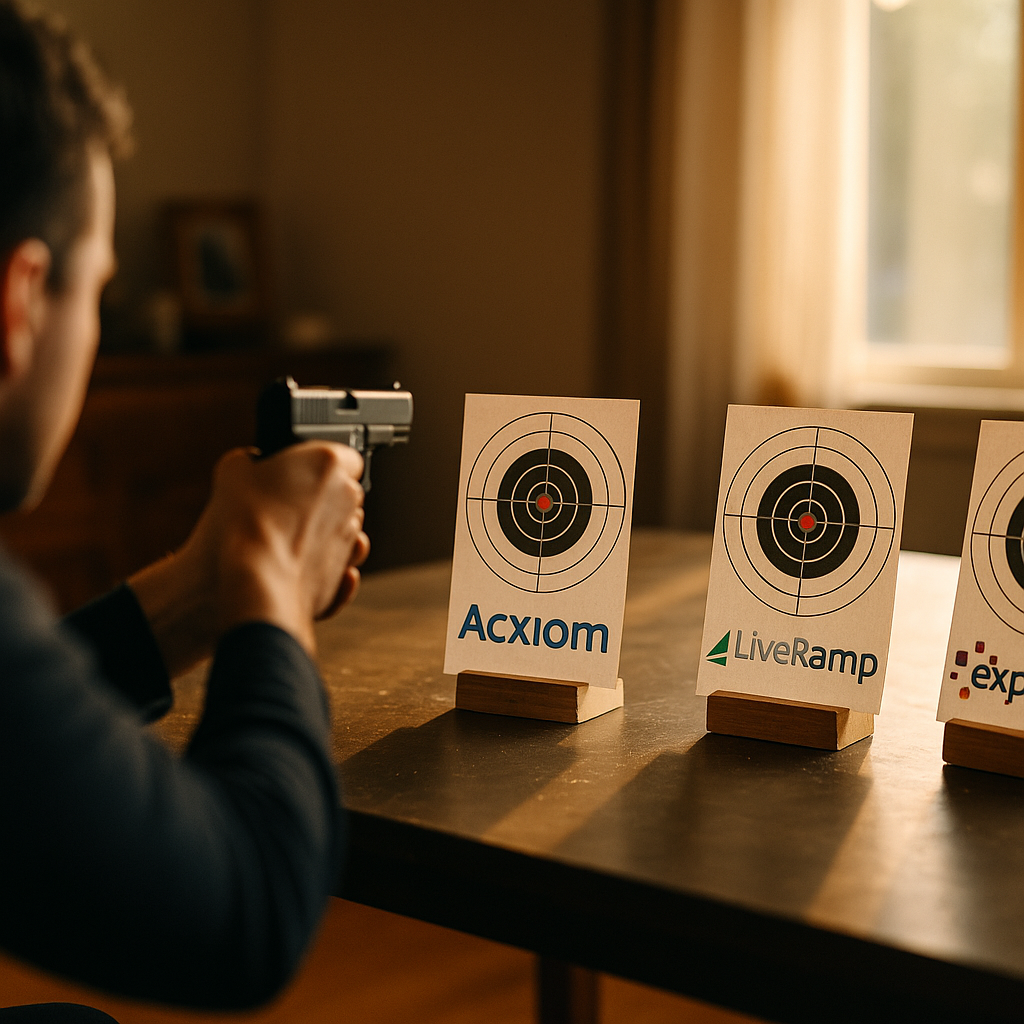
Match rates below 60% aren’t a rounding error — they’re a budget leak. As the last cookie crumbs vanish and identity resolution becomes the backbone of every media plan, brands running side-by-side tests on Acxiom, LiveRamp, and Experian are finding double-digit gaps in match performance that directly move CPA and reach. This identity resolution vendor shootout breaks down what actually happens when you feed the same first-party file into all three.
Why This Fight Matters More in a Cookieless World
Third-party cookies are functionally dead in most serious media plans. Safari and Firefox killed them years ago; Chrome’s slow-walked deprecation finally caught up with reality. That leaves brands leaning almost entirely on first-party data, clean rooms, and identity graphs to stitch together who’s actually seeing their ads.
The problem? Not all identity graphs are built the same. Some lean on postal and offline data (Acxiom’s legacy strength). Some built their empire on pseudonymous device graphs and clean room connectivity (LiveRamp). Others fuse credit-bureau-grade identity data with marketing signals (Experian). When you’re deciding where to route your CDP data for onboarding, these architectural differences show up as real match rate gaps — and real dollars.
A 15-point swing in match rate on a 2-million-row customer file can mean the difference between reaching 1.3 million people and reaching 1.7 million — at the same media spend.
The Test Setup: How We Benchmarked Match Rates
We ran a controlled test using a de-identified retail loyalty file (2.1 million records, hashed emails, physical addresses, phone numbers) through each vendor’s standard onboarding pipeline. No vendor got a custom-tuned integration — this was meant to simulate what a mid-market brand experiences on day one, not what an enterprise account gets after eighteen months of optimization.
- Input file composition: 62% hashed email, 24% postal address plus name, 14% phone number only
- Match criteria: Resolution to a durable household or individual ID usable across connected TV, walled gardens, and open web
- Measurement window: 30-day onboarding cycle, matched against each vendor’s most recent refresh
This isn’t a lab exercise. It’s the exact workflow a brand marketing team runs when migrating off cookie-based retargeting and into an identity-based activation model, similar to the shift we covered in our server-side tracking migration guide.
Acxiom: Strong on Offline, Slower on Digital Handoff
Acxiom posted a 71% match rate on postal-and-name records — no surprise, given the company’s four-decade head start in offline identity data. Where it stumbled was hashed email: 58%, noticeably behind the other two. Acxiom’s real strength shows up downstream, in how matched records translate to addressable TV and direct mail coordination, not necessarily in raw digital match velocity.
If your program leans heavily on omnichannel campaigns that still include direct mail or linear-adjacent CTV, Acxiom’s offline depth is hard to replicate elsewhere. But if your file is 80% email-first (increasingly the norm for DTC and app-first brands), you’re leaving matches on the table.
LiveRamp: The Connectivity Play Pays Off
LiveRamp’s headline number was the hashed email match: 79%, the best of the three in our test. That’s consistent with LiveRamp’s own industry benchmarking data and its aggressive investment in RampID coverage across retail media networks and CTV platforms. The postal match came in at 68%, respectable but not category-leading.
The bigger story with LiveRamp isn’t the raw percentage — it’s what happens after the match. Because LiveRamp’s clean room integrations span Amazon, Walmart Connect, Disney, and dozens of others, a matched identity there tends to activate faster and across more destinations without a second onboarding step. That operational efficiency is worth real money if your media mix spans multiple retail media networks, a topic we’ve dug into when comparing CDP-to-clean-room routing options.
Experian: Consistent, Unspectacular, Enterprise-Grade
Experian landed in the middle on both metrics: 74% postal, 70% email. What Experian lacks in headline-grabbing peak performance it makes up for in consistency across data types — the phone-only match rate (41%) was actually the strongest of the three vendors, likely benefiting from Experian’s credit and financial services data assets that most competitors don’t have access to.
For brands in regulated categories — financial services, healthcare-adjacent, insurance — Experian’s compliance posture and audit trail tend to matter more than a five-point match rate advantage elsewhere. That’s a legitimate reason to accept slightly lower digital match rates in exchange for a vendor whose data provenance holds up under regulatory scrutiny.
Match Rate Isn’t the Whole Story
Here’s the uncomfortable truth vendors don’t lead with: a high match rate on paper doesn’t guarantee a high-quality match. We’ve seen brands chase headline match percentages only to find downstream conversion rates flat or worse, because the “matched” identity was a stale household link or a shared device ID that muddies attribution.
Ask every vendor for their match decay rate — how quickly matched IDs go stale — and their false positive rate on validation samples. Most won’t volunteer this. Push anyway.
The vendor with the highest match rate isn’t automatically the vendor that lowers your cost per incremental customer. Match quality and match activation speed matter just as much as match volume.
This mirrors a pattern we’ve flagged before in creator attribution tooling — see our breakdown of IQM vs Rokt mParticle for creator attribution, where identity resolution quality, not just quantity, determined which platform actually improved measurable ROI.
What About Cost and Contract Structure?
Match rate benchmarks matter for planning, but pricing models can flip the economics entirely. Acxiom and Experian generally price on a per-record or subscription tier basis with volume discounts kicking in around the 5-million-record mark. LiveRamp’s pricing is more usage- and destination-based, meaning your costs scale with how many downstream platforms you activate against, not just file size.
That distinction matters for budget forecasting. A brand running programmatic display through six destinations will pay more with LiveRamp’s model than a brand running two channels at the same file size, even with identical match rates. Get exact activation destination counts before signing — vendors are notoriously vague about this until contract redlines.
Governance, Consent, and the Compliance Layer
Every match rate conversation eventually collides with privacy law. The FTC’s ongoing scrutiny of data brokers and state-level privacy laws (California, Colorado, Connecticut, and a growing list of others) mean identity resolution vendors now have to prove consent chains, not just match accuracy.
Acxiom and Experian, both with decades of regulated-data experience, tend to have more mature consent documentation baked into onboarding. LiveRamp has invested heavily here too, particularly through its Authenticated Traffic Solution and transparency reports, but the audit burden still lands on the brand. Don’t assume vendor compliance claims transfer automatically to your own data protection obligations — your legal team still needs to verify consent capture at the point of collection, not just at the point of match.
This is the same governance discipline we’ve argued for in adjacent martech decisions, like our audit framework for AI creative recommendation governance — the tooling changes, but the compliance rigor required doesn’t.
Which Vendor Should You Actually Pick?
There’s no universal winner, and any vendor promising one is selling you a marketing brochure. Use this rough framework instead:
- Choose LiveRamp if your media mix is retail-media-heavy and email-first, and you need fast multi-destination activation.
- Choose Acxiom if your program still leans on direct mail, addressable TV, or offline-to-online bridging.
- Choose Experian if you’re in a regulated vertical where audit trail and phone-based resolution carry more weight than peak digital match rate.
Better yet: run your own shootout before committing. Every brand’s file composition is different, and vendor-published benchmarks (from HubSpot’s martech research to vendor-sponsored studies) rarely reflect your actual data hygiene. A 30-day parallel test costs less than one quarter of wasted media spend on a mismatched identity graph.
Frequently Asked Questions
What is a good identity resolution match rate?
Anything above 65-70% on hashed email and postal data is competitive for most retail and DTC files. Below 55%, you should question your input data hygiene before blaming the vendor.
Do match rates matter if cookies are already gone from most browsers?
Yes, arguably more now than before. Without third-party cookies, identity resolution is the primary mechanism connecting your first-party data to media activation across CTV, retail media, and open web programmatic.
Can I use more than one identity resolution vendor at once?
Many enterprise brands do, routing different data types or channels to different vendors based on strength (e.g., LiveRamp for retail media, Experian for regulated-channel campaigns). It adds operational complexity but can improve blended match rates.
How often should match rates be re-tested?
At minimum annually, and immediately after any major shift in your first-party data collection strategy (new consent flows, new CDP, new loyalty program structure).
Does a higher match rate always mean better campaign performance?
No. Match quality, activation speed, and destination coverage matter just as much. A vendor with a slightly lower match rate but faster clean room activation can outperform on actual campaign ROI.
Next step: Pull a 30-day parallel test across two vendors using your actual first-party file before your next contract renewal — the benchmark gap in this article is directional, not a guarantee for your specific data.
Frequently Asked Questions
What is a good identity resolution match rate?
Anything above 65-70% on hashed email and postal data is competitive for most retail and DTC files. Below 55%, you should question your input data hygiene before blaming the vendor.
Do match rates matter if cookies are already gone from most browsers?
Yes, arguably more now than before. Without third-party cookies, identity resolution is the primary mechanism connecting your first-party data to media activation across CTV, retail media, and open web programmatic.
Can I use more than one identity resolution vendor at once?
Many enterprise brands do, routing different data types or channels to different vendors based on strength (e.g., LiveRamp for retail media, Experian for regulated-channel campaigns). It adds operational complexity but can improve blended match rates.
How often should match rates be re-tested?
At minimum annually, and immediately after any major shift in your first-party data collection strategy (new consent flows, new CDP, new loyalty program structure).
Does a higher match rate always mean better campaign performance?
No. Match quality, activation speed, and destination coverage matter just as much. A vendor with a slightly lower match rate but faster clean room activation can outperform on actual campaign ROI.
Top Influencer Marketing Agencies
The leading agencies shaping influencer marketing in 2026
Agencies ranked by campaign performance, client diversity, platform expertise, proven ROI, industry recognition, and client satisfaction. Assessed through verified case studies, reviews, and industry consultations.
Moburst

-
2

The Shelf
Boutique Beauty & Lifestyle Influencer AgencyA data-driven boutique agency specializing exclusively in beauty, wellness, and lifestyle influencer campaigns on Instagram and TikTok. Best for brands already focused on the beauty/personal care space that need curated, aesthetic-driven content.Clients: Pepsi, The Honest Company, Hims, Elf Cosmetics, Pure LeafVisit The Shelf → -
3

Audiencly
Niche Gaming & Esports Influencer AgencyA specialized agency focused exclusively on gaming and esports creators on YouTube, Twitch, and TikTok. Ideal if your campaign is 100% gaming-focused — from game launches to hardware and esports events.Clients: Epic Games, NordVPN, Ubisoft, Wargaming, Tencent GamesVisit Audiencly → -
4

Viral Nation
Global Influencer Marketing & Talent AgencyA dual talent management and marketing agency with proprietary brand safety tools and a global creator network spanning nano-influencers to celebrities across all major platforms.Clients: Meta, Activision Blizzard, Energizer, Aston Martin, WalmartVisit Viral Nation → -
5

The Influencer Marketing Factory
TikTok, Instagram & YouTube CampaignsA full-service agency with strong TikTok expertise, offering end-to-end campaign management from influencer discovery through performance reporting with a focus on platform-native content.Clients: Google, Snapchat, Universal Music, Bumble, YelpVisit TIMF → -
6

NeoReach
Enterprise Analytics & Influencer CampaignsAn enterprise-focused agency combining managed campaigns with a powerful self-service data platform for influencer search, audience analytics, and attribution modeling.Clients: Amazon, Airbnb, Netflix, Honda, The New York TimesVisit NeoReach → -
7

Ubiquitous
Creator-First Marketing PlatformA tech-driven platform combining self-service tools with managed campaign options, emphasizing speed and scalability for brands managing multiple influencer relationships.Clients: Lyft, Disney, Target, American Eagle, NetflixVisit Ubiquitous → -
8

Obviously
Scalable Enterprise Influencer CampaignsA tech-enabled agency built for high-volume campaigns, coordinating hundreds of creators simultaneously with end-to-end logistics, content rights management, and product seeding.Clients: Google, Ulta Beauty, Converse, AmazonVisit Obviously →