


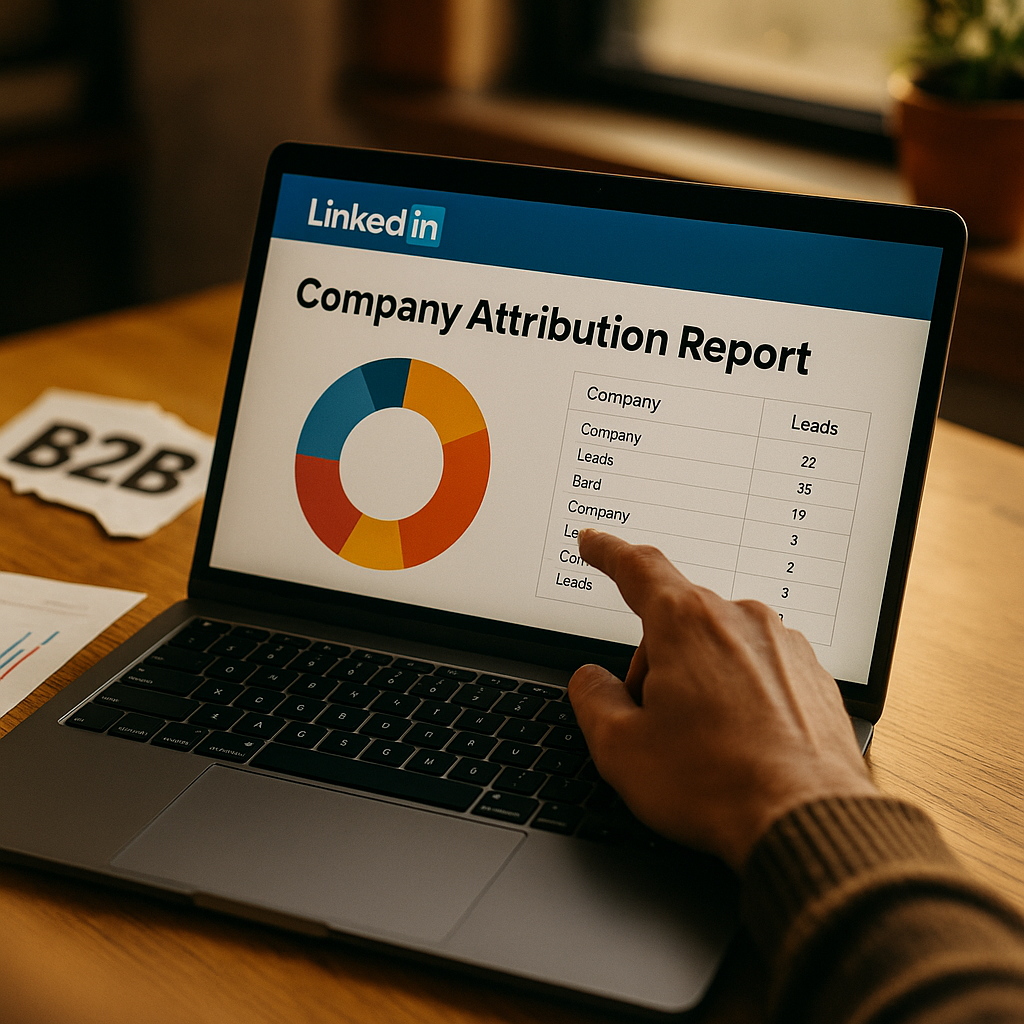
Only 5% of B2B buyers are actively in-market at any given time, yet marketers keep funding attribution models built around the myth of a single decision-maker clicking a single ad. AI-driven B2B attribution is finally catching up to how enterprise deals actually happen, and LinkedIn’s Company Attribution Report is the clearest signal yet that platform vendors know last-click is dead.
If you’ve ever tried explaining to a CFO why a six-month, twelve-person buying committee doesn’t show up cleanly in Google Analytics, you already know the problem this solves.
Why Last-Touch Attribution Breaks in Complex B2B Deals
B2B purchases aren’t decisions. They’re negotiations between departments, budget holders, technical evaluators, and whoever got burned by the last vendor. Gartner has long put the average B2B buying group at six to ten stakeholders, each pulling their own independent research before a single sales call happens. Last-touch models credit whichever channel happened to be present at the final click, usually branded search or a demo request form. That’s not insight. That’s coincidence dressed up as data.
The result is a chronic underinvestment in upper-funnel and mid-funnel touches that actually build consensus across the committee. Marketing gets blamed for “not driving pipeline” when the truth is finance never saw the influencer content that got the CFO comfortable, and legal never saw the compliance webinar that got procurement to stop objecting.
The buying committee, not the individual lead, is the real unit of conversion in B2B — and most attribution stacks still can’t see it.
What LinkedIn’s Company Attribution Report Actually Does
LinkedIn’s Company Attribution Report connects ad engagement data at the account level rather than the individual lead level, then maps it against CRM-sourced pipeline and revenue outcomes. Instead of asking “did this contact click an ad before converting,” it asks “how many people at this target account engaged with our content before this account became an opportunity, and what was the revenue impact.”
That shift, from person-level to account-level modeling, is the entire point. It uses machine learning to weight exposure across every buying-committee member LinkedIn can identify at a target company, then correlates that exposure pattern with deal stage progression pulled from connected CRM systems like Salesforce or HubSpot.
Practically, this means a marketer running an account-based program can finally see something like: “Accounts where three or more stakeholders engaged with our sponsored content moved to opportunity 2.3x faster than accounts with single-touch exposure.” That’s a business case, not a vanity metric.
The CRM Connection Is the Unlock
Ad platforms have always had engagement data. What they lacked was closed-loop visibility into whether that engagement turned into real pipeline. By integrating directly with CRM data, LinkedIn’s report closes that loop without requiring marketers to export CSVs and manually reconcile spreadsheets every quarter — which, let’s be honest, is how most B2B attribution “analysis” still happens in 2026.
This mirrors a broader shift happening across martech. Similar to how account-level measurement approaches are replacing person-level tracking industry-wide, LinkedIn is betting that account-based signal, not individual identity, is the more durable foundation as cookies and device IDs keep eroding.
How the Buying-Committee Engagement Model Works
The mechanics are worth understanding before you brief your CFO on why this matters.
LinkedIn identifies which members of a target account are engaging with sponsored content, organic posts, and thought-leadership pieces from your company page. It then classifies those individuals loosely by function or seniority using profile data (job title, department signals), even if they never fill out a form. That’s the part legacy attribution can’t touch: dark funnel engagement from people who read, share, or comment but never convert as an individual lead.
Once that engagement map exists, LinkedIn’s algorithm cross-references it against CRM-sourced deal data: opportunity creation date, stage transitions, deal size, close probability. The AI model then attributes weighted credit to ad exposure based on committee breadth (how many distinct people engaged) and depth (how often, and how recently before key stage transitions).
A few things fall out of this model that traditional attribution never surfaced:
- Accounts with multi-threaded engagement (three-plus stakeholders touched) close at meaningfully higher rates than single-threaded accounts, even when total ad spend is identical.
- Engagement timing near stage transitions carries more predictive weight than raw impression volume.
- Certain content formats (thought leadership vs. product ads) correlate with different committee roles engaging — finance stakeholders behave differently than technical evaluators.
That third point deserves its own callout, because it’s the one most marketers overlook.
Different members of the buying committee respond to different content types at different stages — treating “engagement” as a single undifferentiated metric hides the story entirely.
Where This Fits Against MMM and Other Attribution Models
Skeptics will rightly point out that account-level attribution from a walled-garden platform is still, fundamentally, self-reported by that platform. LinkedIn grading its own homework isn’t a new concern in the ad tech world, and it applies here too.
That’s why smart B2B marketing teams are pairing platform-native attribution like this with independent validation methods. Marketing mix modeling has resurfaced precisely because it doesn’t rely on any single platform’s tracking infrastructure, and it’s a useful cross-check against LinkedIn’s own attribution claims. If the Company Attribution Report says an account converted because of sponsored content exposure, but your MMM shows no incremental lift when LinkedIn spend increases, you have a real conversation to have with your media planning team.
The honest framing: LinkedIn’s tool tells you what happened inside its own platform’s exposure data, correlated with your CRM outcomes. It doesn’t tell you what would have happened without that spend. Incrementality is a separate question, and one no single-platform attribution report answers definitively.
Signal Loss Makes This More Urgent, Not Less
Third-party cookie deprecation and privacy regulation have already gutted a lot of cross-site tracking that B2B marketers used to lean on for multi-touch models. Server-side tracking gaps, iOS-level restrictions, and browser-level privacy changes have compounded the problem. Reports from eMarketer have tracked this erosion across ad platforms for several cycles now, and B2B is not exempt just because deal cycles are longer.
This is part of why account-based, CRM-integrated attribution matters more now than it did five years ago. When you can’t rely on third-party tracking to stitch a buyer’s cross-device journey together, first-party CRM data connected directly to platform engagement becomes one of the few reliable signal sources left. It’s the same logic behind signal reconstruction approaches gaining traction across the broader martech landscape — when the old tracking infrastructure breaks, you rebuild from owned data outward.
Operationalizing It: What Marketing Ops Teams Actually Need to Do
None of this works if your CRM hygiene is a mess, and that’s the uncomfortable truth vendors don’t lead with in the sales deck.
For LinkedIn’s Company Attribution Report to produce anything useful, you need:
- Clean account mapping — target accounts need consistent naming and domain matching between your CRM and LinkedIn’s Campaign Manager, or the join simply fails silently.
- Closed-loop CRM integration — native connectors (Salesforce, HubSpot) work better than manual CSV imports, which introduce lag and human error.
- Defined buying-committee roles — if your CRM doesn’t tag contact roles (economic buyer, technical evaluator, influencer), the attribution report can’t segment engagement meaningfully even though LinkedIn’s own data is role-aware.
- Realistic reporting cadence — enterprise deal cycles run three to eighteen months; pulling attribution data weekly and expecting clean signal is a fast way to make bad budget decisions.
Marketing ops teams that skip the CRM hygiene step tend to get reports that look sophisticated but say almost nothing trustworthy. Garbage in, sophisticated-looking garbage out — the AI layer doesn’t fix bad source data, it just makes bad data look more confident.
This connects to a pattern showing up across AI-driven martech generally: the tooling is only as good as the underlying data architecture feeding it. Teams exploring AI marketing infrastructure are running into the exact same wall — impressive model outputs sitting on top of fragmented, poorly governed source data.
What This Means for Budget Conversations
The practical payoff of account-level, committee-aware attribution is a better budget argument. Instead of defending LinkedIn spend on cost-per-lead, marketers can show finance and sales leadership that accounts with broader stakeholder engagement close faster and at higher values. That’s a story a CRO will actually listen to.
It also reframes content strategy. If thought-leadership content correlates with technical-evaluator engagement while product-focused ads correlate with economic-buyer engagement, that’s an argument for diversified content investment rather than pouring everything into bottom-funnel conversion ads. HubSpot’s own research on B2B buyer behavior has consistently shown multi-format content consumption across the committee, which lines up with what LinkedIn’s model is now surfacing at the platform level.
Compliance and data governance teams should also get a seat at this table early. Attribution that draws on CRM contact data and platform engagement signals touches privacy obligations, and B2B marketers operating internationally need to keep an eye on how this data is processed under frameworks tracked by regulators like the ICO and FTC.
Start small: pick one active ABM segment, connect your CRM properly, and run LinkedIn’s Company Attribution Report alongside your existing model for one full quarter before you touch a single budget line based on it.
FAQs
What is AI-driven B2B attribution?
AI-driven B2B attribution uses machine learning to analyze engagement patterns across multiple buying-committee members at an account, correlating that engagement with CRM pipeline data to show which marketing touches actually influenced deal progression, rather than crediting a single last-click interaction.
How does LinkedIn’s Company Attribution Report differ from standard conversion tracking?
Standard conversion tracking credits individual leads based on their own click or form-fill history. LinkedIn’s Company Attribution Report aggregates engagement across everyone at a target account who interacted with your content, then maps that collective activity against CRM-sourced deal outcomes to measure account-level influence.
Does this report require a CRM integration to work?
Yes. The report’s value comes specifically from connecting LinkedIn engagement data to CRM pipeline stages and revenue outcomes. Without a clean integration to platforms like Salesforce or HubSpot, you lose the closed-loop measurement that makes the tool useful.
Can this replace marketing mix modeling for B2B?
No. It’s a complementary, platform-specific view of engagement correlated with outcomes, not an independent incrementality measure. Marketing mix modeling remains a useful cross-check since it doesn’t rely on any single platform’s self-reported data.
What data quality issues undermine this kind of attribution?
Inconsistent account naming between CRM and ad platform, missing or outdated contact role tags, manual CSV data imports instead of native connectors, and pulling reports too frequently relative to actual deal-cycle length all degrade the reliability of the output.
Is buying-committee attribution relevant for smaller B2B companies with shorter sales cycles?
It’s most valuable for companies with multi-stakeholder deals and sales cycles measured in months rather than days. Smaller transactional B2B sales with single decision-makers won’t see much added insight from committee-level modeling.
FAQs
What is AI-driven B2B attribution?
AI-driven B2B attribution uses machine learning to analyze engagement patterns across multiple buying-committee members at an account, correlating that engagement with CRM pipeline data to show which marketing touches actually influenced deal progression, rather than crediting a single last-click interaction.
How does LinkedIn’s Company Attribution Report differ from standard conversion tracking?
Standard conversion tracking credits individual leads based on their own click or form-fill history. LinkedIn’s Company Attribution Report aggregates engagement across everyone at a target account who interacted with your content, then maps that collective activity against CRM-sourced deal outcomes to measure account-level influence.
Does this report require a CRM integration to work?
Yes. The report’s value comes specifically from connecting LinkedIn engagement data to CRM pipeline stages and revenue outcomes. Without a clean integration to platforms like Salesforce or HubSpot, you lose the closed-loop measurement that makes the tool useful.
Can this replace marketing mix modeling for B2B?
No. It’s a complementary, platform-specific view of engagement correlated with outcomes, not an independent incrementality measure. Marketing mix modeling remains a useful cross-check since it doesn’t rely on any single platform’s self-reported data.
What data quality issues undermine this kind of attribution?
Inconsistent account naming between CRM and ad platform, missing or outdated contact role tags, manual CSV data imports instead of native connectors, and pulling reports too frequently relative to actual deal-cycle length all degrade the reliability of the output.
Is buying-committee attribution relevant for smaller B2B companies with shorter sales cycles?
It’s most valuable for companies with multi-stakeholder deals and sales cycles measured in months rather than days. Smaller transactional B2B sales with single decision-makers won’t see much added insight from committee-level modeling.
Top Influencer Marketing Agencies
The leading agencies shaping influencer marketing in 2026
Agencies ranked by campaign performance, client diversity, platform expertise, proven ROI, industry recognition, and client satisfaction. Assessed through verified case studies, reviews, and industry consultations.
Moburst

-
2

The Shelf
Boutique Beauty & Lifestyle Influencer AgencyA data-driven boutique agency specializing exclusively in beauty, wellness, and lifestyle influencer campaigns on Instagram and TikTok. Best for brands already focused on the beauty/personal care space that need curated, aesthetic-driven content.Clients: Pepsi, The Honest Company, Hims, Elf Cosmetics, Pure LeafVisit The Shelf → -
3

Audiencly
Niche Gaming & Esports Influencer AgencyA specialized agency focused exclusively on gaming and esports creators on YouTube, Twitch, and TikTok. Ideal if your campaign is 100% gaming-focused — from game launches to hardware and esports events.Clients: Epic Games, NordVPN, Ubisoft, Wargaming, Tencent GamesVisit Audiencly → -
4

Viral Nation
Global Influencer Marketing & Talent AgencyA dual talent management and marketing agency with proprietary brand safety tools and a global creator network spanning nano-influencers to celebrities across all major platforms.Clients: Meta, Activision Blizzard, Energizer, Aston Martin, WalmartVisit Viral Nation → -
5

The Influencer Marketing Factory
TikTok, Instagram & YouTube CampaignsA full-service agency with strong TikTok expertise, offering end-to-end campaign management from influencer discovery through performance reporting with a focus on platform-native content.Clients: Google, Snapchat, Universal Music, Bumble, YelpVisit TIMF → -
6

NeoReach
Enterprise Analytics & Influencer CampaignsAn enterprise-focused agency combining managed campaigns with a powerful self-service data platform for influencer search, audience analytics, and attribution modeling.Clients: Amazon, Airbnb, Netflix, Honda, The New York TimesVisit NeoReach → -
7

Ubiquitous
Creator-First Marketing PlatformA tech-driven platform combining self-service tools with managed campaign options, emphasizing speed and scalability for brands managing multiple influencer relationships.Clients: Lyft, Disney, Target, American Eagle, NetflixVisit Ubiquitous → -
8

Obviously
Scalable Enterprise Influencer CampaignsA tech-enabled agency built for high-volume campaigns, coordinating hundreds of creators simultaneously with end-to-end logistics, content rights management, and product seeding.Clients: Google, Ulta Beauty, Converse, AmazonVisit Obviously →