


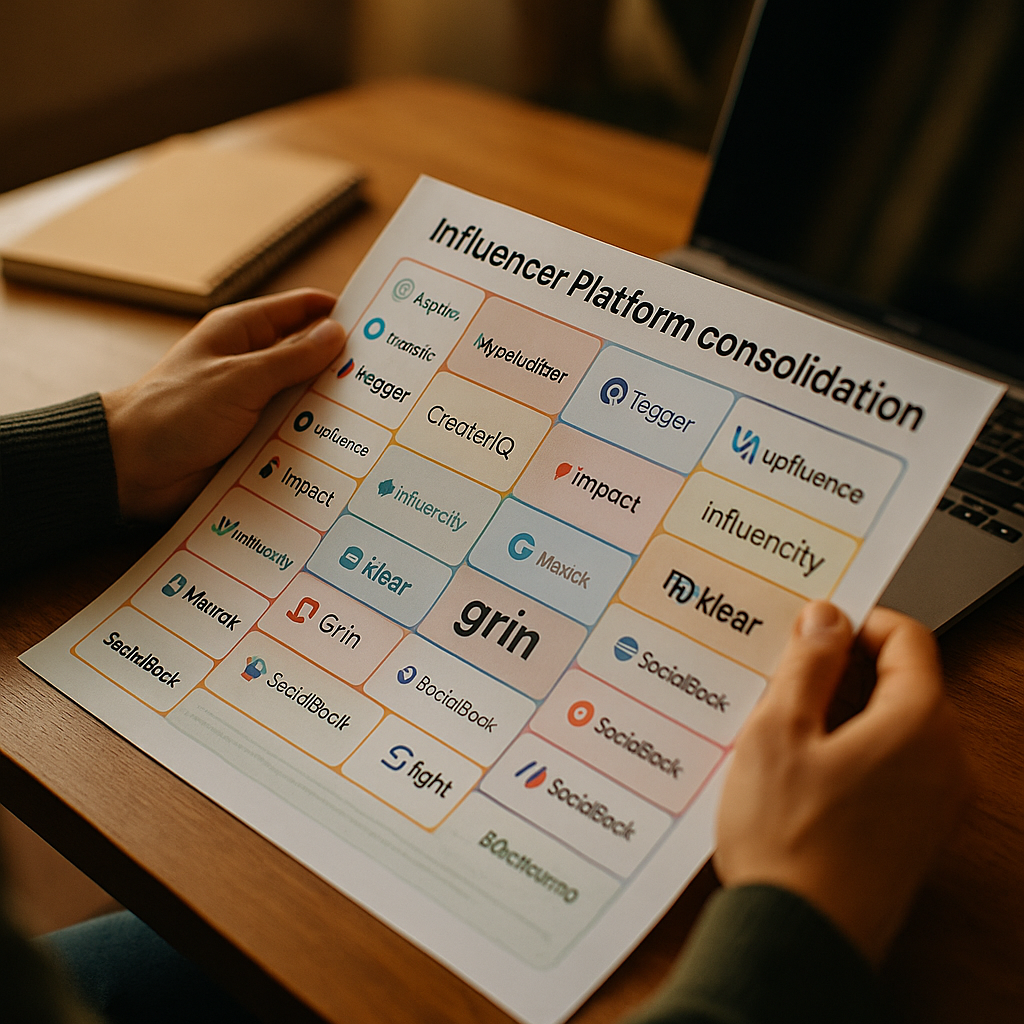
Sixty-seven percent of enterprise marketers say they’ll consolidate their creator tech stack onto a single platform within the next twelve months, according to buyer surveys circulating among agency procurement teams. That number should worry every vendor still selling a point solution. Influencer discovery tools that don’t also handle payment and analytics are quietly becoming legacy software. The question isn’t whether consolidation happens. It’s who wins.
Why Point Solutions Are Losing the RFP
Three years ago, a “best of breed” stack made sense. You’d pair a discovery tool like Grin’s early feature set with a separate payment processor, then bolt on Google Sheets or a BI dashboard for reporting. That approach worked when programs ran a handful of campaigns a quarter. It collapses under the weight of always-on programs running hundreds of creators across TikTok Shop, Instagram, and YouTube simultaneously.
The friction isn’t discovery anymore. It’s what happens after you find the creator. Contracting, tax documentation, cross-border payments, performance tagging, and finance reconciliation now eat more operational hours than sourcing ever did. Payment ops now wins influencer platform RFPs, not the size of the creator database. Procurement teams have caught on. They’re scoring vendors on API depth for accounting systems, not just search filters for follower count.
The vendors winning enterprise deals aren’t the ones with the biggest creator databases — they’re the ones that can close a payment cycle without a finance team opening a second tab.
The 2026 Vendor Landscape, Mapped
Consolidation is happening through three distinct paths, and knowing which path a vendor is on tells you a lot about how stable their roadmap will be.
- Native build-out: Platforms like CreatorIQ and Grin have spent years bolting payment rails and analytics directly into their core product, rather than acquiring them. This tends to produce tighter UX but slower feature velocity.
- Acquisition consolidation: Upfluence and similar players have grown through acquiring smaller payment or analytics vendors and absorbing them into a unified dashboard. Faster to market, but integration debt shows up in support tickets.
- Fintech-first expansion: Payment-native companies (think Tipalti-adjacent players building creator-specific rails) are moving upstream into discovery and matching, betting that finance teams — not marketing — hold the real budget authority.
Each path produces a genuinely different buyer experience. A marketing team evaluating a fintech-first platform might find the discovery tools thin. A team evaluating a native build-out might find payment automation still maturing. Neither is wrong. But the gap is closing fast, and by next renewal cycle most serious platforms will claim rough parity across all three functions.
What “All-in-One” Actually Means in Practice
Vendors love the phrase “all-in-one.” Buyers should treat it skeptically. In practice, consolidated platforms fall into two tiers.
Tier one platforms genuinely unify data models. A creator’s payment history, performance metrics, and contract status live in one record, queryable in one place. This is the tier that actually reduces headcount and reconciliation errors.
Tier two platforms are UI wrappers around separate backend systems, often the result of rushed acquisitions. The dashboard looks unified. The data doesn’t reconcile cleanly, and finance still ends up exporting CSVs to make month-end close work. This distinction rarely shows up in a sales demo. It shows up three months into implementation, usually during the first multi-currency payment run.
Our buyer’s guide to payment reconciliation breaks down the specific questions to ask a vendor’s solutions engineer before signing, not just their sales rep.
A Quick Gut Check for Buyers
Ask any vendor these three questions during evaluation, and watch how confidently they answer:
- Can a creator’s 1099/tax document be generated from the same record that tracks their campaign performance, with zero manual re-entry?
- Does your fraud detection logic run against the same dataset as your payment approval workflow, or are they separate systems?
- What’s your API’s rate limit for pulling combined discovery-to-payment data into our own BI tool?
If the answers are vague, you’re likely looking at a tier-two platform wearing a tier-one marketing deck.
Fraud Detection Is the Sleeper Consolidation Story
Nobody talks enough about this, but fraud and compliance tooling is becoming the fourth pillar of these unified platforms, right alongside discovery, payment, and analytics. It makes sense once you think about it: fake follower detection is only useful if it’s tied directly to the payment gate. A platform that flags suspicious engagement but still lets finance cut a check on the old workflow hasn’t actually solved anything.
This is exactly the gap our analysis of fraud detection meeting payment automation gets into — the technical reality of whether bundled fraud scoring actually blocks bad payouts in real time, or just generates a report nobody reads until after the money’s gone. Related research on bundled fraud detection accuracy found meaningful gains only when the fraud model shares training data with the platform’s own creator performance history, rather than relying on third-party bot-detection APIs bolted on after the fact.
Brand safety teams should treat this as non-negotiable in next-cycle RFPs. Ask specifically whether fraud scoring blocks payment automatically, or simply flags for human review. The difference determines how much manual QA your team still needs to run every payment cycle.
GRIN, Upfluence, and CreatorIQ: Reading Between the Feature Lists
The three names that dominate enterprise shortlists deserve a direct comparison, and we’ve done the legwork elsewhere. Our vendor scorecard framework weights payment automation and matching accuracy separately, rather than treating “platform quality” as one blended score, which is how most analyst reports oversimplify the decision.
Worth noting: matching accuracy and payment maturity don’t always move together. Our head-to-head on AI matching accuracy found meaningful variance between platforms that market themselves as functionally identical. A platform can have excellent AI-driven creator discovery and still run payment operations that feel like they were built in a previous decade. Buyers optimizing purely for matching precision may end up overpaying for a payment stack they’ll need to supplement anyway.
Similarly, the workflow comparison in why payment workflows now win RFPs makes a case that should reframe how procurement teams weight their scorecards altogether: discovery quality is now table stakes, and the differentiator sits entirely in the back office.
What This Means for Budget Conversations
Consolidation changes the pricing conversation too, and not always in the buyer’s favor. Bundled platforms often price on total contract value rather than per-module fees, which can obscure whether you’re overpaying for analytics capabilities you’ll never fully use. A total-cost-of-ownership lens matters here. The framework laid out in AI-native suites versus point solutions applies directly to creator platforms: factor in integration costs, training time, and the switching cost of migrating creator payment history if you ever need to leave.
That last point matters more than most buyers realize. Data portability clauses are still inconsistent across vendors. Before signing a multi-year contract, get explicit language on what happens to your creator payment history and performance data if you terminate. Some platforms treat this as proprietary and make export painfully slow. Others hand over clean CSVs within days. Ask now, not during the exit.
Industry data from eMarketer continues to show influencer marketing spend growing faster than most other digital channels, which is exactly why finance leadership is paying closer attention to platform contracts than they did two years ago. Compliance is part of that scrutiny too — the FTC’s endorsement guidance increasingly shapes what disclosure and contract-tracking features vendors are required to build in, and UK-based brands should keep an eye on ICO guidance on data handling for creator payment records, particularly for cross-border programs.
A Note on Analytics Maturity
Analytics is the piece most likely to be underbuilt in a consolidated platform, mostly because it’s the hardest to fake in a demo. Real analytics maturity means attribution that ties creator content to actual revenue, not just engagement rate dashboards. Platforms borrowing identity resolution techniques from broader adtech, similar to the approaches covered in our piece on identity resolution as a prerequisite layer, tend to produce more defensible attribution than those relying purely on platform-provided engagement metrics. Ask vendors directly how they handle cross-platform attribution when a creator posts the same campaign across TikTok, Instagram, and YouTube. Most can’t answer cleanly yet.
Benchmarks from Sprout Social and platform-level reporting tools from Meta Business remain useful cross-checks, particularly for brands who want a second data source to validate what the consolidated platform’s dashboard is telling them. Don’t take a single vendor’s attribution numbers at face value, no matter how unified the platform claims to be.
Bottom line: before your next renewal, run a payment-cycle stress test with the vendor, not just a discovery demo. Ask them to walk a real creator from contract to 1099 to reconciled payout in front of your finance team, and judge the platform on how many manual steps remain.
FAQs
What does “consolidation” actually mean for influencer marketing platforms?
It means discovery, contracting, payment processing, fraud detection, and performance analytics are merging into a single data model rather than existing as separate tools stitched together with exports and manual entry.
Is a consolidated platform always cheaper than best-of-breed tools?
Not necessarily. Bundled pricing can obscure module-level costs, and buyers sometimes pay for analytics or fraud features they don’t fully use. A total-cost-of-ownership review, including switching costs, is essential before comparing sticker prices.
Which matters more in a vendor evaluation: discovery accuracy or payment automation?
Payment automation is increasingly the deciding factor in enterprise RFPs, since discovery quality has become roughly comparable across major vendors while payment operations still vary widely in maturity.
How can brands tell if a platform’s fraud detection is genuinely integrated?
Ask whether fraud scoring automatically blocks a payment or simply flags it for manual review. True integration means the fraud model and payment approval workflow share the same underlying data.
What should be in a data portability clause before signing a multi-year contract?
Explicit terms on export format, timeline, and completeness of creator payment and performance history if the contract ends, ideally tested during due diligence rather than assumed.
Top Influencer Marketing Agencies
The leading agencies shaping influencer marketing in 2026
Agencies ranked by campaign performance, client diversity, platform expertise, proven ROI, industry recognition, and client satisfaction. Assessed through verified case studies, reviews, and industry consultations.
Moburst

-
2

The Shelf
Boutique Beauty & Lifestyle Influencer AgencyA data-driven boutique agency specializing exclusively in beauty, wellness, and lifestyle influencer campaigns on Instagram and TikTok. Best for brands already focused on the beauty/personal care space that need curated, aesthetic-driven content.Clients: Pepsi, The Honest Company, Hims, Elf Cosmetics, Pure LeafVisit The Shelf → -
3

Audiencly
Niche Gaming & Esports Influencer AgencyA specialized agency focused exclusively on gaming and esports creators on YouTube, Twitch, and TikTok. Ideal if your campaign is 100% gaming-focused — from game launches to hardware and esports events.Clients: Epic Games, NordVPN, Ubisoft, Wargaming, Tencent GamesVisit Audiencly → -
4

Viral Nation
Global Influencer Marketing & Talent AgencyA dual talent management and marketing agency with proprietary brand safety tools and a global creator network spanning nano-influencers to celebrities across all major platforms.Clients: Meta, Activision Blizzard, Energizer, Aston Martin, WalmartVisit Viral Nation → -
5

The Influencer Marketing Factory
TikTok, Instagram & YouTube CampaignsA full-service agency with strong TikTok expertise, offering end-to-end campaign management from influencer discovery through performance reporting with a focus on platform-native content.Clients: Google, Snapchat, Universal Music, Bumble, YelpVisit TIMF → -
6

NeoReach
Enterprise Analytics & Influencer CampaignsAn enterprise-focused agency combining managed campaigns with a powerful self-service data platform for influencer search, audience analytics, and attribution modeling.Clients: Amazon, Airbnb, Netflix, Honda, The New York TimesVisit NeoReach → -
7

Ubiquitous
Creator-First Marketing PlatformA tech-driven platform combining self-service tools with managed campaign options, emphasizing speed and scalability for brands managing multiple influencer relationships.Clients: Lyft, Disney, Target, American Eagle, NetflixVisit Ubiquitous → -
8

Obviously
Scalable Enterprise Influencer CampaignsA tech-enabled agency built for high-volume campaigns, coordinating hundreds of creators simultaneously with end-to-end logistics, content rights management, and product seeding.Clients: Google, Ulta Beauty, Converse, AmazonVisit Obviously →