


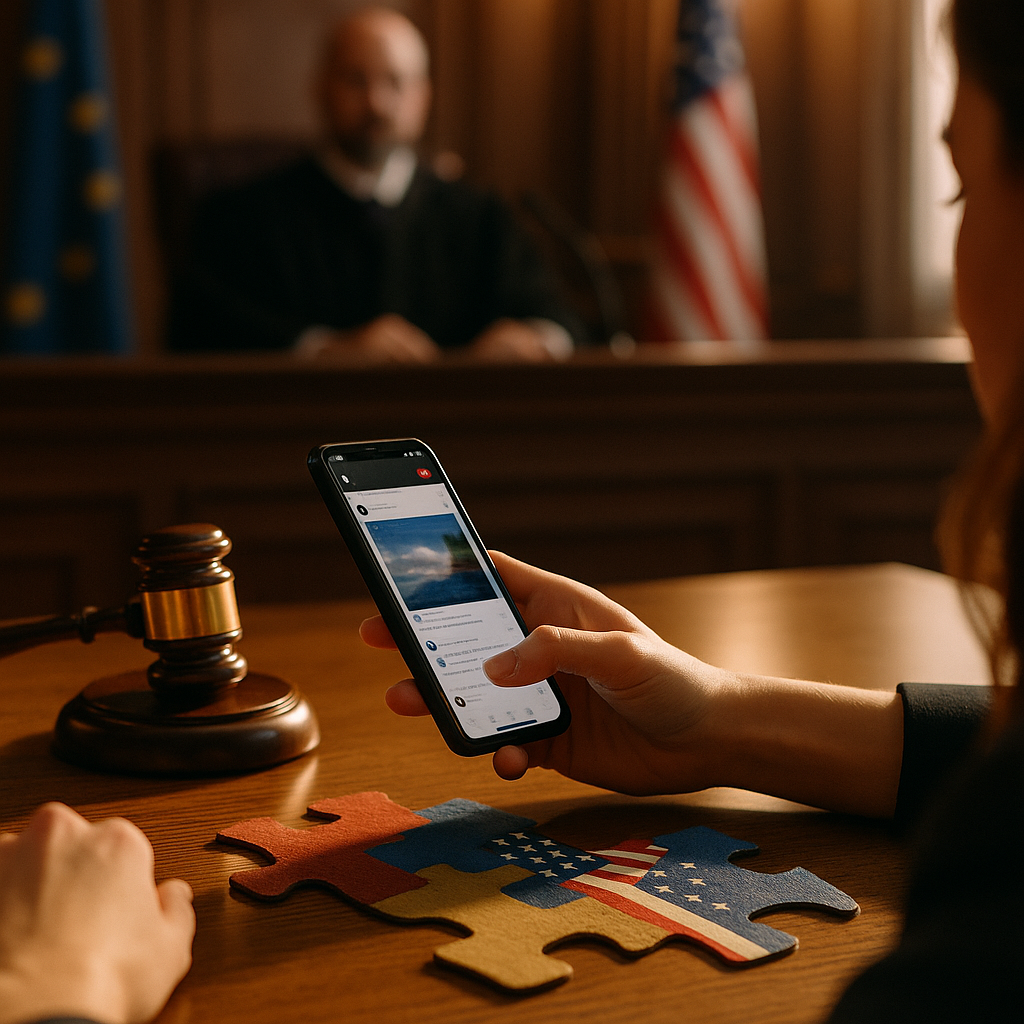
Brussels just told platforms their algorithms can be legally “addictive.” Meanwhile, more than a dozen US states have already passed their own youth safety statutes, each with different age-verification thresholds and design mandates. If your influencer program touches minors anywhere, you’re now compliance-testing against two regulatory philosophies at once — and the Digital Services Act addictive-design ruling is the one most US brand teams haven’t fully priced in.
That’s the uncomfortable part. Most compliance playbooks were built for disclosure and endorsement rules, not design-level liability. This one hits differently because it targets the platform’s engagement mechanics, not just what the creator says on camera. Brands running youth-adjacent or family content need a single standard now, not a patchwork of regional fixes applied after the fact.
What the DSA Ruling Actually Says
The EU’s Digital Services Act has always required “very large online platforms” (VLOPs) to assess systemic risks, including harm to minors. What changed is enforcement posture. Regulators have started treating engagement-optimized design — infinite scroll, autoplay, streaks, push-notification loops — as a compliance category in its own right, not a vague ethical concern. The European Commission’s ongoing investigations into TikTok and Meta platforms have explicitly cited addictive design patterns and their effect on minors as grounds for potential fines reaching up to 6% of global annual revenue.
For brands, this matters because sponsored content lives inside those same mechanics. A branded video isn’t separate from the algorithm that surfaces it, loops it, and nudges a 15-year-old to watch three more.
The DSA doesn’t just regulate what platforms show minors — it regulates the mechanics that keep them watching, which means sponsored content inherits scrutiny it never had before.
The US State Patchwork Problem
While the EU regulates from the top down through platform-level obligations, the US is doing it state by state, and the results don’t line up. Utah, Arkansas, and Texas have passed laws requiring parental consent for minors’ social accounts. California’s Age-Appropriate Design Code Act pushes platforms toward “default high privacy” settings for young users, though it’s been tied up in litigation. New York’s SAFE for Kids Act specifically targets addictive feeds, requiring parental consent before a minor gets an algorithmically-curated feed at all.
None of these laws use the same age thresholds. None define “addictive design” identically. A brand running a back-to-school campaign targeting teens could be compliant in Ohio and exposed in New York, on the same platform, with the same creative.
- Age verification: Some states require hard verification; others accept self-attestation or parental toggle.
- Feed design: New York targets algorithmic feeds specifically; Utah focuses more on account-level consent.
- Enforcement bodies: State AGs, not a single federal regulator, meaning inconsistent interpretation.
- Private right of action: A few states allow parents to sue directly, raising litigation risk beyond regulatory fines.
This is the same fragmentation problem brands have already wrestled with around state-by-state scarcity claim rules and livestream pricing. Addictive-design compliance is shaping up to be the next version of that same headache, just with higher regulatory stakes.
Why “Comply With the Strictest State” Doesn’t Work Here
The usual shortcut in US compliance is: build to the strictest state, apply it everywhere, done. That worked reasonably well for disclosure language, where the FTC’s endorsement guidelines set a national floor and states rarely diverge much on substance.
Addictive design is different because the DSA isn’t regulating disclosure at all — it’s regulating platform architecture and, by extension, the campaigns that run on it. You can’t out-comply an algorithm by changing your caption. If a state law requires parental consent before a minor sees an algorithmically-ranked feed, and the EU is fining platforms for the feed’s design itself, “strictest state” logic gives you zero guidance on what the campaign brief should actually say.
Brand teams need a framework that separates two distinct risk layers:
- Content-level compliance — disclosure, substantiation, claims accuracy. This is the layer most existing playbooks already cover.
- Distribution-level compliance — how the platform serves, ranks, and loops that content to minors. This is the layer the DSA just made explicit and US states are approaching from different angles.
Most brand safety audits stop at layer one. That’s no longer sufficient if any part of your audience skews under 18, or if your creator roster includes accounts with substantial teen followings regardless of your intended target.
Building One Compliance Standard: A Practical Framework
Rather than chasing each jurisdiction’s specific language, build a standard around the strictest mechanism, not the strictest state. Here’s what that looks like operationally.
Step 1: Audit creator audience composition, not just target demo. A creator whose intended audience is 25-34 might still have 18% of followers under 18. Platforms’ own analytics dashboards increasingly surface this, and TikTok’s compliance tooling now flags it more aggressively, similar to how YouTube’s AI now flags undisclosed sponsorships automatically. Treat minor-audience percentage as a hard gate in creator vetting, not a footnote.
Step 2: Separate “youth-directed” from “youth-accessible” in your brief. Regulators increasingly distinguish between content designed for minors and content merely reachable by them. Your legal team should classify every campaign into one of these buckets before creative starts, because the compliance obligations diverge sharply from that point forward.
Step 3: Build a design-mechanics checklist alongside your disclosure checklist. Ask: does this campaign rely on autoplay sequencing, streak mechanics, countdown urgency, or algorithmic feed placement to drive engagement among a youth-accessible audience? If yes, document the mitigation — capped frequency, no push-notification amplification, opt-in gating — the same way you’d document a livestream compliance audit for pricing claims.
Step 4: Centralize consent and age-verification records regardless of where the campaign runs. If any single US state you operate in requires parental consent for algorithmic feeds, capture that consent trail for the entire program. It costs little extra and removes the guesswork about which state’s rules apply to which impression.
Step 5: Build contractual indemnification language that anticipates design-level claims. Most influencer contracts still only address content liability. Following the model used in platform indemnification clause guidance, brands should add language addressing liability arising from platform distribution mechanics, not just from what the creator posted.
Building to the strictest mechanism, rather than the strictest state, is the only approach that scales across both EU platform-level rules and America’s fragmented state statutes.
What This Means for Budget and Platform Selection
There’s a real ROI argument here, not just a risk-avoidance one. Brands that build unified youth-safety compliance into their creator vetting process report fewer campaign delays from legal review, according to industry surveys tracked by eMarketer. Front-loading the audit work is cheaper than post-launch takedowns or state AG inquiries.
It also affects platform mix. Platforms investing heavily in age-assurance technology and transparent recommendation controls, in response to both EU pressure and US state law, are becoming the lower-risk media buy for youth-adjacent categories. That’s a meaningful shift from two years ago, when platform selection was almost entirely about reach and CPM. Now it’s also a compliance decision, and CFOs are starting to ask about it in budget reviews.
Consider building this evaluation into your quarterly platform scorecard: age-verification rigor, feed transparency tools, and documented response to the DSA’s systemic risk assessments. Treat it with the same seriousness you’d apply to merchant verification checklists for commerce campaigns. It’s a similar discipline, just applied to a different risk surface.
Don’t wait for a US federal youth-safety law to arrive and harmonize things. It’s not coming soon, and the states aren’t slowing down in the meantime. Build your standard now around the strictest mechanism, document everything, and treat design-level risk as its own compliance category, not a subset of disclosure.
Frequently Asked Questions
What is the DSA addictive-design ruling, in plain terms?
It’s the EU’s enforcement position, under the Digital Services Act, that engagement-driving design features on large platforms (autoplay, infinite scroll, algorithmic feeds) can constitute a systemic risk to minors, exposing platforms to fines and requiring documented mitigation.
Do US state youth safety laws apply to brands, or only platforms?
Most are written to target platforms directly, but brands face indirect exposure through campaign design choices, creator selection, and contractual liability if a campaign relies on mechanics a state law restricts.
Is there a single US federal law that resolves this patchwork?
Not yet. Various federal proposals have circulated, but as of now compliance still depends on tracking individual state statutes alongside EU platform-level obligations.
How do I know if my campaign counts as “youth-accessible”?
Check creator audience analytics for the percentage of followers under 18, not just your intended target demo. Many platforms now surface this data directly in creator vetting tools.
Should influencer contracts be updated for this specific risk?
Yes. Standard disclosure-focused indemnification clauses typically don’t cover liability arising from platform distribution mechanics, which is the core issue in the DSA ruling.
Does this affect platform selection for campaigns not targeting minors?
It can, if any meaningful share of the audience is under 18 regardless of targeting intent. Youth-accessible reach, not just youth-directed targeting, is increasingly the relevant regulatory trigger.
Frequently Asked Questions
What is the DSA addictive-design ruling, in plain terms?
It’s the EU’s enforcement position, under the Digital Services Act, that engagement-driving design features on large platforms (autoplay, infinite scroll, algorithmic feeds) can constitute a systemic risk to minors, exposing platforms to fines and requiring documented mitigation.
Do US state youth safety laws apply to brands, or only platforms?
Most are written to target platforms directly, but brands face indirect exposure through campaign design choices, creator selection, and contractual liability if a campaign relies on mechanics a state law restricts.
Is there a single US federal law that resolves this patchwork?
Not yet. Various federal proposals have circulated, but as of now compliance still depends on tracking individual state statutes alongside EU platform-level obligations.
How do I know if my campaign counts as “youth-accessible”?
Check creator audience analytics for the percentage of followers under 18, not just your intended target demo. Many platforms now surface this data directly in creator vetting tools.
Should influencer contracts be updated for this specific risk?
Yes. Standard disclosure-focused indemnification clauses typically don’t cover liability arising from platform distribution mechanics, which is the core issue in the DSA ruling.
Does this affect platform selection for campaigns not targeting minors?
It can, if any meaningful share of the audience is under 18 regardless of targeting intent. Youth-accessible reach, not just youth-directed targeting, is increasingly the relevant regulatory trigger.
Top Influencer Marketing Agencies
The leading agencies shaping influencer marketing in 2026
Agencies ranked by campaign performance, client diversity, platform expertise, proven ROI, industry recognition, and client satisfaction. Assessed through verified case studies, reviews, and industry consultations.
Moburst

-
2

The Shelf
Boutique Beauty & Lifestyle Influencer AgencyA data-driven boutique agency specializing exclusively in beauty, wellness, and lifestyle influencer campaigns on Instagram and TikTok. Best for brands already focused on the beauty/personal care space that need curated, aesthetic-driven content.Clients: Pepsi, The Honest Company, Hims, Elf Cosmetics, Pure LeafVisit The Shelf → -
3

Audiencly
Niche Gaming & Esports Influencer AgencyA specialized agency focused exclusively on gaming and esports creators on YouTube, Twitch, and TikTok. Ideal if your campaign is 100% gaming-focused — from game launches to hardware and esports events.Clients: Epic Games, NordVPN, Ubisoft, Wargaming, Tencent GamesVisit Audiencly → -
4

Viral Nation
Global Influencer Marketing & Talent AgencyA dual talent management and marketing agency with proprietary brand safety tools and a global creator network spanning nano-influencers to celebrities across all major platforms.Clients: Meta, Activision Blizzard, Energizer, Aston Martin, WalmartVisit Viral Nation → -
5

The Influencer Marketing Factory
TikTok, Instagram & YouTube CampaignsA full-service agency with strong TikTok expertise, offering end-to-end campaign management from influencer discovery through performance reporting with a focus on platform-native content.Clients: Google, Snapchat, Universal Music, Bumble, YelpVisit TIMF → -
6

NeoReach
Enterprise Analytics & Influencer CampaignsAn enterprise-focused agency combining managed campaigns with a powerful self-service data platform for influencer search, audience analytics, and attribution modeling.Clients: Amazon, Airbnb, Netflix, Honda, The New York TimesVisit NeoReach → -
7

Ubiquitous
Creator-First Marketing PlatformA tech-driven platform combining self-service tools with managed campaign options, emphasizing speed and scalability for brands managing multiple influencer relationships.Clients: Lyft, Disney, Target, American Eagle, NetflixVisit Ubiquitous → -
8

Obviously
Scalable Enterprise Influencer CampaignsA tech-enabled agency built for high-volume campaigns, coordinating hundreds of creators simultaneously with end-to-end logistics, content rights management, and product seeding.Clients: Google, Ulta Beauty, Converse, AmazonVisit Obviously →