


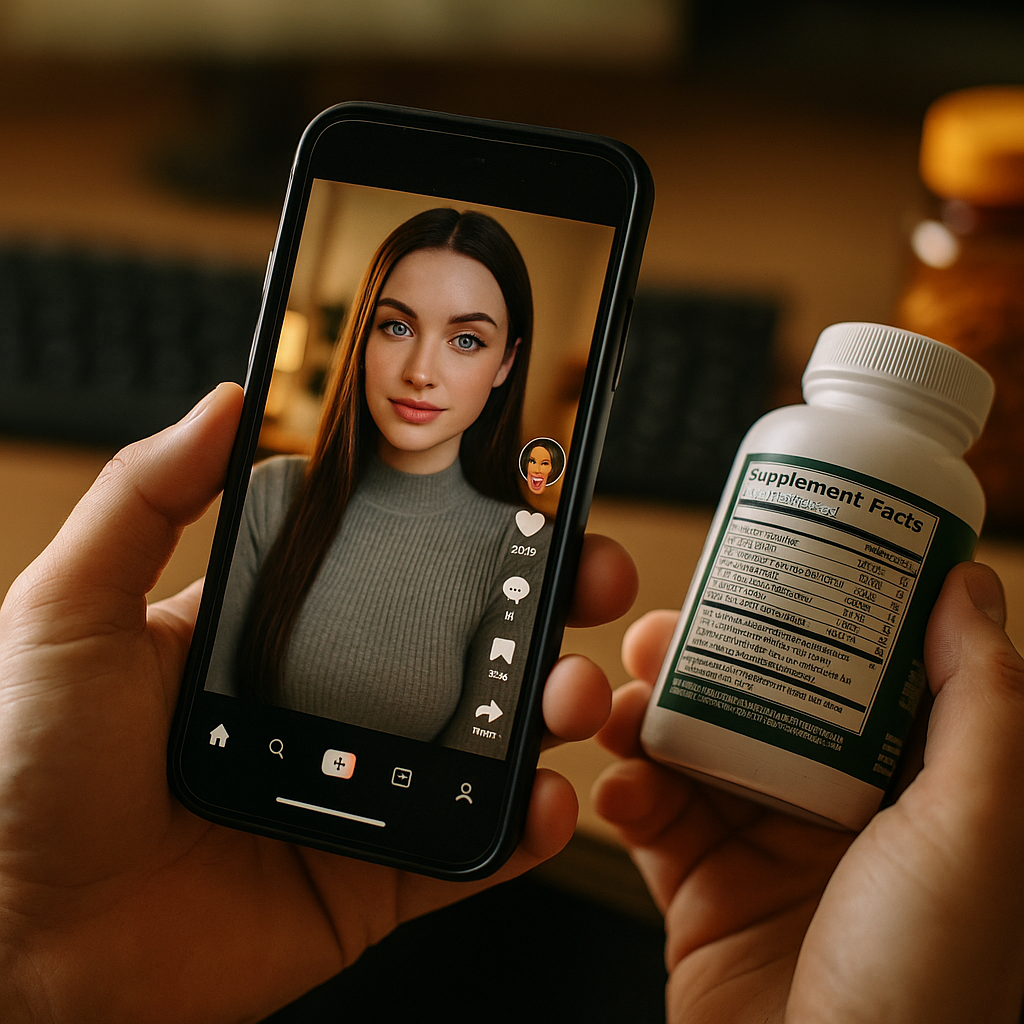
One mislabeled AI avatar in a supplement ad can trigger two separate investigations at once — a TikTok policy strike and an FTC inquiry — because the platform’s synthetic-media disclosure rules and federal testimonial law were never designed to talk to each other. Brands running cross-platform supplement campaigns are discovering this gap the hard way. TikTok wants a synthetic-media label. The FTC wants proof the avatar’s claims reflect real, substantiated results. Satisfying one doesn’t satisfy the other, and supplement marketing sits in the highest-risk category for both regulators.
Two Rulebooks, One Avatar, Zero Overlap
TikTok’s synthetic-media policy requires creators and brands to apply an “AI-generated” or synthetic media label whenever a video features a realistic AI avatar, voice clone, or digitally altered likeness that could be mistaken for a real person. The intent is disclosure of origin: is this content made by a machine or a human? It’s a media-literacy safeguard, not a truth-in-advertising rule.
The FTC’s Endorsement Guides operate on a completely different axis. They don’t care whether the spokesperson is synthetic. They care whether the endorsement reflects honest opinions, findings, or experiences, and whether any results shown are typical or properly qualified. An AI avatar claiming “this supplement cleared my brain fog in three days” is a testimonial claim regardless of whether the face is real. If no human ever experienced that result, you have a substantiation problem — one that TikTok’s label does nothing to fix.
Labeling a video as “AI-generated” tells viewers the messenger isn’t real. It tells them nothing about whether the message is true — and the FTC only cares about the latter.
This is where supplement brands get tripped up. Legal teams see the TikTok synthetic label applied and assume disclosure obligations are met. They’re not. You’ve addressed platform policy. You haven’t touched federal advertising law.
Why Supplements Are the Worst Category to Get This Wrong
The FTC has run more enforcement sweeps against supplement marketing than almost any other vertical in the past several years, and health claims paired with synthetic testimonials are squarely in its crosshairs. An AI avatar delivering a weight-loss or “clinically proven” claim without substantiation isn’t a gray area — it’s a textbook case of false advertising layered on top of an undisclosed synthetic-endorsement issue.
Brands that have already built a substantiation process for human creators need to extend that same rigor to AI-generated spokespeople. Our health claims substantiation file playbook is a useful starting model: every claim an avatar makes needs a paper trail, whether the “creator” is flesh-and-blood or rendered.
There’s also a redistribution wrinkle. TikTok content gets clipped, reposted to Instagram Reels and YouTube Shorts, and often stripped of its original synthetic-media label in the process. If your AI avatar ad loses its TikTok label on a re-upload but keeps making health claims, you’ve now got an unlabeled synthetic testimonial circulating with no FTC-compliant disclosure attached anywhere. That’s a live liability, not a hypothetical one — see how we’ve covered this exact failure mode in TikTok AI labels can vanish.
What “Reconciling” Actually Means in Practice
Reconciliation isn’t about picking one rule over the other. It’s about stacking both disclosures so they satisfy each regulator’s actual concern:
- Synthetic-media label — visible, platform-native tag (TikTok’s built-in tool or #AIGenerated equivalent) disclosing the avatar is not a real person.
- Material connection disclosure — clear #ad or #sponsored language per FTC Endorsement Guides, placed where viewers see it before engaging further.
- Substantiation basis — a documented claim-by-claim justification for anything the avatar says about the product’s effects, ideally reviewed by regulatory counsel before the video goes live.
- Typicality disclosure — if the avatar cites a specific outcome, a “results not typical” or comparable qualifier, since AI avatars can’t have personally experienced anything and any implied outcome needs grounding in real data.
Four layers, one fifteen-second video. It sounds like overkill until you remember the FTC has stated publicly that endorsement rules apply regardless of whether the endorser is human, and TikTok has made synthetic labeling a platform-wide enforcement priority. Skipping either one isn’t a shortcut — it’s an exposed flank.
Building the Cross-Platform Disclosure Stack
Supplement campaigns rarely live on one platform anymore. A brand might launch an AI avatar spot on TikTok, cut it down for Reels, push a longer version to YouTube, and let affiliates repost clips into livestream shopping segments. Each platform has its own disclosure mechanics, and none of them automatically inherit compliance from the others.
YouTube’s AI now flags undisclosed sponsorships automatically, meaning a synthetic avatar ad that skipped proper disclosure on TikTok could get algorithmically caught the moment it lands on YouTube. That’s a useful backstop, but it shouldn’t be your compliance strategy. Build disclosure into the asset itself — burned-in captions, verbal disclosure in the first three seconds, and metadata tags — so it survives platform-hopping and re-editing.
Practical build order for a cross-platform AI avatar supplement campaign:
- Draft the avatar’s script with legal review before production, treating every sentence as a testimonial claim subject to substantiation.
- Apply TikTok’s native synthetic-media label at upload, not as an afterthought caption.
- Burn in “#ad” and “AI-generated content” as on-screen text, not just platform metadata, so the disclosure survives downloads and reposts.
- Log the substantiation file per claim, referencing clinical data, lab results, or approved marketing language.
- Audit weekly for redistributed clips that dropped either disclosure layer.
Step five matters more than most teams think. According to eMarketer, short-form video repurposing across platforms has become standard practice for the majority of brand campaigns, which means your original compliant video is only the seed — the compliance risk lives in every derivative.
Contracts Need to Catch Up, Too
If you’re licensing an AI avatar tool or working with an agency that builds synthetic spokespeople, your contracts probably weren’t written with this scenario in mind. Who owns liability if the avatar makes an unsubstantiated claim — the brand, the AI vendor, or the agency that scripted it? This isn’t theoretical; it’s the same ownership question raised in AI-scripted creator content liability, and supplement brands need it answered in writing before an avatar campaign launches, not after a demand letter arrives.
The same logic applies to redistribution. If a retail partner or affiliate clips your avatar video and reposts it without labels, whose problem is that? Borrow language from the TikTok redistribution liability clause framework and extend it explicitly to synthetic media, since most existing creator contracts assume a human endorser and say nothing about AI-generated likenesses.
A Quick Gut-Check for Legal and Marketing Teams
Before an AI avatar supplement ad goes live, ask three questions:
- Does the synthetic-media label survive if this video is downloaded and reposted elsewhere?
- Is there a substantiation file for every specific claim the avatar makes, independent of the fact that it’s not a real customer?
- Would this disclosure stack satisfy an FTC investigator who has never seen TikTok’s policy — and separately, satisfy a TikTok trust-and-safety reviewer who has never read the Endorsement Guides?
If either answer is “we’re not sure,” you don’t have a compliant campaign. You have a campaign that hasn’t been caught yet.
Where This Is Headed
Regulators are converging, slowly. The FTC has signaled increased attention to AI-generated endorsements broadly, and platform policies keep tightening in response to public pressure over deepfake-adjacent content. Expect TikTok, Meta, and YouTube to eventually require structured metadata tags that carry disclosure information across reposts and platform boundaries — something closer to how the EU AI Act is forcing consent architecture rebuilds in Europe. Until that infrastructure exists, brands running AI avatars in supplement marketing have to manually stack disclosures that regulators built separately, for different reasons, at different times.
That’s not a fun compliance reality. But it’s a manageable one, if you treat every avatar video as carrying two separate legal obligations instead of one combined checkbox.
Next step: Audit your current AI avatar assets this week — check whether the TikTok synthetic label and the FTC material-connection disclosure both survive on every platform where the video currently lives, not just the original upload.
FAQs
Does TikTok’s AI avatar label count as FTC disclosure?
No. TikTok’s synthetic-media label discloses that content is AI-generated, but it does not satisfy the FTC’s requirement to disclose material connections (like #ad) or to substantiate any claims the avatar makes. Both disclosures are needed independently.
Can an AI avatar legally give a product testimonial for a supplement?
Yes, but every claim it makes must be substantiated the same way a human testimonial would be. Since an AI avatar cannot have a genuine personal experience, any implied result needs to be backed by real data, clinical evidence, or clearly qualified as not typical.
What happens if a synthetic-media label gets stripped during a repost?
The brand remains liable for the missing disclosure, regardless of who reposted the content. This is why burning disclosure text directly into the video, rather than relying solely on platform metadata, is a safer practice for cross-platform campaigns.
Are supplement brands held to a stricter standard for AI avatar ads?
Effectively, yes. Health and wellness claims already draw heightened FTC scrutiny, and pairing those claims with an undisclosed or unsubstantiated AI spokesperson compounds the risk significantly.
Who is liable if an AI avatar makes an unsubstantiated claim — the brand or the AI vendor?
It depends on the contract. Brands should explicitly define liability allocation with AI avatar vendors and agencies before launch, since most standard creator agreements assume a human endorser and don’t address synthetic-media claim ownership.
FAQs
Does TikTok’s AI avatar label count as FTC disclosure?
No. TikTok’s synthetic-media label discloses that content is AI-generated, but it does not satisfy the FTC’s requirement to disclose material connections (like #ad) or to substantiate any claims the avatar makes. Both disclosures are needed independently.
Can an AI avatar legally give a product testimonial for a supplement?
Yes, but every claim it makes must be substantiated the same way a human testimonial would be. Since an AI avatar cannot have a genuine personal experience, any implied result needs to be backed by real data, clinical evidence, or clearly qualified as not typical.
What happens if a synthetic-media label gets stripped during a repost?
The brand remains liable for the missing disclosure, regardless of who reposted the content. This is why burning disclosure text directly into the video, rather than relying solely on platform metadata, is a safer practice for cross-platform campaigns.
Are supplement brands held to a stricter standard for AI avatar ads?
Effectively, yes. Health and wellness claims already draw heightened FTC scrutiny, and pairing those claims with an undisclosed or unsubstantiated AI spokesperson compounds the risk significantly.
Who is liable if an AI avatar makes an unsubstantiated claim — the brand or the AI vendor?
It depends on the contract. Brands should explicitly define liability allocation with AI avatar vendors and agencies before launch, since most standard creator agreements assume a human endorser and don’t address synthetic-media claim ownership.
Top Influencer Marketing Agencies
The leading agencies shaping influencer marketing in 2026
Agencies ranked by campaign performance, client diversity, platform expertise, proven ROI, industry recognition, and client satisfaction. Assessed through verified case studies, reviews, and industry consultations.
Moburst

-
2

The Shelf
Boutique Beauty & Lifestyle Influencer AgencyA data-driven boutique agency specializing exclusively in beauty, wellness, and lifestyle influencer campaigns on Instagram and TikTok. Best for brands already focused on the beauty/personal care space that need curated, aesthetic-driven content.Clients: Pepsi, The Honest Company, Hims, Elf Cosmetics, Pure LeafVisit The Shelf → -
3

Audiencly
Niche Gaming & Esports Influencer AgencyA specialized agency focused exclusively on gaming and esports creators on YouTube, Twitch, and TikTok. Ideal if your campaign is 100% gaming-focused — from game launches to hardware and esports events.Clients: Epic Games, NordVPN, Ubisoft, Wargaming, Tencent GamesVisit Audiencly → -
4

Viral Nation
Global Influencer Marketing & Talent AgencyA dual talent management and marketing agency with proprietary brand safety tools and a global creator network spanning nano-influencers to celebrities across all major platforms.Clients: Meta, Activision Blizzard, Energizer, Aston Martin, WalmartVisit Viral Nation → -
5

The Influencer Marketing Factory
TikTok, Instagram & YouTube CampaignsA full-service agency with strong TikTok expertise, offering end-to-end campaign management from influencer discovery through performance reporting with a focus on platform-native content.Clients: Google, Snapchat, Universal Music, Bumble, YelpVisit TIMF → -
6

NeoReach
Enterprise Analytics & Influencer CampaignsAn enterprise-focused agency combining managed campaigns with a powerful self-service data platform for influencer search, audience analytics, and attribution modeling.Clients: Amazon, Airbnb, Netflix, Honda, The New York TimesVisit NeoReach → -
7

Ubiquitous
Creator-First Marketing PlatformA tech-driven platform combining self-service tools with managed campaign options, emphasizing speed and scalability for brands managing multiple influencer relationships.Clients: Lyft, Disney, Target, American Eagle, NetflixVisit Ubiquitous → -
8

Obviously
Scalable Enterprise Influencer CampaignsA tech-enabled agency built for high-volume campaigns, coordinating hundreds of creators simultaneously with end-to-end logistics, content rights management, and product seeding.Clients: Google, Ulta Beauty, Converse, AmazonVisit Obviously →