


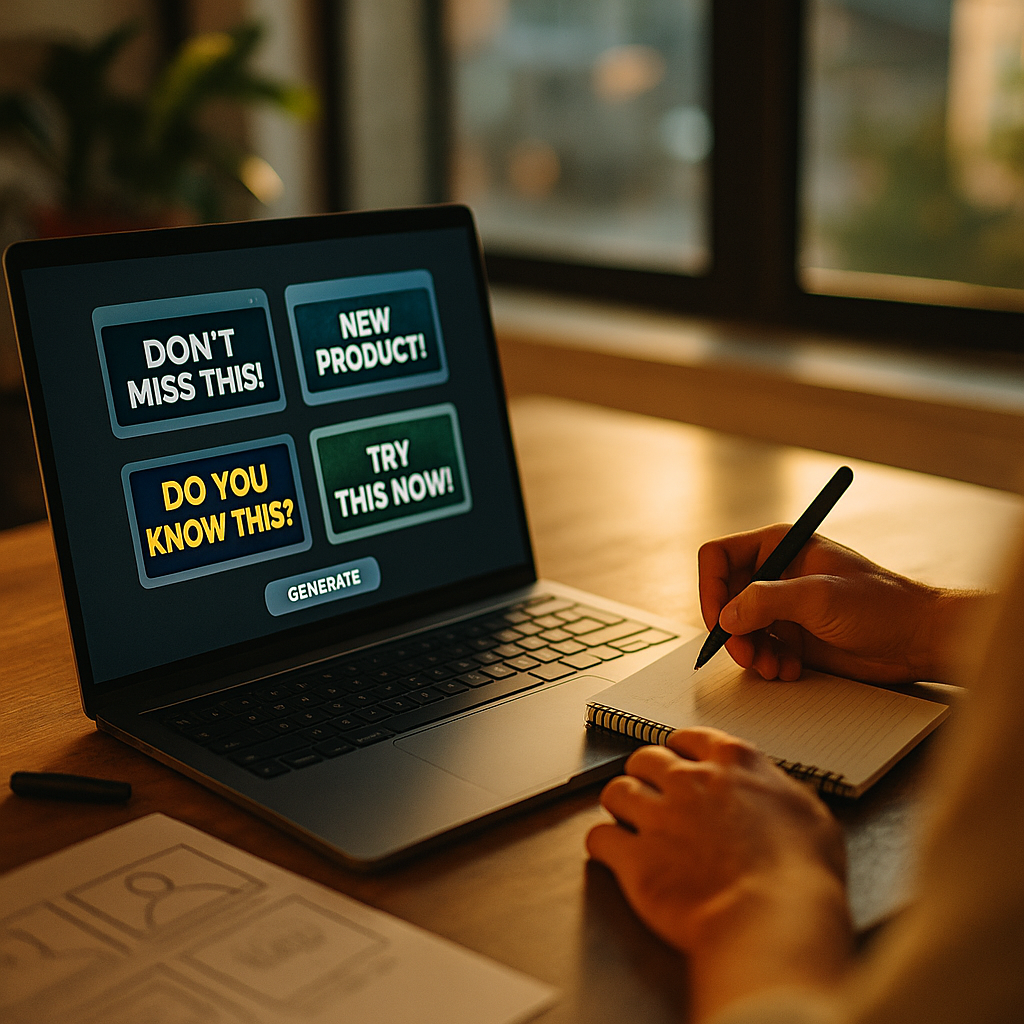
Only 12% of small-business ad creative gets a second version tested before the budget runs out, according to internal benchmarks from several ad platforms. That’s not a testing problem. It’s a resourcing problem. Tools like GetHookd exist precisely because small businesses can’t afford six-week creative sprints for a $3,000 monthly ad budget. But does an AI hook generator actually replace a creative agency, or does it just paper over the gap until you can afford one?
Let’s break down where the line actually sits.
What GetHookd Actually Does
GetHookd belongs to a growing category of AI hook-generation tools built to solve one specific bottleneck: the first three seconds of a video or static ad. Feed it a product description, a target audience, and a platform (TikTok, Meta, YouTube Shorts), and it spits out dozens of scroll-stopping hook variations in minutes. Pattern interrupts, curiosity gaps, problem-agitation openers, the works.
It’s not writing your full script. It’s not shooting your video. It’s solving the narrow, high-stakes problem of getting someone to stop scrolling. That’s a legitimate niche — hooks are arguably the single highest-leverage 3 seconds in performance marketing, and most small businesses have never had a professional copywriter dedicated to just that.
The real question isn’t whether AI can write a hook. It’s whether your business has the testing volume and budget ceiling that makes agency-level creative strategy pay for itself.
The Traditional Agency Value Proposition, Honestly Assessed
Creative agencies don’t just write better copy. At their best, they bring strategic positioning, brand consistency across channels, production quality, and — critically — accountability. When a $50,000/month campaign underperforms, you have a partner to diagnose it with you, not a dashboard.
But let’s be honest about the economics. A mid-tier agency retainer for a small business typically runs $3,000 to $8,000 a month, per HubSpot’s agency pricing benchmarks. For a business spending $2,000/month on ads, that math doesn’t work. You’d be paying more for strategy than for media. That’s the gap AI hook tools are actually built to fill.
Where Agencies Still Win, No Contest
- Brand strategy and positioning — an AI tool optimizes for clicks, not for whether your brand voice holds up across a year of campaigns.
- Production quality — hooks are one line of copy; the video, editing, and casting around it still need craft.
- Cross-channel coherence — agencies think about how a hook on TikTok relates to your email subject lines and landing page copy. AI hook generators generally don’t.
- Compliance and risk review — regulated categories (finance, health, supplements) need human eyes trained on FTC disclosure requirements, not just an algorithm optimizing for engagement.
Where AI Hook Generators Are Genuinely Enough
Here’s the uncomfortable truth for agencies: for a specific, common small-business scenario, an AI hook tool is not just “good enough.” It’s the smarter choice.
That scenario looks like this: a business running direct-response ads on one or two platforms, with a media budget under roughly $10,000/month, that needs high creative *volume* more than high creative *nuance*. Performance marketing on Meta and TikTok in particular rewards testing dozens of hook variations against small audience segments — something agencies are structurally slow and expensive to do at scale, because every variation costs billable hours.
AI hook generators flip that cost structure. Once you’ve got a working product description and offer, generating 40 hook variants costs you an hour, not a $2,000 invoice. For businesses optimizing for volume-driven testing rather than brand-building, that’s a legitimate replacement, not a stopgap.
This mirrors a pattern already playing out across AI-assisted creative work more broadly — our piece on AI-assisted creative testing at scale found that testing volume, not creative polish, is what moves performance metrics for lower-funnel ad spend.
The Volume-vs-Craft Tradeoff
Think of it as a spectrum, not a binary. On one end: a DTC brand doing $1,500/month in Meta ads for a single hero product, where the win condition is “does this hook get a 2%+ CTR.” On the other: a category-defining brand launching a national campaign where the hook needs to carry brand equity, not just clicks. GetHookd and tools like it live comfortably at the first end. They start to strain at the second.
Most small businesses, frankly, live closer to the first end than they’d like to admit. Ego says “we need brand strategy.” Bank account says “we need more hooks tested faster.”
A Practical Evaluation Framework
Rather than treating this as an ideological choice — AI vs. human, disruptor vs. incumbent — run it through a checklist. Ask these questions before deciding:
- What’s your monthly ad spend? Under $10K/month, an agency retainer usually eats too much of your total budget relative to media spend.
- How many creative variants do you need tested per month? If it’s fewer than 10, an agency’s slower pace won’t hurt you. If it’s 30+, AI-generated hooks let you actually run that volume.
- Is your category regulated? Finance, health, and supplements need human compliance review regardless of who writes the hook.
- Do you have someone in-house who can judge a good hook from a bad one? AI tools generate options; they don’t replace editorial judgment. If nobody on your team can filter the output, you’ll ship weak creative fast instead of strong creative slow.
- Is this a brand campaign or a direct-response campaign? DR favors AI-assisted volume testing. Brand campaigns favor strategic agency input.
This is essentially the same vendor-evaluation logic we laid out in our hook-structure generator evaluation framework — the tool matters less than whether your operational context matches its strengths.
The Hybrid Model Nobody’s Marketing Correctly
The false choice being sold right now is “AI tool or agency.” The smarter small businesses in 2026 are running both, just in sequence rather than parallel. Use an AI hook generator to test volume and find the winning angle cheaply. Once a hook proves itself — say, a 3x CTR lift over your baseline — bring it to an agency or freelance producer to build a polished, brand-safe version for scaled spend.
This isn’t a novel idea. It’s the same logic driving AI marketing agent adoption more broadly: AI handles the exploratory, high-volume layer; humans handle judgment, refinement, and risk at the point where money and reputation are actually on the line.
Small businesses don’t need to choose between AI and agencies. They need to know which layer of the funnel each one is built for.
Where the Cost Math Actually Lands
Run the numbers on a realistic scenario. A local service business spends $4,000/month on Meta ads. An agency retainer at $3,500/month for creative and management would consume nearly the entire media budget’s worth in fees. A GetHookd-style subscription, by contrast, typically runs $50 to $300/month — leaving the remaining budget for actual media spend and testing.
That’s not a marginal difference. It’s the difference between running one creative concept for a quarter and testing fifteen. According to Sprout Social’s creator and social marketing research, brands that increase creative testing cadence see measurably better cost-per-result over time, largely because more variants mean more chances to find an outlier winner.
The agency isn’t “wrong” for this business. It’s just priced for a different scale of operation.
What Gets Lost When You Skip the Agency Entirely
It would be dishonest to end this without naming the risk. AI hook generators optimize for one metric: attention. They’re trained on patterns that historically stopped scrolls, not on whether those patterns fit your brand’s actual positioning five campaigns from now.
Run purely on AI-generated hooks for a year and you may find your brand voice has drifted into “generic AI ad” territory — the vague, over-familiar hook structures (“You NEED to see this before it’s banned”) that audiences are getting increasingly fatigued by. There’s also a compliance blind spot: hook generators aren’t trained on your specific regulatory environment, and FTC guidance on ad claims and disclosures doesn’t care that an algorithm wrote the copy.
This is the same governance gap showing up across AI ad tooling generally — see the concerns raised in AI Max and A/B testing governance. Speed without a review layer is how brands end up issuing corrections.
So, When Is GetHookd Actually Enough?
Enough for you means: under $10K/month ad spend, direct-response focus, unregulated category, and at least one person in-house who can review output before it ships. Outside that profile, treat AI hook tools as a testing accelerant that feeds your agency relationship, not a replacement for it.
Frequently Asked Questions
Is GetHookd a replacement for a creative agency?
For small businesses with limited ad spend and a direct-response focus, it can functionally replace agency-level hook writing. It does not replace brand strategy, production, or compliance review, which still require human expertise.
How much does an AI hook generator typically cost compared to an agency?
AI hook tools generally run $50 to $300 per month on subscription pricing, compared to $3,000 to $8,000 monthly for a small-business creative agency retainer, based on industry benchmarks from HubSpot.
What ad spend level justifies hiring a full agency instead?
Generally, once monthly ad spend exceeds $15,000 to $20,000, agency fees represent a smaller percentage of total spend and the strategic and compliance benefits outweigh the cost.
Can AI-generated hooks hurt my brand if used long-term?
Yes. Overreliance on AI-generated hooks without human review can lead to generic, fatigue-prone creative and brand voice drift. Pairing AI-generated volume with periodic human review mitigates this.
Do AI hook generators handle regulated industries like finance or health?
No. Regulated categories require human compliance review regardless of who writes the initial copy, given FTC disclosure and claims requirements.
What’s the best way to combine AI hook tools with agency work?
Use AI tools to generate and test high volumes of hooks cheaply, then hand proven winners to an agency or producer for polished, brand-safe execution at scale.
If your monthly ad spend is under $10,000 and you’re testing fewer than 10 hooks a month, that’s your real problem, not your budget. Fix the testing volume first, then decide if you need an agency at all.
Frequently Asked Questions
Is GetHookd a replacement for a creative agency?
For small businesses with limited ad spend and a direct-response focus, it can functionally replace agency-level hook writing. It does not replace brand strategy, production, or compliance review, which still require human expertise.
How much does an AI hook generator typically cost compared to an agency?
AI hook tools generally run $50 to $300 per month on subscription pricing, compared to $3,000 to $8,000 monthly for a small-business creative agency retainer, based on industry benchmarks from HubSpot.
What ad spend level justifies hiring a full agency instead?
Generally, once monthly ad spend exceeds $15,000 to $20,000, agency fees represent a smaller percentage of total spend and the strategic and compliance benefits outweigh the cost.
Can AI-generated hooks hurt my brand if used long-term?
Yes. Overreliance on AI-generated hooks without human review can lead to generic, fatigue-prone creative and brand voice drift. Pairing AI-generated volume with periodic human review mitigates this.
Do AI hook generators handle regulated industries like finance or health?
No. Regulated categories require human compliance review regardless of who writes the initial copy, given FTC disclosure and claims requirements.
What’s the best way to combine AI hook tools with agency work?
Use AI tools to generate and test high volumes of hooks cheaply, then hand proven winners to an agency or producer for polished, brand-safe execution at scale.
Top Influencer Marketing Agencies
The leading agencies shaping influencer marketing in 2026
Agencies ranked by campaign performance, client diversity, platform expertise, proven ROI, industry recognition, and client satisfaction. Assessed through verified case studies, reviews, and industry consultations.
Moburst

-
2

The Shelf
Boutique Beauty & Lifestyle Influencer AgencyA data-driven boutique agency specializing exclusively in beauty, wellness, and lifestyle influencer campaigns on Instagram and TikTok. Best for brands already focused on the beauty/personal care space that need curated, aesthetic-driven content.Clients: Pepsi, The Honest Company, Hims, Elf Cosmetics, Pure LeafVisit The Shelf → -
3

Audiencly
Niche Gaming & Esports Influencer AgencyA specialized agency focused exclusively on gaming and esports creators on YouTube, Twitch, and TikTok. Ideal if your campaign is 100% gaming-focused — from game launches to hardware and esports events.Clients: Epic Games, NordVPN, Ubisoft, Wargaming, Tencent GamesVisit Audiencly → -
4

Viral Nation
Global Influencer Marketing & Talent AgencyA dual talent management and marketing agency with proprietary brand safety tools and a global creator network spanning nano-influencers to celebrities across all major platforms.Clients: Meta, Activision Blizzard, Energizer, Aston Martin, WalmartVisit Viral Nation → -
5

The Influencer Marketing Factory
TikTok, Instagram & YouTube CampaignsA full-service agency with strong TikTok expertise, offering end-to-end campaign management from influencer discovery through performance reporting with a focus on platform-native content.Clients: Google, Snapchat, Universal Music, Bumble, YelpVisit TIMF → -
6

NeoReach
Enterprise Analytics & Influencer CampaignsAn enterprise-focused agency combining managed campaigns with a powerful self-service data platform for influencer search, audience analytics, and attribution modeling.Clients: Amazon, Airbnb, Netflix, Honda, The New York TimesVisit NeoReach → -
7

Ubiquitous
Creator-First Marketing PlatformA tech-driven platform combining self-service tools with managed campaign options, emphasizing speed and scalability for brands managing multiple influencer relationships.Clients: Lyft, Disney, Target, American Eagle, NetflixVisit Ubiquitous → -
8

Obviously
Scalable Enterprise Influencer CampaignsA tech-enabled agency built for high-volume campaigns, coordinating hundreds of creators simultaneously with end-to-end logistics, content rights management, and product seeding.Clients: Google, Ulta Beauty, Converse, AmazonVisit Obviously →